Section 3.7 Objectives
You will be able to:
- Explain the different rotational characteristics of single and double bonds.
- Determine whether a double bond in a molecule could exist as one of two possible configurations.
There is a significant difference between single and double bonds that goes well beyond the differences in bond strength and bond length that we reviewed in Chapter 1:
Free rotation can occur about single bonds but not about double bonds.
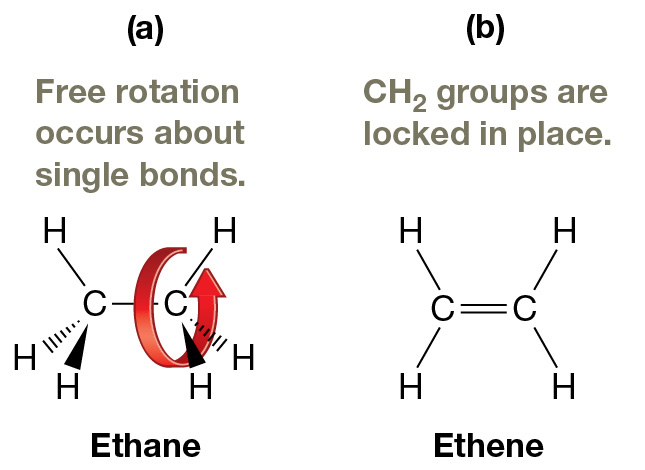
Two illustrations show bond rotation in ethane and ethene. The first illustration shows the condensed structural formula of ethane, which consists of a two-carbon chain where each carbon is bonded to a hydrogen atom by a solid line, to a second hydrogen atom by a dashed wedge, and to a third hydrogen atom by a solid wedge. A curved red arrow around the carbon-carbon bond shows vertical rotation. Text above the structure reads, “Free rotation occurs about single bonds.” The second illustration shows the condensed structural formula of ethene, which consists of two carbon atoms bonded by a double bond. Each carbon atom is bonded to two hydrogen atoms. Text above the structure reads, “CH2 groups are locked in place.” The caption reads, “Bond rotation: Groups connected by a single bond rotate freely relative to each other, but groups connected by a double bond do not.”
In a molecule of ethane (H3C—CH3), for example, the two CH3 groups freely rotate relative to one another about the single bond that connects them (Figure 3-21a). In a molecule of ethene (H2C═CH2, Fig. 3-21b), on the other hand, no rotation occurs. Instead, the entire molecule is planar, with the two CH2 groups locked in place.
The CH3 groups in ethane can rotate freely because, during rotation, the σ bond that connects the two groups is unaffected (Figure 3-22a). The picture is somewhat different with a molecule containing a double bond, which consists of one σ bond and one π bond. Imagine trying to rotate the CH2 groups in H2C═CH2 relative to each other. The σ bond of the double bond would be unaffected, but the π bond would be broken because rotation would destroy the overlap between the p orbitals (Fig. 3-22b). The substantial energy cost associated with breaking the π bond is what locks the CH2 groups of ethene in place.
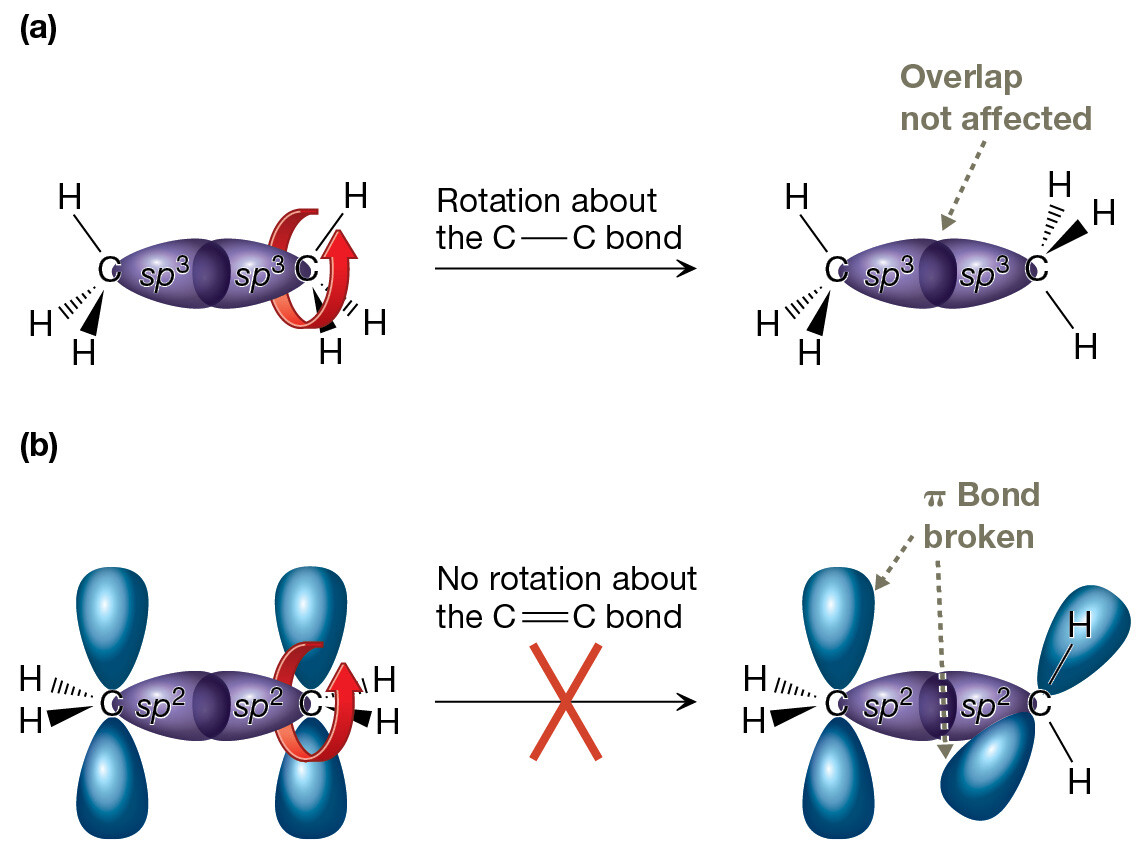
Two illustrations show the overlap of orbitals during bond rotation in ethane and ethene. The first illustration shows a molecule of ethane, with a two-carbon chain where each carbon is bonded to a hydrogen atom above it by a solid line, to a second hydrogen atom below it by a dashed wedge, and to a third hydrogen below it atom by a solid wedge. The carbon-carbon bond is represented by two overlapping sp3 orbitals, one belonging to each carbon atom. A curved red arrow around the carbon on the right shows vertical rotation of the carbon-carbon bond. An arrow labeled “rotation about the C-C bond” leads from this ethane molecule to another, where the carbon on the right has been rotated and is now bonded to a hydrogen atom below it by a solid line, to a second hydrogen atom above it by a dashed wedge, and to a third hydrogen above it atom by a solid wedge. An arrow pointing to the overlapping sp3 orbitals reads, “overlap not affected.” The second illustration shows a molecule of ethene, with two carbon atoms bonded by a double bond. Each carbon atom is bonded to one hydrogen atom by a dashed wedge and to another hydrogen atom by a solid wedge. The carbon-carbon bond is represented by two overlapping sp2 orbitals, one belonging to each carbon atom. Each carbon atom also has a dumbbell shaped orbital about it, with the upper lobe shaded darker than the lower. The two orbitals are represented vertically and are parallel to each other. A curved red arrow around the carbon on the right shows vertical rotation of the carbon-carbon bond. An arrow with a large red X over it, and labeled “no rotation about the C-C double bond,” leads from this ethene molecule to another, where the carbon on the right is now bonded to two hydrogen atoms by solid lines. The dumbbell shaped orbital on the carbon atom on the right is tilted and no longer parallel to the dumbbell shaped orbital on the first carbon. Arrows pointing to the two dumbbell shaped orbitals read, “Pi bond broken.” The caption reads, “Orbital overlap during rotations about single and double bonds: a. Two different orientations of the CH3 groups relative to each other during rotation about the carbon-carbon bond in H3C-CH3. The overlap of the hybrid orbitals is unaffected by the rotation, so this rotation is allowed in the molecule. b. Two different orientations of the CH2 groups relative to each other during rotation about the carbon-carbon double bond in H2C-CH2. Although the overlap of the hybrid orbitals is unaffected, overlap between the p orbitals is destroyed, so the pi bond must be broken first for rotation to occur. Because breaking the pi bond requires a significant input of energy, rotation about a double bond does not normally take place.”
For the π bond in H2C═CH2 to remain intact, all six atoms must be in the same plane. In general:
When two atoms are connected by a double bond, those atoms and any atoms to which they are directly bonded prefer to lie in the same plane.
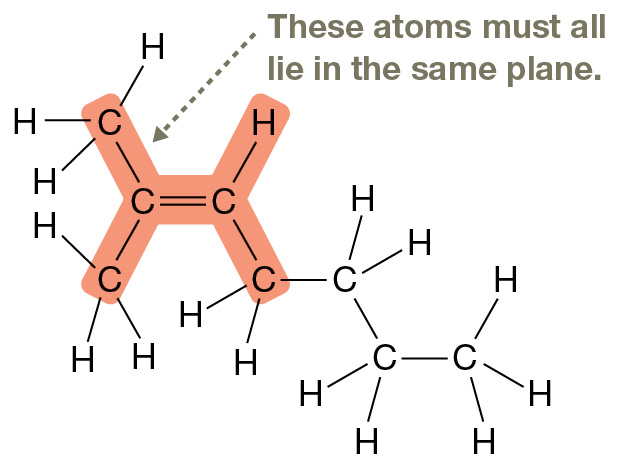
An illustration shows the structural formula of 2-methylhept-2-ene. The structure shows a seven-carbon chain with a double bond between carbon atoms 2 and 3. Carbon atoms 1 and 7 are each bonded to three hydrogen atoms, carbon atoms 4, 5, and 6 are each bonded to two hydrogen atoms, carbon 2 is bonded to a methyl group, and carbon 3 is bonded to one hydrogen atom. The hydrogen atom attached to carbon 3, the carbon atom in the methyl group, and carbon atoms 1, 2, 3, and 4, are highlighted. Text pointing to this highlighted portion reads, “These atoms must all lie in the same plane.” The caption reads, Planar geometry imposed by a double bond: In a molecule of 2-methylhept-2-ene, the five carbon atoms and the hydrogen atom indicated must all lie in the same plane.
This principle is illustrated in Figure 3-23.
YOUR TURN 3.10
In each of the molecules shown here, circle the atoms that must be in the same plane with the atoms connected by the double bond. (Because these are line structures, some H atoms may need to be added back in.)
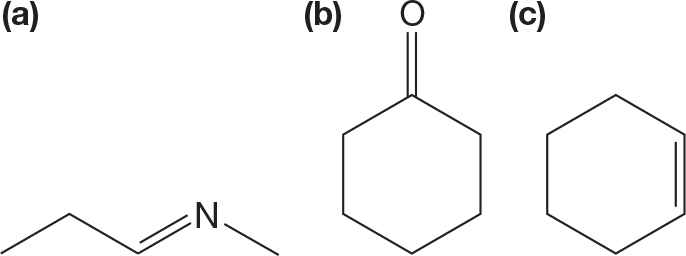
Three illustrations show the skeletal structural formulas of different organic molecules. The first illustration shows a three-carbon chain, where carbon 1 is bonded to a nitrogen atom by a double bond. This nitrogen atom is bonded to another carbon atom by a single bond. The second illustration shows a six-carbon ring, where carbon 1 is bonded to an oxygen atom by a double bond. The third illustration shows a six-carbon ring, with a double bond between carbons 1 and 2.
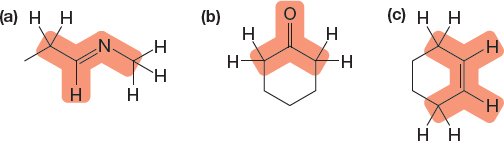
Three condensed structural formula. Structure a is a three carbon chain, the third carbon is double bonded to a nitrogen that is further bonded to a methyl group. The second carbon through methyl group is highlighted red. Structure b is a cyclohexane ring double bonded to oxygen. The first three carbons and double bond to oxygen are highlighted red. Structure c is a cyclo pentane ring with two carbons sharing a double bond. The right side of the ring with the double bond is highlighted red.
Because no rotation takes place about double bonds, some double bonds can exist in one of two distinct configurations. Each configuration has the same connectivity (i.e., which atoms are connected together and by what types of bonds), but they have different arrangements of atoms in space. Molecules like this typically do not interconvert, so they can be isolated from each other and studied separately. This is the case with the two molecules of 1,2-dichloroethene shown in Figure 3-24. In both molecules, notice that each doubly bonded C is singly bonded to one H and one Cl. In the first molecule, both Cl atoms are on the same side of the doubly bonded carbons, whereas in the second molecule, the Cl atoms are on opposite sides. Notice that the two forms of 1,2-dichloroethene have significantly different boiling points.
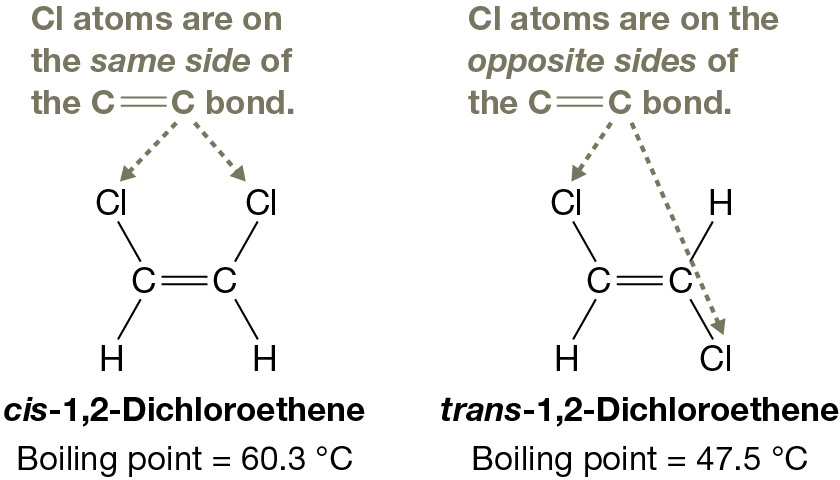
Two illustrations show the condensed structural formulas of cis-1,2-Dichloroethene and trans-1,2-Dichloroethene. Each structure shows, two carbon atoms bonded by a double bond. Each carbon atom is bonded to a hydrogen atom and a chlorine atom. In the first structure, both the chlorine atoms lie on the same side of the double bond. Text below the structure reads, “cis-1,2-Dichloroethene: Boiling point equals 60.3 degrees Celsius.” Text above the structure reads C l atoms are on the same side of the carbon carbon bond. In the second structure, the two chlorine atoms lie on the opposite sides of the double bond. Text below the structure reads, “trans-1,2-Dichloroethene: Boiling point equals 47.5 degrees Celsius.” Text above the structure reads C l atoms are on the opposite side of the carbon carbon bond. The caption reads, Cis and trans configurations: These two molecules differ by the exchange of hydrogen and chlorine on one of the doubly bonded carbon atoms, and the two configurations do not interconvert. The hydrogen atoms are on the same side of the double bond in the cis configuration and are on opposite sides in the trans configuration.
The configurations about a C═C double bond can be named either cis or trans if each carbon has an attached H (see Looking Ahead box):
The configuration about a C═C double bond is:
There are two lessons to take away from the example with cis- and trans-1,2-dichloroethene:
▶ LOOKING AHEAD
To describe the configuration of a C═C double bond as either cis or trans, each C atom must be bonded to one H. In Section 5.8, we will learn how to distinguish the configurations of double bonds more generally, using what is called the E/Z system.
We can apply these ideas to show that distinct configurations are impossible for fluoroethene (H2C═CHF). First, notice that the C on the left is bonded to two H atoms. Second, if we were to exchange the H and F atoms bonded to one C of the double bond, attempting to achieve a distinct configuration, we simply arrive at the same molecule as before the exchange (see Your Turn 3.11).
YOUR TURN 3.11
These two representations of CH2CHF differ by exchanging the H and F atoms bonded to the C atom on the right. Using a molecular modeling kit, construct the two molecules and try to line one up with the other. Are they the same or different? (Try all orientations of the two molecules.)
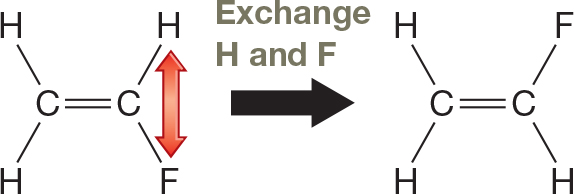
Two illustrations show the different condensed structural formulas of the same organic molecule. Each structure shows two carbon atoms bonded by a double bond. The carbon atom on the left is bonded to two hydrogen atoms, and the carbon atom on the right is bonded to a hydrogen atom and a fluorine atom. In the first structure, the fluorine atom lies below the double bond. A double headed arrow points between the hydrogen and the fluorine. An arrow points to the second structure. The arrow is labeled exchange H and F. In the second structure, the fluorine atom lies above the double bond.
Flipping the molecule on the left vertically 180° shows it is the same as the molecule on the right.
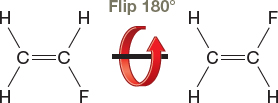
Condensed structural formula with a 180 flip. The structure is a two carbon chain double bonded to each other, the right carbon is bonded to a fluorine atom on the bottom. After flipped 180 degrees, the fluorine atom moves above the carbon on the right.
SOLVED PROBLEM 3.7
How to determine whether two configurations exist about a double bond
Break It Down Does this molecule have two distinct configurations about the double bond?
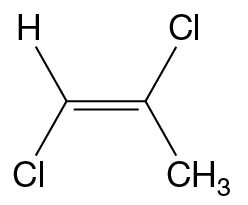
An illustration shows the condensed structural formula of an organic molecule. The structure shows two carbon atoms bonded by a double bond. Carbon 1 is bonded to a hydrogen atom above the double bond, and a chlorine atom below it. Carbon 2 is bonded to a chlorine atom above the double bond, and to carbon 3 below it. This carbon atom is bonded to three hydrogen atoms.
|
Think |
Solve |
|
|
Are two different atoms/groups attached to each doubly bonded C? |
➤ |
On both ends of the C═C bond, the two substituents are different (H and Cl on one end, and Cl and CH3 on the other end). Therefore, two unique configurations about the double bond must exist. 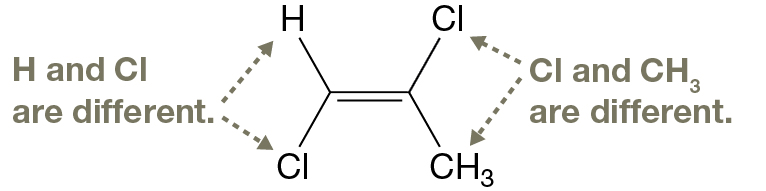
More informationAn illustration shows two different condensed structural formulas of the same organic compound. Each structure shows, two carbon atoms bonded by a double bond. Carbon 1 is bonded to a hydrogen atom and a chlorine atom. Carbon 2 is bonded to a chlorine atom and to carbon 3, which is bonded to three hydrogen atoms. In the first structure, the two chlorine atoms lie on the opposite sides of the double bond. A thick, two-way arrow connects carbon 3 and the chlorine atom bonded to carbon 2. An arrow labeled “Exchange C l and C H 3” leads from the first structure to the second, which shows both chlorine atoms on the same side of the double bond. |
|
Alternatively, will exchanging the two groups attached to a doubly bonded C give rise to a different molecule? How can you tell? |
➤ |
The graphic illustrates the exchange of the Cl and CH3 groups attached to one of the doubly bonded C atoms. The molecules before and after are different: they have different configurations about the C═C bond. Before the exchange, the Cl atoms are on opposite sides of the double bond, whereas after the exchange, the Cl atoms are on the same side. 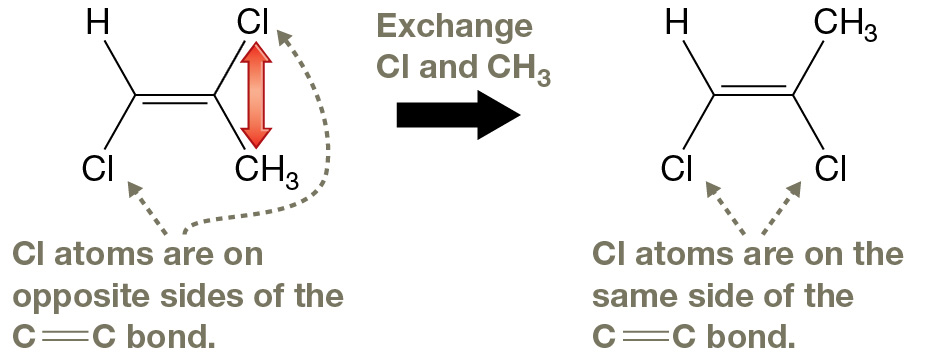
More informationAn illustration shows the condensed structural formula of a molecule. Each structure shows, two carbon atoms bonded by a double bond. Carbon 1 is bonded to a hydrogen atom and a chlorine atom. A label reads H and cl are different. Carbon 2 is bonded to a chlorine atom and to carbon 3, which is bonded to three hydrogen atoms. A label reads C l and C H 3 are different. The two chlorine atoms lie on the opposite sides of the double bond. |
|
Try ItDetermine which of the following molecules A–D have a double bond for which two distinct configurations are possible. 
More informationFour illustrations show the condensed structural formulas of different molecules labeled from A to D. The first illustration shows two carbon atoms bonded by a double bond. Carbon 1 is bonded to a bromine atom above the double bond, and a bromine atom below. Carbon 2 is bonded to a hydrogen atom above the double bond, and a fluorine atom below. The second illustration shows two carbon atoms bonded by a double bond. Carbon 1 is bonded to a hydrogen atom above the double bond, and a bromine atom below. Carbon 2 is bonded to a bromine atom above the double bond, and a chlorine atom below. The third illustration shows a four-carbon chain with double bonds between carbon atoms 1 and 2, and carbon atoms 3 and 4. The fourth illustration shows a carbon atom bonded to a nitrogen atom by a double bond. The carbon atom is bonded to a hydrogen atom above the double bond, and to another carbon atom below, which is in turn bonded to three hydrogen atoms. The nitrogen atom is bonded to another carbon atom above the double bond. This carbon atom is bonded to three hydrogen atoms. |
||
CONNECTIONS 3.7
Protecting the Goodyear blimp Fluoroethene (Your Turn 3.11), also called vinyl fluoride, is used to make poly(vinyl fluoride), a polymer developed by DuPont. Poly(vinyl fluoride) was given the brand name Tedlar, and it is typically produced in thin films and used as protective coatings. This Goodyear blimp, for example, is protected by Tedlar.

CONNECTIONS 3.8
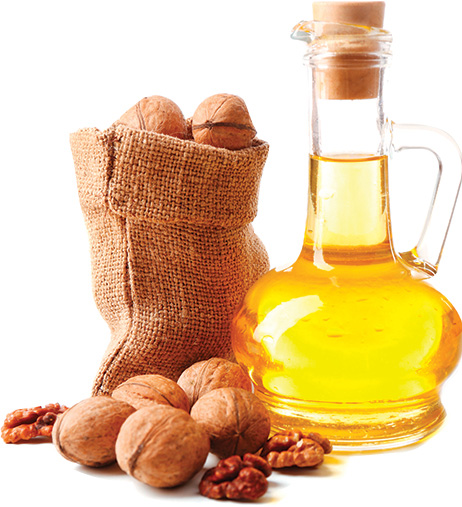
Important dietary oilsα-Linolenic acid (Fig. 3-25), a type of omega-3 fatty acid, is classified as an essential fatty acid for humans because it has vital roles but is not produced by the body. Rather, it must be consumed as part of the diet, from sources such as walnuts and vegetable oils.
Some molecules have more than one C═C double bond, and each double bond can potentially have different configurations. There are three double bonds, for example, in a molecule of α-linolenic acid (Figure 3-25), a natural fatty acid. Notice that each double bond in α-linolenic acid is in the cis configuration: in each case, the two hydrogen atoms (not shown) are bonded to one side of the C═C double bond, and the two carbons are bonded to the C═C on the other side.
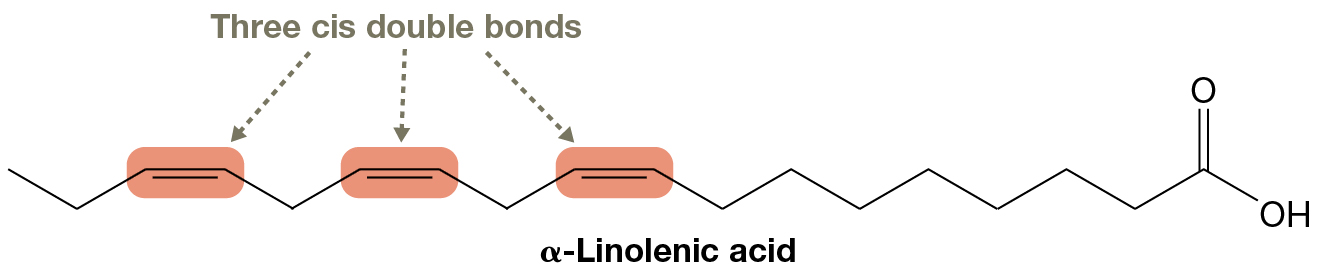
An illustration shows the skeletal structural formula of alpha-linolenic acid. The structure shows a chain of eighteen carbon atoms. Carbon 1 is part of a carboxyl group. Cis double bonds exist between carbon atoms 9 and 10, carbon atoms 12 and 13, and carbon atoms 15 and 16. These bonds are highlighted and labeled “Three cis double bonds.”
YOUR TURN 3.12
Label each of these double bonds as either cis or trans.

The structural formula of a molecule is shown in two different shapes. The molecule is a five membered chain with a carbon then an oxygen and then three carbons. In version A, the shape starts at a carbon, goes up to and oxygen, goes down to a carbon, goes straight across to another carbon via a double bond, and then goes up to a carbon. In version B, the shape starts at a carbon, goes up to and oxygen, goes down to a carbon, goes up to another carbon via double bond, and then goes down to a carbon.
(a) Cis. (b) Trans.