Identify an E2 step when given the reactants and products.
Draw the curved arrow notation, transition state, and products for an E2 step when given the reactants.
Describe the role of the base in an E2 step.
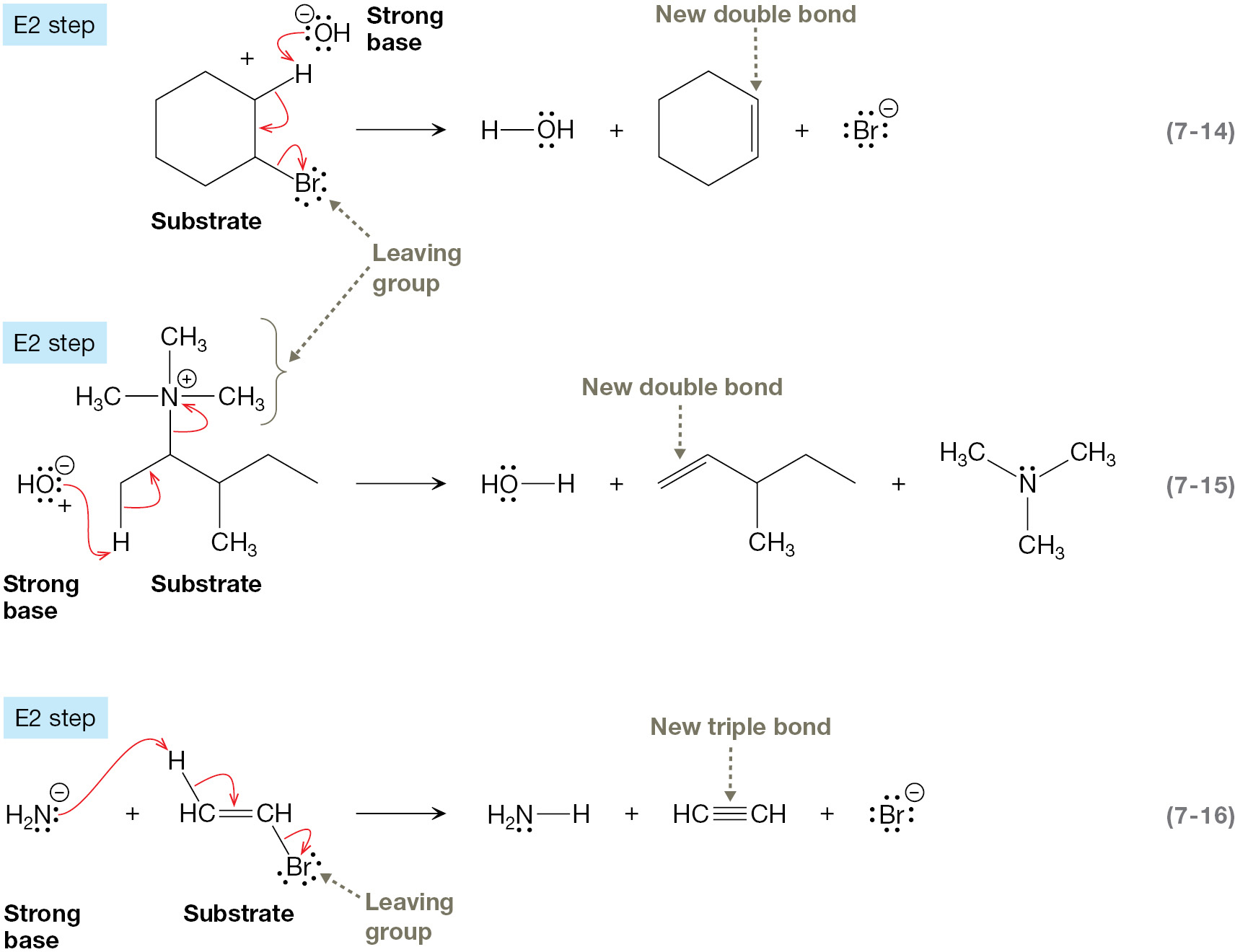
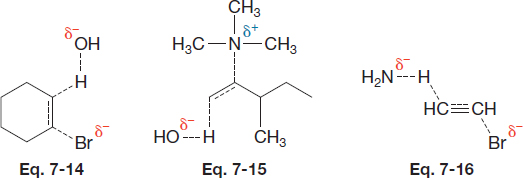
Each of the elementary steps we have examined so far involves only one or two curved arrows. A bimolecular elimination (E2) step, however, is an example of an elementary step that requires three curved arrows, as shown in Equations 7-14 through 7-16.
Elementary Step
Bimolecular Elimination (E2)
More information
Three chemical reactions are shown to represent a bimolecular elimination step (E 2), marked by three curved arrows. The first chemical reaction shows a closed six-ring structure, with a hydrogen atom at carbon-2 and bromine carrying three lone pairs of electrons at carbon-3 by a single bond each, labeled as a substrate. The bromine is labeled as the leaving group. A hydroxyl group with an oxygen atom of the hydroxyl group carrying three lone pairs of electrons and a negative charge is labeled strong base. A curved arrow points from an oxygen atom of the hydroxyl group toward the hydrogen atom at carbon-2 while another curved arrow points from a single bond between carbon-2 and hydrogen toward a single bond between carbon 2 and 3. A third curved arrow points from a single bond between carbon-3 and bromine toward bromine. It is followed by a rightward arrow to show the release of a water molecule, with the oxygen of a hydroxyl group in the water molecule carrying two lone pairs of electrons; a closed six-ring structure, with a double bond between carbon-2 and 3, labeled as new double bond; and a bromine anion carrying four lone pairs of electrons. The second chemical reaction shows a hydroxyl group with an oxygen atom of the hydroxyl group carrying three lone pairs of electrons and a negative charge labeled strong base. It is shown to react with a substrate. The condensed structural formula of a the substrate is made up of a chain of five-carbon atoms, with carbon-3 linked to a methyl group by a single bond, carbon-5 linked to a hydrogen atom by a single bond, and carbon-4 linked to a nitrogen atom carrying a positive charge by a single bond. The nitrogen atom is further linked to three methyl groups by a single bond each. The nitrogen and the three methyl groups are labeled as the leaving group. A curved arrow points from an oxygen atom of a hydroxyl group toward hydrogen atom at carbon-5. Another curved arrow points from a single bond between carbon-2 and hydrogen toward single bond between a hydrogen atom and carbon-5 toward a single bond between carbon-4 and 5. A third curved arrow points from a single bond between carbon-4 and nitrogen toward nitrogen. The resultants show a release of a water molecule, with an oxygen atom of the hydroxyl group in the water molecule carrying two lone pairs of electrons; a chain of five-carbon atoms, with a double bond between carbon 1 and 2, labeled new double bond and a methyl group linked to carbon-3 by a single bond; and a central nitrogen atom carrying a lone pair of electrons surrounded by three methyl groups linked by a single bond each. The third reaction shows the nitrogen atom of an amino group carrying two lone pairs of electrons with a negative charge, labeled strong base. It reacts with a substrate shown as two CH groups linked by a double bond. One of the CH groups connects to a hydrogen atom by a single bond while another connects to a bromine ion carrying two lone pairs of electrons. The bromine is labeled as the leaving group. A curved arrow points from the nitrogen atom of an amino group toward hydrogen atom while another curved arrow points from a single bond between hydrogen and CH group toward a double bond between two CH groups. A third curved arrow points from a single bond between CH and bromine toward bromine. The resultants show a release of three compounds as an addition of a hydrogen atom to the nitrogen of an amino group carrying a lone pair of electrons by a single bond; the formation of triple between two CH groups; and a bromine anion carrying four lone pairs of electrons.
A bimolecular elimination (E2) step is one in which a proton and a leaving group (L) are eliminated from a substrate, resulting in the formation of a new double or triple bond. Like SN2 steps, E2 steps are called bimolecular because they have two reactant species. As the examples above illustrate, an E2 step typically takes place when a strong base reacts with a substrate in which a leaving group (L) and a hydrogen atom are on adjacent carbon atoms.
YOUR TURN 7.16
For each of the E2 steps in Equations 7-14 through 7-16, draw the transition state, taking into account the partial bonds and partial charges.
SHOW ANSWERHIDE ANSWER
More information
Structures of transition states.Eq 7-14 is a cyclohexane ring. There is a dashed double bond between the first and second carbon. The first carbon is bonded to a partial negative water molecule on a dashed bond. The second carbon is bonded to a partial negative bromine atom by a dashed bond. Eq 7-15 is a five carbon chain, the second carbon is bonded to a methyl group. There is a dashed double bond between the first and second carbons. The first carbon is bonded to a partial negative water molecule by a dashed bond. The second carbon is bonded to a partial positive nitrogen on a dashed bond which is further bonded to three methyl groups. Eq 7-16 is two carbons triple bonded to each other by two solid bonds and one dashed. One carbon is further bonded to a partial negative bromine by a dashed bond. The other carbon is bonded to a partial negative amine group with three hydrogens by a dashed bond.
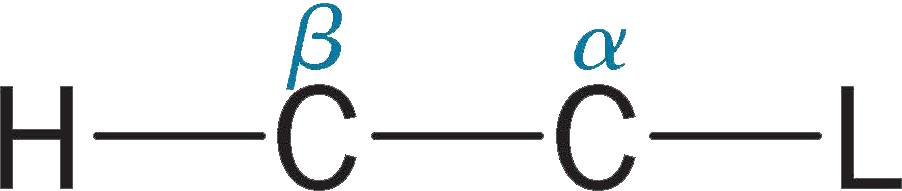
In elimination reactions, the carbon attached to the L is known as the alpha (α) carbon and the adjacent carbon is known as the beta (β) carbon. Therefore:
In an E2 step, the substrate generally has the form
or , in which the leaving group (L) and the beta (β) hydrogen are eliminated simultaneously.
For this reason, an E2 reaction is a type of β elimination.
Equations 7-14, 7-15, and 7-16 illustrate the diversity of reactants and products that can be involved in E2 steps. The base is HO– in Equations 7-14 and 7-15, whereas it is H2N– in Equation 7-16. The leaving group can come off as a negatively charged species, as in Equations 7-14 and 7-16, or it can be uncharged, as in Equation 7-15. And the α and β carbon atoms in the substrate may be joined by either a single bond (Eqs. 7-14 and 7-15) or a double bond (Eq. 7-16), resulting in the formation of a new C═C double bond or C≡C triple bond, respectively (see Looking Ahead box).
▶ LOOKING AHEAD
The C═C double bond or C≡C triple bond formed in an E2 reaction can itself undergo reaction, as we discuss later in this chapter, as well as in Chapter 12 and 13. We therefore revisit E2 steps in greater detail in Chapter 8 and 9.
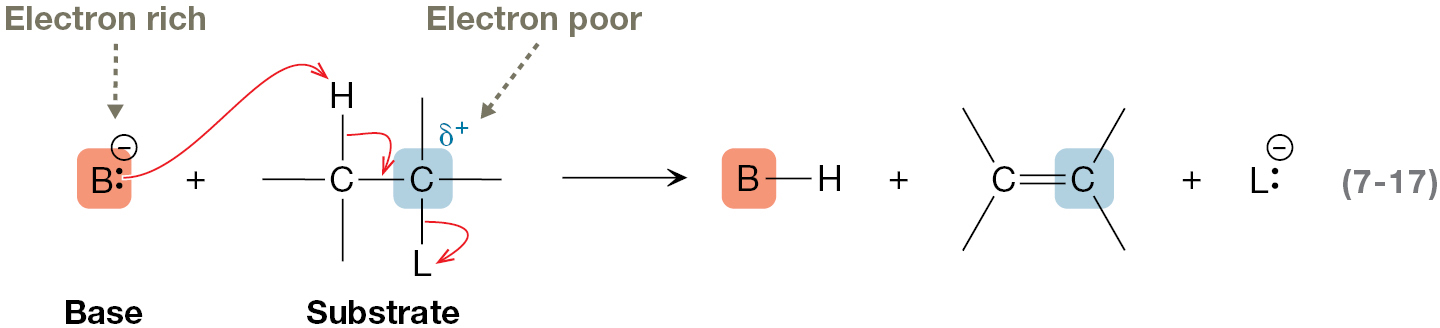
The base in an E2 step is the electron-rich species, but the β hydrogen atom that the base attacks is not particularly electron-poor; instead, the electron-poor atom is the carbon atom bonded to the leaving group (the α carbon). Thus, the flow of electrons from the electron-rich site to the electron-poor site is depicted with two curved arrows (Eq. 7-17). One curved arrow is drawn from the negatively charged atom in the base to the β hydrogen in the substrate. The second curved arrow is then drawn from the C—H bond to the bonding region between the α and β carbon atoms, and the third curved arrow is necessary to depict the departure of L to avoid exceeding the octet on the α carbon. Overall, the electron-poor α carbon atom gains a share of electrons from the C—H bond.
More information
A chemical reaction represents the flow of electrons from an electron-rich to electron-poor site using a curved arrow notation. The chemical reaction shows a boron atom carrying a lone pair of electrons and a negative charge, labeled electron-rich, reacting with a carbon atom linked to a hydrogen atom, a carbon atom, marked delta plus and labeled electron-poor and two vacant single bonds. The second carbon atom is linked to a lithium group and two vacant single bonds. A curved arrow points from a boron atom toward a hydrogen atom while another curved arrow points from a single bond between carbon and hydrogen toward a hydrogen atom. A third curved arrow from a single bond between carbon and lithium toward lithium. The resultant shows addition of hydrogen atom to boron atom; formation of double bond between two carbon atom, with each containing two vacant single bonds; and a lithium carrying a lone pair of electrons and a negative charge.
YOUR TURN 7.17
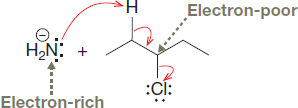
The reactants and products for this E2 step are shown, but the curved arrow notation has been omitted. Supply the missing curved arrow notation and identify the pertinent electron-rich and electron-poor sites.
SHOW ANSWERHIDE ANSWER
More information
Arrow pushing mechanism reaction. One reactant is a negative N H 2 molecule that is electron rich, the second reactant is a five carbon chain, the second carbon is bonded to hydrogen, the third carbon is bonded to chlorine and is electron poor. An arrow starts at the nitrogen and ends at the hydrogen of the second carbon. Another arrow starts at the hydrogen bond on the second carbon and ends at the bond between the second and third carbon. A third arrow starts at the bond between carbon and chlorine and ends at the chlorine.
YOUR TURN 7.18
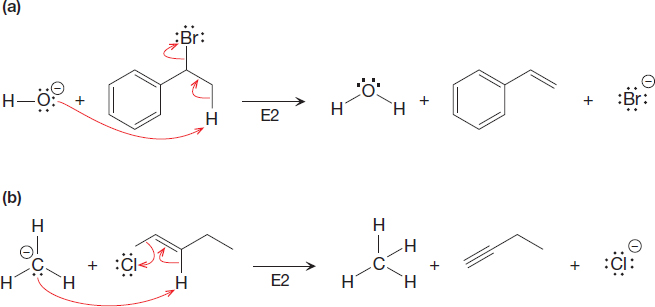
Supply the appropriate curved arrows and the products for each of the following E2 steps. If atoms or electron pairs involved in the reaction are not shown, you must draw them in. Hint: Consider simplifying the electron-rich species.
SHOW ANSWERHIDE ANSWER
More information
Arrow pushing mechanism reactions a and b. Reaction a first reactant is a negative hydroxide ion, the second reactant is a benzene ring bonded to an ethyl group, the first carbon of the ethyl group is bonded to hydrogen and the second is bonded to a bromine atom. An arrow starts at the oxygen and ends at the hydrogen of the second reactant. Another arrow starts at the hydrogen bond and ends at the bond between the carbons of the ethyl group. A third arrow starts at the bromine bond and ends at the bromine atom. The reaction arrow is labelled E2. The products are water, a bromine anion, and a benzene ring bonded to a ethylene group. Reaction b first reactant is a negative carbon bonded to three hydrogens. The second reactant is a five carbon chain, the second and third carbons share a double bond, the third carbon is bonded to a hydrogen, there is also a chlorine atom. An arrow starts at the negative carbon and ends at the hydrogen of the third carbon. Another arrow starts at the hydrogen bond and ends at the double bond. A third arrow starts at the bond between first and second carbons and ends at the chlorine. The reaction arrow is labelled E2. The products are methane, a four carbon chain with a triple bond between first and second carbons, and a negative chlorine ion.

 or
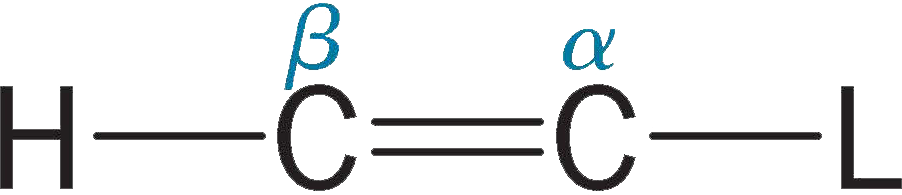 , in which the leaving group (L) and the beta (β) hydrogen are eliminated simultaneously.