7.6 Electrophilic Addition and Electrophile Elimination Steps
SECTION 7.6 OBJECTIVES
You will be able to:
Identify an electrophilic addition or electrophile elimination step when given the reactants and products.
Draw the curved arrow notation, transition state, and products for an electrophilic addition or electrophile elimination step when given the reactants.
Describe how the reactants of an electrophilic addition step behave as a nucleophile and an electrophile.
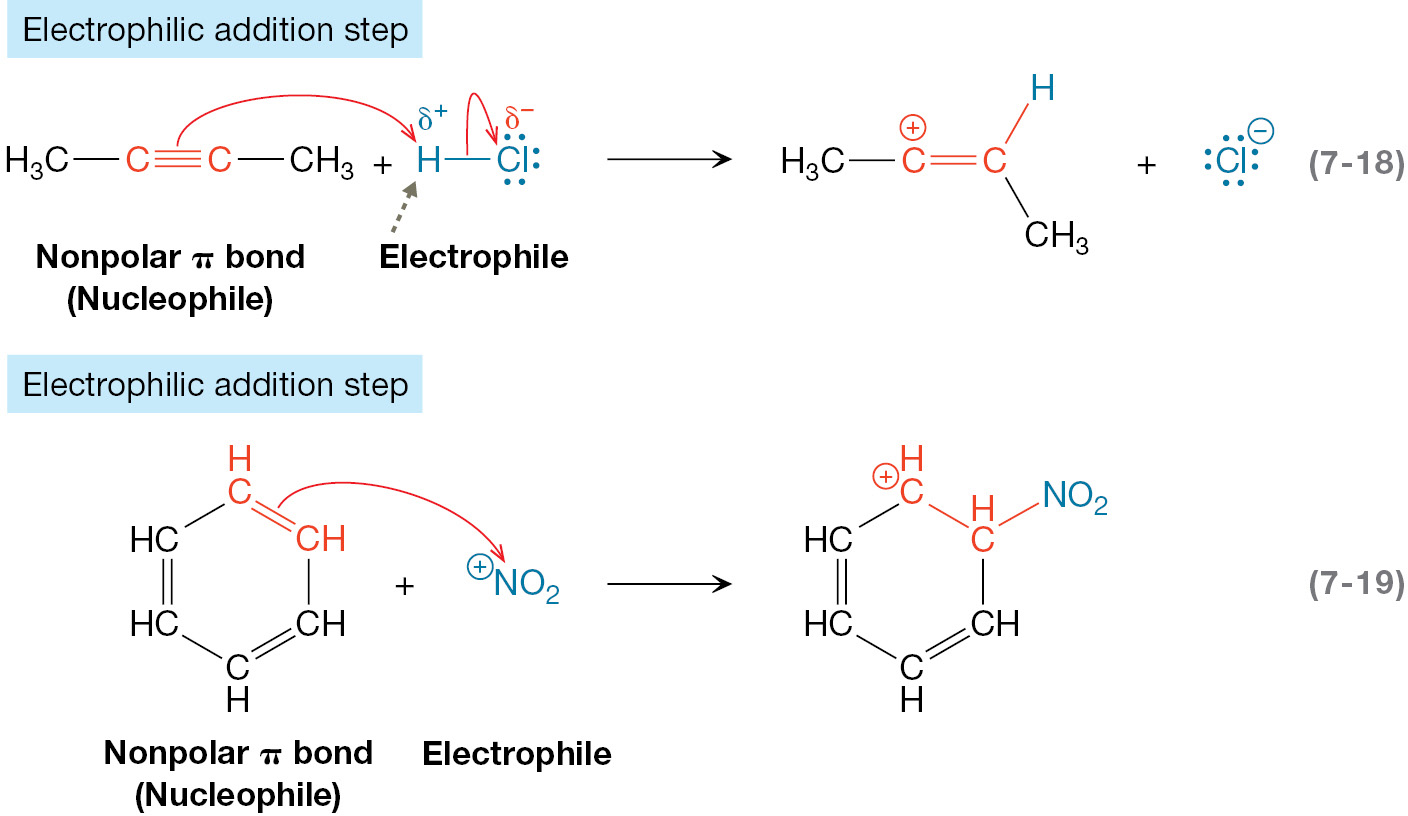
An electrophilic addition step occurs when a species containing a nonpolar π bond (as part of a double or triple bond) approaches a strongly electron-deficient species (an electrophile), and a bond forms between an atom of the π bond and the electrophile (Eqs. 7-18 and 7-19).
Elementary Step
Electrophilic Addition
More information
Two chemical reactions are shown to represent an example of electrophilic addition step. The first reaction shows two carbon atom linked by a triple bond, with each of the carbon atom linked with a methyl group to each of the group by a single bond, labeled non-polar pi-bond (nucleophile), reacting with hydrochloride acting as an electrophile. A curved arrow is drawn from a triple bond between two carbon atoms with its head pointing toward a hydrogen atom of hydrochloride. Another curved arrow is drawn from a single bond between the hydrogen and chlorine atom with its head pointing toward chloride. The resultants show an addition of hydrogen to one of the carbon atoms with the other carbon atom carrying a positive charge. It also shows a release of chlorine anion carrying four lone pairs of electrons. The second reaction shows a closed six-ring structure having an alternate double bond, labeled as non-polar pi-bond (nucleophile), reacting with N O 2, acting as an electrophile. The nitrogen atom of the N O 2 is shown carrying a positive charge. The resultant shows an addition of nitrogen dioxide to the second carbon atom of the closed six-ring and a positive charge on the first carbon atom of the closed ring.
The nonpolar π bonds involved in electrophilic addition steps are typically ones that join a pair of carbon atoms. The electrophile, on the other hand, can have a variety of different forms. For example, the electrophile can be Hδ+ from a Brønsted acid, such as HCl in Equation 7-18. Alternatively, the electrophile can exist on its own, as shown for the NO+2 species in Equation 7-19. In both electrophilic addition steps, however, notice that a carbocation is produced.
YOUR TURN 7.19
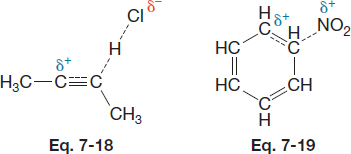
For each of the electrophilic addition steps in Equations 7-18 and 7-19, draw the transition state, taking into account the partial bonds and partial charges.
SHOW ANSWERHIDE ANSWER
More information
Structures of transition states. Eq 7-18 is two carbons bonded together by a single solid bond and a dashed one. One carbon with a partial positive charge is bonded to a methyl group. The other carbon is bonded to an hydrogen chlorine group which has a partial negative charge by a dashed bond and it is also bonded to a methyl group by a solid bond. Eq 7-19 is a benzene ring, one of the double bonds of the ring has a dashed bond. The ring is bonded to a nitro group.
YOUR TURN 7.20
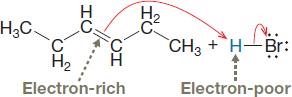
Add the appropriate curved arrows for the electrophilic addition step shown here.
SHOW ANSWERHIDE ANSWER
More information
Arrow pushing mechanism. The electron rich molecule is a six carbon chain with a double bond between the third and fourth carbons. The electron poor molecule is hydrogen bromide. An arrow starts at the double bond and ends at the hydrogen bonded to bromine. The second arrow starts at the bond between hydrogen and bromine and ends at bromine.
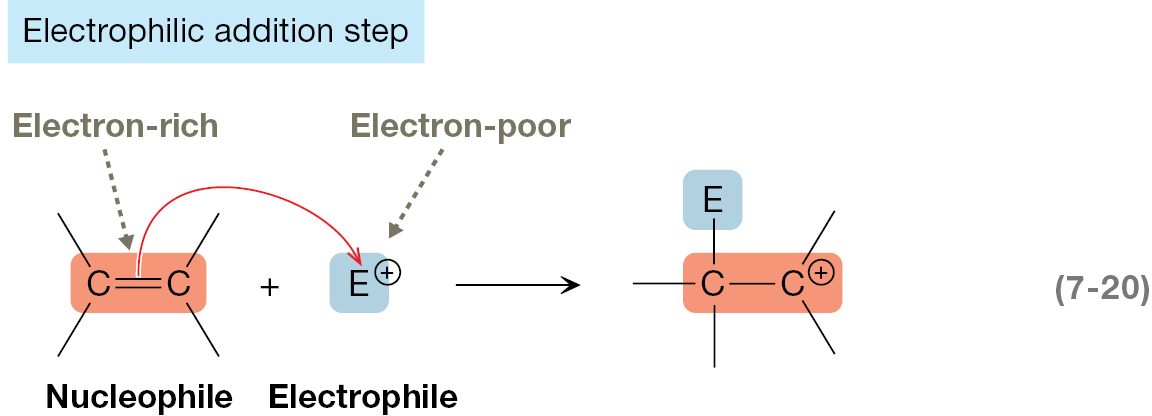
As shown in Equation 7-20, the electrophile (E+) in an electrophilic addition step is relatively electron-poor because it either carries a full positive charge (Eq. 7-19) or has an atom with a significant partial positive charge (Eq. 7-18). The double or triple bond, on the other hand, is relatively electron-rich. In a C═C double bond, for example, four electrons are localized in the region between the two atoms, and in a C≡C triple bond, six electrons are localized between the two atoms. Therefore, the movement of electrons from electron-rich to electron-poor is indicated by a curved arrow that begins at the center of the multiple bond and points to the electrophile.
More information
A chemical reaction shows an example of an electrophilic addition step with an arrow representing the transfer of electrons. The nucleophile shows two carbon atoms linked by a double bond, with each carrying two vacant single bonds and labeled electron-rich. It is shown to react with E carrying positive charge and labeled electrophile, electron-poor. The resultant shows an addition of E to the first carbon atom and replacement of double bond between two carbon atoms by a single bond. The second carbon atom is shown carrying a positive charge.
Notice in Equation 7-20 that the nonpolar π bond acts as a nucleophile in an electrophilic addition step. Unlike other nucleophiles we have seen so far, there is no atom with a lone pair that also bears a full or partial negative charge. Nevertheless, the C═C double bond is electron-rich and uses a pair of electrons to form a new bond to an electrophile.
YOUR TURN 7.21
In Your Turn 7.20, label the pertinent electron-rich and electron-poor sites.
SHOW ANSWERHIDE ANSWER
See answer to Your Turn 7.20.
▶ LOOKING AHEAD
Electrophilic addition and electrophile elimination steps generally involve carbocations, which tend to be highly reactive because they lack an octet and are positively charged. Therefore, electrophilic addition and electrophile elimination steps are usually part of a multistep mechanism, such as the ones we will explore in greater detail in Chapter 8, 12, 13, 24, and 25.
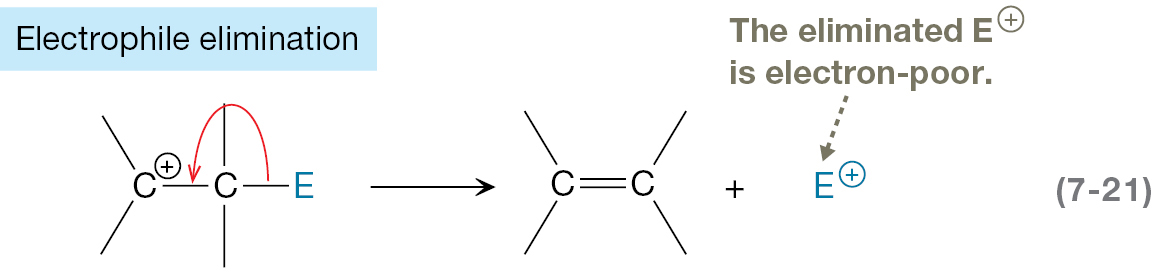
Carbocations are typically quite unstable, so the reverse of electrophilic addition is also a common elementary step in organic reactions. In the reverse step, called electrophile elimination (Eq. 17-21), an electrophile is eliminated from the carbocation, generating a stable, uncharged organic species (see Looking Ahead box).
Elementary Step
Electrophile Elimination
More information
A chemical reaction shows an example of an electrophilic elimination step to check for potential electron-rich and electron-poor sites. It shows a chain of two carbon atoms linked to each other by a single bond, with each carbon atom carrying two vacant single bonds. The first carbon atom is marked with a positive charge. The second carbon atom is linked to an E group by a single bond. An arrow points from the bond between the second carbon and the E to the bond between the two carbons. The resultant shows two carbon atoms linked by a double bond, with each carrying two vacant single bonds and a release of E carrying a positive charge. The eliminated E is electron-poor.
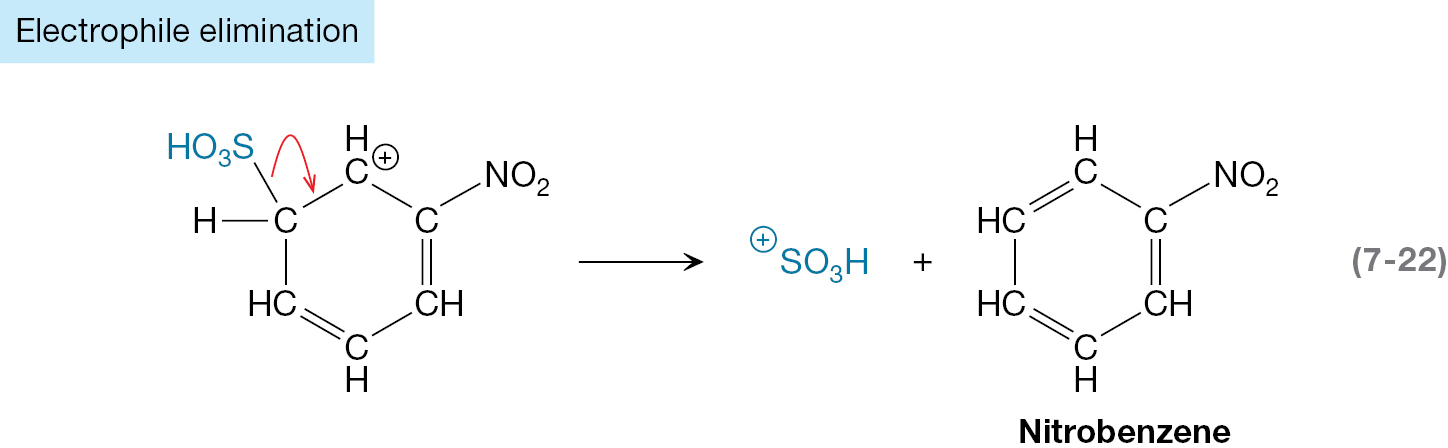
Equations 7-22 and 7-23 show examples in which the eliminated electrophile is SO3H+ or H+, respectively.
More information
Two chemical reactions showing examples of electrophile elimination. The first reaction shows a closed six-ring structure. The first carbon atom is linked to N O 2 with a single bond. The second carbon atom is labeled with a positive charge. The third carbon is linked to H O 3 S with a single bond. An arrow points from this bond to the bond between the second and third carbons. The resultant shows nitrobenzene with alternate double bonds in it closed six-ring structure. S O 3 H with a positive charge is released. The second reaction shows a water molecule with an oxygen that has two lone pairs of electrons. There is a positively charged carbon with three methyl groups linked by single bonds. An arrow goes from one of the lone electron pairs to a hydrogen atom in one of the methyl groups. A second arrow goes from the bond between the hydrogen and the carbon in the methyl group to the bond between the two carbon atoms. The resultant is H 2 O H and Methylpropene. The oxygen in H 2 O H is marked with a positive charge.
CONNECTIONS 7.2
More information
An image of a pair of blue jeans.
Nitrobenzene: Explosives, perfumes, and blue jeans Nitrobenzene (C6H5NO2, Eq. 7-22) has an odor that resembles almonds, which once made it useful in the fragrance industry. Now, nitrobenzene is used primarily in the production of aniline, which is a precursor to a variety of compounds, including explosives, pharmaceutical drugs, and dyes such as indigo, the dye associated with blue jeans.
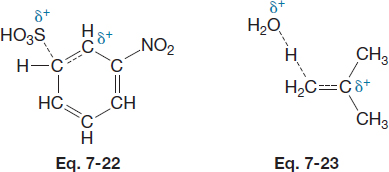
In Equation 7-22, the SO3H+ electrophile is eliminated on its own. In Equation 7-23, however, the H+ that is eliminated is simultaneously picked up by water, which acts as a Brønsted base. Such participation of a base is necessary because H+ does not exist on its own in solution.
YOUR TURN 7.22
For each of the electrophilic elimination steps in Equations 7-22 and 7-23, draw the transition state, taking into account the partial bonds and partial charges.
SHOW ANSWERHIDE ANSWER
YOUR TURN 7.23
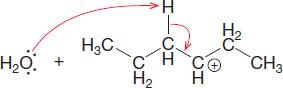
Add the appropriate curved arrow(s) to the electrophile elimination step shown here, which is essentially the reverse of the addition step in Your Turn 7.20.
SHOW ANSWERHIDE ANSWER
More information
Arrow pushing mechanism. The first product is a water molecule. The second product is a six carbon chain and the third carbon has positive charge. An arrow starts at the oxygen of water and ends at the hydrogen of the fourth carbon. Another arrow starts at the fourth carbon hydrogen bond and ends at the bond between the third and fourth carbon.
YOUR TURN 7.24
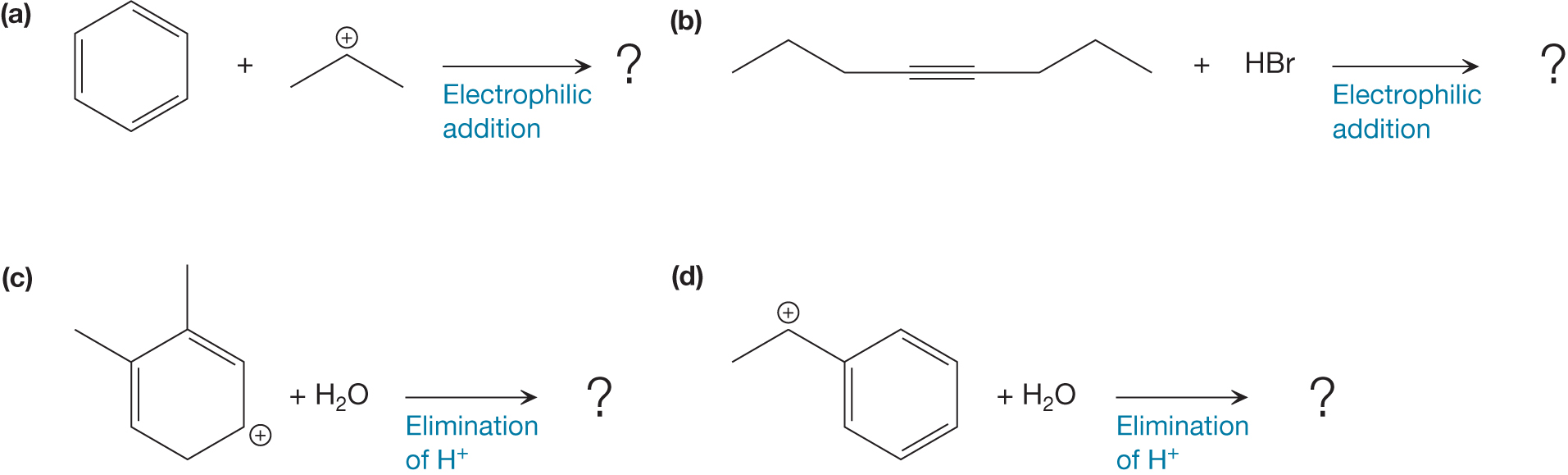
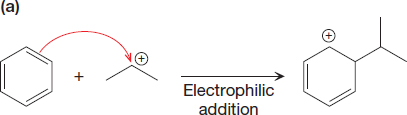
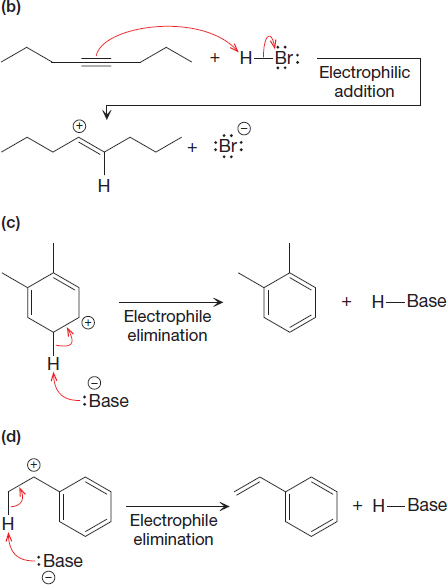
Supply the appropriate curved arrows and draw the product of each of the elementary steps shown here, indicated underneath the reaction arrows. If atoms or electron pairs involved in the reaction are not shown, you must draw them in.
SHOW ANSWERHIDE ANSWER
More information
Arrow pushing mechanism reaction for a, b, c, and d. Reaction a has reactants of a benzene ring and propane with a positive charge on the second carbon. An arrow starts at one of the double bonds of the benzene ring and ends at the carbon with a positive charge. The reaction arrow is labeled electrophilic addition. The final product is a cyclohexane ring bonded to a isopropyl group at the second carbon. The first carbon of the ring has a positive charge. And there are double bonds at the third and fourth carbons. Reaction b has reactants of an eight carbon chain with a triple bond at the fourth carbon and hydrogen bromide. An arrow starts at the triple bond and ends at the hydrogen of hydrogen bromide, another arrow starts at the hydrogen bond and ends at the bromine. The reaction arrow is labeled electrophilic addition. The products are an eight carbon chain with a double bond at the fourth carbon which also has a positive charge, the other reactant is a negative bromine ion. Reaction c has reactants of a cyclohexane ring with positive charge at first carbon, a hydrogen at second carbon, double bonds at the third and fifth carbon, and methyl groups at the fourth and fifth carbon, the other reactant is a negative charged base with a lone pair of electrons. An arrow starts at the lone pair of electrons and ends at the hydrogen, another arrow starts at the hydrogen bond and ends at the bond between first and second carbons of the ring. The reaction arrow is labeled electrophile elimination. The products are a benzene ring with methyl groups at first and second carbons and a hydrogen bonded to the base. Reaction d has reactants of a benzene ring bonded to an ethyl group, the second carbon is positively charged, and a negatively charged base. An arrow starts at the base and ends at the hydrogen of the first carbon of they ethyl group, another arrow starts at the hydrogen bond and ends at the bond between the carbons of the ethyl group. The reaction arrow is labeled electrophile elimination. The products are a benzene ring bonded to an ethylene group and a hydrogen bonded to the base.