A ritual is the acting out of an established, prescribed behavior—usually employing bodily movement, words, or interactions with objects—in order to affect a community. Some scholars see theatre as an evolution of ritual. In other words, they think that ancient people engaged in rituals, and then once those ritual performances were separated from their religious function, the performances became theatrical.
Most rituals are efficacious; that is, they are intended to achieve results. Many world religions have ceremonies intended to serve some purpose: to commune with ancestors, to plead for help, to transition from life to death. An example is the Egungun Masquerade in Yoruba areas in West Africa (which we will discuss more fully in Chapter 6), for which performers dress in masks and costumes and perform dances and other actions to renew their connection to their ancestors. While many Yoruba people still practice Egungun festivals for religious purposes, there also exist professional, traveling Egungun performing troupes who are celebrated not for their ability to summon the ancestors or for other ritual purposes, but for their dance prowess and entertainment value. Some people interpret this as an evolution from sacred ritual to secular theatre.
Another way of thinking about the relationship between ritual and theatre is that they are not in an evolutionary lineage (ritual first, then theatre later), but rather they co-exist as distinct human practices. While ritual and theatre might incorporate some of the same elements—masks, costumes, dance, storytelling—they can have differing functions within the same society. One element that can be distinct between rituals and theatre is methexis, or group sharing. In some religious rituals, there is little distinction between who is the performer and who is the audience; all in attendance may sing, dance, and recite at times, making them both performer and audience. In theatre, by contrast, the distinction between performer and audience is often much clearer; in traditional theatre, the performers are onstage while the audience is not.
But still, other scholars do not distinguish between efficacious performance and performance for entertainment. For them, ritual and theatre not only coexist but share common elements that make them intricately related and worth studying together. Rather than seeing ritual as the purview of the anthropologist and theatre as the purview of the arts scholar, we can say that theatre, performance, and ritual inform one another and are worthy of study by researchers from various disciplines. For expediency, and because this textbook cannot cover every performative tradition, we will focus more on nonreligious theatre—but not to the exclusion of major theatre movements intertwined with religious practice, especially those in ancient times such as Sanskrit drama in India, ancient Greek and Roman theatre, nō theatre in Japan, and medieval theatre. All of these were staged for religious purposes as well as for entertainment.
Popular Entertainment and Theatre
Another root of theatre is what we call popular entertainment. These are activities that people engage in because they give joy: singing, dancing, juggling, magic, acrobatics, circus acts, animal exhibits, amusement parks, talent shows, and the like. Some scholars argue that popular entertainment is distinct from theatre because it does not have all the necessary components of theatre—such as character, heightened language, or design—even though it may have one or two of those elements. In addition, popular entertainments usually appeal to mass audiences and are not restricted to specific socioeconomic classes.
In the twenty-first century, many theatre scholars study popular entertainment because these types of activities and events often shed light on the values and behavior of historical cultures. In periods for which we have no extant play scripts or other evidence of formal theatre, evidence of popular entertainment shows that theatrical activity remained an important part of the social, political, or religious culture of a region. An example is the long period in European history from the end of the Roman Empire in the fifth century CE until medieval theatre emerged almost 1,000 years later. From around 500 BCE to 1300 CE, Europeans enjoyed troubadours, jugglers, dancers, and mimes crisscrossing parts of Europe and entertaining at large manor houses—often during banquets and on other special occasions. Despite the absence of theatrical records during this time, popular entertainment remained just that: popular.
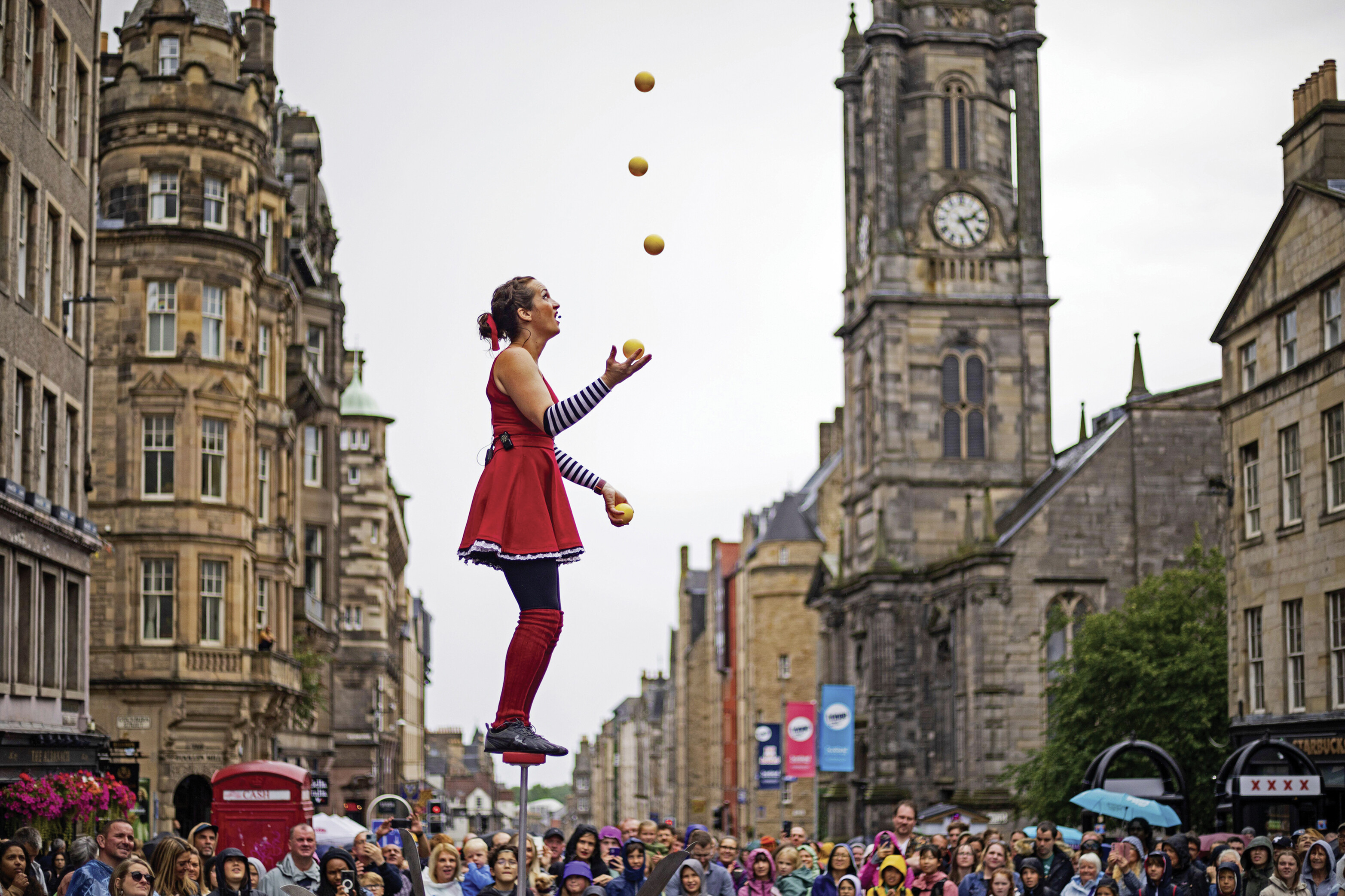
Popular Entertainment: Circus Acts Popular entertainment involves activities meant to entertain people. Circus acts, such as the juggling and stilt walking shown here, are a form of popular entertainment. This is a picture of street performer Kate the Great on the Royal Mile in Edinburgh, Scotland during the 2023 Edinburgh Fringe Festival.
History makes clear that theatre and popular entertainment often borrowed stories, gestures, and themes from one another, which blur these categories. More recently, some twentieth-century vaudeville comedians have gone on to write or star in plays, and today’s jukebox Broadway musicals such as Mamma Mia! and Tina: The Musical employ pop songs to attract audience members to the theatre.
At times, we will survey various popular entertainments throughout history, focusing on their performative characteristics. We will especially note when other forms of more traditional theatre either are not documented in the historical record or possibly did not exist to a significant extent—or at all.
Imitation, Role Playing, and Oral Storytelling
Another root of theatre is the human instinct to imitate others and to take on roles. Imitation is universal among children as a way to learn about the world and how to interact with it. For example, a child sees an older person walking up stairs or opening a door and learns to do the same by imitation. Role playing is universal among young and old alike, and it too has a theatrical component. In everyday life, people assume family roles (father, mother, grandfather, sister, brother) and also social roles (doctor, salesperson, clown). In playing these roles, individuals adopt behaviors and attitudes required by their society. Both imitation and role playing involve aspects of acting. The Greek philosopher Aristotle, whom we will discuss in Chapter 3, suggested that theatre may have originated from the human instinct to imitate.
Another everyday activity with a theatrical element is storytelling, which occurs in cultures throughout the world. Experienced storytellers create suspense, evoke laughter or tears, and play many characters through their gestures, body language, and voice. Not unlike actors, storytellers use performative gestures to make the audience see and hear different people. Some scholars believe that puppet theatre evolved from storytelling when storytellers started using and making objects to represent different characters rather than relying on their voices and bodies to tell the story. From Algeria to Japan, from the Americas to Africa—every region of the globe has had storytelling traditions.
It is easy to see the connection between storytelling and theatre: someone doing an imitation, someone playing a societal role, and someone telling a story all provide clues to the origins of theatre.
On Stage Today
Storytelling Then and Now
Storytelling practices have a long history in all regions of the globe. Chapter 5 explains the storytelling tradition in the Eastern Empire, which encompassed most of North Africa and the Middle East along with parts of Europe until the 1400s CE. Countries in sub-Saharan Africa also have a heritage of storytelling, as do the cultures in Asia and in the Indigenous Americas. Two of the most important ancient texts are the epics the Ramayana and the Mahabharata, both of which were written in India in ancient times. Perhaps you have read the surviving Greek epics attributed to Homer: the Odyssey and the Iliad. Or perhaps you know the 1001 Nights. All of these are examples of ancient stories that stem from oral storytelling traditions—and that theatre artists still tell today in theatrical presentations.
Some historians see storytelling as a significant root of theatre. The theory is that as storytellers became more sophisticated, they started using different voices and mannerisms to help make the characters distinct. As storytellers further developed, they started using props, costumes, and masks to represent their characters more clearly to their audiences. Some scholars of puppetry think that storytellers started using objects to make the stories clearer, and those objects ultimately became puppets. Early puppet theatre existed in the Middle East and East Asia in the first few centuries CE.
Today, oral storytelling remains in a relationship with theatre and performance. Two contemporary American theatre artists who use storytelling as a method are Anna Deavere Smith and John Leguizamo.
Anna Deavere Smith writes and performs one-woman shows, or solo performances. Her most well-known plays tackle moments of crisis in the United States. Fires in the Mirrors: Crown Heights, Brooklyn, and Other Identities is about the tensions between Black and Jewish New Yorkers during the Crown Heights riots of 1991. Twilight: Los Angeles, 1992 is about unrest in Los Angeles after the murder of Rodney King. For both plays, Smith interviewed dozens of regular people. When she performs these shows, she impersonates her interviewees and speaks their exact words, with their unique accents and dialects, taken from the interviews. She alters her appearance to resemble the interviewees. Smith has said that she speaks the interviewees’ words verbatim because she sees language itself as a window into a person’s character.
More information
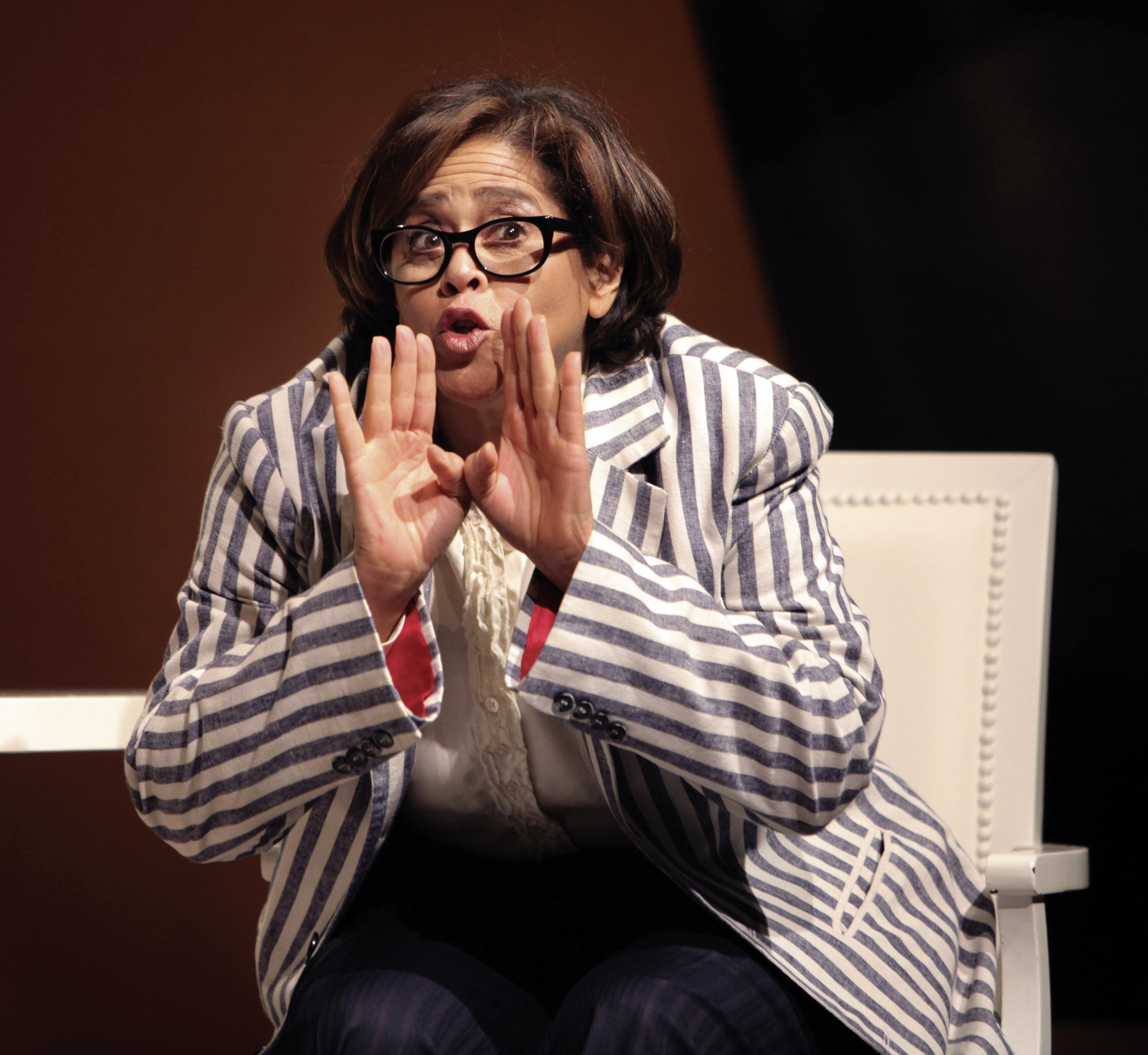
A woman leans forward in her chair, holding both hands around her mouth in an exaggerated whisper.
Storytelling and Theatre Storytelling and theatre have an innate connection. Artist Anna Deavere Smith is famous for her solo performances, in which she plays many different characters. Shown here is her one-woman play, Let Me Down Easy, at the Second Stage Theater in New York in September 2009.
John Leguizamo also writes and performs solo shows. His best-known shows are Freak (1998), Sexaholix (2002), and Latin History for Morons (2018). Leguizamo’s shows are largely autobiographical: they relate his upbringing as a Latine American child in New York in the 1970s. Leguizamo uses different voices and mannerisms to depict people from his neighborhood and his life, and he clearly differentiates onstage between himself as the narrator of the story and the other versions of himself at different ages who are characters in his stories.
Because theatre exists to tell stories to an audience, it makes sense that storytelling and theatre are intricately connected, both in history and in the present time. Solo performance artists give us a window into what may have been one of the origins of theatre: storytelling.
Theatre Is Ancient, Global, and Ephemeral
Although theories about the origins of theatre are often subject to debate, we do know that humans have engaged in theatre and performance since before recorded history. When we talk about ancient theatre and performance, which make up Part One of this book, we refer to all of the theatrical events that occurred before approximately the fifteenth century. This means that ancient theatre spans over 6,400 years, from 5000 BCE to 1400 CE, including performances that happened all over the globe.
More information
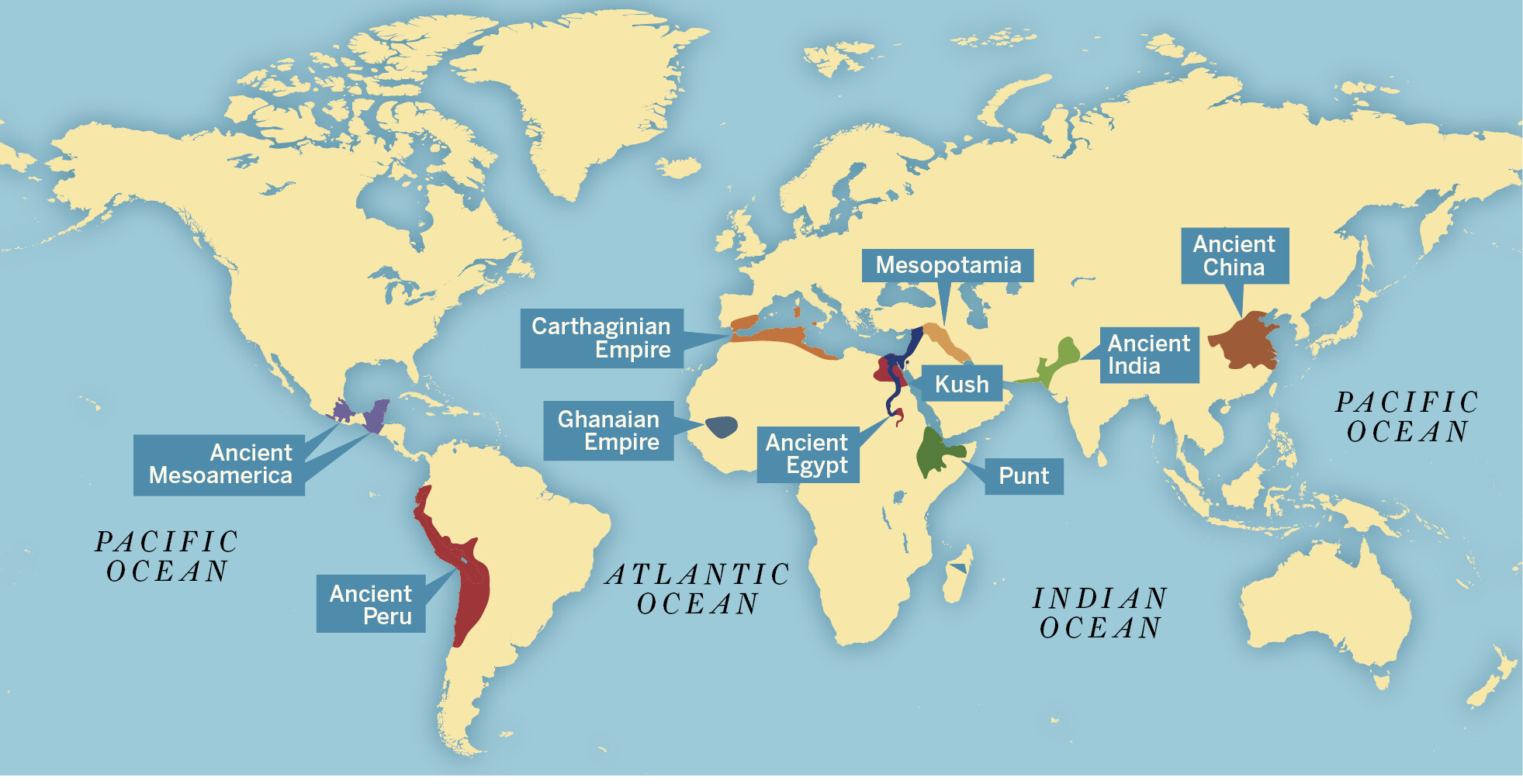
A map of the world pinpoints the world’s oldest civilizations, including Ancient Mesoamerica, Ancient Peru, Carthaginian Empire, Ghanaian Empire, Ancient Egypt, Mesopotamia, Kush, Punt, Ancient India, and Ancient China.
The World’s Oldest Civilizations Pictured here are some of the world’s oldest civilizations. Many of these civilizations began thousands of years ago. Notice how many are at the same latitude.
Theatre and performance are ephemeral: that is, they last for a very short time and cannot truly be revisited. If you have seen a Broadway musical—whether staged at a school, in a community playhouse, or at a professional theatre—you can never return to that very same performance. If you go to see it again, different performers may be playing the roles, someone might drop a prop, the weather outside the theatre will likely be different, or the way the audience engages might change the way the performers act on stage. Theatre’s ephemeral nature makes it difficult for historians to study, so they often look to written documents—scripts—to know what happened. In the writing and telling of history, scholars have generally privileged performances that have associated written texts, such as ancient Greek drama, because scripts provide important evidence for the stories that were told and the manner in which theatrical productions happened.
There is a problem with studying theatre history that way, though: it ignores the many performances and theatrical events for which we do not have written records or scripts. Until recently, historians from the Global West and Global North have overlooked or dismissed performances from oral cultures, such as those in what is now Latin America and sub-Saharan Africa. Even though few to no scripts exist from these places from antiquity, other types of historic records and continued practices in many of these places demonstrate that the cradle of theatre and performance is located in the world’s oldest cultures, including Africa and Asia. In fact, the oldest surviving written literature reflects even older oral traditions—such texts as the Odyssey in Greece and the Mahabharata in India.
The oldest global civilizations—including those of Mesopotamia, ancient Egypt, ancient India, ancient China, ancient Peru, and ancient Mesoamerica—had cities, armies, agriculture, arts, and performance. In addition to these civilizations, multiple ancient empires and kingdoms flourished in Africa before the modern era. These include the Carthaginian Empire, the Berber Kingdom, the Ghanaian Empire, the Malian Empire, the ancient land of Punt, the kingdom of Kush, and the city-state of Ife, just to name a few. But most theatre history does not categorize performance practices from these early civilizations as theatre because they did not use or leave behind written theatre texts.
Outlining all of the prehistoric and ancient theatre and performances from these civilizations would be impossible, so this chapter will highlight only some of the important moments of that early theatre history. Whenever possible, we will note the years that historians imagine these performances took place. But because most of these performances were not recorded or were obliterated by colonizers and imperial powers, often we simply do not know when they began.
Some ancient performance traditions only entered the written historical record in the past 400 years—once colonizers took note of them. This is especially true for sub-Saharan Africa and the Americas, regions that have a long history of performance traditions but that had limited trade with Europe and Asia in antiquity. In the case of Africa, many of the early performance traditions continue to the present day, so historians can study them to draw hypotheses about the past. In this chapter, we will explore performances in Africa and the Americas past and present, which theatre scholars and practitioners examine to discover the roots of theatre.
Social Justice and Theatre History
Absent Archives Erase the Past
Historians traditionally use archives to study the past. Archives are collections of historical records that provide information about a place or group of people. Archives can look like books on a shelf, documents in a file folder, images in an online database, or a museum-like collection of objects from a specific group of people or culture. Archives are assembled by people who have specific goals in mind when collecting materials and then make judgments about what to save based on those goals. For example, if we were to try and assemble an archive about U.S. theatre in our present time, we would have to make judgments about what to preserve for inclusion. We could create a file with video recordings of performances; or we could keep props and costumes from performances in a museum collection. We could archive posters from the longest-running shows on Broadway; or we could create a collection of scripts by underrepresented playwrights that were never produced. Each option would prioritize and highlight a different aspect of the history of U.S. theatre. We would decide which objects to archive based on our perception of their value for our collection.
As we’ve discussed, rituals and popular entertainment from the Global South—a vast region of the world encompassing most of the Americas, Africa, the Middle East, and Southeast Asia—have garnered limited academic and historic attention, despite being likely roots of theatre.
As you’ll read several times in this chapter, we do not know much about what these early performances looked like. This is because much of the Global South was colonized by invaders from the Global North—powerful regions such as North America, Europe, and Australia—in the fifteenth to the twentieth centuries. Colonizers and other aggressors thought that Indigenous peoples and practices were primitive and not as sophisticated or evolved as the peoples and cultures of the colonizers, and therefore they frequently did not save, respect, or record Indigenous practices. For hundreds of years, many historians did not believe that the people living in Africa and in the Americas prior to colonization were worth studying. For the historians who did want to study Indigenous African and American cultures, there was little to no archival material to turn to.
Performance studies scholar Diana Taylor argues that in addition to archives, people have repertoires, or embodied behaviors—cooking, praying, hair styling, and dancing are just a few examples. Colonizers often prohibited Indigenous peoples from engaging in their cultural repertoires, so many of those practices were lost, too. But even if those who originally held the embodied knowledge of these practices are no longer with us, and even if there is scant evidence of how they performed the activities in the past, many of these practices live on through the peoples’ descendants. Studying peoples’ embodied behaviors can help historians reconstruct performative traditions of the past.
In the last fifty years or so, cultural historians have recovered and studied aspects of early human history by attending to the few archival items that were not lost and by imagining the details of the cultures who owned or created those objects or participated in those practices. This has coincided with the development of sophisticated technologies in archaeology, such as carbon dating, that help place those events within history.
It is difficult to write the history of groups that were oppressed and nearly eliminated by colonizers, and historians have much work to do to recover their worlds. When we no longer have the physical objects that ancient cultures used (or understand the context in which they were used), theatre and performance can be a way to better comprehend the social and cultural contexts of those worlds. In this way, theatre practices represent an important intersection of both archives and cultural repertoires, and theatre can be a place where we rediscover and embrace marginalized cultures. Theatre scholars, practitioners, and historians have a duty to continue to research lost cultures, and they also have a duty to guard against contemporary forms of colonial bias so that no more of these performative traditions are lost.
In theatre, the act of group sharing. In this process originating from Greek theatre, the audience participates, creating and improvising the action of the ritual.