Describe how we define a microbe, and explain why the definition is a challenge.
Describe the three major domains of life: Archaea, Bacteria, and Eukarya. Explain what the three domains have in common and how they differ.
Define viruses, and explain how they relate to living cells.
Where did life come from? Life on Earth began early in our planet’s history with microscopic organisms, or microbes. Microbial life has since shaped our atmosphere, our geology, and the energy cycles of all ecosystems. Some early microbes eventually evolved into multicellular plants and animals, including ourselves. Today, microbes generate the very air we breathe, including nitrogen gas and much of the oxygen and carbon dioxide. They fix (or combine) nitrogen into forms used by plants, and they make essential vitamins that we consume, such as vitamin B12. Microbes are the primary producers of food webs, particularly in the oceans; when we eat fish, we indirectly consume tons of algae at the base of the food chain.
The human body contains as many microbes as it does human cells, including numerous bacteria on the skin and in the digestive tract. Throughout history, humans have had a hidden partnership with microbes ranging from food production and preservation to mining for precious minerals. Today, microbes serve as tools for biotechnology in fields from medicine to microscopic robots. Nevertheless, a small but critical proportion of all microbes are pathogens, the causative agents of disease. Diseases caused by pathogens, commonly called “germs,” remain the principal cause of human mortality.
A Microbe Is a Microscopic Organism
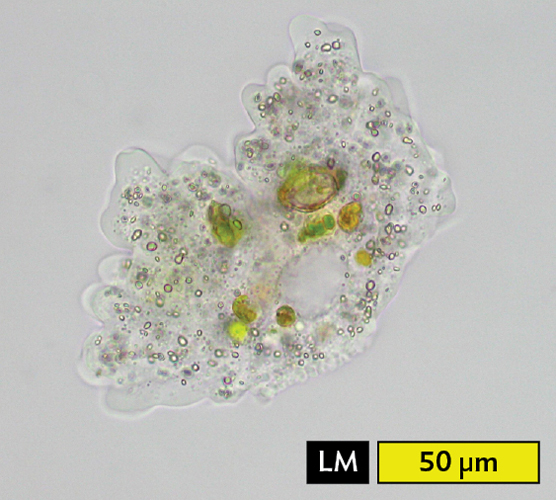
A microbe is commonly defined as a living organism that requires a microscope to be seen. Microbial cells range in size from millimeters (mm) down to 0.2 micrometer (μm), and viruses may be tenfold smaller (Figure 1.1). Some microbes consist of a single cell. A cell is the smallest unit of life, composed of a membrane-enclosed compartment of water solution containing molecules that carry out metabolism.
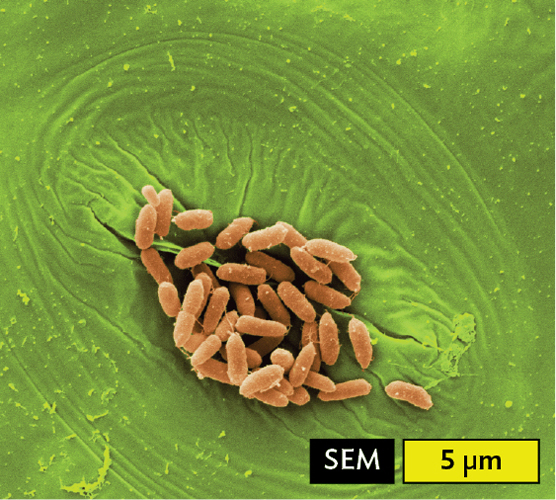
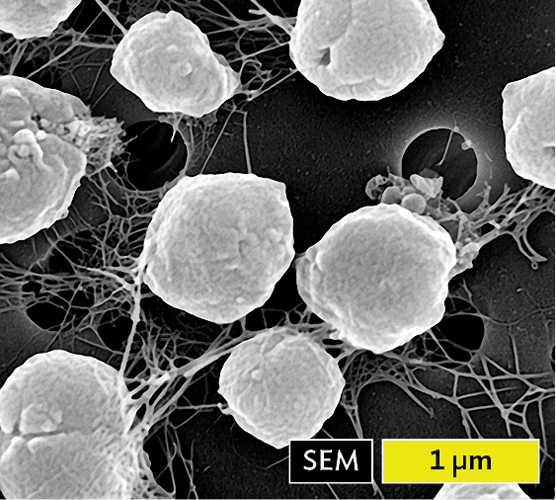
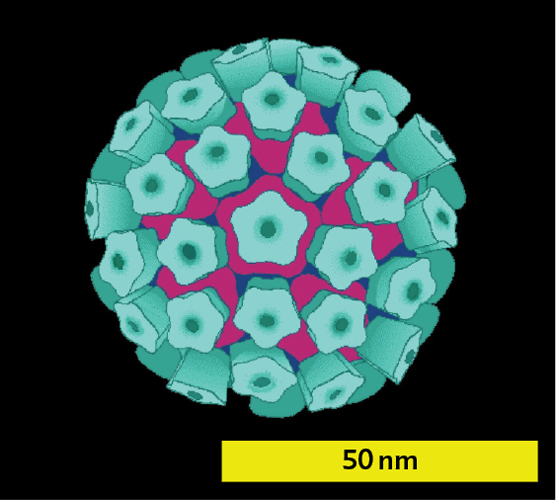
Figure 1.1 Representative Microbes
A.Pelomyxa sp., a large ameba.B.Escherichia coli bacteria colonizing a stomate cell in a lettuce leaf (colorized scanning electron micrograph).C.Methanocaldococcus jannaschii, an archaeon that produces methane.D. Human papillomavirus, the cause of genital warts and cervical or penile cancer (model based on electron microscopy).
Each microbe contains in its genome the capacity to reproduce its own kind. Microbes are found throughout our biosphere, from the superheated black smoker vents at the depths of the ocean floor to the subzero ice fields of Antarctica. Bacteria such as Escherichia coli live in our intestinal tract, whereas algae and cyanobacteria turn ponds green.
Our simple definition of a microbe, however, leaves us with contradictions. Most single-celled organisms require a microscope to render them visible, and thus they fit the definition of “microbe.” Nevertheless, some protists and algae are large enough to be seen with the naked eye. An example is the ameba Pelomyxa, which can span several millimeters (Figure 1.1A). Some amebas can cause meningitis; others can harbor thousands of Legionella bacteria, the cause of legionellosis, a severe form of pneumonia.
Other kinds of microbes form complex multicellular assemblages, such as mycelia (multicellular filaments) and biofilms. In a biofilm, cells are differentiated into distinct types that complement one another’s function, as in multicellular organisms. On the other hand, some complex multicellular animals, such as mites and roundworms, require a microscope for us to see, but they are not considered microbes. Allied health courses may cover parasitic invertebrates under “microbiology” because these infectious agents are transmitted in a manner similar to that of disease-causing microbes. For example, hookworms infect about 700 million people worldwide, including some in US communities with poor sanitation.
Different Kinds of Microbes
Microbes, like other organisms, are classified as members of a species according to a shared set of genes and traits. The scientific name of the species, such Staphylococcus epidermidis for a common skin bacterium, consists of a capitalized genus name (Staphylococcus) and a lowercase species name (epidermidis), both italicized. In addition, members of a genus are often referred to informally by a romanized vernacular term, such as “staphylococci.” The names of some microbial species are sometimes changed to reflect our new understanding of genetic relationships. For example, the causative agent of bubonic plague was formerly called Bacillus pestis (1900) and Pasteurella pestis (1923), but it is now called Yersinia pestis (since 1944). The older names, however, still appear in the literature.
Microbes are classified according to their genetic relatedness. The more closely related two organisms are, the more recently they diverged from a common ancestor. Relatedness is important for understanding how microbes respond to treatment. For example, an antibiotic used against an intestinal pathogen will also kill many beneficial bacteria that normally live in the intestine; consequently, the antibiotic may cause digestive problems. The degree of genetic relatedness between microbes is calculated by comparing DNA sequences in the genome—the total DNA sequence content of each organism. Genome comparison is now the fundamental basis for classifying all life forms.
A major trait distinguishing microbes is possession or lack of a membrane-enclosed nucleus. Microbes that lack a nuclear membrane are called prokaryotes, which include bacteria and archaea. Microbial eukaryotes (cells with a nucleus) include fungi, protozoa, and algae.
Bacteria are prokaryotic cells, usually 0.2–20 μm in size—or, one-tenth to one-hundredth the size of a sentence period. Different species may grow as single cells, as filaments (chains), or as communities with simple differentiated forms. An example is Escherichia coli (Figure 1.1B), a bacterial species that grows in the human intestine. Most strains of E. coli are harmless members of the microbial community that aid human digestion, but some strains cause acute gastroenteritis that may lead to kidney failure. Bacteria are found in every habitat of our biosphere, even several kilometers underground.
Archaea (singular, archaeon) are a genetically distinct group of prokaryotes that evolved by diverging from bacteria and eukaryotes more than 3 billion years ago. Some archaea are “extremophiles” that live in seemingly hostile environments, such as the boiling sulfur springs of Yellowstone. Other archaea are methanogens, whose metabolism releases methane (natural gas; Figure 1.1C). Methanogens are common in the gut of humans and animals, the source of the “gas” passed by one’s intestinal tract. Their metabolism increases the efficiency of digestion. A remarkable feature of archaea is that none cause disease. The absence of pathogenesis (disease causation) in archaea is of great interest to medical researchers studying the cause and prevention of disease.
Eukaryotic microbes include protozoa (singular, protozoan), which are motile heterotrophs (consuming organic food), usually single-celled. A protozoan such as an ameba (see Figure 1.1A) may be free-living or parasitic. Algae (singular, alga) are eukaryotic microbes containing chloroplasts that conduct photosynthesis. Algae form an essential base of the food web, although overgrowth causes “algal blooms” that poison fish. Protozoa and algae together are classified as protists. Distinct from protists are fungi (singular, fungus), heterotrophic organisms that are usually nonmotile and grow by absorbing nutrients from their surroundings. Fungi may grow as single cells (yeast) or as filaments (bread mold), or they may form complex structures such as mushrooms. Some fungi cause infections, especially in people with a depressed immune system.
Eukaryotic microbial pathogens are also called parasites. Parasites are organisms that live at the expense of a host they inhabit, debilitating the host. By convention, the word “parasite” is used for both single-celled and multicellular eukaryotes. Multicellular parasites include, for example, worms and mites (presented in Chapter 11).
Viruses are noncellular microbes. A virus particle contains genetic material (DNA or RNA) that takes over the metabolism of a cell to generate more virus particles. Some viruses, such as papillomaviruses (Figure 1.1D), consist of only a few molecular parts. Other viruses, such as herpesviruses, show complexity approaching that of a cell, although none are fully functional cells. Engineered viruses are used as tools for gene therapy. For example, in 2017 the Food and Drug Administration (FDA) approved a nonpathogenic derivative of the human immunodeficiency virus (HIV) for gene delivery to the white blood cells of a child, enabling the child’s immune system to overcome leukemia.
SECTION SUMMARY
Microbes are microscopic; that is, they are organisms too small to be seen without a microscope. Different species of microbes grow as single cells, in filaments, in biofilms, or in simple differentiated structures.
Bacteria are cells lacking a nucleus (prokaryotes). Bacteria grow in all habitats. Most human-associated species are harmless, but some cause disease.
Archaea are nonbacterial cells that lack a nucleus (prokaryotes) and are distantly related to other microbes. Methanogens live in the human intestine (among other places), where their metabolism releases methane. No archaea cause disease.
Eukaryotic microbes include protists (protozoa and algae) and fungi. Parasitic protozoa and fungi may infect humans.
Viruses are noncellular microbes that must infect a host cell.
A bacterial, viral, fungal, protozoan, or helminthic agent of disease; among health professionals, pathogens typically are limited to bacteria, viruses, and fungi. (1, 2)
A heterotrophic eukaryote with chitinous cell walls; nutrition is by absorption. Fungi include Eumycota but traditionally may refer to fungus-like protists such as the oomycetes. (1, 11)
A heterotrophic eukaryote with chitinous cell walls; nutrition is by absorption. Fungi include Eumycota but traditionally may refer to fungus-like protists such as the oomycetes. (1, 11)
Any bacterium, virus, fungus, protozoan (protist), or helminth that colonizes and harms its host; the term commonly refers to protozoa and to invertebrates. (1, 2)