CHAPTER 2The Manchu Conquest
THE RISE OF THE QING
 While the Ming dynasty was sliding into a final decline, its eventual successor was rising in the northeast. The people later known as the Manchus were Jurchen tribes, who claimed descent from the Jin dynasty that ruled north China from 1122 to 1234. After their defeat, they had retreated northward to the Sungari River region. By the fifteenth century, there were three main Jurchen groups, whose territory (the present-day Heilongjiang and Jilin provinces) the Ming dynasty claimed as part of its frontier defensive system. The Jurchen nominally accepted the political authority of the Ming and in return received honorific titles and trading privileges. In this ecologically diverse region, some Jurchen had stayed near the Sungari River and lived mainly by fishing and hunting. Others established a base in the vicinity of the Changbai mountains near the Korean border, where they developed a mixed agricultural and hunting economy. Yet others moved to more fertile, open land east of the Liao River, where they mingled with Mongol tribes and Chinese emigrants, and practiced settled agriculture or thrived as traders of furs, horses, and ginseng.
In the late sixteenth century, a chieftain of the Aisin Gioro clan named Nurhaci rose to leadership, out of the shifting alliances and rivalries among the Jurchen groups. As a young man Nurhaci had traveled to Beijing on tribute missions, which were lucrative opportunities to present the Ming court with horses in exchange for “rewards”: silk, silver, and trading licenses. Through skillful domination of the ginseng trade, his clan accumulated a near-monopoly on exporting the highly valued medicinal root to the Ming. The accumulated profits from this commercializing economy, in the form of a steady inflow of Ming silver, would provide the resources to fund the conquest.1
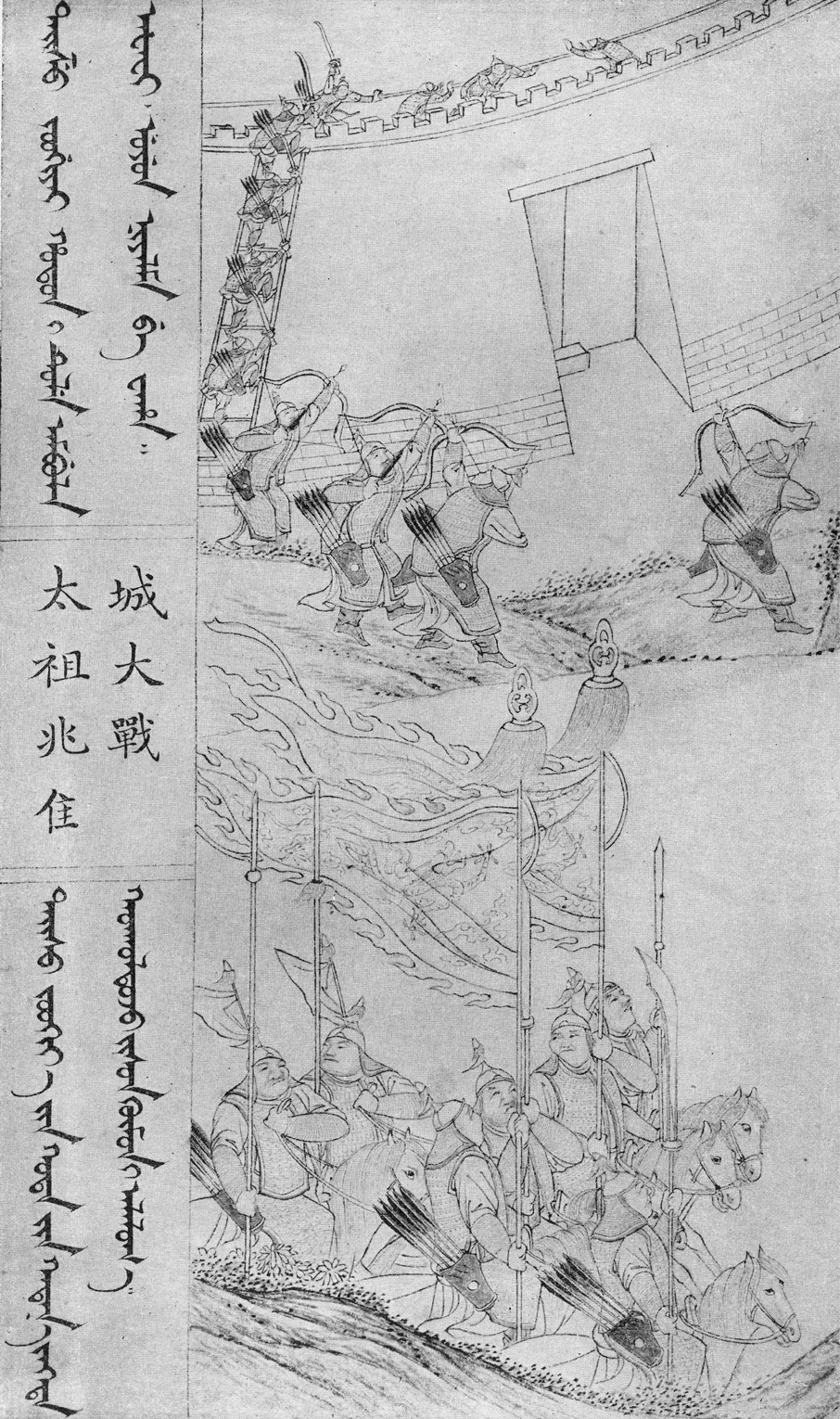
Nurhaci defeats forty men
Jurchen chieftain Nurhaci organized Mongol and Jurchen tribes in a united front against the Ming. In the image, Nurhaci is shown on horseback with a sword raised in his hand. He was described as single-handedly finishing off forty Chinese soldiers.
A Korean diplomatic envoy who visited Nurhaci’s base camp around this time noted the rude simplicity of the Jurchen weapons and defensive stockades, Nurhaci’s own bluff manner and tough physique, and the distinctive hairstyle, clothing, and massive silver earrings worn by some of his attendant generals. But if initially Nurhaci seemed uncouth to such a visitor, he soon showed his abilities. Between 1610 and 1620 Nurhaci steadily increased his power at the expense of neighboring Jurchen and Mongol tribes, either dominating them by warfare or allying with them through marriage. He instituted the Eight Banners system, which organized his troops and their families into eight different groups of “banners,” which were distinguished according to color (yellow, red, blue, and white, four plain and four bordered). The banners served as identification devices in battle, and membership was used as the basis for population registration in daily life. Nurhaci also assembled large numbers of craftsmen to manufacture weapons and armor, and appointed a group of scholars to develop a writing system for the Jurchen language, based on Mongolian script. In 1616 he took the important symbolic step of declaring himself the “khan” (ruler) of a second Jin dynasty, thus evoking the past glory of the Jurchen people, claiming the mantle of Mongol political legitimacy, and issuing a provocative challenge to the Ming state. Two years later Nurhaci openly declared the end of his allegiance to the Ming. In an announcement of his intentions, he enumerated a list of seven grievances against the Ming, including responsibility for the murders of his grandfather and father. He then launched a series of shattering military blows at mixed Chinese and Jurchen settlements east of the Liao River, in the region known as Liaodong.*
The Ming rulers had regarded Liaodong as part of their domain and maintained garrisons and outposts there. Nurhaci used a mixture of threats and blandishments to induce the Ming commanders to surrender, sending them elaborate messages written out for him by Chinese advisers in his employ. To one officer he wrote, “Even if you fight, you certainly will not win. . . . If you do not fight, but surrender, I shall let you keep your former office and shall care benevolently for you. But if you fight, how can our arrows know who you are?”2 Nurhaci also tried to undermine Ming influence in Liaodong by posing as a reformist ruler who had come to bring a better life to the Chinese, and he urged those who lived west of the Liao River to join him in his new kingdom. “Do not think that the land and houses will not be yours, that they will belong to a master,” he wrote in another message that was distributed in the countryside. “All will equally be the Khan’s subjects and will live and work the fields on an equal basis.”3 On other occasions, Nurhaci claimed he would take over the benevolent functions of the ideal ruler that had so obviously been neglected by Wanli in his waning years, saying that he would never let “the rich accumulate their grain and have it rot away,” but would “nourish the begging poor.”
Nurhaci disciplined his troops and tried to stop all looting or harming of the civilian population, publicly punishing guilty soldiers. To those Chinese with education who surrendered, he offered a chance of serving in the growing Jurchen bureaucracy, and senior Chinese officials who came over to his side were offered marriage into his family, honorific titles, and high office. Shenyang and Liaoyang fell to his troops in 1621, and in 1625 he made Shenyang his capital. Soon all the territory east of the Liao River and some land west of the river were under his control.
Initially Nurhaci faced little overt opposition, despite the order that men who surrendered must follow Jurchen practice to shave the fronts of their foreheads and wear their hair in a long braid or “queue.” But in some areas the reception was mixed: some conquered Chinese settlers welcomed the Jurchen with flutes and drums; others poisoned the wells in attempts to kill Nurhaci’s troops. Nor is there any easy way to categorize the fates of those who were now in Nurhaci’s power. Some were rewarded as promised, others were moved from their city homes to work for the Jurchen on the land. Some were enslaved, others—most notably those with some knowledge of artillery—were registered in new military formations known as “Chinese martial” banner units. Although still in an embryonic state, these units were later to play a critical role in the Manchu victories.
As early as 1622, Nurhaci had expressed his intention of attacking China by sending an army down through the strategic pass of Shanhaiguan, where the Great Wall ends at the North China Sea. He might well have done so the following year had not a serious rebellion against his rule broken out among the Chinese in Liaodong. What prompted the uprising is not known, but there were many possible causes. With the arrival of large numbers of Jurchen troops, there was intense pressure on the available farmland. Shortages of grain and salt grew to crisis proportions, and famine was reported in some areas. Compulsory grain rationing was introduced, and Chinese under Jurchen control had to spend a portion of their time working designated parcels of land without compensation. In many areas of Liaodong, partly as a control measure and partly because there was a housing shortage, the Jurchen moved into Chinese homes to live and eat as co-occupants. The Chinese responded by setting fires, poisoning wells once again, killing Jurchen women and children, hiding their grain, or fleeing into the mountains. Some Chinese killed border guards and tried to escape to the south; those caught were killed in turn by the Jurchen. The Ming court did not take advantage of the uprising, however, and it was soon suppressed by Nurhaci’s troops. A second revolt of the Chinese took place in 1625 and was even more ruthlessly repressed.
The Ming generals had failed to respond to either of these uprisings, but late in 1625 these generals began a series of vigorous counterattacks and won their first serious victories over Nurhaci in 1626. Later that same year, Nurhaci died. In accordance with Jurchen custom—a custom derived from the Mongols of Central Asia—he had not left his dominions and the title of khan to one successor, but instead had ordered them divided among his most able sons and nephews.
Not surprisingly, there followed a protracted struggle for power. The victor was Nurhaci’s eighth son, Hong Taiji, who had been the general commanding the plain yellow and bordered yellow banners. This son was helped to power by Chinese advisers, and he responded by taking a more favorable view of the Chinese and their institutions than his father had. Six ministries, in imitation of those at the Ming court, were established, and Chinese were employed throughout this new bureaucracy. Nominally, the senior ministers were all Jurchen notables, but they were often absent on military or other business, leaving the practical running of affairs to their Chinese subordinates.
On the grounds that it was punitive to the Chinese, Hong Taiji abolished the registration system instituted by Nurhaci; he also held competitive examinations for the civil service in Liaodong, following the Ming model. He ordered reforms to standardize the Manchu written language and make it more serviceable in a new era of record keeping, census taking, and tax gathering. A literary institute established in 1629 and the expansion of literacy education for young males in the banner system indicated the growing importance of written Manchu in a multi-lingual environment.4 Hong Taiji continued his father’s strategy of forming alliances with Mongol tribes: twelve of his daughters married their chieftains. A swelling number of Chinese defectors from the Ming cause, many of them officers who brought their own troops along with them, sought service with the new khan, who responded generously—too generously, thought some of his advisers, who protested that Chinese “boors without character” were filling the court.
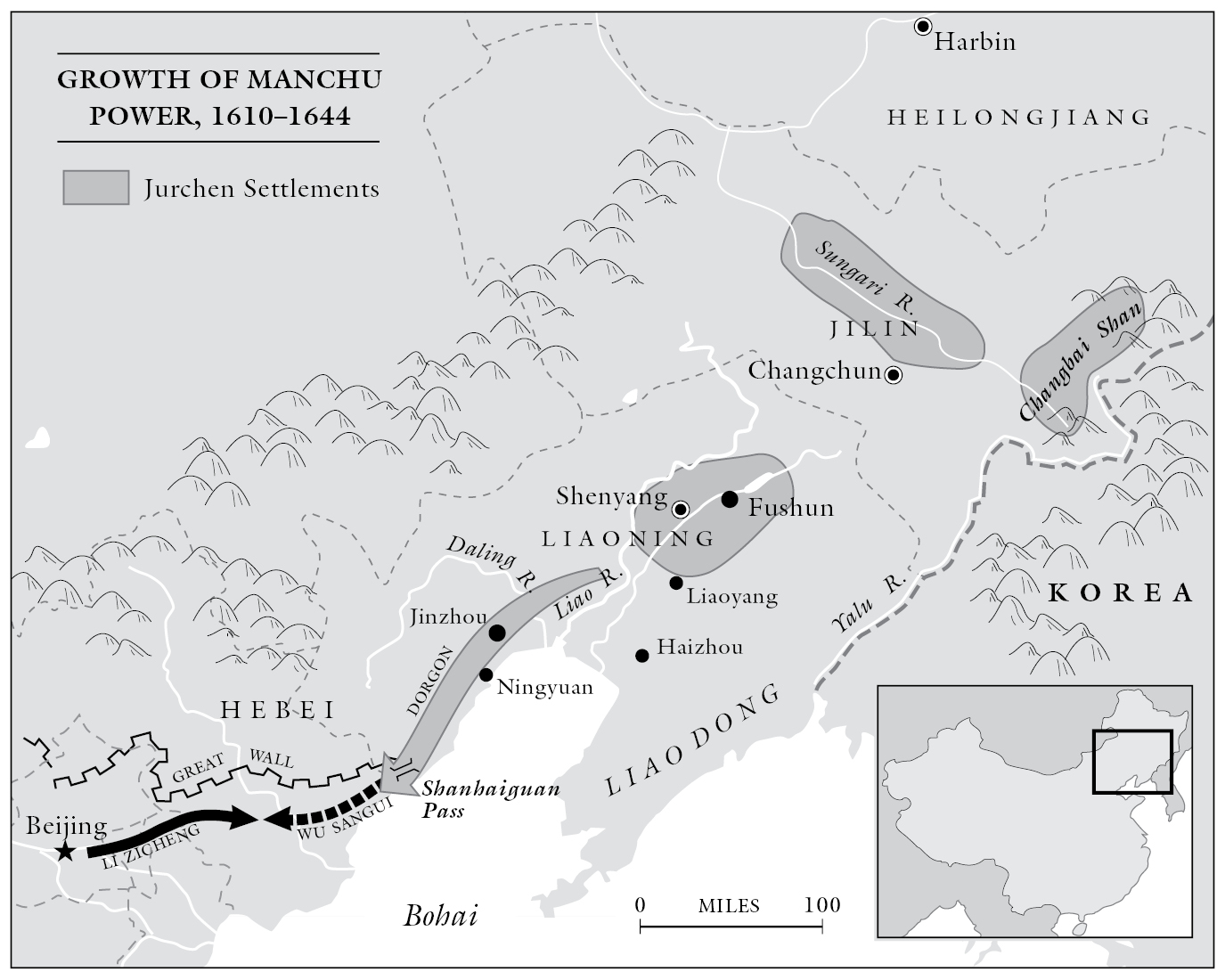
More information
The map plots the advancement of Li Zicheng toward Beijing and entering China through the Shanhaiguan Pass opened by Wu Sangui. The Jurchen Settlements are plotted in the Jilin, Liaoning, and Dorgon provinces. An inset map highlights the focus area plotted on the map.
Boors or not, the defection of the senior Chinese generals assigned to defend the area near the mouth of the Yalu River, and the northern areas of Shandong province, brought new power to Hong Taiji. In 1637 he established two full Chinese banners on the lines of Nurhaci’s earlier system, increasing the number to four in 1639 and to eight in 1642. There was already a parallel structure of eight Mongol banners, formed in 1635, from those who had pledged themselves to Hong Taiji’s service. Other Mongol companies were divided and absorbed into existing Manchu banners. So by the early 1640s, the Jurchen leader had constructed a multiethnic military and administrative structure, which was used to provide soldiers for active combat on a rotating system, to register and protect their wives and children, and to supervise work on the land.
Even before this, in 1636, Hong Taiji had taken a symbolic step that went beyond that taken by Nurhaci in establishing the Jin dynasty in 1616: Hong Taiji decided to abolish his fledgling state’s connection with the tribal past that was associated with the Jurchen name and the memories it evoked of servitude to the Ming dynasty. He declared the formation of a new dynasty called the Qing, claiming greater power and a wider mandate than the former Jin. Meaning “pure” or “clear” in Chinese, Qing (pronounced “Ching”) had a dramatically different connotation in the Manchu language, meaning “martial” or “warrior.” From 1636 until the final abdication of the Manchus in 1912, Qing was the dynastic name for the successive Manchu rulers and for the empire over which they ruled. Instead of Jurchen, Hong Taiji’s people were in the future to be known as Manchus, unless they were otherwise identified as being from Mongol or “Chinese martial” roots. “Manchu” seems to have been a self-selected marker of identity, chosen by the ruler himself.5
Hong Taiji now seemed poised for wider conquests. In the 1630s he had extended his influence into territory controlled by various Mongol aristocratic lineages (in present-day Inner Mongolia), through diplomatic and marital alliances. He had conquered Korea in 1638, forcing the king to renounce his loyalty to the Ming and to give his sons to the Manchus as hostages. Inside China, the Ming failures were evident everywhere, with the rebels Li Zicheng and Zhang Xianzhong in control of much of the western and northern parts of the country. Manchu raiding parties had crossed the Great Wall north of Beijing and looted the area near the capital, along with wide swathes of land in Shandong province. They seized women and children, draft animals, silk, and silver, and left burnt-out, devastated cities in their wake.
In 1642, the strategic Ming city of Jinzhou, south of the Daling River, finally fell after a sporadic ten-year siege in which the Manchus had been repulsed again and again by the Ming garrison troops. Two of the last few talented Ming generals surrendered after the battle and were suitably rewarded. But the mainland route to Beijing through the pass at Shanhaiguan was still guarded by the redoubtable Ming general Wu Sangui, and in 1643 Hong Taiji suddenly died, leaving his younger brother Dorgon as a regent for the compromise choice as heir, Hong Taiji’s ninth son, a five-year-old boy.
At this juncture the prospect for further Manchu expansion looked doubtful. Li Zicheng and his rebel army controlled Beijing, which they had seized in April 1644. But Li then led his forces out of the capital and advanced across the plains to attack General Wu Sangui, whom Li saw as the last major defender of the Ming cause. General Wu turned from the Shanhaiguan pass and marched westward to confront Li. Seizing the incredible opportunity, the regent Dorgon rallied and led the armies of the Manchu, Mongol, and Chinese banners swiftly down the coast, crossing the border into China unopposed in May. Nurhaci’s dream had become a reality.
Endnotes
- Dong is Chinese for “east.”Return to reference *
- Nicola Di Cosmo, “The Manchu Conquest in World-Historical Perspective: A Note on Trade and Silver,” Journal of Central Eurasian Studies 1 (2009): 43–60.Return to reference 1
- Franz Michael, The Origin of Manchu Rule in China (New York: Octagon Books, 1965), 121.Return to reference 2
- Gertraude Roth, “The Manchu-Chinese Relationship, 1618–1636,” in Jonathan Spence and John Wills, eds., From Ming to Ch’ing (New Haven: Yale University Press, 1979), 9.Return to reference 3
- Mårten Söderblom Saarela, The Early Modern Travels of Manchu: A Script and Its Study (Philadelphia, PA: University of Pennsylvania Press, 2020).Return to reference 4
- Mark C. Elliot, The Manchu Way: The Eight Banners and Ethnic Identity in Late Imperial China (Stanford: Stanford University Press, 2001), 71–72, 402 fn 116 and fn 118.Return to reference 5