
More information
A close-up portrait of Greta Thunberg. She is a teenager with hair pulled into a braid.
NOTABLE SPEAKER Greta Thunberg
Greta Thunberg is a Swedish activist who, from a very young age, was moved by the enormity of the global climate crisis to become a public voice for her generation. Thunberg has been diagnosed with autism spectrum disorder and finds many aspects of social interaction difficult, but she felt compelled to speak out in order to persuade adults about the dangers of climate change. In August of 2018, at the age of 15, she skipped school for three weeks to protest in front of Sweden’s Parliament House with a black-and-white sign reading “Skolstrejk för Klimatet” (School Strike for Climate). Her efforts grabbed the world’s attention. That same year she spoke at a TEDx event in Stockholm, Sweden. In her talk, Thunberg makes a passionate case for why all of us need to be more concerned about climate change by asking us to act and not to rely on hope for change. Since then, Thunberg has received numerous honors, including Time’s Person of the Year (the youngest person to receive that honor), a place on Forbes’s list of the World’s Most Powerful Women, and three consecutive nominations for the Nobel Peace Prize. In 2018, she founded Fridays for a Future, an international movement of students calling for action to combat climate change.
Search Terms
To locate a video of this presentation online, enter the following key words into a search engine: Greta Thunberg The Disarming Case to Act Right Now on Climate Change Stockholm November 2018. The video is approximately 11:12 in length.
What to Watch For
More information
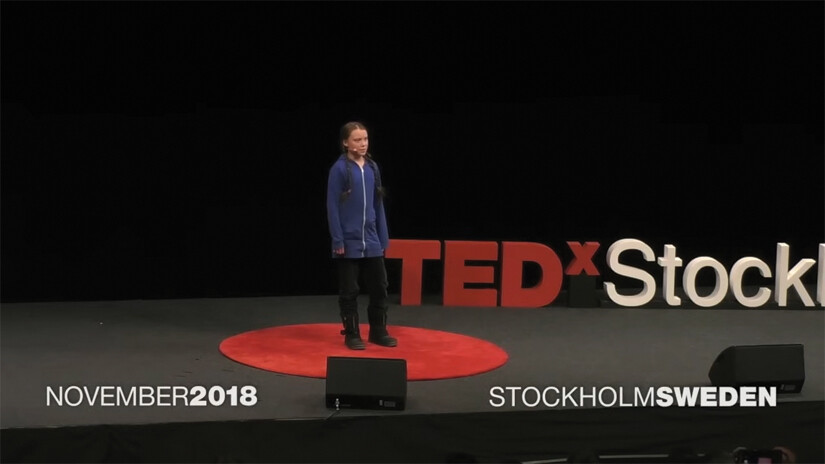
A screenshot of Greta Thunberg’s Ted X talk. She stands on a stage in an auditorium. She has her hair in two braids and wears a zip-up jacket, black pants, and an over-ear microphone. A display that says Ted X Stockholm sits on the stage behind her. Text at the bottom reads November 2018 and Stockholm Sweden.
[0:00–1:07] The occasion can be determined by considering the reason, time, setting, and medium for Thunberg’s TEDx presentation. The reason for her presentation was to tell her story about fighting climate change, and it’s likely that people gathered to hear her presentation because they are interested in fighting climate change as well. Speaking in an auditorium setting meant that Thunberg had to use a microphone to be heard, had to stand in a particular place on stage for the video recording, and had to follow specific guidelines of giving a TEDx talk, including abiding by a time limit.
More information
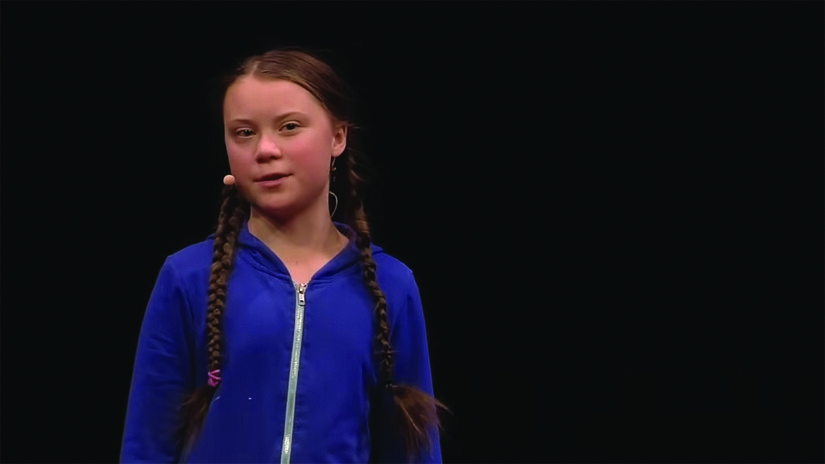
A screenshot of Greta Thunberg speaking on stage. She has her hair in two braids and wears a zip-up jacket and over-ear microphone. She looks at the viewer.
[1:25–2:06] Thunberg’s personal characteristics, attitudes, skills, and experiences affect who she is as a speaker and how her audience reacts to her. She explains that, as someone “with Asperger syndrome, OCD [obsessive-compulsive disorder], and selective mutism . . . I only speak when I think it’s necessary.” Drawing on these characteristics as a strength, she pointedly says, “Now is one of those moments.” But what makes a teenager knowledgeable and qualified to speak about the climate crisis? Thunberg demonstrates her credibility by citing sources throughout her presentation that provide the necessary research to support her claims.
More information
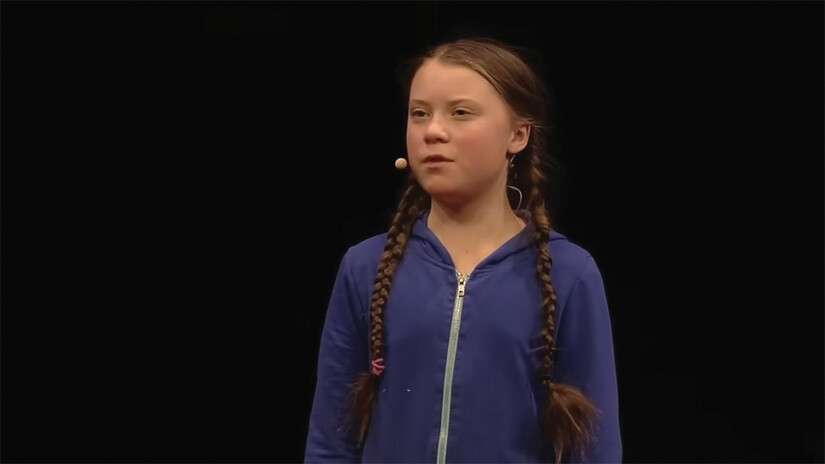
A screenshot of Greta Thunberg speaking on stage. She has her hair in two braids and wears a zip-up jacket and over-ear microphone. She looks to the viewer’s left.
[2:25–5:20] Thunberg’s purpose is to persuade her audience that action needs to be taken to address the climate crisis. Succinctly stated, Thunberg concludes, “Because if the emissions have to stop, then we must stop the emissions.” She clearly identifies the benefits of her purpose for both the audience and her: “There are no gray areas when it comes to survival. Either we go on as a civilization or we don’t. We have to change.” To support her purpose, the content of her presentation conveys a message focused on key ideas and relevant information about the climate crisis. She provides an abundance of relevant information, including the situation in her own country, the recommendations of the Intergovernmental Panel on Climate Change, trapped greenhouse gases, extinction of species, the Paris Agreement, and managing the climate crisis in poorer countries.
More information
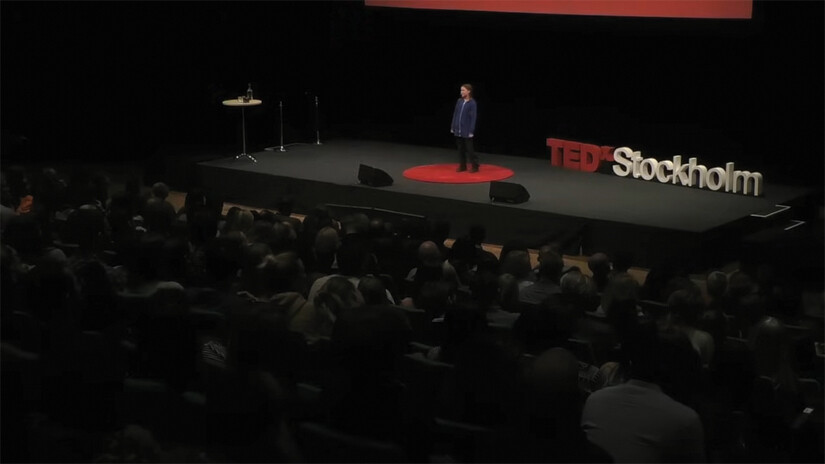
A screenshot of Greta Thunberg’s Ted X talk. She stands on a stage in an auditorium and a crowd is seated facing her. She has her hair in two braids and wears a zip-up jacket, black pants, and an over-ear microphone. A display that says Ted X Stockholm sits on the stage behind her.
[7:10–9:20] As in the case of most of her presentations to an audience of adults, Thunberg is keenly aware that they are the ones with the power to change the rules that govern how we respond to climate change. Focusing on their belief that climate change is important against the backdrop of their inaction about this belief, she argues that the climate crisis has already been solved “because we already have all the facts and solutions.” She asks her audience why she should bother studying at school, given that “the most important facts given by the finest science of that same school system clearly means nothing to our politicians and our society.”
More information
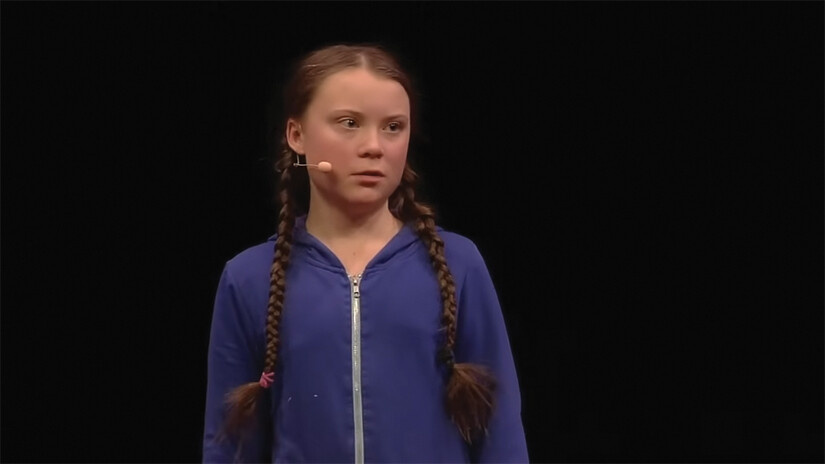
A screenshot of Greta Thunberg speaking on stage. She has her hair in two braids and wears a zip-up jacket and over-ear microphone. She looks to the viewer’s right.
[9:24–10:50] Thunberg’s delivery—how she uses her voice, face, and body to convey her message to her audience—is direct, clear, and principled. By noting at the outset that she has Asperger syndrome and selective mutism, Thunberg contextualizes her speaking style so that the audience knows what to expect from her. As she addresses how “thirty years of pep talking and selling positive ideas” has not worked, she rolls her eyes and gives a nod that indicates it is time to do something different. She pauses after saying “And yes, we do need hope” and before saying “Of course we do.” Lowering her volume and pausing here helps highlight the importance of the statement. Her hand gestures help emphasize the enormity of using “one hundred million barrels of oil every single day.” Thunberg’s delivery conveys that she knows why she is speaking—and she does so with poise rather than dramatics, with simple language rather than fancy words, and with absolute assurance that what she has to say must be said. This is especially clear in the precise final words of her conclusion: “Everything needs to change—and it has to start today.”
EXERCISE
After reviewing Thunberg’s speech, reflect on these questions:
- Using the definition of the rhetorical situation, describe whether Thunberg delivered an effective presentation.
- What expectations do you believe the audience had about Thunberg and what she would say based on the occasion?
- How did Thunberg demonstrate to her audience that she shares similar questions and concerns about climate change?
- How might it have altered her message if Thunberg had not mentioned her diagnoses of Asperger syndrome, OCD, and selective mutism? Do you believe it was appropriate for her to mention them?
- Describe whether Thunberg’s purpose was specific, achievable, and relevant.
- What presentation aids could Thunberg have used to help the audience visualize key points from her presentation?