THE GREEK MIRACLE AND THE PRESOCRATIC PHILOSOPHERS
Some 400 years before Plato’s time, settlers from the Peloponnesian peninsula of present-day Greece spread out and established scores of prosperous Greek-speaking colonies. Magnificent sailors and enterprising traders, these settlers populated the islands and coastlines from Ionia (present-day western Turkey) to Sicily and southern Italy on the west (Figure 1.2). These colonies, as well as the various city-states on the Greek mainland, developed in many different ways and established widely varying forms of government. Some were traditional kingdoms, ruled by royal families; others were oligarchies, governed by small groups of powerful leaders; and a few, notably the large city-state of Athens beginning about 500 BC, became democracies in which political decisions were made according to the collective votes of all qualified citizens.* These ancient Greeks were also highly confrontational, and their disputes often degenerated into outright wars—both among themselves and with outsiders.
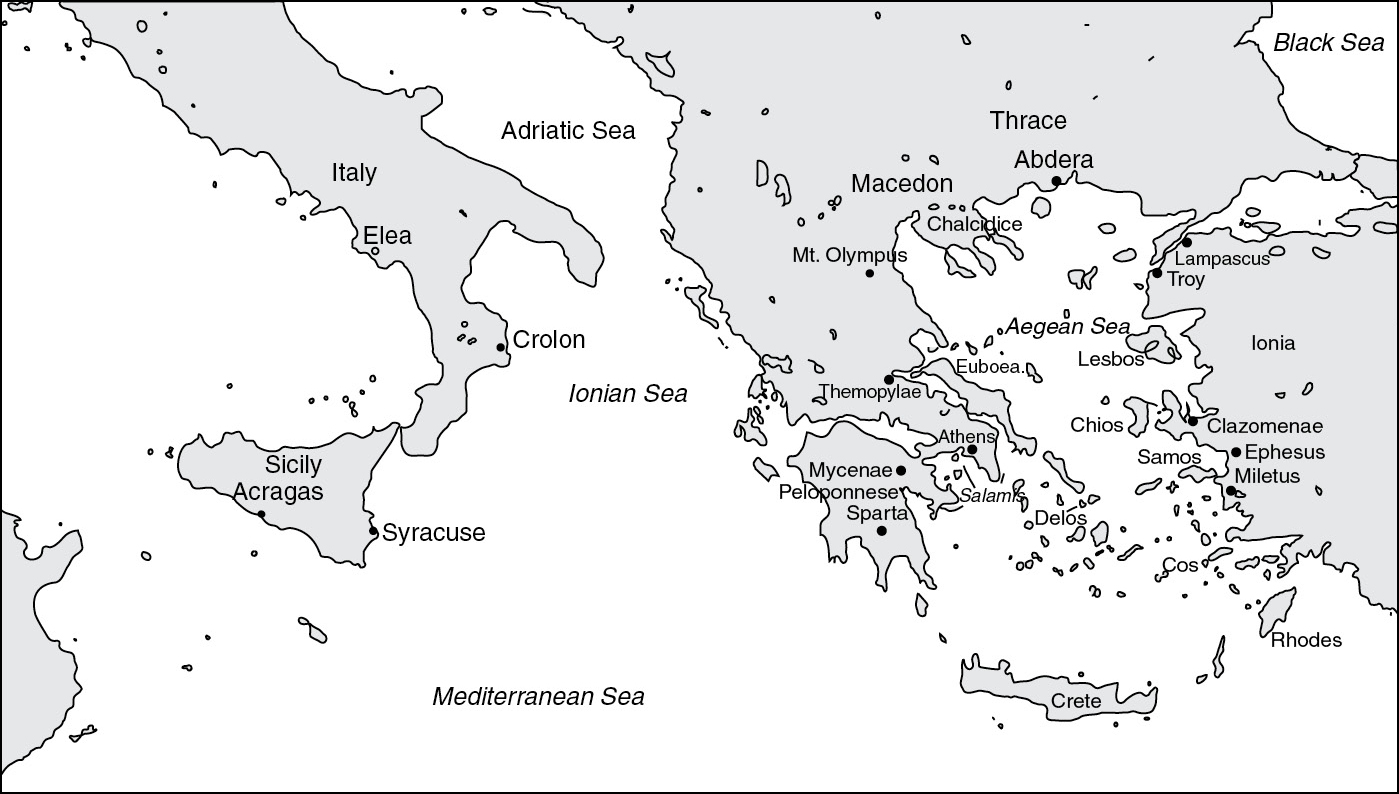
Figure 1.2 A map of the ancient Greek world.
The Greeks were united, however, in their pride for their common native language. They coined the derisive word barbaros to describe all non-Greek-speaking people. The syllables “bar-bar” were intended to mimic the ugly-seeming (to the Greeks) sounds of uncultured foreign languages, and provided the origin of our modern word barbarian. This linguistic pride was at least partially justified, in the sense that there was something about the Greek language, combined with the temperaments of its speakers, that facilitated verbal discussions, speculative arguments and theories, and the creation of abstract concepts for expressing their ideas. Sometimes these discussions focused on topics that in other cultures were considered taboo, any speculation about which would be considered sacrilegious. The early Greeks coined two important words. Roughly translated as “word” or “reason,” logos has become in English the suffix indicating a study of, as in such terms as geology, physiology, and psychology. Philosophia, meaning literally “love of wisdom,” was their general term for discussions about the true and ultimate foundations of the world as we know it.
The first recognized philosophers hailed from the Ionian islands and Greek-speaking settlements located in what is now western Turkey. Their earliest preoccupations were observing the natural world and attempting to understand it in terms of underlying fundamental principles: essentially the same goal as that of modern physical scientists.* A man named Thales (ca. 624–546 B.C.) from the city of Miletus became famous for his accurate astronomical and meteorological observations, and promoted the idea that water was the most important element in the physical makeup of the cosmos. Little else is known about Thales except for an anecdote reporting that once while walking down the street and looking up to contemplate the sky, he stumbled and fell into a well. Here was the first recorded image of an absent-minded philosopher.
A series of later presocratic philosophers continued and modified Thales’s attempts at physical theorizing, usually by emphasizing one of the other classical elements (air, fire, and earth) or some combination of the four, as the ultimate building blocks of the universe. Often these physical theories intersected with speculations about an emerging concept the Greeks called psyche.
The original meaning of the Greek word psyche was simply “breath.” However, because it was something present in a living person but absent from a dead one, it gradually took on broader metaphorical meaning and came to signify a general life-principle. All living things were said to possess a psyche and dead things to lack one. The Latin translation for psyche was anima, a term that retains its original meaning in English when used as the root for animal and animated to describe living things, and inanimate for dead ones. When translated directly from Greek into English, however, psyche is traditionally rendered as “soul.” In modern English, the word has taken on a narrower meaning as a near synonym for mind and as the root word for psychology and psychiatry.
For the most part we will use the original word psyche in the context of the ancient Greeks, but we must keep in mind that the term had broader connotations for them than it does today. The ancient philosophers became increasingly preoccupied with providing descriptions and analyses of this important concept. Early speculation centered on its physical makeup, with some seeing air as its principal component because of its association with breath, and others opting for fire because of the fact that living bodies are warm while dead ones are cold. Increasingly, however, philosophers began analyzing the psyche in terms of its functionality in controlling different aspects of life. These inquiries reached a high point in the thinking of Plato and, especially, Aristotle, and involved the consideration of some other intriguing issues raised by presocratic philosophers.
Pythagorean Mathematics and Philosophical Paradoxes
Pythagoras (ca. 570–495 B.C.) was born in Ionia but settled in Croton in southern Italy. Like Socrates he left no writings of his own, and has been described as “more myth than man.”4 One certain fact is that he attracted an important school of followers who discovered and emphasized the wondrous regularities of mathematics, and their relationship to the physical world. They discovered, for example, that harmonious musical chords occur only when the lengths of plucked strings (of equal tension) differ by precise numerical ratios. If one string is exactly twice the length of the other, the result is the musical octave; a ratio of 3 to 2 gives a pleasing chord known to musicians as a fifth. The famous Pythagorean theorem expressed the discovery that for any right triangle (a triangle with a 90-degree angle), the square of the long side (hypotenuse) is precisely equal to the sum of the squares of the two shorter sides. The Pythagoreans—who persisted as a school and were visited by both Socrates and Plato—attached a genuine religious significance to these wonderful correspondences between abstract mathematics and concrete experiences in the physical world.
Some other presocratics raised thought-provoking issues and paradoxes that still give pause today. A generation after Pythagoras, Heraclitus (ca. 535–470 B.C.) highlighted the sometimes ambiguous relationship between stability and change when he asserted, “You can never step into the same river twice.” He also promoted the idea of the unity of opposites, exemplified by the fact that a road going upward is also going downward, depending on one’s relative position and direction.
A generation later Zeno (ca. 490–430 B.C.) pondered the concept of infinity, as, for example, in the idea that any linear distance contains an infinite number of intermediate points between its beginning and end. He challenged his fellow philosophers to resolve the Achilles and the tortoise paradox—an imagined race between a speedy Achilles and a slow tortoise, in which the tortoise starts at some distance in front of Achilles. At one point after the race begins, Achilles will reach the tortoise’s starting position, but the tortoise will still be some shorter distance ahead; when Achilles reaches that second distance, the tortoise will still be a bit ahead but by a smaller margin—and so on. Given that there are an infinite number of intermediate points, he can never overtake or pass the plodding creature. In the real world, of course, this conclusion is ridiculous, and represents the kind of abstract, pie-in-the-sky daydreaming that practical folks like to accuse philosophers of undertaking. We shall see in later chapters, however, that meditations on the concept of infinity have played a huge role in the development of modern mathematics, science, and, indirectly, psychology.
Shortly before Socrates began his teaching, Protagoras (ca. 490–420 B.C.) adopted a practical point of view and argued that it was fruitless to speculate about big questions such as the ultimate nature and makeup of the universe, or hypothetical paradoxes like Zeno’s. Instead, he favored a focus on purely human experience and behavior and declared: “Man is the measure of all things.” This idea lay behind the approach taken by sophists such as Gorgias. Instead of worrying about ultimate, theoretical questions, the sophists sought to understand people, and especially how they can be manipulated and persuaded to act according to the purposes of those in the know. As noted, it was precisely this expediency and relativism that attracted the opposition of Socrates.
Before we turn to Socrates himself, we must mention one more pioneer who is often labelled presocratic, although in all likelihood he was slightly younger than Socrates. Like Protagoras and the sophists, Hippocrates (ca. 460–370 B.C.) dealt with everyday human concerns, but whereas the former were the lawyers and politicians of their day, Hippocrates was a great physician. As with the life of Pythagoras, personal details about Hippocrates are extremely scarce, except that he hailed from the Ionian island of Cos and lived into old age. But also like Pythagoras, he attracted a dedicated school of students and followers—the Hippocratics—who collectively produced an extensive body of medical writings now known as the Hippocratic Corpus. These works are notable because they regarded diseases as natural phenomena, rather than the results of some sort of demonic or supernatural interference with the course of normal health.
Using the limited but best available observational techniques of their time, the Hippocratics proposed a humoral theory to explain health and illness as the result of the balance or imbalance among four prominent liquid substances, which they called humors, found in the human body: blood, yellow bile, black bile, and phlegm. According to this theory, people are healthy when the four humors exist within reasonable balance within themselves; sharp deficiencies or excesses of one or more produce various disease states, and moderate imbalances lead to differences in temperament or character. Modern languages continue to echo aspects of the humoral theory in certain words describing diseases or temperaments. The Greek word for ordinary (yellow) bile was chole, which still appears in the disease name cholera, or the adjective choleric, meaning restless or easily angered. Prefixing the Greek melan for black to chole yields melancholy or melancholic. The English word sanguine (from the Latin for blood) means optimistic or cheerful, and phlegmatic means calm or lethargic.
Like the ancient Greek physicists’ elements, the humors of the Hippocratics have not withstood the tests of modern science, but the group’s more general emphasis on naturalistic causes has fared much better. One famous treatise entitled On the Sacred Disease dealt with severe convulsive epilepsy; many contemporaries referred to the disorder as “sacred” because of its supposed origin in divine or demonic possession, resulting from an abnormal flow of phlegm into the brain. Although wrong in detail, this treatise correctly attributed epilepsy to physical causes in the brain.
In their general treatment of diseases, the Hippocratics stressed the value of balance and moderation. Sometimes they tried to remove presumed humoral excesses by purges and bleedings, but they equally emphasized the great importance of exercise, diet, and proper sanitation. They also favored cautious experimentation to discover the therapeutic benefits of numerous herbal and other pharmacological substances.
The Hippocratics established a basic platform for responsible, observationally based medical practice that is still honored today. Newly licensed physicians must take the Hippocratic Oath, agreeing to uphold specific ethical standards in their own professional medical careers.