THE LIFE AND THOUGHT OF SOCRATES
Only a few facts have been firmly established about the life of Socrates. He was born in Athens in 470 B.C.; his father was a respected stonecutter and sculptor and his mother a midwife. As a young man he adopted his father’s profession, and also fought bravely as a soldier in three military campaigns. In middle age he married a much younger woman, Xanthippe, who bore him three sons. According to unsubstantiated reports she was not pleased when Socrates abandoned the security and moderate income of his stone-cutting profession to become an itinerant teacher. Xanthippe became, perhaps unfairly, the symbolic stereotype for a nagging housewife.
Socrates differed from the sophists by charging little or nothing for his services, and dressed in worn and shabby clothing. Apart from Plato, the most famous of his known students was Xenophon (ca. 430–354 B.C.), who went on to become one of the first great historians. At the age of 70 Socrates was arrested by a new and unsympathetic Athenian government and tried on a series of dubious charges, including corrupting youth and treason against Athens. Socrates’s defense of himself at the trial was ineffective— perhaps deliberately so—and he was sentenced to death by drinking the poison, hemlock. He apparently rejected an escape plan plotted by his admirers, and voluntarily drank the poison following a final philosophical discussion with them.
Three of Socrates’s younger contemporaries left descriptions of him. The playwright Aristophanes depicted him in his satirical comedy The Clouds as a figure who literally descends from the clouds and proceeds to sound like a sophist by boasting he can teach anybody about anything. More like a Saturday Night Live lampoon than an objective portrayal, this image was strongly contradicted by two other chroniclers, who had actually been students of Socrates. Xenophon portrayed him as a completely admirable and courageous figure, outspoken in expressing his viewpoint. Only in his reconstruction of Socrates’s behavior at his final trial is there any hint of the arrogant braggadocio presented by Aristophanes. Asked at the trial what punishment he thought he should receive, Socrates in Xenophon’s account responds sarcastically that as a benefactor to Athens, he should receive a pension and free dinners for the rest of his life. Xenophon portrays Socrates as reacting defiantly to a jury that he knew was stacked and unjust. Plato’s account of the trial describes a more dignified and resigned Socrates, who even acknowledged that if one adopted the point of view of his persecutors, then he really was a danger to the kind of Athens they desired, and in that sense his sentence was just.
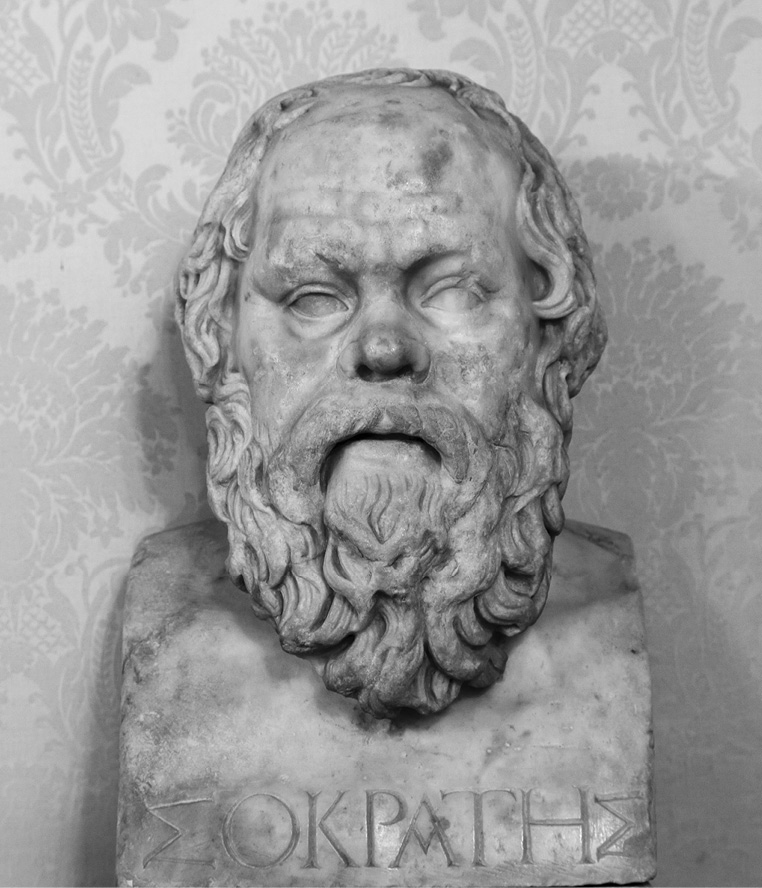
Figure 1.3 A bust of Socrates.
Figure 1.3 A bust of Socrates.
Neither Plato nor Xenophon was present at the trial, so their reports are based on hearsay conditioned by their personal impressions of the man. All three informants agree, however, that Socrates was a visible and controversial character. He was odd (some said ugly) in appearance, with a propensity to stir people up. Most representations of him, such as the sculpture in Figure 1.3, feature an unsmiling and very serious face. Plato famously characterized Socrates as a social “gadfly” who would sting his dialogue partners intellectually, just as a horsefly can agitate a peacefully grazing horse.
Yet in many ways Socrates was very modest. When told that he was regarded as the wisest man in Greece, he responded that his only real wisdom lay in knowing how much he did not know. He likened his role as a teacher to that of his mother as a midwife, only instead of helping women bring forth the babies within themselves, he helped his pupils bring out the knowledge and wisdom that already resided within their psyches.
Plato depicted this process in the dialogue Meno, where Socrates relates a myth that the human psyche or soul is immortal and becomes repeatedly reincarnated in new bodies following the deaths of older ones. In the process of rebirth, each psyche’s accumulated knowledge is forgotten but under certain conditions can be partially rearoused or “recalled.” Socrates then demonstrates something like this process by showing an uneducated slave boy a square and asking him how to construct a new one whose area will be precisely double that of the first. The boy does not know, but without giving away the answer directly, Socrates leads him through a question-and-answer process, after which the boy concludes—correctly—that the new square must have sides that are precisely equal to the diagonal of the original square. Since the boy had not been specifically told about this relationship but had discovered it himself, Socrates suggests that at least in the metaphorical sense he had “remembered” it.
Taken literally, Socrates’s myth of reincarnation and recollection represents an extreme version of philosophical nativism, in the notion that fully formed but forgotten knowledge lies within a psyche, and just needs help from empirical experience to bring it out. It is questionable whether Socrates himself accepted this literal interpretation, and it certainly has not been accepted by later mental philosophers. But in a more moderate form Socratic nativism has had greater staying power—namely, in the assertion that the human mind contains innately within itself features and predispositions that enable it to interpret and comprehend empirical experiences in ways that go far beyond their raw sensory input. The ability to create abstract ideas, or to comprehend mathematical regularities as the Pythagoreans did, or to formulate other “laws of nature” lies somehow innately within the human mind. According to this view, the path to wisdom was not simply to accumulate opinions and experiences through the external senses, but rather to “Know thyself” and interpret those experiences in light of one’s own innate rational faculties. This was the greatest legacy Socrates left to Plato.