PLATO’S LIFE AND PHILOSOPHY
Plato’s aristocratic family dated back two centuries to the great Athenian lawmaker Solon, whose legal reforms from two centuries earlier established many of the foundations for eventual Athenian democracy. One interesting legend holds that Plato’s birth name was Aristocles, but that as he grew up to be a broad-shouldered, athletic youth who might even have wrestled in the original Olympic games, he was given the nickname Platon (Greek for “broad”). It is nice to speculate that he might have been one of the earliest outstanding student-athletes. But little is known for certain about his early life, and we can only guess at his specific reasons for taking up with Socrates, or at what his parents must have thought when he allied himself with the notorious social gadfly.
Plato was about 25 when Socrates was tried and executed. Horrified by the event, he fled from Athens for several years, during which he spent some important time in Italy with the Pythagoreans. In his 30s, Plato inherited property in Athens and ended his voluntary exile. First on his own property and then on the nearby site of a grove of sacred olive trees he established the Academy, which (as noted earlier) became a forum for scholars of varying ages and interests to congregate and pursue their diverse intellectual goals. These topics included mathematics and astronomy, as well as more general philosophical problems. As the leader of his school for more than 40 years, Plato himself explored the Socratic question of what is innate in the human psyche, and added the question of what is the relationship between those innate features and the sensory experiences imposed on the psyche from the external world.
Among Plato’s most influential answers to those questions was a proposed distinction between appearances and ideal forms. His notion of an appearance (the Greek word was phenomenon) referred to a person’s actual conscious experience of something, as when we see a particular tree, or horse, or dog. Lying behind each transient individual appearance, Plato believed, were something much more permanent: general and ideal forms representing the essences of all trees, all horses, or all dogs. This general view—that there exists something more fundamental and ultimate, or “ideal,” lying behind everyday sensory experience—is referred to as idealism.
An interesting example is provided by the Pythagorean theorem. In Figure 1.4 we see four right triangles, which look quite different from each other. Our conscious perceptions of each of these are appearances. Although they all look different, our intellect tells us first that they share in common the obvious perceptual feature of having three sides and one right (90-degree) angle.
For the mathematically educated they also share the abstract and more “mystical” commonality that the squares of their long sides are precisely equal to the summed squares of their shorter ones. Plato took this sort of evidence as proof that there exists in some higher realm an ideal right triangle, which is never directly or completely perceived by the human senses, but which has an unquestioned reality that is more permanent, perfect, and “real” than any fleeting sensory experience. For Plato this higher realm of ideal forms was more fundamental and important than the empirical world of transiently experienced appearances.
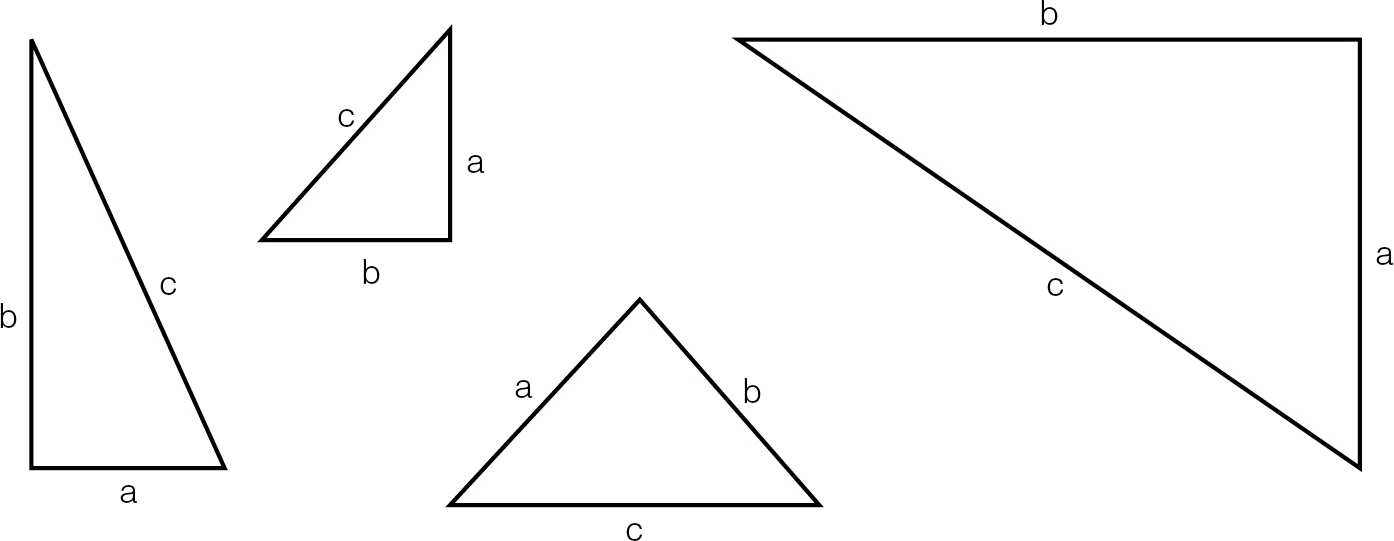
Figure 1.4 Differing “appearances” of a right triangle.
Plato illustrated the appearance-form distinction differently in one of his most famous works, The Republic, with his allegory of the cave. He asks the reader to imagine a group of prisoners confined in a cave, facing its back wall (on the right hand side of Figure 1.5). Men walk along a walled roadway just outside the cave carrying puppets on sticks, and bright sunlight from the left casts shadows of the puppets on the cave’s back wall. Thus the prisoners become aware of the events behind them only indirectly and incompletely as shadows on the wall they face, and not in their full reality. Metaphorically, the shadows are like Plato’s appearances and the real events like his ideal forms.
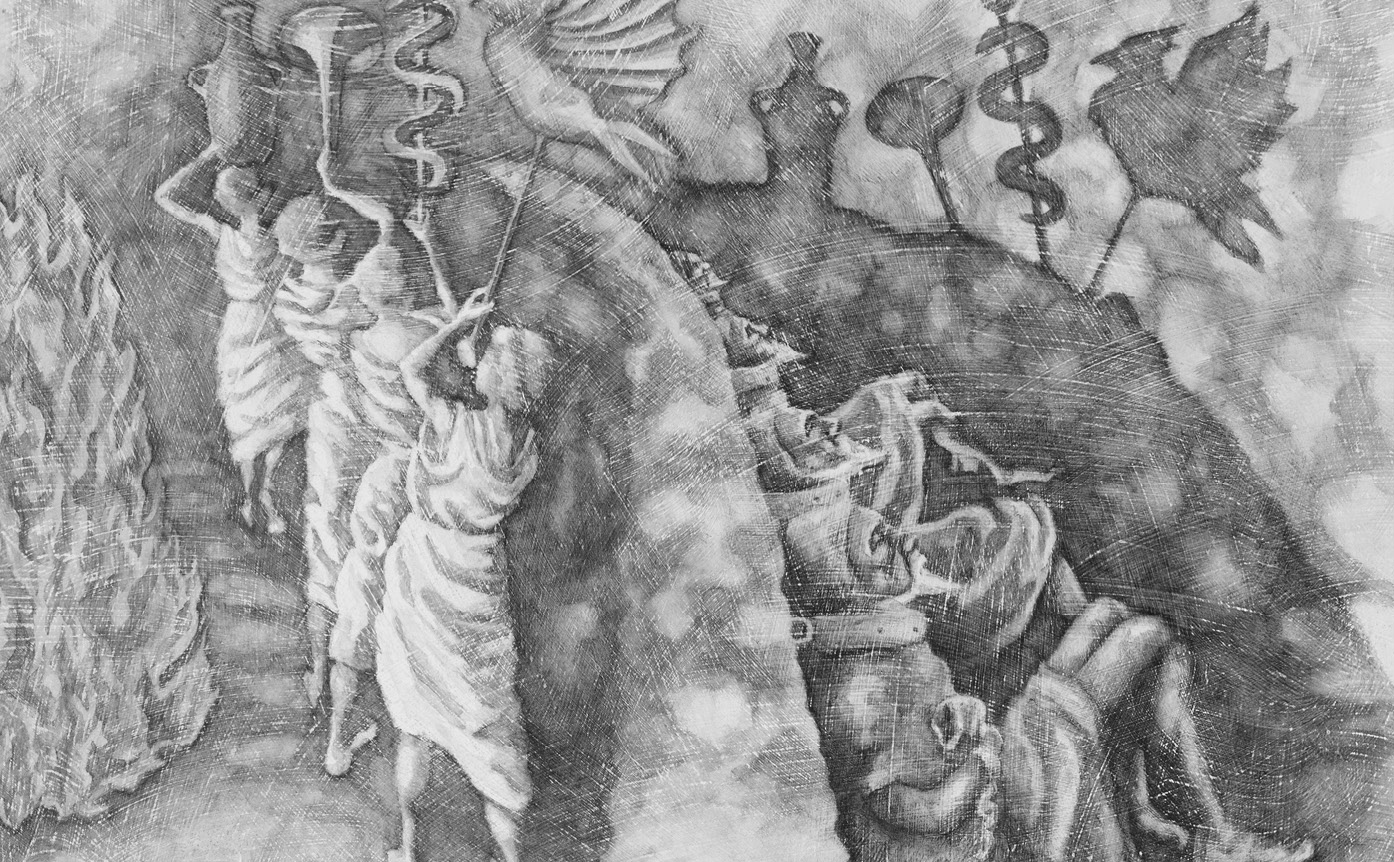
Figure 1.5 The prisoners in Plato’s allegory of the cave.
As Plato’s dialogue continues, one of the prisoners is forcibly turned around and taken out of the cave, where at first he is dazzled and pained by the brightness. Gradually, however, he habituates and comes to understand the relationship between the shadows and the real events that cause them. But when he returns to the cave and tries to tell the others what he has learned, he is regarded with hostility and disbelief. For Plato the enlightened prisoner is like the genuine philosopher, whose search for true knowledge is often painful and disturbing, and whose insights are likely to be dismissed or suppressed by the ordinary population.
Plato’s prisoners in a cave image illustrates a fundamental issue that, 2,000 years later, would loom large in the establishment of modern scientific psychology: the relationship between conscious experiences of the external world and the objective nature of the physical stimuli that give rise to those experiences. Our conscious experiences—Plato’s appearances, or phenomena—consist of sensations such as sounds, colors, or shapes, which come to be interpreted as perceptions of meaningful objects. But the actual physical stimuli that give rise to such conscious experiences are now understood to be differing forms of energies, such as light or sound waves of differing frequencies and wavelengths. As we shall see in later chapters, analyzing exactly how the human mind converts the raw energies of the physical world into conscious sensations and perceptions was central to the establishment of modern psychology in the 1800s.
Plato’s thought extended into a wide variety of subjects, enough so that one influential modern philosopher called the entire Western philosophical tradition “a series of footnotes to Plato.”5 That may be an exaggeration, but his scope was certainly broad and encompassed other topics that remain highly relevant to modern psychology. He argued, for example, that the human psyche, or soul, has three separate basic components that govern the appetites (needs for physical gratification); courage (the propensity to confront difficulties with action); and reason (the ability to appreciate the underlying realities of the world). In another famous metaphor, he symbolically represented these three as a driver trying to control a chariot pulled by two winged horses. One horse represents the appetites and tries to pull in the direction of the fastest and most immediate physical gratification; the other represents duty and the motivation to respond bravely to threats to the self or society; and the charioteer represents the rational component that must try to direct and coordinate the horses so they cooperate and proceed in the same direction.
Plato further believed that each person’s psyche innately possesses these three components in different proportions, giving rise to three general types, or classes, within a society. Those dominated by their appetites constituted the ordinary masses (hoi polloi, in Greek) of a civil society; those dominated by courage became the soldiers who protected the society; and the small minority dominated by reason—at least in an ideal society—should be the elite guardians who govern the society.
Plato saw the relative proportions of these three functions as largely innate and fixed within every individual, so in terms of our modern nature-nurture or heredity-environment debate, he favored nature and heredity. Consistent with this, and even though Plato was the product of a democratic society, he did not believe democracy to be the best form of government. The masses, he believed, were like those prisoners in the cave who had been unable or unwilling to accept the acquired wisdom of the one who had been enlightened. Decisions left to them were likely to be impulsive and dangerous. On the other hand he did not favor a monarchy or rule by a single tyrannical power, which posed obvious dangers to general well-being. His ideal solution would be an oligarchy, a society ruled by the select few of elite guardians whose innate powers of reason have been honed by rigorous training in institutions such as his Academy.
Plato’s Academy did turn out many significant graduates, the greatest of whom was Aristotle. We turn now to this other eminent Greek, whose more empirically oriented philosophy would become a second pillar on which much of future Western thought would rest.