FRANZ JOSEF GALL: BRAIN ANATOMIST AND PHRENOLOGIST
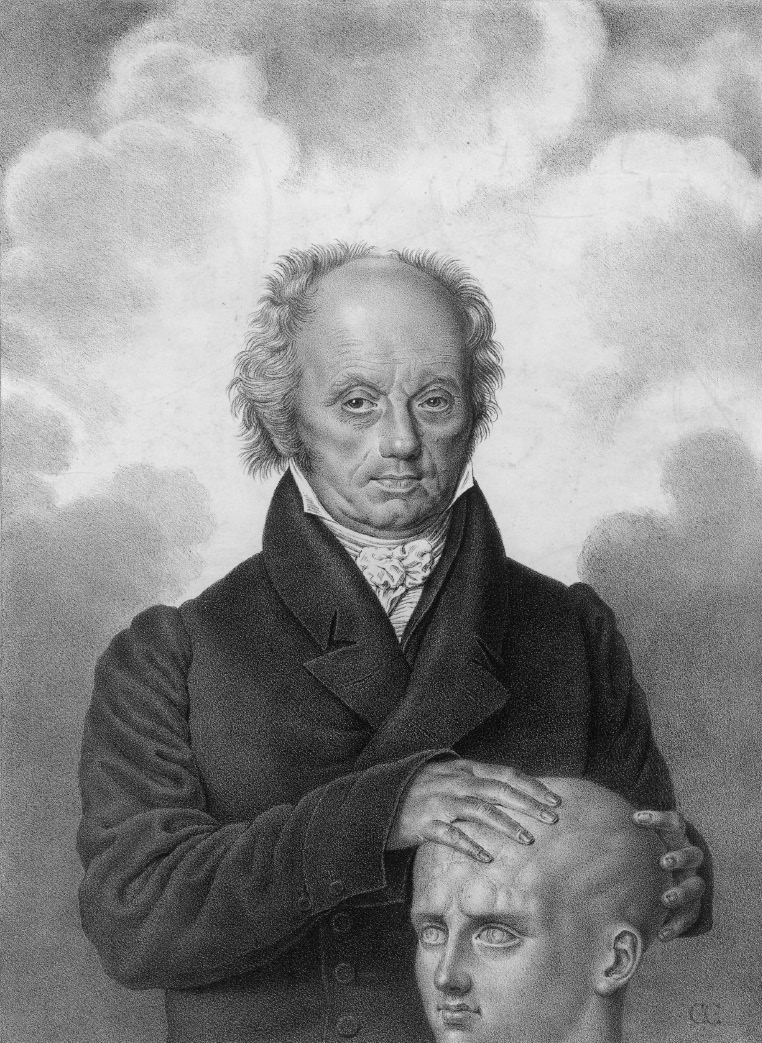
Figure 3.1 Franz Josef Gall (1758–1828).
Figure 3.1 Franz Josef Gall (1758–1828).
Among the first scientist to regard the entire brain as a complex organ responsible for higher mental functions was the controversial German physician Franz Josef Gall (1758–1828; Figure 3.1). Early in his career Gall established a reputation as a brilliant anatomist of the brain, building on earlier work by Locke’s old Oxford teacher, the physician Thomas Willis (1621–1675). In 1664 Willis published the first accurate and detailed description of the brain’s complex physical shape, illustrated with plates by the celebrated architect Christopher Wren. In speculating about how the brain functions, Willis emphasized the substance of the brain’s various structures rather than its spaces and the fluids that filled them. He observed that brain tissue was not undifferentiated, as Aristotle had thought; it consisted of two kinds of substances: a pulpy gray matter occupying the outer surface of the brain, the inner part of the spinal cord, and several discrete centers within the brain; and a fibrous white matter in the other regions. Willis speculated that the white matter consisted of narrow canals whose function was to distribute “spirits” generated in the gray matter. Willis also accurately described the blood vessels of the brain, firmly establishing that the living brain was far from a bloodless organ.
Other physicians after Willis discovered that localized interruptions to the brain’s blood supply could cause apoplexy, today known as strokes. These sudden and often devastating attacks left some patients without the power of speech, others partly paralyzed, or with other sensory disabilities. By the early 1700s, physicians further recognized that injuries to one side of the brain often produced paralysis or loss of feeling somewhere on the opposite side of the body.
Gall built upon these findings while becoming, in many minds, the greatest brain anatomist since Willis. Using new, delicate dissection techniques, he confirmed and developed many of Willis’s basic findings regarding gray and white matter. He showed that the two halves of the brain are interconnected by stalks of white matter (nerve tissue) called commissures, and that other, smaller tracts of white fibers cross over from each side of the brain to connect with the opposite sides of the spinal cord. This last finding helped explain how damage to one side of the brain could result in paralysis, or other types of dysfunction, to the opposite side of the body.
Gall’s anatomical findings laid the groundwork for the later discovery that the brain and spinal cord are composed of billions of nerve cells called neurons, each with an electrochemically active cell body, or nucleus. Neurons are interconnected by branchlike dendrites, which receive signals from other neurons; long, fibrous axons transmit signals to other neurons. The axons tend to cluster together to form the brain’s white matter, while the cell bodies and dendrites constitute the gray matter.
Gall was also the first great comparative brain anatomist, as he carefully examined the similarities and differences among the brains of various animal species, as well as differing human types (children, elderly people, and brain-damaged patients, as well as normal, healthy adults). In a general but convincing way, these studies showed that higher mental functions correlated with the size and health of the brain in question, particularly its outer surface or cortex. We shall later see that the correlation is imperfect and can give rise to some misleading assumptions about intellectual differences within an adult human population. But Gall documented an undeniable tendency for animals with larger brains to manifest more complex, flexible, and intelligent behavior. More than any other single argument, this demonstration convinced scientists once and for all that the brain was in fact the center of higher mental activity.
These contributions should have earned Gall a secure and respected place in the history of science. Unfortunately for his reputation, however, he embedded these credible ideas within another doctrine his followers labeled phrenology, literally meaning science of the mind (from the Greek phrenos, “mind”). Not content to stop at the assertion that the higher functions resided generally within the brain, Gall believed discrete psychological “faculties” were localized within specific parts of the brain. Moreover, he believed the bumps and indentations on the surface of an individual skull reflected the size of the underlying brain parts, and therefore of the different faculties.
A curious mixture combining a few astute observations with some fanciful logic, phrenology never won the respect of the most orthodox scientists. And when Gall failed to win over the professionals, he appealed increasingly to the general public. Phrenology became very popular, earning Gall and a host of followers a good living; but its popularity only increased the disdain with which it was regarded by many scientists. One prominent figure labeled phrenology a “sinkhole of human folly and prating coxcombry.”1
Gall’s controversial theory had an appropriately idiosyncratic origin in his childhood experience. As a schoolboy he was irritated by some fellow students who, while less intelligent than himself (or so he judged them), nevertheless got higher grades because they were better memorizers. As he thought about these exasperating rivals, he realized they all had one prominent physical characteristic in common: large and bulging eyes.
At that time, people commonly associated particular facial characteristics with specific psychological qualities. The art of physiognomy, the reading of a person’s character in his or her physical features, had been effectively promoted during the 1770s by the Swiss mystic and theologian Johann Kaspar Lavater (1741–1801), and it remained a popular pastime throughout the 1800s.* But Gall’s physiognomic observation took on a new and different significance when he recalled it as an adult, in the context of his emerging view of the brain.
Already convinced that the higher intellectual and psychological faculties were associated with large brains in a general way, Gall next speculated that perhaps specific parts of the brain were the seats of specific functions or faculties. If a certain part happened to be unusually large and well developed, then the specific function it housed should be unusually strong. For example, people with especially good “verbal memories,” like his schoolboy rivals, might have particularly well-developed “organs of verbal memory” somewhere in their brains. And Gall believed he knew exactly where this was: in the region of the frontal lobes directly behind the eyes, where the pressure of the enlarged brain caused the eyes to protrude.
After tentatively localizing verbal memory in one part of the brain, Gall naturally began to look for other faculties in other locations. Of course, in an era before brain scans and other modern techniques, he had no direct way of observing a living person’s brain and therefore had to make an important but questionable assumption. Just as the brain part responsible for verbal memory causes the eyes to protrude, he argued, so will the shape of the rest of the brain cause corresponding irregularities in the skull that surrounds it. Through craniometry, the measurement of the physical dimensions of the skull, Gall hoped to draw conclusions about the shape of the brain beneath. He thus sought a correspondence between particular bumps and depressions on the skull and the psychological characteristics of the people who had them.
Once embarked on this search, Gall quickly developed other hypotheses. One of his patients, a woman whose strong erotic inclinations earned her the title of “Gall’s Passionate Widow,” once conveniently collapsed into his arms in such a way that his hand supported the back of her neck. Gall could not help but notice that her neck and the base of her skull were unusually thick, leading him to suspect that her cerebellum, the structure at the base of her brain, was unusually well developed. Observations of other people with strong sexual drives convinced Gall that they, too, had well-developed necks and skull bases, and that led him to localize the personality characteristic of “amativeness” in the cerebellum.
Gall’s continuing explorations led him to befriend a gang of lower-class boys who ran errands for him. After gaining their confidence, he found that the boys’ attitudes toward petty theft varied greatly—some expressing a distaste for it, and others openly engaging in it, even bragging about it. Gall measured the boys’ heads and found that the committed thieves had prominences just above and in front of their ears, while the skulls of the honest boys were flat in that region. As a result, Gall hypothesized an “organ of acquisitiveness” in the brain beneath. He justified this hypothesis with more cases, including a man with an unusually large bulge who had been repeatedly jailed for theft until he came to understand his acquisitive nature. Gall reported that when the man realized he could not resist temptation, he decided to become a tailor so “he might then indulge his inclination with impunity.”2
Gall did not justify his slander of tailors (who must have had a reputation for fleecing their customers), but he made similar derogatory judgments about some other professions after identifying another region just above the ear as the organ of a faculty he called “destructiveness.” After noting that this part of the skull was particularly well developed in carnivorous animals, he described two striking examples of men with large prominences there. One was a pharmacist who changed his career plans to become an executioner, and the other was a student “so fond of torturing animals that he became a surgeon.”3
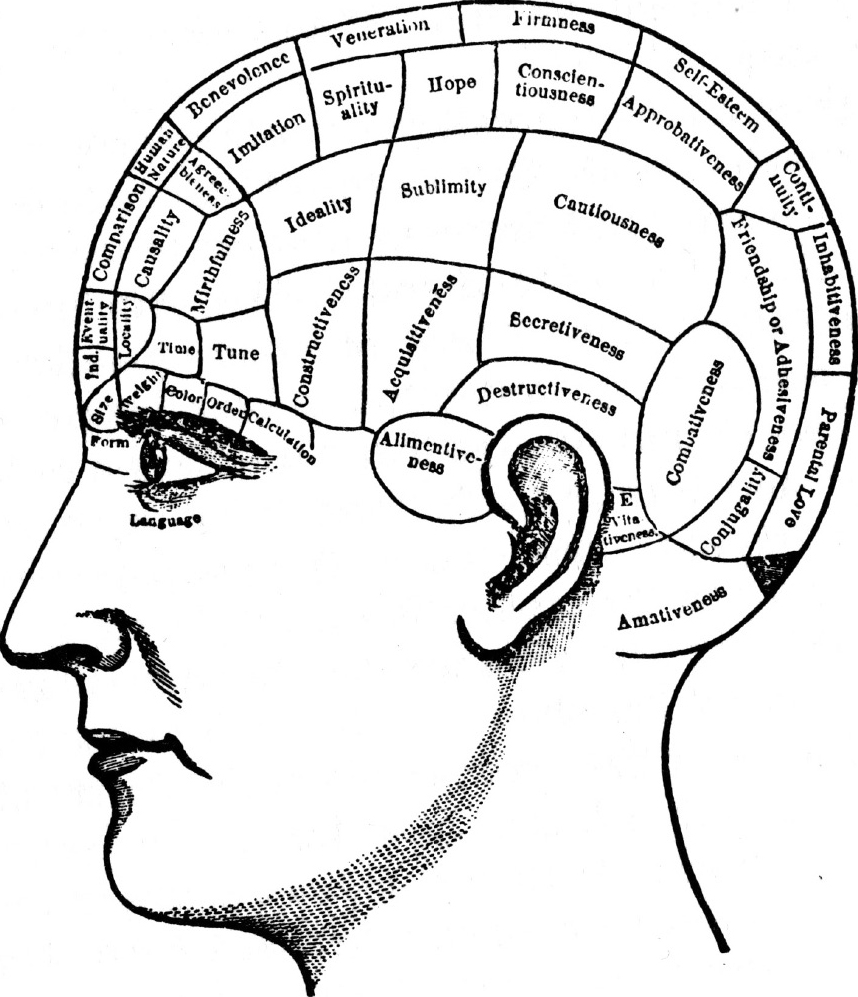
Figure 3.2 The phrenological organs and their corresponding faculties.
Figure 3.2 The phrenological organs and their corresponding faculties.
Through similar observations of other people with outstanding characteristics, Gall localized the qualities of veneration, benevolence, and firmness in separate areas on the top of the brain, love of food and drink just below the organ of acquisitiveness, and a host of other qualities in other regions. While it is easy today for us to laugh at this phrenological theorizing, it did have a certain naive plausibility and was properly “scientific” in being derived from direct (if ultimately misleading) empirical observation. The major weaknesses of Gall’s theory lay in three other factors.
First, Gall incorrectly assumed that the shape of one’s skull accurately reflects the shape of the underlying brain. However, while recognition of the incorrectness of this “fact” obviously invalidated the phrenologists’ practical claims to be able to read character in head shapes, it did not discredit their more basic hypothesis of a relationship between brain shapes and character.
A second and more fundamental weakness of phrenology lay in Gall’s choice of specific psychological qualities to localize within the brain—a collection of twenty-seven “faculties” located in specific brain areas called “organs.” These faculties referred to qualities such as “mirthfulness,” “secretiveness,” and “philoprogenitiveness” (parental love), in addition to the ones discussed so far. Gall’s followers quickly added more, yielding complex configurations like the one in Figure 3.2. Phrenologists saw these particular faculties as basic to human character, the elemental building blocks out of which all significant personality variations are constructed. However, their arbitrary list included complex qualities that were themselves the result of many different interacting factors. The question of just what the basic dimensions of personality variation really are remains in some dispute today (see Chapter 12), but the faculty solution was unquestionably oversimplified. And as long as phrenology lacked an adequate classification of psychological characteristics, its attempts to localize those characteristics in the brain were doomed.
Phrenology’s third and fatal flaw lay in the unreliable methods by which its hypotheses were often tested. Gall always maintained that his theory was grounded in observation, a claim literally true but unreflective of the selectivity and arbitrariness of many of the observations. Further, with twenty-seven or more interacting faculties to work with, it became almost ridiculously easy to explain away apparently discrepant observations. When confronted with a huge organ of acquisitiveness in a highly generous person, for example, Gall could claim that a large organ of benevolence (or some other convenient faculty) counteracted the acquisitive tendencies that would otherwise show clearly. Or he could claim that certain organs of the brain became selectively or temporarily impaired by disease, accounting for intermittent alterations in people’s behavior. Between the presumably counterbalancing effects of several faculties and the “illnesses” that arbitrarily interfered with some faculties but not others, Gall explained away virtually any observation that ran counter to his theory.
If Gall himself was casual in his interpretations of evidence, he attracted some followers who raised that tendency to an art form. When a cast of the right side of Napoleon’s skull predicted qualities markedly at variance with the emperor’s known personality, one phrenologist replied that his dominant side had been the left brain—a cast of which was conveniently missing. When Descartes’s skull was examined and found deficient in the regions for reason and reflection, some phrenologists retorted that the philosopher’s rationality had always been overrated.
Such tactics, and the promise of easy but “scientific” character analysis, helped phrenology retain a hold on the public imagination throughout much of the nineteenth century—in much the same way that astrology, biorhythm analysis, and psychic readings do today. Some practicing phrenologists undoubtedly helped some of the clients who flocked to them for readings, using their general knowledge of people (rather than any specific phrenological theories) to offer shrewd advice. We shall see in Chapter 7 how a phrenologist’s advice helped convince Francis Galton to become an African explorer, an important step in launching his career. In the United States, where practical phrenology was particularly popular, traveling phrenologists would set up shop in local hotels and, for a fee, offer detailed readings resulting in vocational guidance, marital counseling, and even child-rearing advice.4 But in contrast to the general public, most in the established scientific community regarded phrenology as a joke; as told in one widely circulated story, Gall’s own skull, when examined after his death, turned out to be twice as thick as the average.