PIERRE FLOURENS AND THE DISCREDITING OF PHRENOLOGY
The prevailing attitude reflected not only the scientists’ disdain for phrenology but also their respect for a series of experiments conducted in the early 1800s by the young French scientist Pierre Flourens (1794–1867; Figure 3.3). Flourens’s investigations ran counter to several of Gall’s specific hypotheses, thereby starting a classic controversy about the nature of the brain that remains alive today.
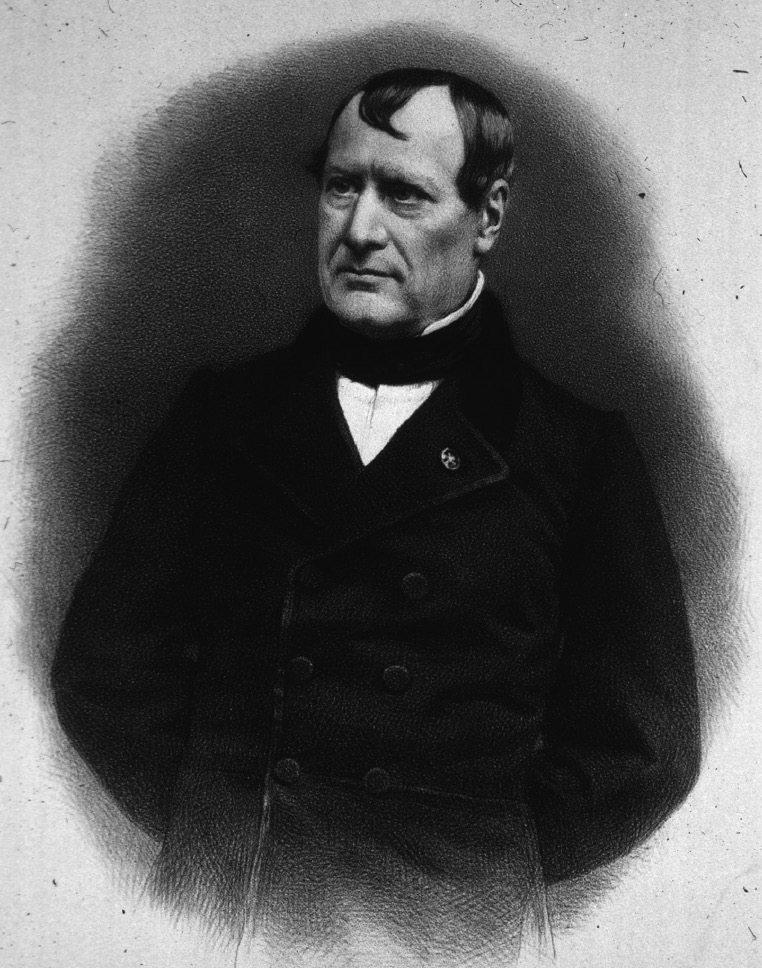
Figure 3.3 Pierre Flourens (1794–1867).
Figure 3.3 Pierre Flourens (1794–1867).
In style and personality, as well as in the course of his career, Flourens contrasted dramatically with Gall. Whereas Gall was regarded suspiciously by orthodox scientists, Flourens epitomized the man of the establishment. Born near Montpellier in the south of France, he graduated from that city’s famous medical school at age 19. He had already published his first scientific article, and after moving to Paris he became the special protégé of Georges Cuvier, the most celebrated scientist in France, known appropriately as the “Dictator of Biology.” Cuvier’s endorsement guaranteed that Flourens’s work would be greeted respectfully—although it was in fact good enough to stand out on its own.
Appalled by the undisciplined observational strategies of the phrenologists, Flourens decided to study the functions of the brain strictly according to experiment—that is, he would deliberately and systematically manipulate specific variables and carefully observe the resulting effects. To do so, he used the technique of ablation, the surgical removal of specific small parts of an animal’s brain, in order to observe any resulting changes in behavior or function. Believing that brain tissue does not regenerate after removal, when he observed specific functions to be permanently missing or altered following an ablation, Flourens hypothesized that the excised brain parts must normally be involved in producing those functions.
Flourens did not actually invent the brain ablation experiment, but he refined it considerably. Showing great surgical skill, he removed more precisely defined areas from the small brains of animal subjects than his predecessors had been able to do, with a higher survival rate. After creating these ablations, or lesions, he always carefully nursed the animals back to as healthy a state as possible before drawing any conclusions, to avoid confusing the transient effects of surgical shock or postoperative complications with the permanent effects of the surgery.
Flourens tested Gall’s hypotheses by ablating brain regions associated with particular phrenological faculties. Since he worked with animals, he could directly investigate only those few faculties presumably shared by animals and humans. Sexual responsiveness obviously qualified, so some of Flourens’s earliest and most influential experiments involved ablations of the cerebellum—Gall’s “organ of amativeness.” His ablations produced alterations of behavior all right, but scarcely of the type that phrenological theory predicted:
I removed the cerebellum in a young but vigorous dog by a series of deeper and deeper slices. The animal lost gradually the faculty of orderly and regular movement. Soon he could walk only by staggering in zigzags. He fell back when he wanted to advance; when he wanted to turn to the right he turned to the left. As he made great efforts to move and could no longer moderate these efforts, he hurled himself impetuously forward, and did not fail to fall or roll over. . . . [N]evertheless he was perfectly well. . . . He had all his intellectual faculties, all his senses; he was only deprived of the faculty of coordinating and regularizing his movements.5
This classic description of a cerebellar lesion, originally published in 1824, has scarcely been improved on to the present (though such an experiment would not be allowed today for ethical reasons). Flourens clearly established the cerebellum’s major role in the integration and “programming” of the countless small muscular movements that make up any organized behavior. Even a simple act like walking requires the proper ordering of thousands of discrete movements, and the cerebellum helps achieve this ordering. Flourens observed that his experimental subjects often moved about as if drunk—and we now know that persistent and heavy alcohol use can in fact produce degenerative changes in the cerebellum, leading to the odd and clumsy walking style of many chronic alcoholics. The cerebellum is also believed by current researchers to be somehow involved in Parkinson’s disease. In sum, Flourens proved that the cerebellum was indeed the center of a specific function—but unfortunately for Gall and phrenology, that function bore little relation to “amativeness.”
Flourens’s ablation studies of the cortex—the brain’s surface area implicated by Gall in most of the higher faculties—seemed at first even more damaging to phrenology. As Flourens removed progressively larger sections of cortex from birds, they gradually lost the use of all of their senses and their capacity for voluntary action. One pigeon, with its entire cortex removed, was kept alive by force-feeding and other measures, but it became completely insensitive to visual or auditory stimulation and never initiated a movement on its own. Only when prodded or physically disturbed would it move, to resume its customary resting position. In describing this bird’s state, Flourens imagined it had lost all capacity for consciousness: “Picture to yourself an animal condemned to perpetual sleep, and deprived even of the faculty of dreaming during this sleep.”6 In his view, the animal had lost its will along with its cortex.
Flourens believed his findings demolished phrenology. Although he had demonstrated localization of a sort, with different functions attributed to the cerebellum and cortex, he believed these separate functions were evenly distributed within each organ. As increasingly larger sections of cortex were removed, for example, all the various sensory and voluntary functions seemed to disappear together. Flourens argued that if the phrenologists were right and the cortex housed many different specific organs, then small ablations should have removed some organs while leaving others intact, producing more specific effects than he had actually observed.
Flourens was skating on thin ice, though, since by his own description he had ablated progressively deeper slices of cortex. Any slice, no matter how shallow, very likely interfered with many cortical regions at once, thus producing an apparently general effect. Gall, who contemptuously referred to all brain ablators as “mutilators,” eagerly seized on this point: “[Flourens] mutilates all the organs at once, weakens them all, extirpates them all at the same time.”7 With hindsight, we know that Gall was at least partially correct and that Flourens did miss important effects of cortical localization.
More enduring, however, have been some of Flourens’s other conclusions regarding the cortex’s flexibility and plasticity. For example, he observed that sometimes (though not always) ablation-caused deficits improved over time, particularly if the animal was young and the ablations were relatively small. The fact that the lost brain tissue did not regenerate suggested that intact parts of the brain must somehow have been able to take over functions previously performed by the ablated portions. The exact limits and conditions of such brain plasticity continue to be explored by neuroscientists today.
Flourens’s investigations of the brain also highlighted the state of integration and harmony that normally prevails among its separate parts. While he conceded a certain “action propre” (“specific action”) for the cerebellum and cortex considered separately, he also emphasized the cooperation and communication between the two brain parts. Actions initiated by the “will” in the cortex had to be put together and integrated by the cerebellum, and the loss of coordination caused by damage to the cerebellum had to be dealt with by voluntary reactions in the cortex. In Flourens’s terminology, the actions propres of the parts were subject to an overall “action commune” (“common action”) of the brain acting as a whole. In a conception somewhat reminiscent of Descartes, Flourens saw the brain as the seat of an integrated and harmonious soul.
Flourens’s views seemed more scientifically respectable than phrenology, and they were generally accepted by the scientific establishment throughout the mid-1800s. In the 1860s, however, new findings suggested that Flourens’s meticulous experiments had failed to detect some important localized functions in the cortex, and the fact that he had overemphasized the unity of the brain’s functioning overall.