
Incentives
Trade-offs
Opportunity cost
Marginal thinking
Trade creates value
Incentives
Trade-offs
Opportunity cost
Marginal thinking
Trade creates value
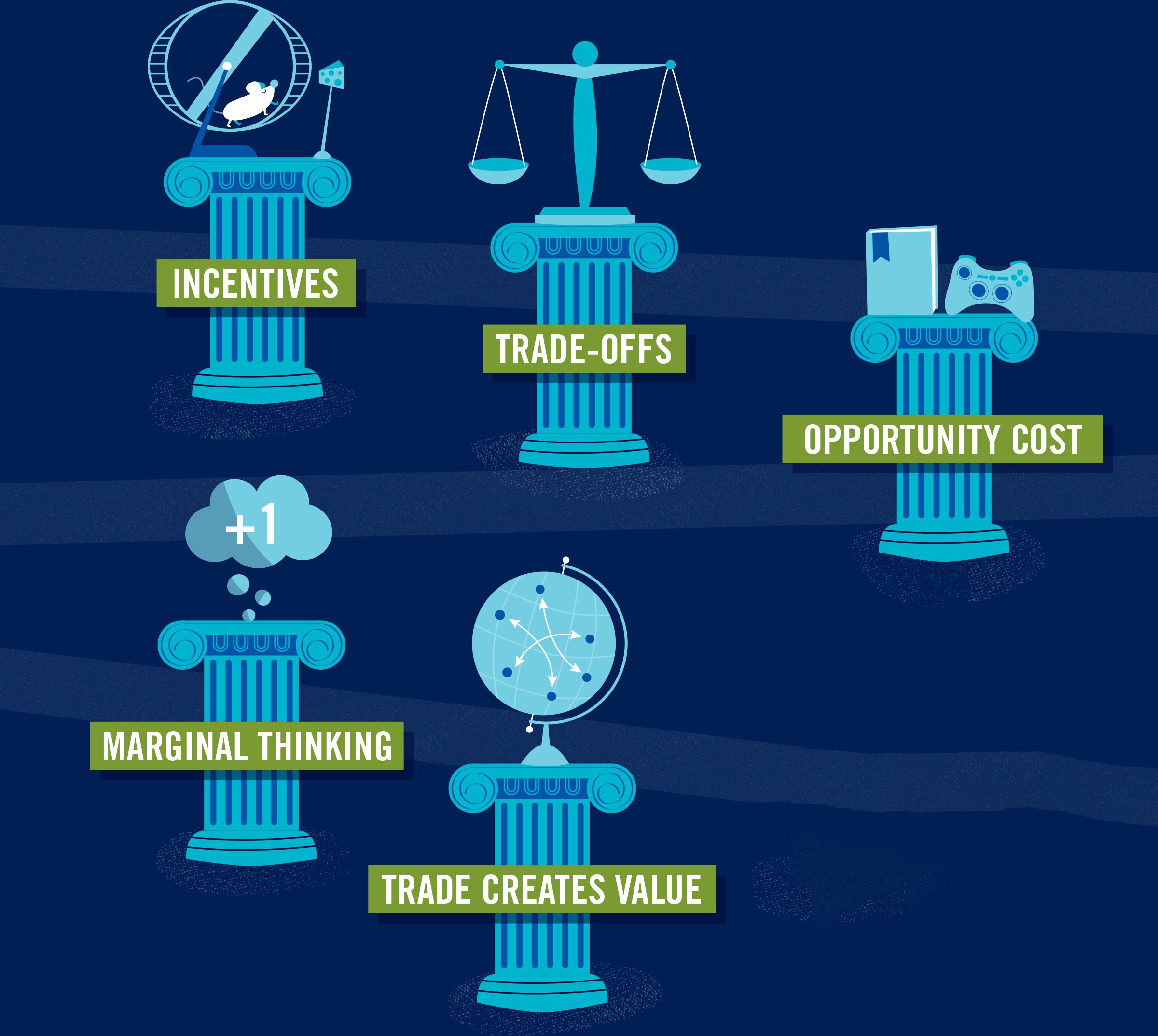
The study of economics can be complicated, but we can make it very accessible by breaking it down into a set of component parts. The five foundations presented here are key components of economics. They are a bit like the natural laws of physics or chemistry. Almost every economic subject can be analyzed through the prism of one of these foundations. By mastering the five foundations, you will be on your way to succeeding in this course and thinking like an economist. The five foundations of economics are:
Scarcity
NATION JUST WANTS TO BE SAFE, HAPPY, RICH, COMFORTABLE, ENTERTAINED AT ALL TIMES
A short video on the satirical website The Onion describes a fictitious report from the Pew Research Center about what Americans want and expect from life. After a graphic details how practically all Americans would like to be everything from “safe” to “romantically fulfilled,” the video segues to interviews with individuals whose “all I want” lists range from the endearing (a big, happy dog) to the quirky (a new Wes Anderson movie), the unrealistic (quick and easy weight loss), and the impossible (“I don’t want to die”).
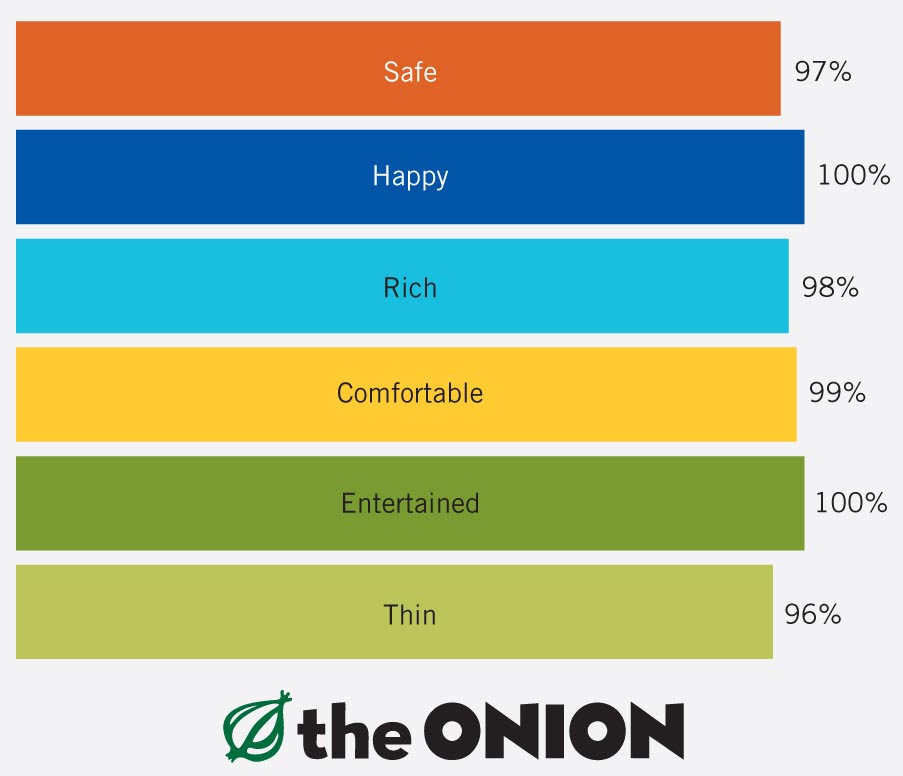
A bar graph with six bars representing personal traits: safe, happy, rich, comfortable, entertained, and thin. All are desired by more than 95 percent of people.
We live in a world of scarcity. But that alone doesn’t explain why we’re unable to meet everyone’s wants. Couldn’t we just redistribute goods and services more evenly, to satisfy everyone? No chance, because our wants exceed our needs, and when all our wants are met, we come up with new ones. Many people spend their lives trying to “keep up with the Joneses.” This isn’t all bad, because competitive drive causes people to work longer and harder, which makes the economy more productive. At the same time, when we purchase one good, we have less to spend on other goods we also desire, and therefore we face trade-offs and opportunity costs.
Each of these five foundations reappears throughout the book and enables you to solve complex problems. Every time you encounter one of the five concepts, you will see an icon of a house in the margin. As you become more adept at economic analysis, you will often use two or more of these foundational ideas to understand the economic world around you.
When you are faced with making a decision, you usually make the choice that you think will most improve your situation. In making your decision, you respond to incentives—factors that motivate you to act or exert effort. For example, your choice to study for an exam you have tomorrow, instead of spending the evening with your friends, is based on your belief that doing well on the exam will provide a greater benefit. You have an incentive to study because you know that an A in the course will raise your grade-point average and make you a more attractive candidate on the job market when you are finished with school. We can further divide incentives into two paired categories: positive and negative, and direct and indirect.
Microeconomics and Macroeconomics: The Big Picture
Decide whether each of the following statements identifies a microeconomic issue or a macroeconomic issue.
STATEMENT: The personal savings rate averages more than 10% of income.
 ANSWER
 ANSWER: The personal savings rate is a statistic based on the average amount each household saves as a percentage of income. As such, it is a broad measure of savings that describes a macroeconomic issue.
STATEMENT: Maya was laid off from her job and is currently unemployed.
ANSWERANSWER: Maya’s personal financial circumstances constitute a microeconomic issue, because she is an individual worker.
Close-up of an eye composed of mosaic tiles.
STATEMENT: Apple decides to open 100 new stores.
ANSWERANSWER: Even though Apple is a very large corporation, and 100 new stores will create many new jobs, Apple’s decision is a microeconomic issue because it is best understood as part of an individual firm’s competitive strategy.STATEMENT: The government passes a jobs bill designed to stabilize the economy during a recession (an economic downturn).
ANSWERANSWER: You might be tempted to ask how many jobs are created, but that information is not relevant to answering this question. The key part of the statement refers to “stabilize the economy during a recession,” which is an example of the government taking an active role in managing the overall workings of the economy. Therefore, it is a macroeconomic issue.Positive incentives encourage action by offering rewards or payments. For example, end-of-year bonuses motivate employees to work hard throughout the year, higher oil prices cause suppliers to extract more oil, and tax rebates encourage citizens to spend more money. Negative incentives discourage action by providing undesirable consequences or punishments. For instance, the fear of receiving a speeding ticket keeps motorists from driving too fast, higher oil prices might spur some consumers to use less oil, and the dread of a trip to the dentist motivates people to brush their teeth regularly. In each case, we see that incentives spur individuals to action.
Conventional wisdom tells us that “learning is its own reward,” but try telling that to most students. Teachers are aware that incentives, both positive and negative, create additional interest among their students to learn the course material. Positive incentives include bonus points, gold stars, public praise, and extra credit. Many students respond to these encouragements by studying more. However, positive incentives are not enough. Suppose your instructor never gave any grade lower than an A. Your incentive to participate actively in the course, do assignments, or earn bonus points would be small. For positive incentives to work, they generally need to be coupled with negative incentives. This is why instructors require students to complete assignments, take exams, and write papers. Students know that if they do not complete these requirements, they will get a lower grade, or perhaps even fail the class.
Incentives can also be direct or indirect. For instance, if one gas station lowers its prices, it most likely will get business from customers who would not usually stop there. This is a direct incentive. Lower gasoline prices also work as an indirect incentive, because lower prices might encourage consumers to use more gas.

A nearly empty street in New York City.
Direct incentives are easy to recognize. “Cut my grass and I’ll pay you $30” is an example of a direct incentive. Indirect incentives are more difficult to recognize. But learning to recognize them is one of the keys to mastering economics. For instance, consider the indirect incentives at work in some government assistance programs. Almost everyone agrees that societies should provide a safety net for those without employment or whose income isn’t enough to meet their basic needs. In other words, a society has a direct incentive to alleviate suffering caused by poverty. But how does a society provide this safety net without taking away the incentive to work? If the amount a person receives is higher than the amount that person can hope to make from a job, there is far less incentive to go back to work. In fact, there is an incentive not to. This situation creates an unintended consequence, where assistance originally meant as a safety net could start to be seen as a permanent source of income.
Policymakers have the tough task of deciding how to balance such conflicting incentives. Budget planners and legislators could decide to reduce benefits, but this decision might leave some people without enough to live on. For this reason, many government programs specify limits on the amount of time people can receive benefits. Ideally, this limit allows the welfare programs to continue meeting people’s basic needs while creating incentives that encourage recipients to search for a job and acquire skills that will help them get a job. We’ll learn more about welfare issues in Chapter 15.
WHY ARE THERE SO MANY DASHBOARD CAMERAS IN RUSSIA?
Let’s look at an example of how incentives operate in the real world and how they can produce surprising consequences. Compared to the United States, Russia is quite a dangerous place to drive (see Figure 1.1). On top of the collisions that occur due to chaotic traffic conditions, insurance scammers regularly stage accidents. To protect themselves against scammers, most Russian motorists have dashcams, which provide video evidence of a driver’s innocence in court. The fact that so many Russian drivers are willing to invest in dashcams strongly suggests that the benefits of having a cam exceed the cost.
In the United States, and in most other countries where there are fewer annual deaths (and accidents) per vehicle, staged accidents are much less common, and consequently dashcams are much less prevalent.
Incentives also play a vital role in innovation, the engine of economic growth. An excellent example is Steve Jobs. He and the company he founded, Apple, held over 300 patents at the time of his death in 2011.
FIGURE 1.1
Global Status Report on Safety
Compared to the United States, Russia is quite a dangerous place to drive. Widespread insurance scamming in Russia has led most motorists to install dashcams. The fact that insurance scammers exist is an unintended consequence of mandated insurance, especially in Russia where the rules of the road and safe driving are often ignored.

A table of annual vehicle accident deaths in Russia, Europe, the United States, and Australia. Russia has by far the most, 53.4 per 100,000 vehicles.
A truck swerving in front of a pedestrian on an icy road.
In the United States, the patent system and copyright laws guarantee inventors a specific period of time in which they have the exclusive right to sell their work. This system encourages innovation by creating a powerful financial reward for creativity. Without patents and copyright laws, inventors would bear all the costs, and almost none of the rewards, for their efforts. Why would firms invest in research and development or artists create new music if others could immediately copy and sell their work? To reward the perspiration and inspiration required for innovation, society allows patents and copyrights to create the right incentives for economic growth.
In recent years, new forms of technology have made the illegal sharing of copyrighted material quite easy. As a result, illegal downloads of books, music, and movies are widespread. When writers, musicians, actors, and studios cannot effectively protect what they have created, they earn less. So illegal downloads reduce the incentive to produce new content. Will the next Oprah work so hard? Or the next John Legend or Tyler Perry? Will the next Leigh Bardugo (author of the Shadow and Bone books) hone her writing craft so diligently if there is so much less financial reward for success? Is the “I want it for free” culture causing the truly gifted to be less committed to their craft, thus depriving society of excellence? Maintaining the right rewards, or incentives, for hard work and innovation is essential for making sure that inventors and other creative people are compensated for their creativity and vision. Some see services like Spotify, Apple Music, and SoundCloud as the answer. While streaming services are now very successful, the amount artists receive is still far lower than it used to be.
One very powerful incentive is saving time. You can test out your time-savings skills when you walk across campus to a class. An app will give you a detailed route and an estimated time of arrival, but your app won’t know the local shortcuts. Sometimes the shortcuts everyone takes are through buildings or along dirt paths. Sometimes all you have to do is crowdsource the best route by following others. The paths worn into greens by students’ feet will show you how to get across campus as quickly as possible.
Incentives
Understanding incentives, from positive to negative and direct to indirect, is the key to understanding economics. If you remember only one concept from this course, it should be that incentives matter.

Students walking across a campus.

Two characters from the baby shark video, a pink fox and a baby shark.
In a world of scarcity, each and every decision incurs a cost. Even time is a scarce resource; after all, there are only 24 hours in a day. So deciding to play Animal Crossing now means you won’t be able to read one of the Harry Potter books until later. More generally, doing one thing often means you will not have the time, resources, or energy to do something else. Similarly, paying for a college education can require spending tens of thousands of dollars that might be used elsewhere instead.
Trade-offs
Understanding the trade-offs that exist in life can completely change how you view the world. Let’s look at Pinkfong’s catchy melody “Baby Shark.” The video for this song has been viewed over 10 billion times on YouTube, making it the most watched video of all time. Imagine what could have been accomplished if people had used that time differently. Consider the trade-offs. “Baby Shark” is 2 minutes and 16 seconds long, which means that more than 370 million hours have been spent watching the video. That’s over 40,000 years! In the same amount of time, 16 Burj Khalifas (one of the world’s tallest buildings, constructed with over 22 million total hours of human labor) could have been built, or the entire contents of the English Wikipedia entered—22 times over! (On the plus side, to be fair, millions of weary caregivers have used the catchy tune to “buy” a few minutes of rest.)
People who don’t understand economics sometimes ignore the trade-offs that are natural in a world of scarcity. They unconsciously assume that we can (as individuals or a group) have more of everything we want. But in fact, decision-making generally involves trade-offs. For example, if you decide to increase your time allotment for studying economics, you will need to give up something else: you might study less for other courses, work fewer hours at your job, or spend less time on social media. That is, there is a trade-off between higher economics grades and other things you desire. As a nation, we may wish to increase subsidies to college education, or to increase international aid, or to strengthen our national defense. Economists are the ones who then ask: What about the trade-offs?
For a recent example, take the Coronavirus Aid, Relief, and Economic Security (CARES) Act, which was passed by Congress with overwhelming bipartisan support and signed on March 27, 2020. This $2.2 trillion relief package provided financial assistance for American workers, families, and small businesses, and preserved jobs in American industries. But what could all that money have bought instead, if we’d spent it differently? Well, we could have created 1.5 million state-of-the-art hospital beds. Or we could have built 440 brand-new NFL stadiums, or given every citizen a check for $6,728, or created 550,000 one-megawatt solar farms, or hired 700,000 K–12 teachers for 50 years each. You get the point.
Ultimately, thinking about trade-offs means that we will make more informed decisions about how to use our scarce resources.
Opportunity cost
The existence of trade-offs requires making hard decisions. Trade-offs are about having to give something up, while opportunity cost quantifies “what” or “how much” is being given up. Choosing one thing means giving up something else. Suppose you receive two invitations for the same Saturday—the first to spend the day hiking and the second to go to a concert. No matter which event you choose, you have to sacrifice the other option. In this example, you can think of the cost of going to the concert as the lost opportunity to go on the hike. Likewise, the cost of going hiking is the lost opportunity to go to the concert. No matter what choice you make, there is an opportunity cost, or next-best alternative, that must be sacrificed. Opportunity cost is the highest-valued alternative that must be sacrificed to get something else.
Opportunity cost
Every time we make a choice, we experience an opportunity cost. The key to making the best possible decision is to minimize your opportunity cost by selecting the option that gives you the largest benefit. If you prefer going to a concert, you should go to the concert. What you give up (the hike) has less value to you than the concert, so it represents an opportunity cost.
The hiking/concert choice is a simple and clear example of opportunity cost. Usually, it takes deliberate effort to see the world through the opportunity cost prism. But it is a worthwhile practice because it will help you make better decisions. For example, imagine you are a small business owner. Your financial officer informs you that you have had a successful year and made a sizable profit. So everything is good, right? Not so fast. An economist will tell you to ask yourself, “Could I have made more profit doing something else?” Good economic thinkers ask this question all the time. “Could I be using my time, talents, or energy on another activity that would be even more profitable for me?”

A handheld gaming console on which Animal Crossing is being played.
Profits on an official income statement are only part of the story, because they only measure how well a business does relative to the bottom line. Accountants cannot measure what might have been better. For example, suppose you had decided not to open a new store. A few months later, a rival opened a very successful store in the same location you had considered. Your profits were good for the year, but if you had opened the new store, your profits could have been even better. So when economists talk about opportunity cost, they are assessing whether the alternatives are better than what you are currently doing, which considers a larger set of possible outcomes.

Alicia Keys
For example, in the chapter opener, we mused about having a money tree. It turns out that money trees really do exist—in the virtual world. In Animal Crossing, Nintendo’s breakout title of the 2020 pandemic, the player must bury a bag of Bells (the game’s currency) using a golden shovel. After the tree has fully grown, it will bloom with three bags of Bells at amounts dependent on how much was initially buried. In this simple example, there is still an opportunity cost—what might have been done with the bag of Bells instead of growing a Bell tree! Planting a Bell tree today increases your future income, but you forgo the opportunity to spend Bells now.
Opportunity cost
Back in the real world, Alicia Keys understands opportunity cost. A high school valedictorian, she was enrolled at Columbia University but left when she signed a contract with Columbia Records. Keys defied the usual wisdom about staying in school and completing her degree, because finishing school would have meant passing up an opportunity that might not come her way again. Given her success, it’s hard to fault her decision. If she had completed her degree, she may have missed the opportunity to become the star we know today.

A graduation cap sits on top of a large stack of 100 dollar bills.
The Opportunity Cost of Attending College
QUESTION: What is the opportunity cost of attending college?
ANSWERANSWER: When people think about the cost of attending college, they usually think of tuition, room and board, course materials, and travel-related expenses. While those expenses are often a part of going to college, they are not its full cost. The opportunity cost is the next-best alternative that is sacrificed. This opportunity cost—or what you potentially could have done if you were not in college—includes the lost income you could have earned working a full-time job. If you consider the cost of attending college plus the forgone income lost while in college, you can see that college is an awfully expensive proposition. Setting aside the question of how much more you might have to pay for room and board at college rather than elsewhere, consider the cost of tuition, which can be $40,000 or more at many of the nation’s most expensive colleges. Add that out-of-pocket expense to the forgone income from a full-time job that might pay $40,000 a year, and your four years in college can easily cost over a quarter of a million dollars.CHALLENGE QUESTION: Alicia Keys honed her stage presence in small venues until she became famous. But for every Alicia Keys, there are thousands of other singer-songwriters who never made it big. What advice would you give to someone wrestling with the decision to leave college?
ANSWERANSWER: The question is tricky. We can’t know the future, and staying in college and leaving college both have opportunity costs. By staying, you forgo the opportunity to try new things and, perhaps, discover in the process something else you excel at. However, leaving means a college degree will not be part of your résumé. Making decisions when there is uncertainty about how the future will unfold is what makes choices difficult, because there are opportunity costs in both directions.HOW LONG WOULD YOU WAIT IN LINE ON BLACK FRIDAY TO SAVE $300?

Two people outside the front of a store sitting in chairs with blankets and thick jackets.
A few years ago in Beaumont, California, Vicky Torres and Juanita Alva were first in line to secure a large-screen television at Best Buy during the Black Friday Sale. The TV they wanted was advertised at $199. Let’s say that was a markdown from $499. How many hours would you wait in line to save $300? Two hours? Five? Ten? How about 500 hours? That’s how long the two women waited, because they arrived three weeks early. By all accounts they enjoyed their time waiting, spending their days talking to strangers and taking turns saving each other’s spots in line overnight. However, there’s an opportunity cost here that makes Vicky and Juanita’s decision puzzling. Think of the many trade-offs they faced: missed sleep, time they could have spent with friends and family, and the time they could be working instead of waiting in line, to name just a few. It is hard to justify the women’s choices using marginal analysis. Saving $300 by spending 500 hours makes their time worth 60 cents an hour. They could have spent 30 hours working an extra job at $10 an hour and each earned enough money to purchase the TV at full price—and still had 470 hours to do other things. In short, they don’t seem to have been aware of the opportunity cost of waiting in line.
The process of systematically evaluating a course of action is called economic thinking. Economic thinking involves a purposeful evaluation of the available opportunities to make the best decision possible. In this context, economic thinkers use a process called marginal analysis to break down decisions into smaller parts. Often, the choice is not between doing and not doing something, but between doing more or less of something. For instance, if you take on a part-time job while in school, you probably wrestle with the question of how many hours to work. If you work a little more, you can earn additional income. If you work a little less, you have more time to study. Working more has a tangible benefit (more money) and a tangible cost (lower grades). All of this should sound familiar from our earlier discussion about trade-offs. The work-study trade-off affects how much money you have and what kind of grades you earn.
An economist would say that your decision—weighing how much money you want against the grades you want—is a decision at the margin. What exactly does the word “margin” mean as used in economics? In economics, marginal thinking requires decision-makers to evaluate whether the benefit of one more unit of something is greater than its cost. Understanding how to analyze decisions at the margin is essential to thinking like a good economist.
Marginal thinking
For example, have you ever wondered why people vacuum, dust, scrub the bathrooms, clean out their garages, and wash their windows, but leave the dust bunnies under the refrigerator? The answer lies in thinking at the margin. Moving the refrigerator out from the wall to clean requires a significant effort for a small benefit. Guests who enter the kitchen can’t see under the refrigerator. So most of us ignore the dust bunnies and just clean the visible areas of our homes. In other words, when economists say you should think at the margin, what they really mean is that you should weigh the costs and benefits of your actions and choose to do the things with the greatest payoff. For most of us, that means being willing to live with dust bunnies. The marginal cost of cleaning under the refrigerator (or on top of the cabinets or even behind the sofa cushions) is too high, and the added value of making the effort, or the marginal benefit, is too low to justify the additional cleaning.
 Marginal Analysis
Trade creates value
Imagine trying to find food in a world without grocery stores. The task of getting what you need to eat each day would require visiting many separate locations. Many centuries ago, this need to bring buyers and sellers together was met by weekly markets, or bazaars, in central locations like town squares. Markets bring buyers and sellers together to exchange goods and services. As commerce spread throughout the ancient world, trade routes developed. Markets grew from infrequent gatherings, where exchange involved trading goods and services for other goods and services, into more sophisticated systems that use cash, credit, and other financial instruments. Today, when we think of markets, we often think of eBay or Craigslist. For instance, if you want to find a rare Hot Wheels Black Panther Movie Die-Cast Vehicle, an excellent place to look is eBay, which allows users to search for just about any product, bid on it, and then have it sent directly to their home.
When we consider all the trade that occurs in an economy, it is helpful to use a circular flow diagram. This shows how goods, services, and resources flow through the economy via commerce between households and firms. Households are made up of consumers, as we usually picture them. Firms are businesses. Households desire the goods and services produced by firms, but to produce those goods and services, firms require the resources owned by households. The circular flow diagram illustrates the movement of goods, services, and resources that results when firms and households do business with each other.
In the circular flow in Figure 1.2, households are on the right and firms on the left. Households buy goods and services from firms in product markets, at the top of the diagram. This is the kind of transaction you undertake all the time: when you buy groceries or school supplies, you purchase these in product markets, from firms. But households are also sellers, in that they provide the inputs or resources that firms use to produce their output. These transactions take place in resource markets, at the bottom of the diagram. When you put in time at your job and get a paycheck in return, that is a resource market transaction.
The red arrows that form the clockwise inner loop show goods and services flowing from firms to households across the top of the circle and resources flowing from households to firms across the bottom. Goods, services, and resources are paid for with funds. The green arrows forming the outer loop show how funds flow in the opposite direction of whatever they are paying for. Each loop is closed. On the inside, resources go into the production of goods and services, which in turn go into sustaining households so they can continue to provide firms with resources. On the outside, funds are transferred from households’ bank accounts to firms’ accounts as payment for goods and services, and then return to households as payment for resources.
FIGURE 1.2
The Circular Flow
The circular flow of goods and services appears as the red inner loop, and the circular flow of funds to purchase goods and services appears as the green outer loop.
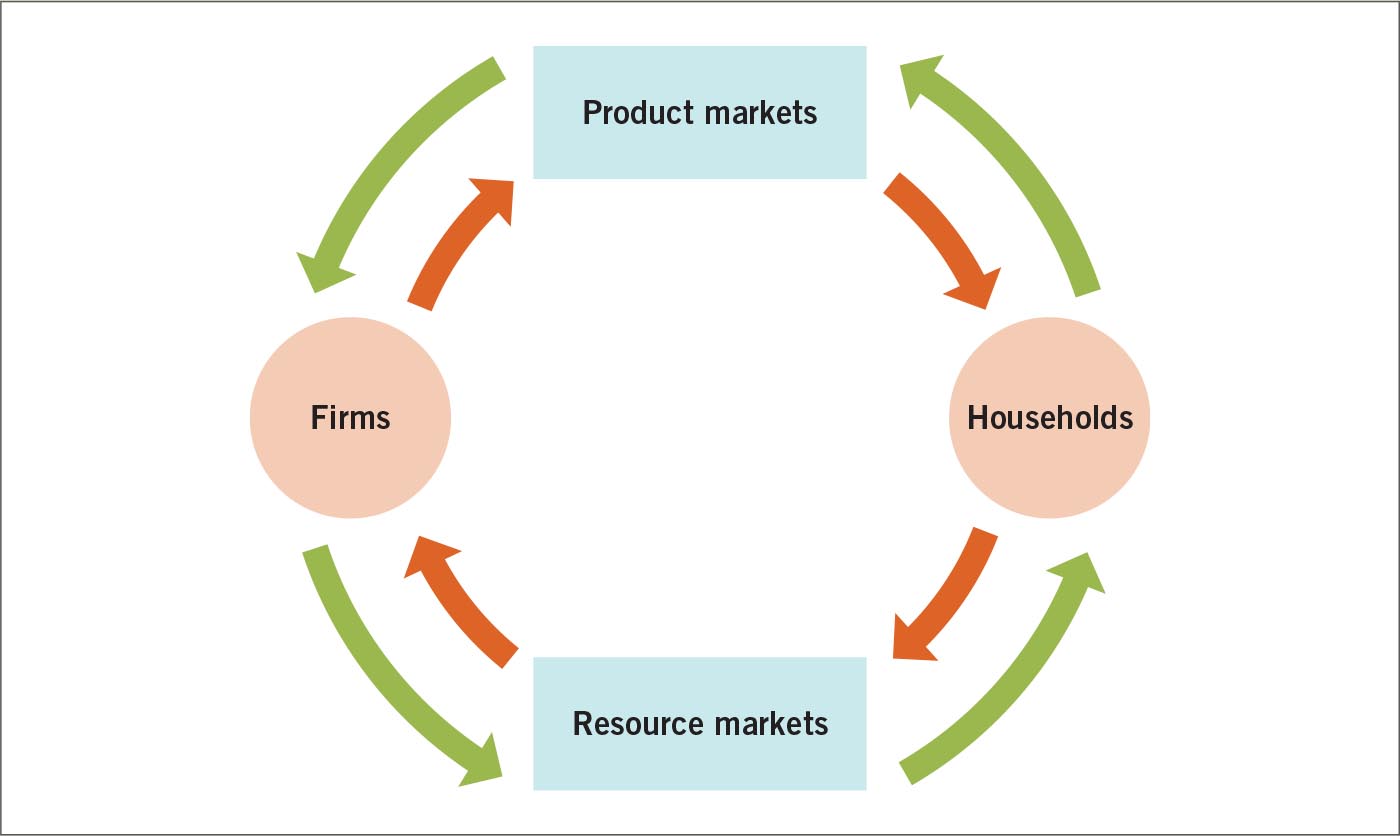
A cyclical flow chart with 2 flow directions. The red inner flow is clockwise, from Product markets to Households, to Resource markets, to Firms, and back to Product markets. The green outer flow is counterclockwise, from Product markets to Firms, to Resource markets, to Households, and back to Product markets.
Consider a simple example. Let’s say you spend $1,000 on a new Dell computer. You trade for your computer in a product market, and Dell gets the $1,000: this takes place in the top half of the circular flow diagram. Then Dell uses the $1,000 to pay its workers’ wages and other suppliers for the use of resources. This happens in the bottom half of the diagram. In the end, the funds make the complete circuit back to households.
This simple circular flow diagram leaves out some details. For one thing, government is an important player in any economy. Funds flow into and out of governments, which participate in both the product and resource markets. In addition, households and firms also interact with foreign firms and households. We consider the roles of government and foreign firms and households later in the text, but for now, this simple circular flow diagram serves as a schematic summary of how households and firms interact through trade in an economy.
Incentives
Trade creates value
Trade is the voluntary exchange of goods and services between two or more parties.
Voluntary trade among rational individuals creates value for everyone involved. Imagine you are on your way home from class and you want to pick up a gallon of milk. You know that milk will be more expensive at a convenience store than at the grocery store 5 miles away, but you are in a hurry to study for your economics exam and are willing to pay up to $5 for the convenience of getting the milk quickly. At the store, you find that the price is $4 and you happily purchase the milk. This ability to buy for less than the price you are willing to pay provides a positive incentive to make the purchase. But what about the seller? If the store owner paid $3 to buy the milk from a supplier, and you are willing to pay the $4 price she has set in order to make a profit, the store owner has an incentive to sell. This simple voluntary transaction has made both of you better off.

A crowd of professionals, all smiling.
By fostering the exchange of goods, trade helps to create additional growth through specialization. Comparative advantage refers to the situation in which an individual, business, or country can produce at a lower opportunity cost than a competitor can. Comparative advantage harnesses the power of specialization, a topic we discuss in more detail in Chapter 2. As a result, it is possible to be a physician, teacher, or plumber and not worry about how to do everything yourself. The physician becomes proficient at dispensing medical advice, the teacher at helping students, and the plumber at fixing leaks. The physician and the teacher call the plumber when they need work on their plumbing. The teacher and the plumber see the doctor when they are sick. The physician and the plumber entrust their children’s education to the teacher.
The same process is at work among businesses. For instance, Starbucks specializes in making coffee, Honda in making automobiles. You would not want to get your morning cup of joe at Honda any more than you would want to buy a car from Starbucks!
On a broader scale, specialization and trading of services exist at the international level as well. Some countries have highly developed workforces capable of managing and solving complex processes. Other countries have large pools of relatively unskilled labor. As a result, businesses that need skilled labor gravitate to countries where they can easily find the workers they need. Likewise, firms with production processes that rely on unskilled labor look for employees in less developed countries, where workers are paid less. By harnessing the power of increased specialization, global companies and economies create value through increased production and growth.
However, globalized trade is not without controversy. When goods and jobs are free to move across borders, not everyone benefits equally, nor should we expect this outcome. Consider the case of a U.S. worker who loses her job when her position is outsourced to a call center in India. The jobless worker now has to find new employment—a process that requires significant time and energy. In contrast, the new position in the call center in India provides a job and an income that improve the life of another worker. Also, the U.S. firm enjoys the advantage of being able to hire lower-cost labor elsewhere. The firm’s lower costs often translate into lower prices for domestic consumers. None of those advantages make the outsourcing of jobs any less painful for affected workers, but outsourcing is an important component of economic growth in the long run.
In this book, we study five foundations of economics—incentives, trade—offs, opportunity cost, marginal thinking, and the principle that trade creates value. Once you have mastered these five concepts, even complex economic processes can be reduced to smaller, more easily understood parts. If you keep these foundations in mind, you’ll find that understanding economics is rewarding and fun.
Travie McCoy and Bruno Mars collaborated on the mega-hit “Billionaire.” Little did they know that majors in economics are most likely to make the Forbes 400, a list of the richest people in the United States. In this graphic, we report the six majors that produce the highest number of billionaires and cross-reference those findings with projected lifetime earnings to give you a sense of how much the average college graduate with one of these degrees is likely to earn. We’ve intentionally used lifetime earnings, since they are a better indicator of financial well-being than the typical starting salary ranges you might be more familiar with. It is how much money you make over your entire career that matters.

Bruno Mars and Travie McCoy
The financial rewards are nice, but that’s not the only reason to choose economics. Economics majors are also versatile in other ways: they are top performers on the LSAT (Law School Admission Test) and are in demand as policy experts, consultants, and forecasters.
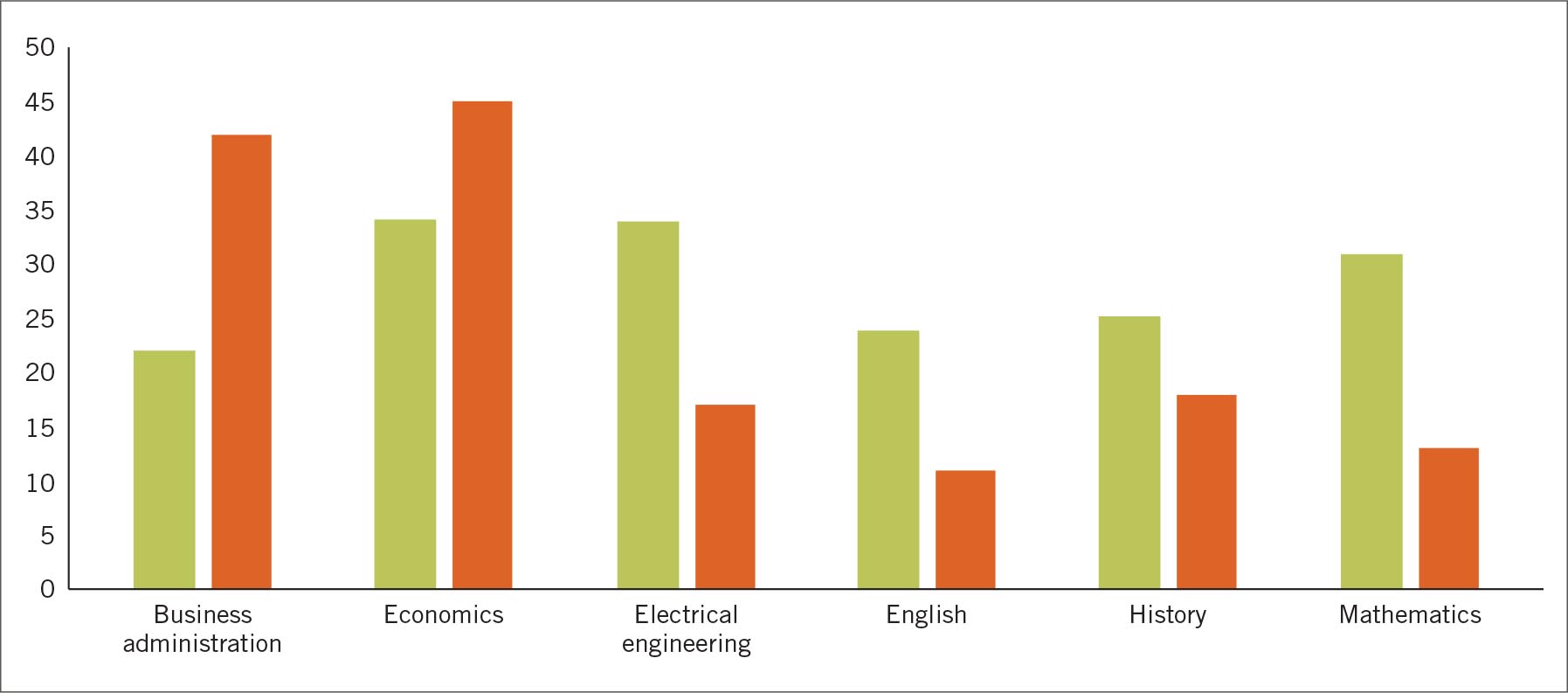
A grouped bar graph with six college majors. Each major has a green bar representing lifetime income and a red bar representing number of billionaires in the Forbes 400. The lifetime incomes are business administration 2 million dollars, economics 3.2 million dollars, electrical engineering 3.2 million dollars, English 2.3 million dollars, history 2.5 million dollars, and mathematics 2.7 million dollars. The numbers of billionaires are business administration 41, economics 43, electrical engineering 15, English 10, history 15, and mathematics 12.
Comparative Advantage