
Incentives
Economics is a social science that uses the scientific method to develop economic models. To create these models, economists make many assumptions to simplify reality. These models help economists understand the key relationships that drive economic decisions.
Veritasium is a YouTube channel with over 8 million subscribers. It is dedicated to the scientific exploration of counterintuitive results. In 2021, Veritasium’s creator, Derek Muller, posted a video titled “A Physics Prof Bet Me $10,000 I’m Wrong.” The video shows Muller driving a wind-powered vehicle directly downwind—and going faster than the wind that’s pushing him.
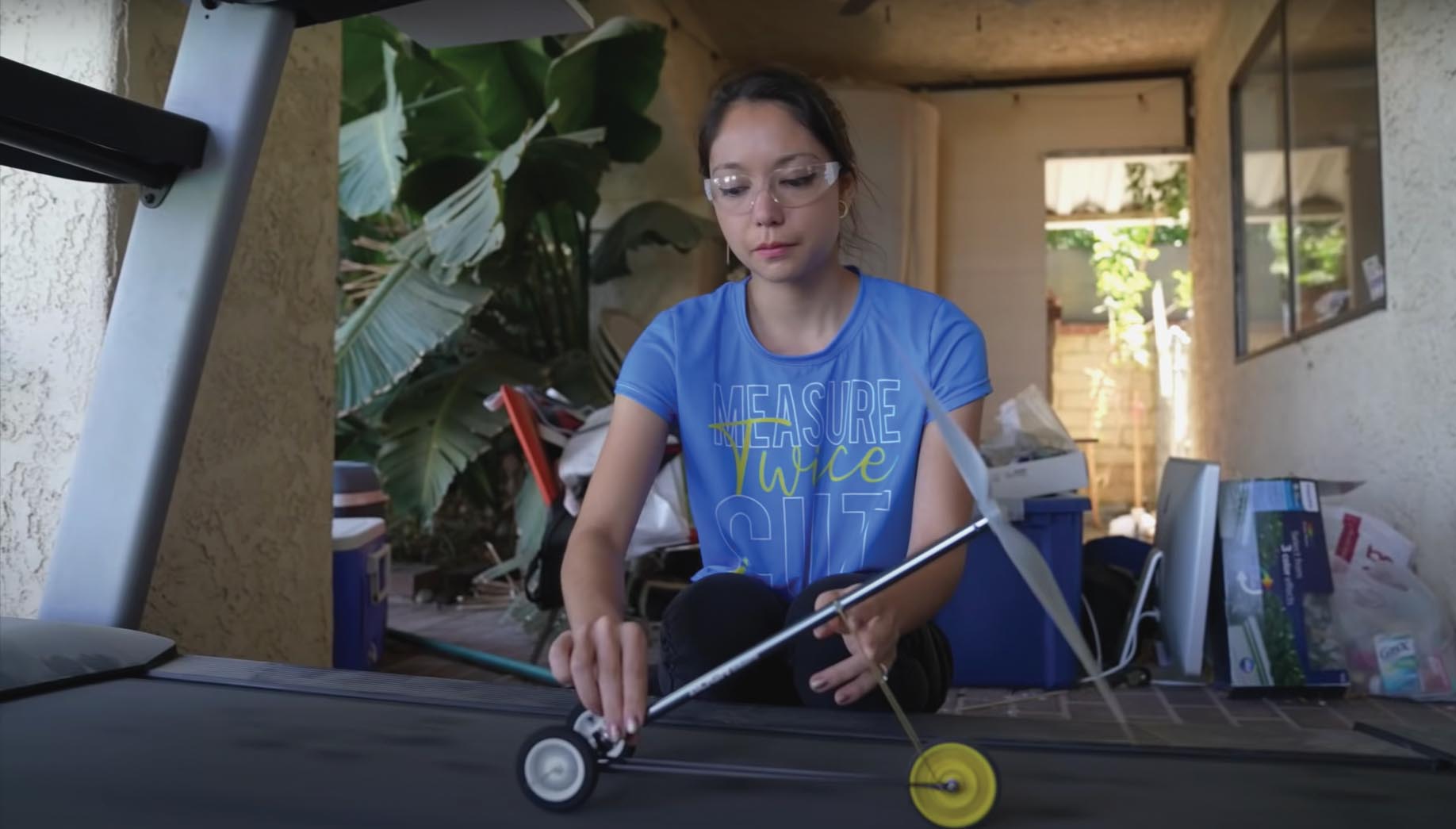
YouTuber Xyla Foxlin places a wind-powered model vehicle on an exercise treadmill and observes the models performance.
A UCLA physics professor believed that what the video supposedly showed was impossible. According to him, the video footage could be explained by factors like gusting winds with variable speeds and different wind speeds at different heights above the ground. The professor bet Muller $10,000 that the Veritasium result would not hold up under careful testing.
To settle the bet, Muller asked engineer Xyla Foxlin (a YouTuber in her own right) to build small-scale models and test them under controlled conditions. Muller believed, based on a mathematical analysis, that even after the factors the professor proposed were eliminated, faster-than-wind travel could still occur. Foxlin’s models confirmed that a wind-driven vehicle traveling directly downwind can indeed exceed the speed of the wind behind it! The professor, graciously, paid up.

A full-size wind-powered vehicle, piloted by a helmeted figure, races across a flat desert floor. The power comes from an enormous propeller atop a tall mast.
Economists work in much the same way as the Veritasium team: they use the scientific method to answer questions about observable phenomena and to explain how the world works. The scientific method consists of four steps:
The economist’s laboratory is the world around us, and it ranges from the economy as a whole to the decisions made by firms and individuals. As a result, economists cannot always design experiments to test their hypotheses. Often, they must gather historical data or wait for real-world events to take place—such as the Great Recession (economic downturn) of 2007–2009 or the coronavirus pandemic of 2020—to better understand the economy. When real-world events meet the criteria of an experiment designed to test a hypothesis, we have what’s called a natural experiment.
As scientists, economists strive to approach their subject with objectivity. They want to understand how the world actually works. It might be nice, for example, if everyone were perfectly altruistic, but the reality is that most people favor their own interests and those of people close to them. For economists, this is a fact to be dealt with, not something to be wished away.
To be as objective as possible, economists deploy positive analysis. A positive statement can be tested and validated. Each positive statement can be thought of as a description of “what is.” For instance, the statement “The unemployment rate is declining” is a positive statement, because it can be tested by gathering data and shown to be true or false.
Incentives
In contrast, a statement about “what ought to be” is a normative statement that cannot be empirically tested or validated. For instance, the statement “An unemployed worker should receive financial assistance to help make ends meet” is a matter of opinion. One can reasonably argue that financial assistance to the unemployed is a socially beneficial anti-poverty measure. However, some argue that financial unemployment assistance provides the wrong incentives. If the assistance is enough to meet basic needs, workers may end up spending more time unemployed than they otherwise would.
Of course, policy decisions eventually have to be made by somebody, one way or the other. Just remember that when we talk about what is “best” or what “should happen,” we are in the realm of differing viewpoints, based on values, beliefs, and opinions.
 Positive vs. Normative Analysis
Positive versus Normative Statements
QUESTION: Which of the following statements are positive and which ones are normative?
 ANSWERS
 ANSWERS:

Basketball player Steph Curry smiling and pointing at someone. He has a towel over his head.
CHALLENGE QUESTIONS: Some statements aren’t simple declarative sentences but instead take the form of hypotheticals. Are the following hypotheticals positive or normative?
ANSWERSANSWERS:
Thinking like an economist means learning how to analyze complex issues and problems. Many economic topics, such as international trade, Social Security, job loss, and inflation, are complicated. To analyze these phenomena and to determine the effect of various government policy options related to them, economists use economic models, which are simplified versions of reality. Models help us analyze the components of the economy.
Let’s return to the example of the wind-powered vehicle driven by Veritasium creator Derek Muller. Using a small-scale model on a treadmill, engineer Xyla Foxlin was able to alter a single variable—for example, propeller size—while keeping other factors, such as wheel size and treadmill speed, the same. Changing one variable while holding everything else constant involves a concept known as ceteris paribus, from the Latin meaning “other things being equal” or “all else equal.”
The ceteris paribus assumption is central to model building. If Foxlin had changed many design elements on the wind-powered model simultaneously and found that the new version worked better, she would have had no way of knowing which change was responsible for the improved performance. For this reason, engineers generally modify only one design element at a time and test only that one element before testing additional elements.
Like Foxlin, economists start with a simplified version of reality. They build models, change one variable at a time, and ask whether the change in the variable has a positive or negative impact on performance. Perhaps the best-known economic model is supply and demand, which we study in Chapter 3.
Models must account for factors we can control (endogenous) and factors we can’t (exogenous). Factors that are accounted for inside the model are endogenous factors. Foxlin’s treadmill setup allowed her to control as many endogenous factors as possible, including wind speed, wheel size, propeller size, propeller pitch, and gear ratio.
Factors beyond our control—outside the model—are exogenous factors. The wind gusts that the UCLA professor thought could explain the faster-than-wind travel in the video were an exogenous factor. They made experiments with a full-sized wind vehicle more challenging.
Building an economic model is remarkably similar to the process Foxlin used. We need to be mindful of three factors: (1) what we include in the model, (2) the assumptions we make when choosing what to include in the model, and (3) the outside conditions that can affect the model’s performance. In the case of the wind-driven vehicle, the design was an endogenous factor, because it was within the designer’s control. In contrast, the weather (wind, air pressure, and other atmospheric conditions) was an exogenous factor, because it could not be controlled.
Because the world is a complex place, a model that works perfectly on a treadmill may not perform reliably when it is exposed to the elements. If we add more exogenous variables, or factors we cannot control—for example, wind and rain—to test our model’s performance, the test becomes more realistic, but at the same time, the outcome becomes less predictable.
When we build a model, we need to make choices about which variables to include. Ideally, we would like to include all the important variables inside the model and exclude all the variables that can safely be ignored. Then we have made reasonable simplifying assumptions. Excluding the wrong variables, on the other hand, can lead to spectacular failures. So can making false assumptions. An excellent example is the financial crisis and Great Recession that began in December 2007.

Three 100 dollar bills folded and stacked into a house shape.
In the years leading up to the crisis, banks sold and repackaged mortgage-backed investments under the faulty assumption that real estate prices will always rise. This assumption seemed perfectly reasonable in a world where real estate prices were rising annually. Unfortunately, the assumption turned out to be false. From 2007 to 2008, real estate prices fell dramatically. Because of one faulty assumption, the entire financial market teetered on the edge of collapse. Shocks, be they financial or pandemic-related, often defy the usual logic. Contrary to conventional wisdom, the real estate market did not crater during the pandemic, but instead it skyrocketed in 2020–2021, as the pandemic caused people to hunker down and invest more in their homes.
Throughout this textbook we will assume that firms and households are rational benefit-maximizers who both respond to incentives predictably and thoughtfully consider the costs and benefits of their actions. Rationality is a cornerstone of most economic theory. It’s a simplifying assumption, and in Chapter 17 we will see how it sometimes fails in real life, but for the most part we treat it as “true enough.”
ECONOMISTS INVESTIGATE: ARE CRIMINAL SENTENCES FAIR?
Two European lawyers in robes sit at a courtroom table.
Ideally, the outcome of a criminal trial should depend only on the evidence at hand, not on irrelevant events outside the courtroom. But is that how things work in practice? In France, economists Arnaud Philippe and Aurélie Ouss obtained some unexpected, unsettling results when they examined the impact of television news coverage of crimes on juries’ sentencing decisions.
Philippe and Ouss used the scientific method. Specifically: they focused on something of interest, namely the potential influence of crime stories in the media on juries’ sentencing deliberations.
Philippe and Ouss found that in France, coverage of crime on television leads to longer sentences for those convicted of a misdeed. What is particularly interesting is that the coverage on TV does not need to be related to the specific case a jury is hearing. If the media covers a story about any crime the day before a verdict, the average sentence handed down by a jury is, on average, 3 months longer than if there is no media coverage.
Here is something else that’s interesting: while juries were found to be influenced by what they saw on the evening news, judges were not. If a sentence was decided by a judge rather than by a jury, there was no discernable difference in the length of a sentence.
Source: Arnaud Philippe and Aurélie Ouss, “‘No Hatred or Malice, Fear or Affection’: Media and Sentencing,” Journal of Political Economy 126, no. 5 (October 2018): 2134–2178, https://doi.org/10.1086/699210.