How Do Supply and Demand Interact to Create Equilibrium?

We have examined supply and demand separately. Now it is time to see how the two interact. The real power of supply and demand analysis is in how well it predicts prices and output in the entire market.

Supply, Demand, and Equilibrium

Let’s consider the market for salmon again. This example meets the conditions for a competitive market because the salmon sold by one vendor is essentially the same as the salmon sold by another, and there are many individual buyers.

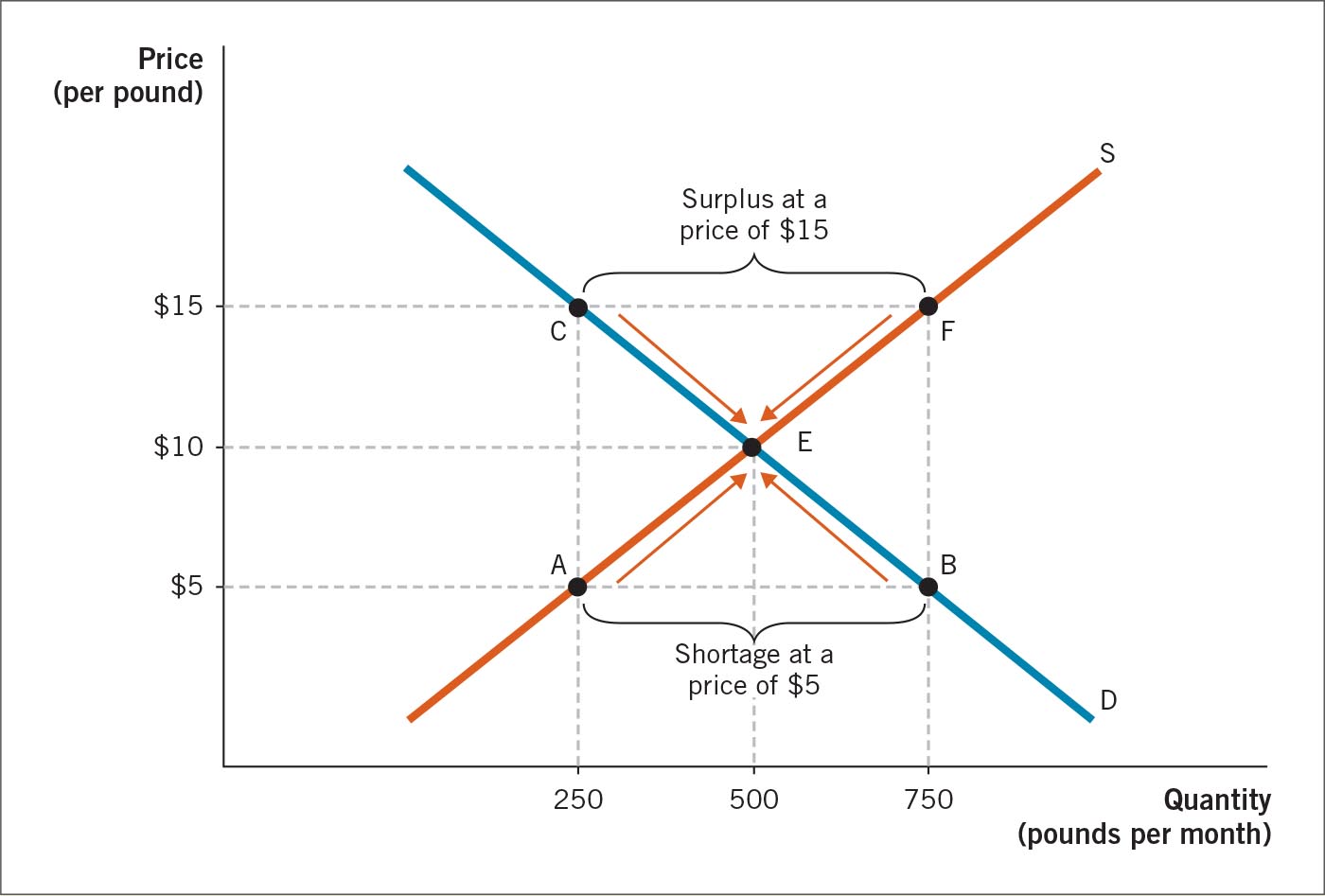
In Figure 3.9, we see that when the price of salmon fillets is $10 per pound, consumers demand 500 pounds and producers supply 500 pounds. This situation is represented graphically at point E, known as the point of equilibrium, where the demand curve and the supply curve intersect. At this point, the two opposing forces of supply and demand are perfectly balanced.

Notice that at $10 per pound, the quantity demanded equals the quantity supplied. At this price, and only this price, the entire supply of salmon in the market is sold. Moreover, every buyer who wants salmon is able to find some and every producer is able to sell his or her entire stock. We say that $10 is the equilibrium price because the quantity supplied equals the quantity demanded. The equilibrium price is also called the market-clearing price, because this is the only price at which no surplus or shortage of the good exists. Similarly, there is also an equilibrium quantity at which the quantity supplied equals the quantity demanded (in this example, 500 pounds). When the market is in equilibrium, we sometimes say that the market clears or that the price clears the market.

The equilibrium point has a special place in economics because movements away from that point throw the market out of balance. The equilibrium process is so powerful that it is often referred to as the law of supply and demand, the idea that market prices adjust to bring the quantity supplied and the quantity demanded into balance.

FIGURE 3.9

The Salmon Market

At the equilibrium point, E, quantity supplied and quantity demanded are perfectly balanced. At prices above the equilibrium price, a surplus exists. At prices below the equilibrium price, a shortage exists.

Supply and Demand curves for the Salmon Market.
More information

Supply and Demand curves for the Salmon Market. Quantity in pounds per month is on the x axis and Price per pound is on the y axis. The demand curve, D, is linear with a negative slope, and the supply curve, S, is linear with a positive slope. The supply and demand curves intersect at point E, where the equilibrium price is 10 dollars and equilibrium quantity is 500. Above the equilibrium point are two points C and F, and between these points is a surplus at a price of 15 dollars. Below the equilibrium point are two points A and B, and between these points is a shortage at a price of 5 dollars. Four arrows pointing inwards to the equilibrium point, E, indicate that the market will balance towards equilibrium if market conditions are set below or above the equilibrium point.

SHORTAGES AND SURPLUSES

How does the market respond when it is not in equilibrium? Let’s look at two other prices for salmon shown on the y axis in Figure 3.9: $5 per pound and $15 per pound.

At a price of $5 per pound, salmon is quite attractive to buyers but not very profitable to sellers. The quantity demanded is 750 pounds, represented by point B on the demand curve (D). However, the quantity supplied, which is represented by point A on the supply curve (S), is only 250 pounds. So at $5 per pound there is an excess quantity of 750 − 250 = 500 pounds demanded. This excess demand creates disequilibrium in the market.

When there is more demand for a product than sellers are willing or able to supply, we say there is a shortage. A shortage, or excess demand, occurs whenever the quantity supplied is less than the quantity demanded. In our case, at a price of $5 per pound of salmon, there are three buyers for each pound. New shipments of salmon fly out the door, providing a strong signal for sellers to raise the price. As the market price increases in response to the shortage, sellers continue to increase the quantity they offer. You can see the increase in quantity supplied on the graph in Figure 3.9 by following the upward-sloping arrow from point A to point E. At the same time, as the price rises, buyers demand an increasingly smaller quantity, represented by the arrow from point B to point E along the demand curve. Eventually, when the price reaches $10 per pound, the quantity supplied and the quantity demanded are equal. The market is in equilibrium.

What happens when the price is set above the equilibrium point—say, at $15 per pound? At this price, salmon is quite profitable for sellers but not very attractive to buyers. The quantity demanded, represented by point C on the demand curve, is 250 pounds. However, the quantity supplied, represented by point F on the supply curve, is 750 pounds. In other words, sellers provide 500 pounds more than buyers wish to purchase. This excess supply creates disequilibrium in the market. Any buyer who is willing to pay $15 for a pound of salmon can find some because there are 3 pounds available for every customer. A surplus, or excess supply, occurs whenever the quantity supplied is greater than the quantity demanded.

When there is a surplus, sellers realize that salmon has been oversupplied, giving them a strong signal to lower the price. As the market price decreases in response to the surplus, more buyers enter the market and purchase salmon. Figure 3.9 represents this situation on the demand side by the downward-sloping arrow moving from point C to point E along the demand curve. At the same time, sellers reduce output, represented by the arrow moving from point F to point E on the supply curve. As long as the surplus persists, the price will continue to fall. Eventually, the price reaches $10 per pound. At this point, the quantity supplied and the quantity demanded are equal and the market is in equilibrium again.

In competitive markets, surpluses and shortages are resolved through the process of price adjustment. Buyers who are unable to find enough salmon at $5 per pound compete to find the available stocks; this competition drives the price up. Likewise, businesses that cannot sell their product at $15 per pound must lower their prices to reduce inventories; this desire to sell all inventory drives the price down.

Every seller and buyer has a vital role to play in the market. Venues like the Pike Place Market bring buyers and sellers together. Amazingly, market equilibrium occurs without the need for government planning to ensure an adequate supply of the goods consumers want or need. You might think that a decentralized system would create chaos, but nothing could be further from the truth. Markets work because buyers and sellers can rapidly adjust to changes in prices. These adjustments bring balance. When markets were suppressed in communist countries during the twentieth century, shortages were commonplace, in part because there was no market price system to signal that additional production was needed.

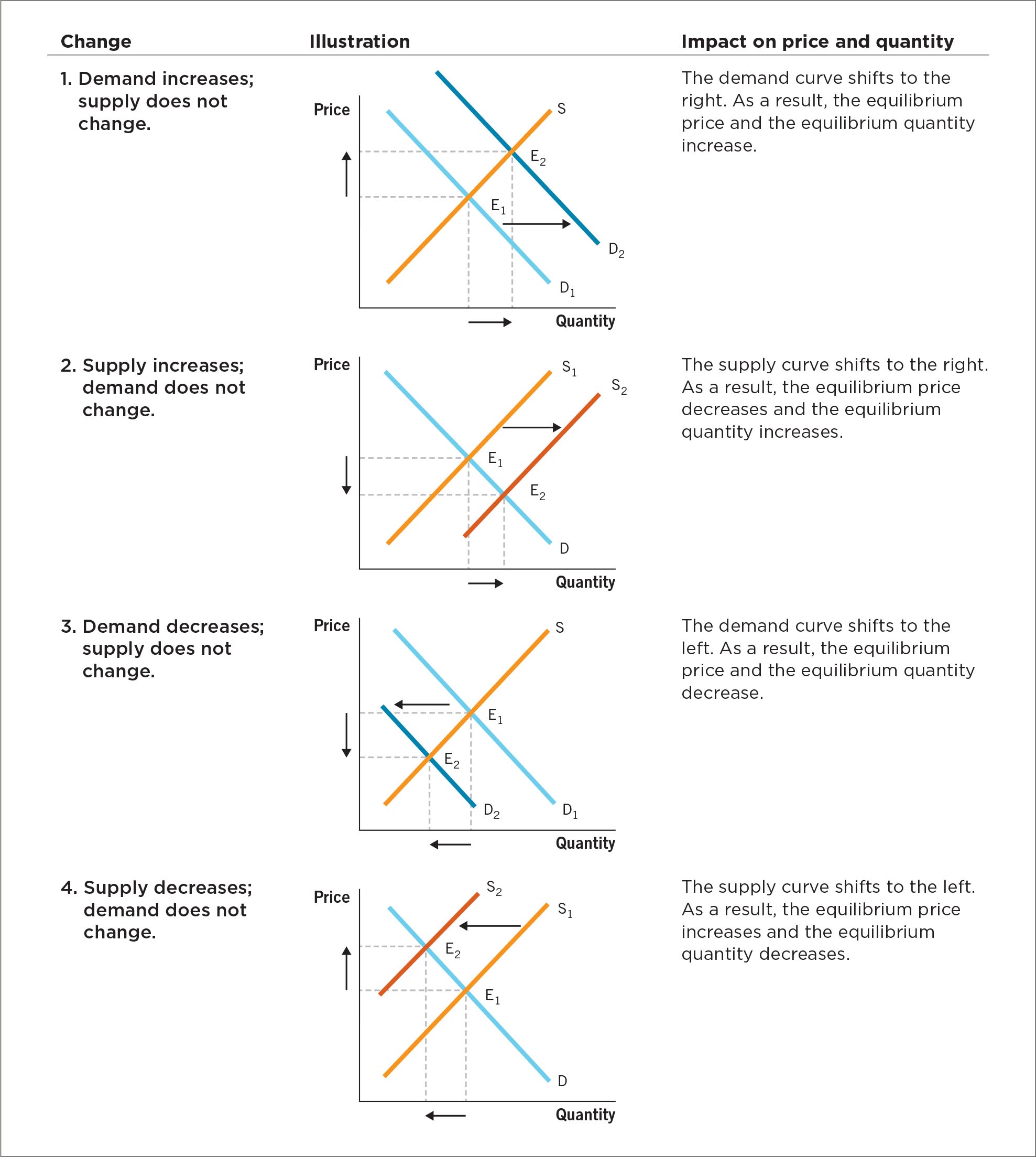
In summary, Figure 3.10 provides four examples of what happens when either the supply curve or the demand curve shifts. As you study these examples, you should develop a sense for how price and quantity are affected by changes in supply and demand. When one curve shifts, we can make a definitive statement about how price and quantity will change.

In Appendix 3A, we consider what happens when supply and demand change at the same time. There you will discover the challenges in simultaneously determining price and quantity when more than one variable changes.
PRACTICE WHAT YOU KNOW

Bacon: Supply and Demand

QUESTION: Suppose that the government decides to subsidize bacon producers. What is the impact on the equilibrium market price and output?

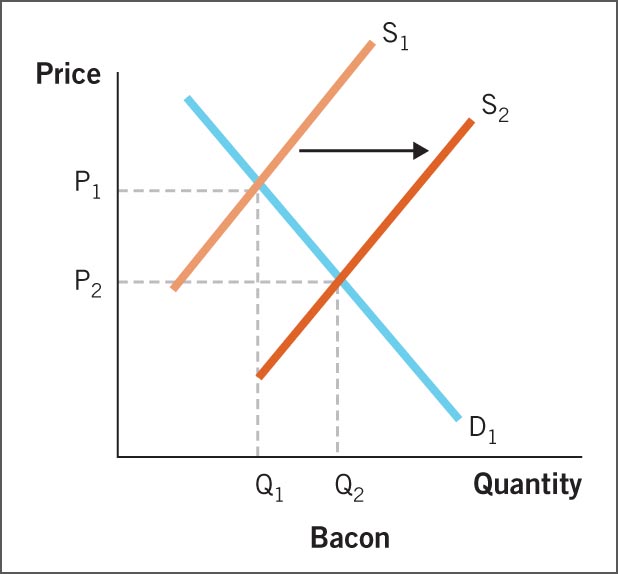
ANSWERANSWER: In order to answer this question, you first need to determine whether the supply curve or the demand curve shifts in response to the subsidy. Since the subsidy is given to the bacon producers, the supply curve shifts out. The end result is that the market price falls to P2 and the market output increases to Q2.
Supply and demand curves for bacon.
More information

A supply and demand curve for bacon. The x axis is quantity and the y axis is price. There is one demand curve and two supply curves. Supply 1 shifts to the right to supply 2. There are two equilibriums, the first equilibrium point is quantity 1 and price 1 and the second equilibrium point is quantity 2 and price 2.

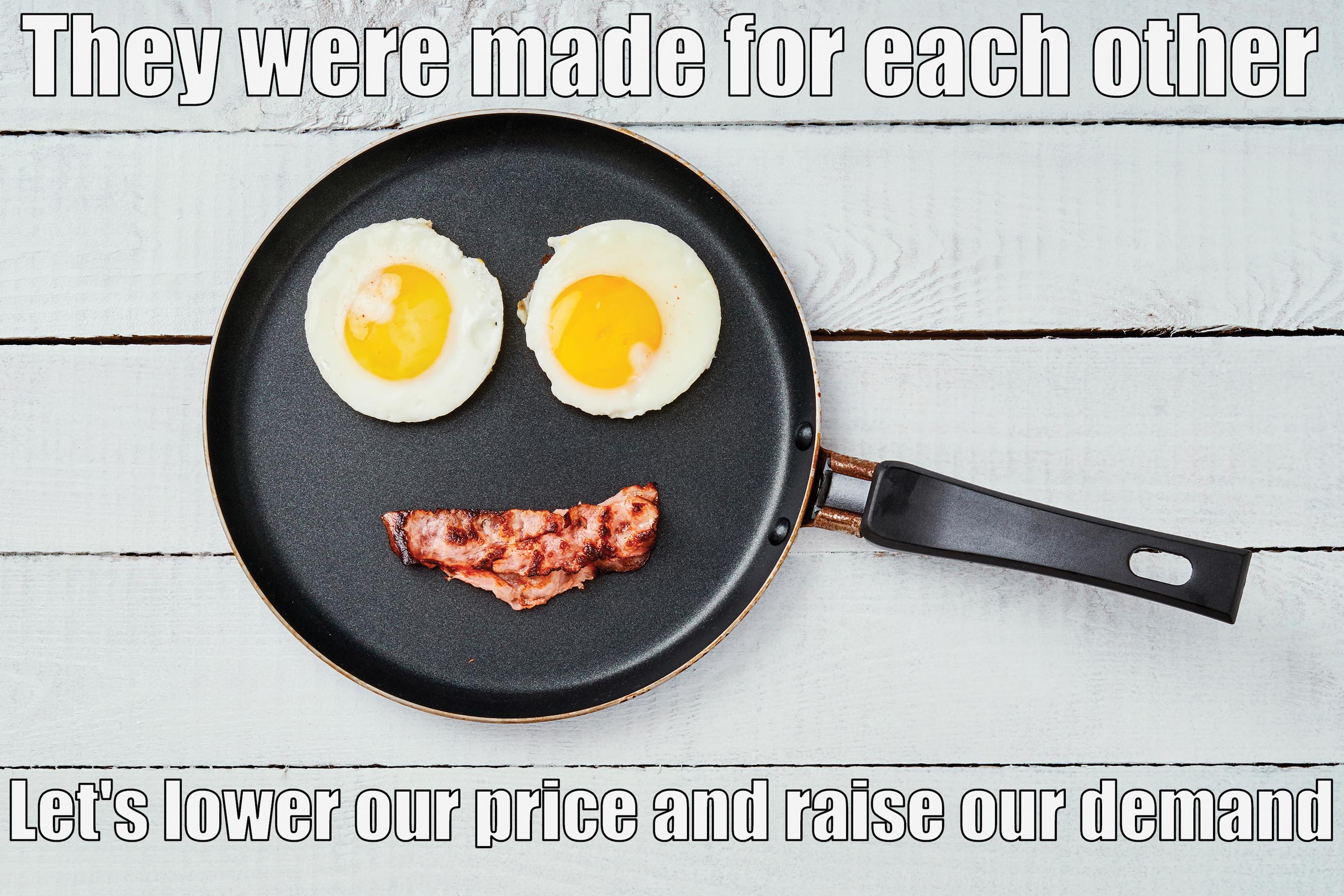
CHALLENGE QUESTION: Is the statement in the meme true or false?

Two eggs served sunny side up and a strip of bacon in a frying pan.
More information

Two eggs served sunny side up and a strip of bacon in a frying pan. The caption reads: they were made for each other, lets lower our price and raise our demand.

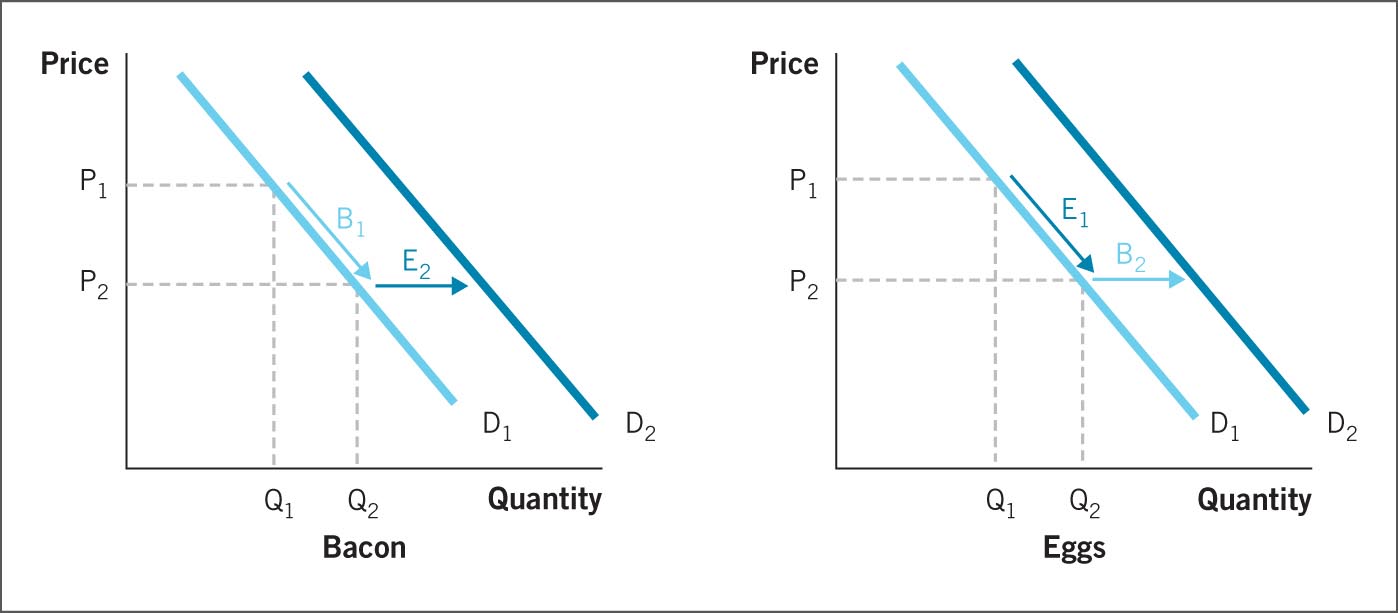
ANSWERANSWER: By now you should know that a price decrease causes a change in the quantity demanded, not a change in demand. Therefore, you might be tempted to judge the meme false. But if you did, you would be wrong! Let’s see why. The first step is recognizing that bacon and eggs are complements. Therefore, a reduction in the price of the one increases the demand for the other. Recall that a reduction in the price of a complementary good shifts the demand curve to the right. The second step is to look at this graphically (see the graphs below). Using the color-coded letters, we see that (B1) the price drop on bacon causes an increase in the quantity demanded of bacon (a slide along the existing demand curve) and (E2) since consumers buy more bacon than before, this increases the demand for eggs (demand shifts to the right) in the egg market. At the same time, (E1) the price drop on eggs causes an increase in the quantity demanded of eggs (a slide along the existing demand curve) and (B2) since consumers buy more eggs than before, this increases the demand for bacon (demand shifts to the right) in the bacon market. We model this by showing the two related markets, bacon and eggs, side by side so you can see how a price reduction of the related goods increases the “demand for each other.” Since both curves shift out, the meme is true.
Two demand curves shows the demand shift for bacon and eggs.
More information

Two demand curves shows the demand shift for bacon and eggs. The x axis is quantity and the y axis is price. Both demand curves for bacon and eggs shift to the right. The quantity demanded for bacon and eggs increase from Q1 to Q2 as the price decreases from upper P subscript 1 to upper P subscript 2.

FIGURE 3.10

Price and Quantity When Either Supply or Demand Changes

A table of the different possible results from a shift in demand or supply.
More information

A table with 3 columns and 5 rows with the following column headers: change, illustration, and impact on price and quantity. Each illustration is a graph with supply and demand curves showing equilibrium points with quantity on the x axis and price on the y axis with linear supply curves (S), and demand curves (D) which intersect at equilibrium points (E).

ECONOMICS for LIFE

Bringing Supply and Demand Together: Advice for Buying Your First Home

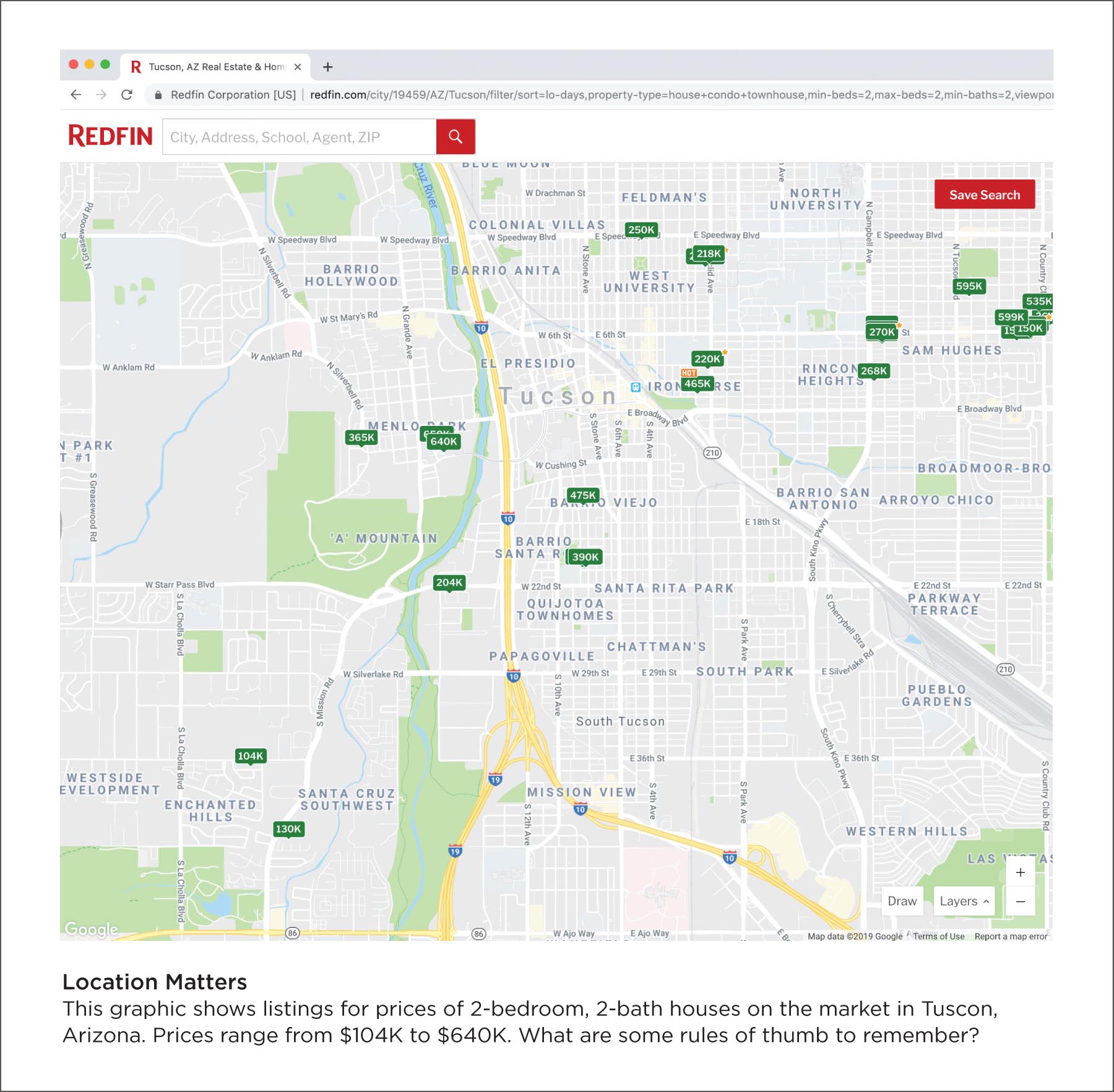
  • The first rule of real estate is “location, location, location.”
  • Consider the school district, even if you don’t have children, because properties in better districts command higher prices.
  • A home along a busy street may sell for half the price of a similar property a few blocks away that backs up to a quiet park.

There are a number of popular HGTV shows, such as Flip or Flop, Property Brothers, Love It or List It, and House Hunters, that help viewers become better informed about the process of buying a home. If you have seen any of these shows, or almost any show on HGTV involving buying or fixing up a property, you know that watching an episode is one of the best lessons in economics you will ever get.

One real estate adage you’re eventually bound to pick up, if you watch one of these shows long enough, is “location, location, location.” Why does location matter so much? Simple. Supply and demand. There are only so many places to live in any given location—that is the supply. The most desirable locations have many buyers who’d like to purchase in that area—that is the demand.

Consider for a moment all of the variables that can influence where you want to live. As you’re shopping for your new home, you may want to consider proximity to where you work and your favorite restaurants, public transportation, and the quality of the schools. You’ll also want to pay attention to the crime rate, differences in local tax rates, traffic concerns, noise issues, and zoning restrictions. In addition, many communities have restrictive covenants that limit how owners can use their property. Smart buyers determine how the covenants work and whether they would be happy to give up some freedom in order to maintain an attractive neighborhood. Finally, it is always a good idea to visit the neighborhood in the evening or on the weekend to meet your future neighbors before you buy. All of these variables determine the demand for any given property.

The Property Brothers pose for a picture in front of an H G T V sign.
More information

The Property Brothers pose for a picture in front of an H G T V sign.

Once you’ve done your homework and settled on a neighborhood, you will find that property values can vary tremendously across very short distances. A home along a busy street may sell for half the price of a similar property a few blocks away that backs up to a quiet park. Properties near a subway line command a premium, as do properties with views or close access to major employers and amenities (such as parks, shopping centers, and places to eat). Here is the main point to remember, even if some of these things aren’t important to you: when it comes time to sell, the location of the home will always matter. The number of potential buyers depends on the characteristics of your neighborhood and the size and condition of your property. If you want to be able to sell your home easily, you’ll have to consider not only where you want to live now but who might want to live there in the future.

All of this discussion brings us back to supply and demand. The best locations are in short supply and high demand. The combination of low supply and high demand causes property values in those areas to rise. Likewise, less desirable locations have lower property values because demand is relatively low, and the supply is relatively high. Because first-time buyers often have wish lists that far exceed their budgets, considering the costs and benefits will help you find the best available property.

The Redfin website displays a map with house listings available in a specific area.
More information

The Redfin website displays a map with house listings available in a specific area.

Glossary

Equilibrium
Equilibrium occurs at the point where the demand curve and the supply curve intersect.
equilibrium price
The equilibrium price is the price at which the quantity supplied is equal to the quantity demanded. It is also known as the market-clearing price.
equilibrium quantity
The equilibrium quantity is the amount at which the quantity supplied is equal to the quantity demanded.
law of supply and demand
The law of supply and demand states that the market price of any good will adjust to bring the quantity supplied and the quantity demanded into balance.
shortage
A shortage occurs whenever the quantity supplied is less than the quantity demanded. A shortage is also called excess demand.
surplus
A surplus occurs whenever the quantity supplied is greater than the quantity demanded. A surplus is also called excess supply.