Learning Objectives
- Identify the three primary goals of science.
- Describe the scientific method.
- Differentiate among theories, hypotheses, and research.
Psychology is a science. As scientists, psychologists gain accurate knowledge about behavior and mental processes only by observing the world and measuring aspects of it. This approach is called empiricism. Empirical research involves data collection and analysis and requires carefully planned, systematic steps. Using the methods of science allows psychologists to be confident that empirical results provide a true understanding of mental activity and behavior.
There are three primary goals of science: description, prediction, and explanation. Psychological science uses research to describe what a phenomenon is, predict when and where it will occur, and explain the mechanisms behind why it occurs. For example, consider the observation that people vape even though they know it can be harmful. To understand how this behavior happens, we need to address each of the three goals.
We begin by asking: How many people really use e-cigarettes, and are they aware of the harms? Answering this question can help us describe the phenomenon of vaping tobacco products, specifically measuring the prevalence of this unsafe behavior. Related descriptive questions are: What are people’s beliefs about vaping? How did they start? Answering these questions can help us predict who is more likely to vape and what causes them to begin in the first place.

Next, what psychological processes give rise to the decision to start vaping? Answering this question can help us understand the causal factors that explain why people vape. Ultimately, knowing about the causes of vaping can help inform prevention and treatment programs that will benefit public health. Psychological questions relevant to treatment include: What are the psychological aspects of quitting that such programs can target? Which people at risk to begin vaping would benefit most from prevention programs?
Careful scientific study also enables us to understand other aspects of e-cigarette use, such as why people do it in the first place. Understanding how e-cigarette use is harmful and why people continue do it, even when they know it is dangerous, will enable scientists, the medical community, and policymakers to develop strategies to reduce the behavior.
SCIENTIFIC METHOD Scientific evidence obtained through empirical research is considered the best possible evidence for supporting a claim. Research involves the careful collection, analysis, and interpretation of data, which are measurements gathered during the research process. In conducting research, scientists follow a systematic procedure called the scientific method. This procedure begins with the observation of a phenomenon and the question of why that phenomenon occurred.
THE ROLE OF THEORY The scientific method is an interaction among research, theories, and hypotheses (FIGURE 2.2). A theory is an explanation or model of how a phenomenon works. Consisting of interconnected ideas or concepts, a theory is used to explain prior observations and to make predictions about future events. A hypothesis is a specific, testable prediction, narrower than the theory it is based on.
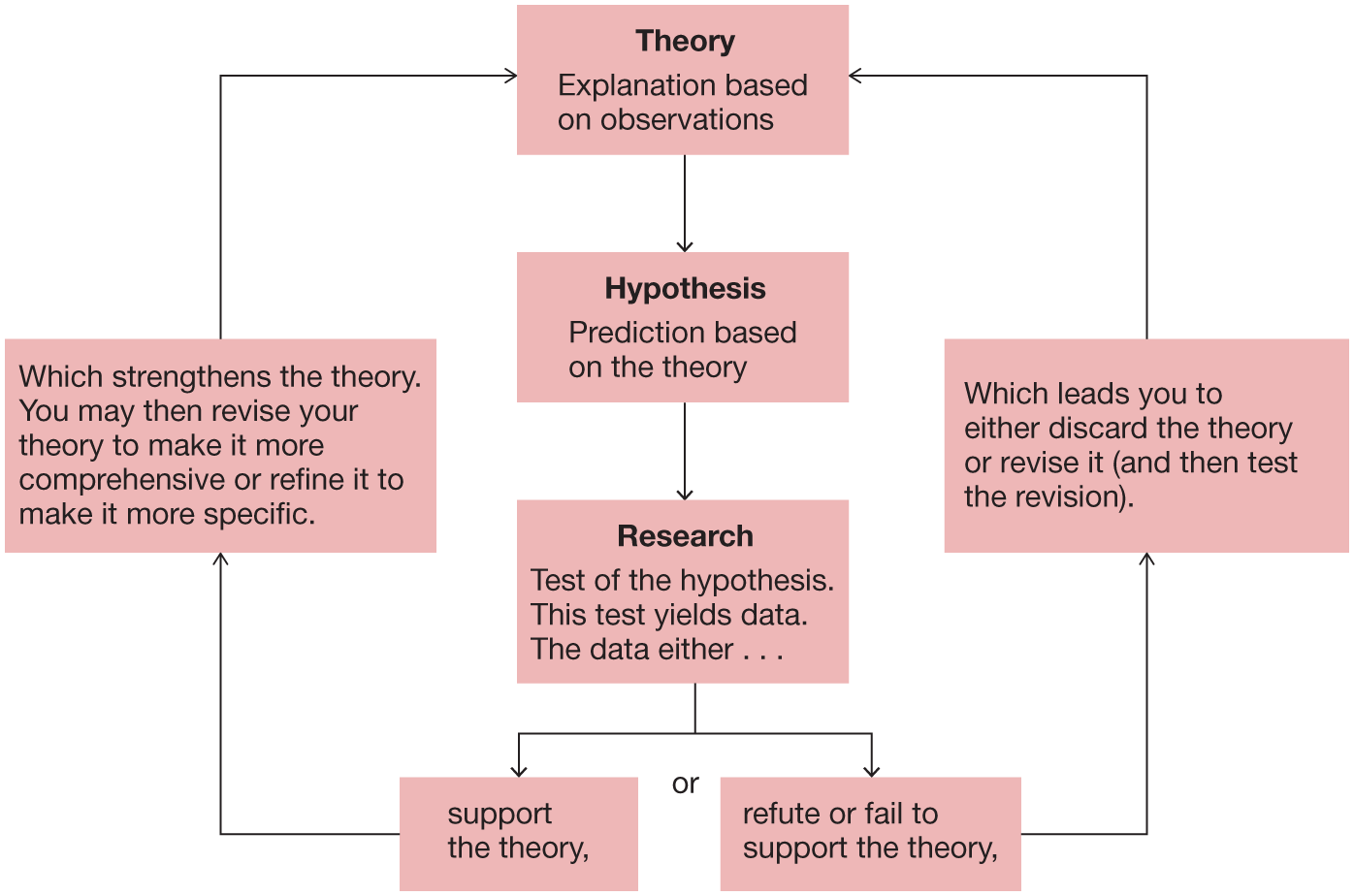
FIGURE 2.2
The Scientific Method
The scientific method is a cyclical process: A theory is generated based on evidence from many observations and refined based on hypothesis tests (scientific studies). The theory guides scientists in casting one or more testable hypotheses. Scientists then conduct research to test the hypotheses. Sound research produces findings that will prompt scientists to reevaluate and adjust the theory. A good theory evolves over time, and the result is an increasingly accurate model of some phenomenon.
How can we know whether a theory is good? The best theories are those that produce a wide variety of testable hypotheses. An especially important feature of good theories is that they should be falsifiable. That is, it should be possible to test hypotheses that show the theory is wrong. For example, a theory of cognitive development might predict that basic numerical skills such as counting must develop before more advanced skills such as subtraction. Evidence that children can subtract before they can count would falsify the claim, calling the theory into question. Falsifiable theories help advance science because our understanding of a phenomenon is enhanced both when evidence supports a theory and when it does not.
Good theories also tend toward simplicity. This idea has historical roots in the writings of the fourteenth-century English philosopher William of Occam. Occam proposed that when two competing theories exist to explain the same phenomenon, the simpler of the two theories is generally preferred. This principle is known as Occam’s razor or the law of parsimony. There is little need for more-complex theories if a simple one captures the data.