What Types of Studies Are Used in Psychological Research?
Learning Objectives
Distinguish among descriptive studies, correlational studies, and experiments.
List the advantages and disadvantages of different research methods.
Explain the difference between random sampling and random assignment, and explain when each might be important.
Once a researcher has defined a hypothesis, the next issue to be addressed is the type of research method to be used. There are three main types of research methods: descriptive, correlational, and experimental. These methods differ in the extent to which the researcher has control over the variables in the study. The amount of control over the variables in turn determines the type of conclusions the researcher can draw from the data.
2.5Descriptive Research Consists of Case Studies, Observation, and Self-Report Methods
Descriptive research involves observing behavior to describe that behavior objectively and systematically. Descriptive research helps psychologists achieve the scientific goals of describing human mental life and behavior and (sometimes) predicting when or how behaviors might occur. However, by nature, descriptive research cannot achieve the goal of explanation. Only the experimental method, described later in this chapter, can do that.
Descriptive methods are widely used to assess many types of behavior. For example, an observer performing descriptive research might record the types of foods that people eat in cafeterias, count the number and types of behaviors that penguins engage in during their mating season, or tally the number of times poverty or mental illness is mentioned during a presidential debate. Each of these observations offers important information that can be used to describe current behavior and even predict future behavior.
There are three basic types of descriptive research methods: case studies, observations, and self-report methods and interviews.
CASE STUDIES A case study is the intensive observation, recording, and description of an atypical person or organization. Individuals might be selected for intensive study if they have a special or unique aspect, such as an exceptional memory, a rare disease, or a specific type of brain damage. An organization might be selected for intensive study because it is doing something very well (such as making a lot of money) or very poorly (such as losing a lot of money). The goal of a case study is to describe the events or experiences that led up to or resulted from the exceptional feature of the person or organization.
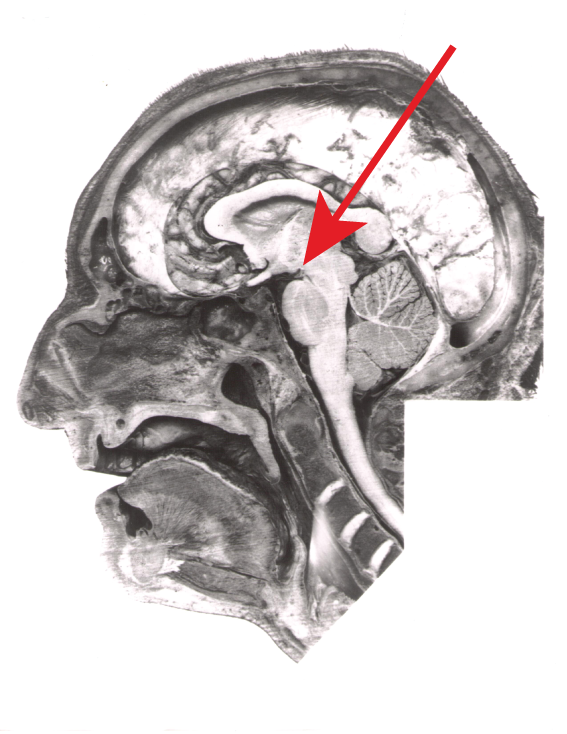
FIGURE 2.8
Case Study Data
The damage in this region to Patient N.A. provided new insights into how the brain creates memories.
One famous case study in psychological science involves a young American man, referred to as N.A., whose unusual injury impaired his memory (Squire, 1987). After a brief stint in college, N.A. joined the Air Force and was stationed in the Azores. One night, he was assembling a model airplane in his room. His roommate was joking around with a miniature fencing foil, pretending to jab at the back of N.A.’s head. When N.A. turned around suddenly, his roommate accidentally stabbed him through the nose and up into his brain (FIGURE 2.8). Although N.A. seemed to recover from his injury in most ways, he developed extreme problems remembering events that occurred after the injury. He could remember events before his accident, but he simply could not remember new information. He had trouble watching television because he would forget the story lines, and he had difficulty having conversations because he would forget what others had just said. The case study of N.A. spurred researchers to generate new hypotheses about how the brain supports memory.
FIGURE 2.9
Participant Observation
Researchers can study human behavior by observing it in the world. Scientists have learned which factors contribute to youth smoking by observing children and teenagers at tobacco points of sale.
Not all people with brain injuries suffer the same types of challenges as N.A. Such differences highlight the major limitation with case studies. Because only one person or organization is the focus of a case study, scientists cannot tell from that study if the same thing would happen to other people or organizations who have the same experiences. The findings from case studies do not necessarily generalize, or apply to the general population.
OBSERVATIONAL STUDIES Two main types of observational techniques are used in research: participant observation and naturalistic observation. In participant observation (FIGURE 2.9), the researcher is involved in the situation. In naturalistic observation (FIGURE 2.10), the observer is passive, remains separated from the situation, and makes no attempt to change or alter ongoing behavior.
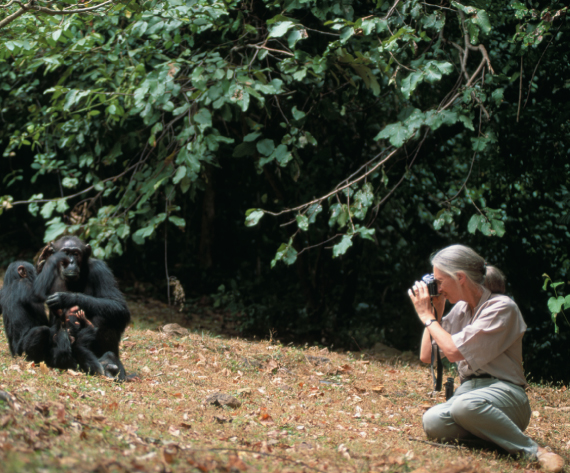
FIGURE 2.10
Naturalistic Observation
Using naturalistic observation, the primatologist Jane Goodall observes a family of chimpanzees. Animals are more likely to act naturally in their native habitats than in captivity.
Observation in the scientific sense involves systematically assessing and coding overt behavior. Suppose you hear that one popular student in a middle school dissuaded her entire class from using e-cigarettes. You develop the hypothesis that people with high status within a social network can be exceptionally influential on the behavior of others. How would you operationally define “high status”? How would you measure someone’s being “exceptionally influential”? Once you have defined your terms, you collect data by observing the behavior of students in a middle school. Then you need to code the behaviors you observe. This coding might involve narrative summaries of patterns of behavior. Alternatively, you could count the number of times students mimic the behavior of high-status individuals after interacting with them. You might then compare how often students mimic after interacting with more versus less popular peers. Indeed, research has shown that the behavior of an entire school class can be altered by changing the behavior of just a few high-status people (Paluck et al., 2016).
SELF-REPORTS AND INTERVIEWS Ideally, observation is an unobtrusive approach to studying behavior. By contrast, asking people about themselves, their thoughts, their actions, and their feelings is a much more interactive way of collecting data. Methods of posing questions to participants include surveys, interviews, and questionnaires. The type of information sought can range from demographic facts (e.g., ethnicity, age, religious affiliation) to past behaviors, personal attitudes, beliefs, and so on: “Have you ever used an illegal drug?” “Should people who drink and drive be jailed for a first offense?” “Are you comfortable sending food back to the kitchen in a restaurant when there is a problem?” Questions such as these require people to recall certain events from their lives or reflect on their mental or emotional states.
Self-report methods, such as surveys or questionnaires, can be used to gather data from a large number of people in a short time. Responses can be invited in person or via the internet, phone, or mail from a sample drawn from the population of interest. Self-report surveys are easy to administer and cost-efficient. Responses on surveys are usually numeric, for instance on a 1-to-5 scale of liking, or short answer.
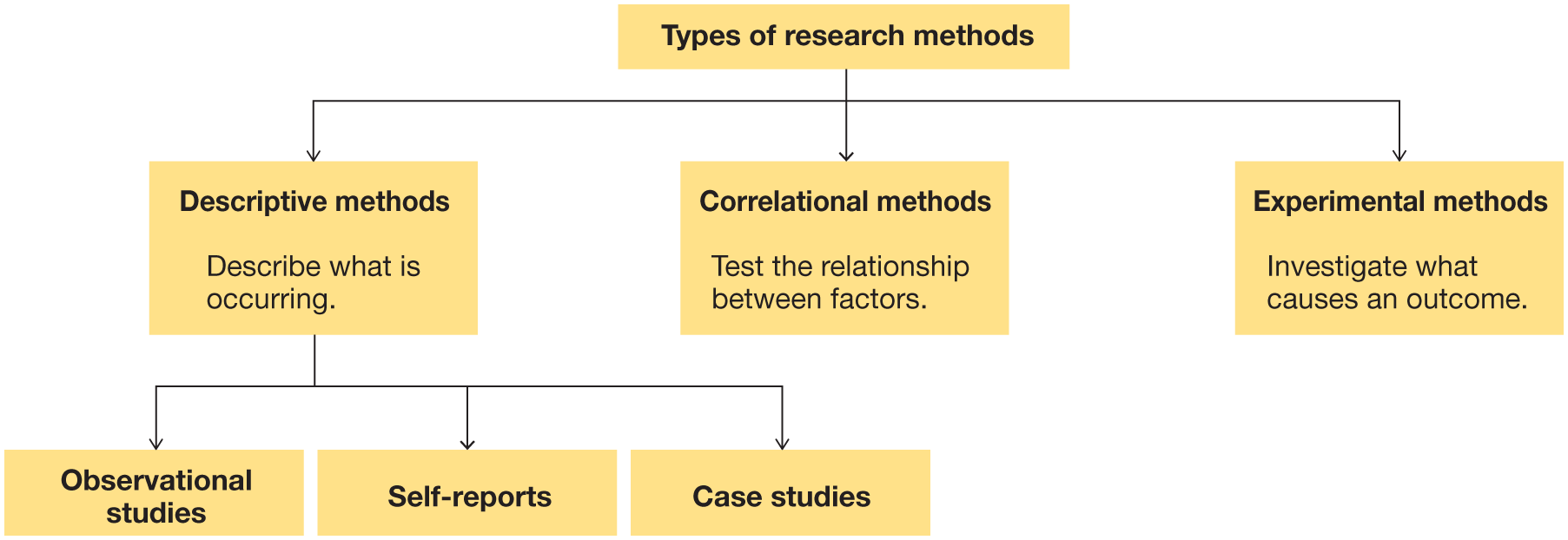
Interviews, another type of interactive method, can be used successfully with groups that cannot be studied through surveys or questionnaires, such as young children. Responses to interviews are typically spoken or written in sentences or paragraphs. Interviews are also helpful in gaining a more in-depth view of a respondent’s opinions, experiences, and attitudes. Thus, the answers from interviewees sometimes inspire avenues of inquiry that the researchers had not planned. Detailed interviews are a method that psychologists have in common with sociologists, who also use interviews to learn about a given culture or group of people. (For a recap of the types of research methods, see FIGURE 2.11.)
A type of descriptive study in which the researcher is a passive observer, separated from the situation and making no attempt to change or alter ongoing behavior.