Learning Objectives
- Identify ethical issues associated with conducting psychological research on human participants.
- Identify the key issues regarding the humane treatment of animal subjects.
Psychologists have a responsibility to carefully consider the ethics of the research they conduct. Will the study contribute to the betterment of humanity? Do participants understand what exactly they are agreeing to do? Are the requests reasonable, or will they put the participants in danger of physical or emotional harm over the short or long term? If animals are involved, will they be treated humanely? Is their use justified?
Psychological science could not happen without human participants. However, there are limits to how researchers can manipulate what people do in studies. As noted in the section on correlations, there are ethical reasons why researchers cannot always use the experimental method. And there are some aspects of human experience that are unethical to study in the lab, with or without experimental designs. For example, it would be unethical to randomly assign people to drink and drive to study the effect of intoxication on driving ability. In studying severe psychopathology, it would be unethical to conduct even an observational study on self-injurious behavior because any observer would have the obligation to intervene.

FIGURE 2.21
Belmont Report
Following horrific examples of abuses of human subjects by researchers, the National Commission for the Protection of Human Subjects of Biomedical and Behavioral Research issued the Belmont Report, which described the key ethical principles that should guide all research using human participants.
In 1979, the National Commission for the Protection of Human Subjects of Biomedical and Behavioral Research issued the Belmont Report, describing three fundamental ethical principles that all human subjects research should uphold: respect for persons, beneficence, and justice (FIGURE 2.21).
RESPECT FOR PERSONS People who participate in research must retain their autonomy when deciding to participate and throughout the duration of the psychological study. Respecting the autonomy of research participants means ensuring that they know what will happen to them during the study and that they have control over their personal information. Informed consent is the ongoing process of ensuring that participants understand what they are asked to do and actively agree to it. Compensating people with either money or course credit for their participation in research does not alter this fundamental right. Ethical standards require giving people all relevant information that might affect their willingness to participate (FIGURE 2.22).
It is not always possible to inform participants fully about a study’s details. If knowing the study’s specific goals may alter the participants’ behavior, thereby rendering the results meaningless, researchers may need to use deception. That is, they might mislead the participants about the study’s goals or not fully reveal what will take place. Researchers use deception only when other methods are not appropriate and when the deception does not involve situations that would strongly affect people’s willingness to participate. If deception is used, a careful debriefing must take place after the study’s completion, in which the researchers inform the participants of the study’s goals. They also explain the need for deception to eliminate or counteract any negative effects it produces.
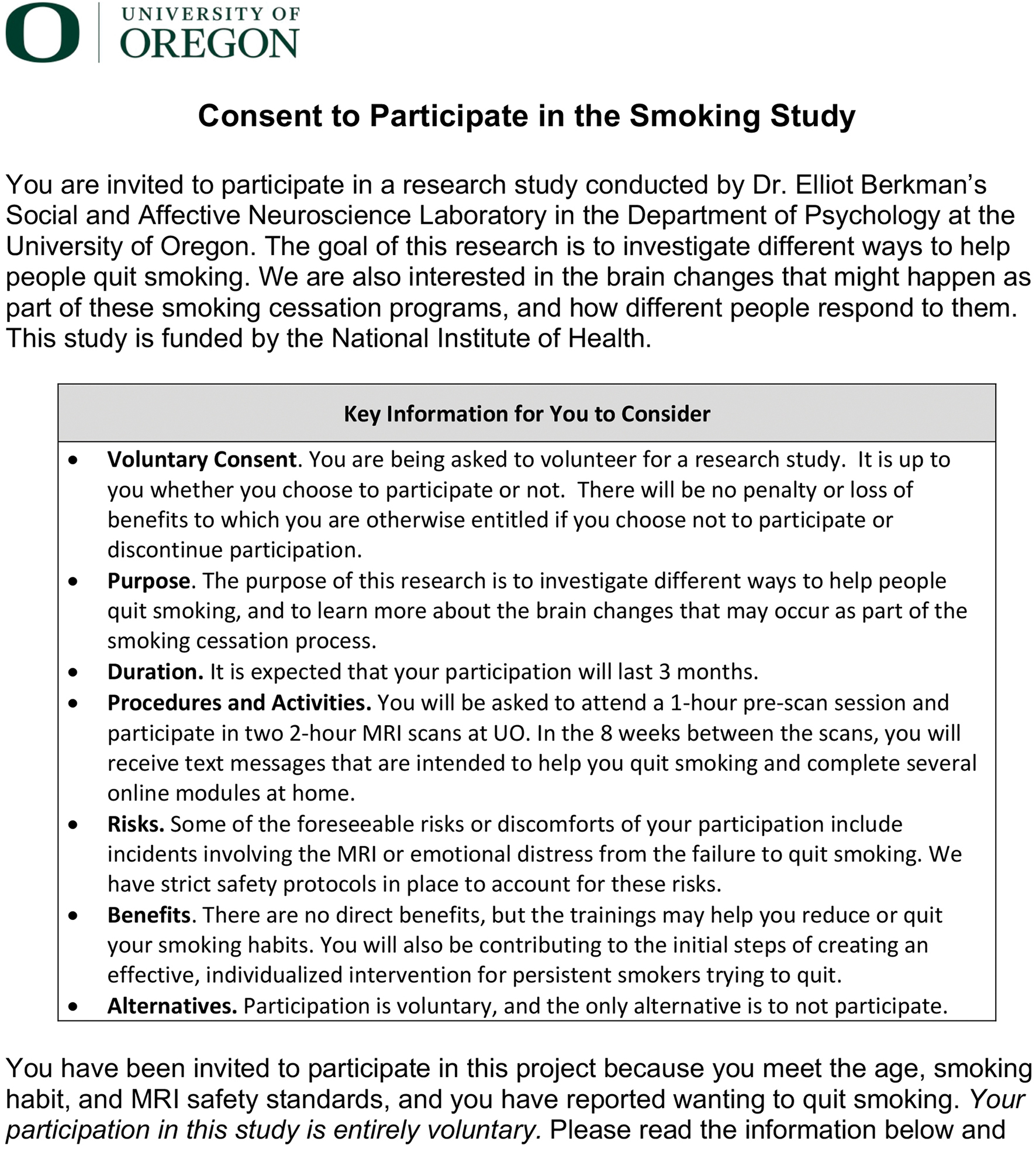
FIGURE 2.22
Informed Consent Form
This portion of an approved form gives you a sense of how researchers typically obtain informed consent in writing.
Another aspect of respecting autonomy is providing participants with an assurance of privacy. Two main aspects of privacy must be considered. One aspect is confidentiality. This term means that personal, identifying information about participants cannot be shared with others. In some studies, anonymity is maintained. Although this term is often confused with confidentiality, anonymity means that the researchers do not collect personal, identifying information in the first place. Without such information, responses can never be traced to any individual. Anonymity helps make participants comfortable enough to respond honestly.
BENEFICENCE Researchers have an ethical obligation to weigh the potential benefits of a study against its risks and to minimize risks as much as possible. Risks to a participant’s health or well-being might be acceptable in a study that has a potentially large benefit, such as a cure for a fatal disease. In contrast, studies that have limited potential benefits to participants or society need to pose very low risk.
The vast majority of psychology studies are low risk. However, even though risk may be low, researchers still have to think carefully about whether the benefit of the study outweighs the risk. Part of informed consent is making sure participants are fully aware of any risks of a study before they decide to participate.
JUSTICE This principle refers to fairness in the distribution of the costs and benefits of research across a population. Everyone should have an equal chance to participate in and benefit from research. It would be unethical for the risks of participating in a research study to be borne by one group of people while its benefits went to another group. Unfortunately, medical research has a history of violating this principle. The Tuskegee Study referenced in FIGURE 2.23 violated the principle of justice because only African American men were included as participants even though everyone vulnerable to syphilis benefited from the results. That study also violated respect for persons because participants were not informed of their diagnosis. The outrage that followed when a whistleblower informed the public about the Tuskegee Study contributed to the creation of the Belmont Report and the formalization of the fundamental research ethics principles.

FIGURE 2.23
Justice
Between 1932 and 1972, the U.S. Public Health Service and the Tuskegee Institute, in Alabama, studied the progression of untreated syphilis in African American men. Without their knowledge, 400 men with syphilis were randomly assigned to receive treatment or not. In 1997, the U.S. government officially apologized to the participants and their families. Here, President Bill Clinton and Vice President Al Gore appear at a news conference with participant Herman Shaw.
INSTITUTIONAL REVIEW BOARDS (IRBs) Most countries now have formal guidelines based on the Belmont Report or similar sets of principles to ensure the health and well-being of all study participants. These guidelines are in effect in all places where research is conducted, including colleges, universities, and research institutes. Institutional review boards (IRBs) are responsible for monitoring research and enforcing the guidelines.
Convened at schools and other institutions where research is done, IRBs consist of administrators, legal advisers, trained scholars, and members of the community. At least one member of the IRB must not be a scientist. The purpose of the IRB is to review all proposed research to ensure that it meets scientific and ethical standards to protect the safety and welfare of participants. Most scientific journals today ask for proof of IRB approval before publishing research results.