What are the main findings on similarities and differences in cognitive variables, and what role does culture play in these findings?
We’ll now focus on sex/gender similarities and differences in general intelligence, mathematical ability, spatial skills, verbal ability, and academic achievement. Much of the data we discuss is based on large-scale studies or meta-analyses. As you’ll see, the cognitive picture is complicated. In some domains, women have a slight advantage; in others, men do. In some domains, the interesting question is not who scores better on average but who has the greater variability. However, in all cases there is high overlap, and similarity is more the rule than difference. We’ll also explore data relevant to the four questions above. For many cognitive skills, context matters, and the findings can change depending on how the question is asked and where or when the data are collected. Also, it’s important to remember that finding a difference doesn’t tell us the cause. Differences may have biological or social causes—and most likely a combination of factors is in play.
General Intelligence
Women and men typically score similarly on tests of general intelligence. This is largely because IQ (intelligence quotient) tests are designed to be free of sex/gender bias. During test development, when women and men score consistently differently on an item, either it is removed or items are balanced so that there are no sex/gender differences overall (Halpern, 2006). In fact, one early intelligence test, the Stanford-Binet, showed a small advantage for women, but the items were subsequently revised so that women no longer outperformed men (Terman & Merrill, 1937). There are, however, some differences in specific domains included in IQ tests—memory, for example. Meta-analyses indicate that women consistently score better on memory tasks, with effect sizes in the small to moderate range (d = −0.20 to −0.56; Halpern & LaMay, 2000). Another component on which women consistently outperform men is processing speed, or the ability to maintain concentration and perform quickly while under pressure (Camarata & Woodcock, 2006).
There are also small sex/gender differences in variability on IQ tests. Men’s scores generally have greater variability than women’s. For example, researchers found more men than women at both the very top and the very bottom of the score distribution in a study with more than 80,000 participants from Scotland (Dreary, Thorpe, Wilson, Starr, & Whalley, 2003). However, a later analysis of this sample indicated that men had extremely variable scores at the low end of the distribution. At the high end, the variability was less extreme (Johnson, Carothers, & Deary, 2008).
Mathematical Ability
Because general intelligence tests are designed to be free of sex/gender bias, more attention has been given to differences between women and men on tests of specific cognitive abilities such as math skills, spatial skills, and verbal skills. The stereotype is that women excel in verbal skills and men excel in math skills. However, the data represent very complex findings. An effect size of −0.05 was found in a meta-analysis on math skills done in 1990 (Hyde, Fennema, & Lamon, 1990). This means that the difference in math skills was negligible—but in the direction of women having higher scores than men! However, there was some indication that at the highest levels of math skills, men did outperform women. For example, when only looking at highly selective samples, such as those who attended very selective colleges or those who were selected for study because they excelled at math, the effect size was larger, with men having higher scores than women (d = 0.54).
A more recent meta-analysis reviewed math achievement scores of almost a half million students across 69 nations (Else-Quest, Hyde, & Linn, 2010). Researchers found, on average, a very small male advantage in various domains of math skills (d < 0.15 for each skill). However, this small effect indicates large gender similarities. Also, there were extensive variations from nation to nation, and girls outperformed boys in some countries. Furthermore, in nations with greater gender equality (e.g., more women enrolled in schools, represented in the legislature, and holding high-level science and math positions), girls performed better on math tests, and the sex/gender difference often disappeared. Another study looked at almost 300,000 students in 40 countries who took identical, challenging math tests designed to be free of cultural bias (Guiso, Monte, Sapienza, & Zingales, 2008). This study confirmed that countries with the greatest level of gender equity, such as Iceland, Norway, and Sweden, show either similarities between women and men or a difference with a slight female advantage.
These two studies support the gender stratification hypothesis, the idea that differences found between women and men (especially on cognitive skills) relate to the level of gender equality in a country. Interestingly, countries that have smaller sex/gender gaps in mathematics—possibly because of social programs that promote the education of girls—also tend to have large sex/gender gaps in reading, with girls outperforming boys (Marks, 2008).
The international data have also challenged the idea of greater male variability. In one study, researchers found, based on data from the international math study described above, that in Iceland, Thailand, and Great Britain either as many or more girls scored in the top 99% of math tests as boys (Guiso et al., 2008). Other researchers have found in several nations, including Ireland, Tunisia, and the Czech Republic, that women and men are equally variable in their math performance (Machin & Pekkinarin, 2008).
Finally, the idea that men are over-represented at the upper levels of math performance may have been more applicable decades ago than it is today. For example, in one study, researchers reviewed data of mathematically gifted children—those who take and excel on the math portion of the Scholastic Aptitude Test (SAT) before they reach age 13 (Hyde & Mertz, 2009). In the early 1980s, boys doing this outnumbered girls by a ratio of 13:1, but by 2005, boys only outnumbered girls 2.8:1.
Spatial Skills
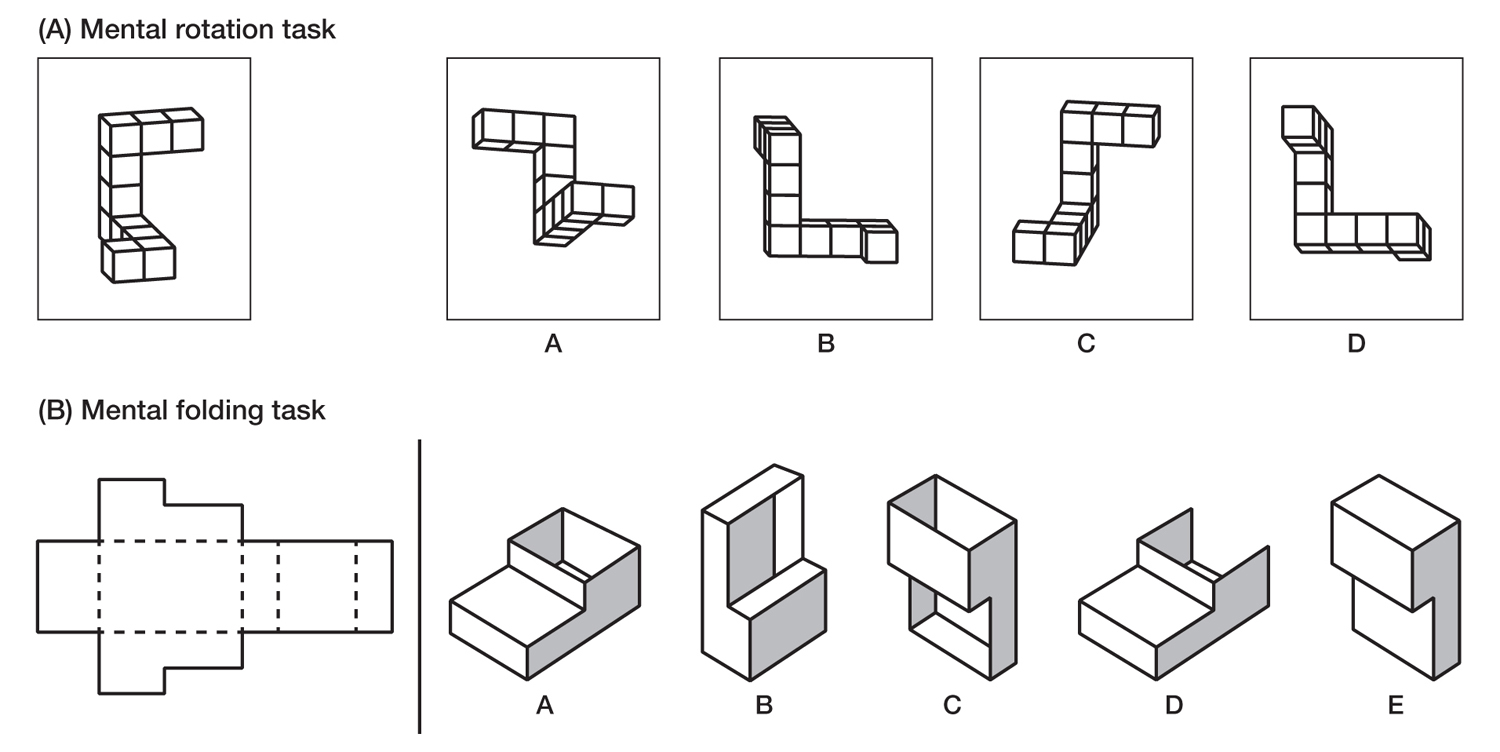
There are a wide variety of spatial skills, but mental rotation—the ability to imagine what an object would look like when rotated in three-dimensional space—has been the subject of much research. Mental rotation has consistently shown a male advantage, with generally large effect sizes (d = 0.70; Voyer, 2011). However, it’s important to remember that even this large effect implies an approximately 72% overlap between groups. There are also data suggesting that men do particularly well on this task under time limits (Maeda & Yoon, 2013). Other spatial skills, though, don’t show such a strong sex/gender difference. For example, imagining what a paper will look like when folded demonstrates a pattern of gender similarities (Miller & Halpern, 2014). If you look at the sample materials from the two tasks shown in Figure 3.3, can you explain why men reliably outperform women on one but not the other? Stumped? So are the researchers who found this outcome (Harris, Hirsh-Pasek, & Newcombe, 2013).
Image Description
Overview
An illustration shows two tasks titled "(A) Mental rotation task," and "(B) Mental folding task." Both tasks contain a template illustration followed by subsequent options, which appear to be based on the template but rotated or folded in 3D space.
(A) Mental rotation task
The first illustration's template is a black and white representation of cubes connected 3D space. The four options appear similar to the original template but rotated in 3D space.
The template illustration contains a stack of four cubes that are kept vertically. The right face of the first cube at the top is attached to two cubes serially and the front face of the bottom cube is attached to three cubes serially. The left face of the third cube in the series attached to the bottom cube is further attached to a single cube.
The option labeled A shows a stack of four cubes kept vertically. The left face of the first cube at the top is attached to two cubes serially and the front face of the bottom cube is attached to three cubes serially. The right face of the third cube in the series attached to the bottom cube is further attached to a single cube.
The option labeled B shows a stack of four cubes kept vertically. The back face of the first cube at the top is attached to two cubes serially and the right face of the bottom cube is attached to three cubes serially. The front face of the third cube in the series attached to the bottom cube is further attached to a single cube.
The option labeled C shows a stack of four cubes kept vertically. The right face of the first cube at the top is attached to two cubes serially and the front face of the bottom cube is attached to three cubes serially. The left face of the third cube in the series attached to the bottom cube is further attached to a single cube.
The option labeled D shows a stack of four cubes kept vertically. The front face of the first cube at the top is attached to two cubes serially and the right face of the bottom cube is attached to three cubes serially. The back face of the third cube in the series attached to the bottom cube is further attached to a single cube.
(B) Mental folding task
The second illustration's template is a black and white representation of an unfolded box and the five options all appear to be 3D folded boxes.
The template box has dotted lines and the folding along the lines resembles a rectangular box with a raised platform halfway along the length of the box. The raised platform curves inward.
The folded shape labeled A resembles a rectangular box with a raised platform halfway along the length of the box with only the raised platform curved inward. The flat surface of the box is shown at the base.
The folded shape labeled B resembles a rectangular box with a raised platform halfway along the length of the box. The portion devoid of the raised platform curves inward. The breadth of the box with the raised platform is shown at the base.
The folded shape labeled C resembles a rectangular box with a raised platform halfway along the length of the box. The portion devoid of the raised platform and the breadth along the raised platform curve inward. The breadth of the box devoid of the raised platform is shown at the base.
The folded shape labeled D resembles a rectangular box with a raised platform halfway along the length of the box with the raised platform curving inward. The breadth surface along the raised platform is shown empty. The flat surface of the box is shown at the base.
The folded shape labeled E resembles a rectangular box with a raised platform halfway along the length of the box without any inward curve. The breadth of the box devoid of the raised platform is shown at the base.
Figure 3.3 For the example mental rotation task shown on top, participants are asked to imagine rotating the drawing on the left and to pick two of the four drawings on the right that match (Answers: B and C). For the example mental folding task shown on the bottom, participants are asked to imagine folding the drawing on the left along the dotted lines and to choose the folded shape on the right that would match (Answer: A).The mental rotation task shows a large sex/gender difference, while the mental folding task shows a very small one. The reason why there are large sex/gender differences for one but not the other remains a mystery. (After Miller & Halpern, 2014)
There are some spatial skills in which women have an advantage. As noted earlier, women generally outperform men on memory tasks. In line with this, spatial memory, or the ability to remember where an object was located, shows a small female advantage, although still a great deal of overlap (d = −0.23; Voyer, Postma, Brake, & Imperato-McGinley, 2007). Interestingly, this female advantage can disappear and even reverse when the objects are stereotypically masculine (e.g., a car or a train; Cherney & Ryalls, 1999; Voyer et al., 2007). In another study conducted in France, researchers showed girls and boys a complicated object and then asked them to draw it from memory. The test’s context made a big difference. Girls did better than boys when told it was a test of drawing skills, but boys did better than girls when told it was a test of geometry (Huguet & Régner, 2009).
EMPOWERING OR OPPRESSING?
Single-Sex Education
T
hose who claim that single-sex education is better for girls generally offer two arguments (Pahlke, Hyde, & Allison, 2014). First, they argue that biological differences between girls and boys mean that they have different learning styles and should be educated in different ways. For example, Leonard Sax, author of Why Gender Matters, argues that boys respond better to energetic teachers who speak to them loudly and abruptly, but because this approach makes girls scared and nervous, they should be addressed in a kind, soft voice (Sax, 2007, as cited in Halpern et al., 2011).
The second argument is that girls do better if they aren’t around boys, who may dominate the classroom or receive undue attention from the teacher. The underlying idea behind this “girl power” argument (Pahlke et al., 2014, p. 1043) is that a single-sex educational setting gives girls the freedom to excel in these domains without the sexism and discrimination that may occur in co-educational classrooms.
Do single-sex classrooms provide girls with a beneficial learning experience, or do they just promote gender stereotypes?
However, others have argued that girls and boys actually act in more gender-stereotypical ways in single-sex classes (Halpern et al., 2011). Critics claim that just as racial segregation failed to create racial equality, sex/gender segregation fails to create gender equality. They argue that the best way to eliminate sex/gender differences in educational outcomes is to allow girls and boys to work together on meaningful tasks and to train teachers to use the most effective methods to teach all people (Halpern et al., 2011).
One problem with research in this area is selection effects, that is, higher-achieving students are usually the ones placed in these kinds of educational settings in the first place. If they do better than those in co-ed settings, it’s not clear whether this is due to single-sex education or the fact that they were high achieving to begin with. Results from a meta-analysis showed that, in the poorly designed studies that didn’t control for selection effects, positive effects of single-sex education were found (Pahlke et al., 2014). But when only studies that controlled for selection effects were analyzed, there were negligible effects. Another recent study showed that when prior educational achievement was accounted for, high school girls did equally well in single- versus mixed-sex classrooms for math and science subjects, but they actually underperformed in single-sex classrooms in other subjects (Pennington, Kaye, Qureshi & Heim, 2018). However, when prior achievement was not considered, single-sex education appeared to result in better performance across all subjects.
What do you think? Is single-sex education empowering or oppressing? Can you think of circumstances in which you’d seek out single-sex educational opportunities for yourself, your children, and others you know? Would you avoid single-sex education? Explain your responses.
Verbal Ability
Data show that women generally have higher verbal abilities than men, although the difference is relatively small, meaning that there is more similarity than difference (d = −0.11; Hyde & Linn, 1988). More recent data suggest a moderate female advantage in reading comprehension, which varies from nation to nation. For example, in 2009 when almost a half million students in 69 countries took a standardized reading assessment, there was a female advantage in reading comprehension both in the United States (d = −0.26) and internationally (d = −0.42; Reilly, 2012). A key component of this difference may have been that a much greater proportion of boys than girls scored very poorly on the test (4.5:1 boys to girls at the lowest levels of achievement). Girls also outperformed boys at the high end of the test 2.4:1, but the difference was not as large as at the low end.
Academic Achievement
Although most meta-analyses focus on achievement as measured through standardized tests, one meta-analysis of 350 studies from the period 1914–2011 examined sex/gender differences in grades across subjects from elementary school through college (Voyer & Voyer, 2014). Researchers found that girls got higher grades than boys across all subjects (d = −0.23), although the small effect indicates considerable overlap. The differences were largest for language-related courses and were near zero for math, but girls still had higher grades in math. There was also no effect of year of publication, indicating that the female advantage in grades is not a recent phenomenon. It’s interesting that women get higher grades, even in math courses, all the way through college but are still extremely under-represented in STEM fields: science, technology, engineering, and mathematics. It’s also interesting to consider why girls get better grades but boys have a slight advantage on standardized tests. It may be that girls are likely to be socialized to be attentive and polite in the classroom, behaviors that may positively impact their grades (Houtte, 2004; Zusman, Knox, & Lieberman, 2005).
In sum, the data on cognitive differences between women and men paint an overall picture of sex/gender similarity rather than difference. Although there are some small differences in various domains, they vary according to race, culture, and social class.