If, overall, sex/gender differences in intelligence and personality are relatively small, why do researchers find such large differences in certain fields? Let’s look at STEM fields to explore how small sex/gender differences can become magnified to ultimately promote larger differences in women’s and men’s career choices. In particular, we’ll look at engineering, math, computer science, and physics (EMCP fields), a subset of STEM that is particularly sex/gender imbalanced (Hyde, 2014). This is a controversial topic. Recently, a Google employee circulated a memo claiming that women don’t hold leadership positions in tech companies because of biological differences, largely in personality (Bergen & Huet, 2017). This memo caused considerable controversy, and ultimately its author was fired. But the controversy highlights the need to understand the various factors that can influence women’s participation in STEM/EMCP fields.
At the high school level, there are small sex/gender differences in math and science participation. For example, male students are more likely than female students to take calculus Advanced Placement exams (59% vs. 41%; National Science Board, 2014). In college, the difference gets larger. Between 2002 and 2007, men earned an average of 7,521 and women earned an average of 6,102 bachelor’s degrees in math per year (Gillen & Tannenbaum, 2014). The numbers were lower for some women of color. Although Black, Latinx, and Native American women represent 16% of the U.S. population, they earn only 10% of the bachelor’s degrees in STEM fields (Espinosa, 2011). Gender and racial disparities are greatest at the doctoral level, where men earned almost three times as many doctoral degrees in mathematics compared to women (2,341 vs. 788), and only 6% of those degrees were awarded to Black, Latinx, and Native American women.
As one moves up the ladder of success in math, the sex/gender discrepancies increase. For example, only 3% to 12% of the top 50 universities in the United States have female professors at the highest rank in math-intensive fields (Ceci, Williams, & Barnett, 2009). Overall, in 2010, women made up only 13% of people employed in engineering and 25% in math and computer science (National Science Board, 2014). Furthermore, in 2010, Black, Latinx, and Native American women held only 2.1% of STEM faculty positions (Hess, Gault, & Yi, 2013).
It’s clear that something happens in women’s progression toward careers in math and science. The fact that women aren’t pursuing these careers at the same rates as men is particularly striking considering that girls get better grades in math than boys, even at the undergraduate level (Voyer & Voyer, 2014). Although all women experience academic and professional barriers in STEM/EMCP fields, the type and magnitude of those barriers depend on other aspects of social identities—for example, the challenges are greater for women of color (Williams, Phillips, & Hall, 2014). The following section reviews some of the research that explores these varied experiences. If you keep expectancy role value theory in mind as you read about those studies, you’ll discover that the barriers keeping women from STEM/EMCP careers can affect not only their expectations for success but also the value they place on these careers.
spotlight on . . .
Initiatives to Increase Women’s Participation in STEM
Women remain under-represented in STEM fields. However, increasing numbers of initiatives seek to encourage women to choose STEM careers and stay in them.
Scientista offers conferences, mentoring, and web-based resources. It was started by two Harvard graduates who were concerned about how few women stay in STEM careers.
The Career Communications Group promotes workplace diversity. The organization has sponsored several conferences for women of color in STEM.
Girls Who Code offers classes, camps, and mentoring for girls interested in computer science. One of its programs for rising high school juniors and seniors is a free summer immersion program held at companies such as Amazon and Twitter. Girls from diverse backgrounds are encouraged to apply, and stipends for transportation and living expenses are available.
Some colleges are also making an effort to enhance women’s participation in STEM. For example, at Harvey Mudd College in California, 55% of computer science majors are now women. The school attributes this strong percentage to policy changes, including promoting women to leadership positions and changing the curriculum to emphasize functional aspects of computer science (Staley, 2016).
Does your school have any programs that encourage women in STEM majors?
Lowered Expectations
How do expectations relate to the performance of girls and women in STEM fields, and how can other aspects of their social identities interact with these expectations?
Although she is tremendously successful in her career, psychologist Maria Dolores Cimini recalls many times when people downplayed her skills, likely due to her visual impairment. In high school, when Cimini intended to apply to Ivy League colleges, her guidance counselor suggested she consider “a special school—not necessarily even a college or university” (Miller, 2013, para. 3). Now Cimini works to make sure that other students who have disabilities and show interest in STEM fields have a different experience (Miller, 2013). Her efforts couldn’t be more timely. Research shows that both teachers and parents have lowered expectations about girls’ math ability (Gunderson, Rameriz, Levine, & Beilock, 2012), and especially for girls with disabilities (Hammrich, Price, & Nourse, 2002). Much like Cimini, girls with disabilities are often advised to pursue academic tracks other than STEM (Faulkner, Crossland, & Stiff, 2013).
To complicate matters, a disproportionately large number of low-income and Black, Latinx, and Native American students are placed in special education programs (Hawley, Cardosa, & McMahon, 2013). Researchers speculate that some of these students have been misclassified because of racial bias in the referral and evaluation processes (Ferri, 2010; Sullivan & Artiles, 2011). When students are placed in special education tracks, because of either a documented disability or misclassification, their teachers often lack the knowledge base or experience to teach high-level math or science (Aron & Loprest, 2012; Faulkner et al., 2013; Moon, Todd, Morton, & Ivey, 2012). Such inequalities in early education probably prevent potentially qualified students from developing STEM/EMCP-related skills and interests (Hawley et al., 2013). These findings lead some scholars to conclude that recruitment and retention of under-represented minorities in STEM/EMCP fields won’t change until biases found in middle and high school are addressed (Hawley et al., 2013).
Unfortunately, low expectations can lead to a self-fulfilling prophesy. This is the idea that expectations for how someone is going to behave, in either a positive or a negative way, influence that person’s behavior so that the expectations are fulfilled, making the prophesy come true (Merton, 1948). For example, in one study of primarily White participants, parents who believed that boys were better at math than girls had lower expectations for how their daughters would perform in future math courses (Jacobs, 1991). When parents had lower expectations for their daughters, the daughters also had lower expectations for themselves and did less well in math courses. These expectations predicted achievement more accurately than the girls’ actual grades in previous math classes. In another study with mostly White participants, seventh-grade girls, as compared to boys, perceived their teachers as having lower expectations for them in math (Wang, 2012). These expectations predicted how motivated the girls were about math and how well they expected to do in tenth grade. Furthermore, the expectations from seventh grade predicted whether the girls took challenging math courses in twelfth grade. Researchers have also found that Latinx and Black high school students perceive their science teachers as being particularly unsupportive (Aschbacher, Li, & Roth, 2010).
Expectations about math are somewhat different for individuals who are Asian American. A common stereotype is that Asian American people are hard-working, smart, and over-achieving. As reflected in this stereotype, they’re thought of as a model minority, or the ideal example of a minority group. Although this perception may seem positive, research shows it has drawbacks (Suzuki, 2002). For example, when teachers treat Asian American students in differential ways, that behavior can create conflict with other students and perpetuate the stereotype that all Asian American people are good at math (Thompson, Kiang, & Witkow, 2016). Therefore, despite not facing low expectations around math and science, Asian Americans, particularly women, face different academic, professional, and social pressures (Thompson et al., 2016; Williams et al., 2014).
Low expectations appear to follow girls into their working environments in adulthood. Women in STEM/EMCP careers often have to provide more evidence of competence in order to be seen as credible (Eagly & Mladinic, 1994; Foschi, 2000). One study showed that over 75% of Black female scientists felt pressured to provide more evidence than was typical of other colleagues in order to prove competence to colleagues (Williams et al., 2014). The numbers were also high for other women: 65% of Latinx female scientists, 64% of Asian American female scientists, and 63% of White female scientists felt a need to prove their competence (Williams et al., 2014).
Stereotypes
What is stereotype threat, and how can it contribute to the experiences of girls and women in STEM?
There’s a pervasive stereotype of a scientist as a White man in a lab coat working alone (Archer, Dewitt, & Osborne, 2015). It’s an image that probably alienates many people who don’t match this perception. For example, in one study, researchers found that many LGBT individuals working in STEM/EMCP fields weren’t completely “out” to their colleagues, although those working in STEM/EMCP fields with better female representation reported a higher degree of openness (Yoder & Mattheis, 2016). Other research showed that transgender women were more likely to avoid male-dominated professions because of fear that the climate wouldn’t be supportive (Brown et al., 2012).
Research also shows that STEM/EMCP colleagues interact with women on the basis of stereotypes, which are often racialized (Williams et al., 2014). One study showed that Latinx female scientists were more likely than White, Asian, or Black female scientists to experience backlash for expressing frustration in the workplace. Latinx female scientists reported that if they weren’t deferential, colleagues perceived them as being angry or “too emotional” (Williams et al., 2014, p. 6). Black women, however, were given more latitude to act assertively—as long as they weren’t seen as “angry Black women” (p. 6). Asian American women reported more pressure to conform to traditionally feminine roles, such as office mother or dutiful daughter. Research such as this indicated that many female scientists’ experience of work has been influenced by racialized gender stereotypes.
try it for yourself
Picture a scientist. What images come to mind? Do you see someone with a white coat working alone in a laboratory? Do you see someone working on a team with others? Do you see men? Do you see women? How do these internalized images of what constitutes a scientist and science affect your interest in science? Ask three of your friends these questions, and see if their answers are similar to or different from your own. Talk to people who are majoring in STEM/EMCP fields as well as those majoring in other fields. Are there differences in their responses?
Such stereotypes can interfere with performance. The term stereotype threat refers to the idea that when people think their social group does poorly on a certain task (or think that others believe this is true), their anxiety about confirming that stereotype can actually undermine their performance (Shapiro & Williams, 2012; Steele & Aronson, 1995). In a testing situation, stereotype threat likely interferes with performance because becoming self-conscious and having distracting, stressful thoughts about doing poorly can hijack attention and memory resources that are needed to do well on the test (Schmader, Johns, & Forbes, 2008). In the absence of an intervention, women generally come into math tests with internalized negative stereotypes about their math abilities. In fact, one meta-analysis showed that women had lower math self-confidence than men despite having similar math abilities (Else-Quest et al., 2010). Ironically, women’s reduced self-confidence in math seems unjustified, given that the sex/gender differences in math achievement are small enough to be negligible (e.g., Hyde et al., 1990) and that women get better grades than men in math all the way through college (Voyer & Voyer, 2014).
One study showed that when women and men were told that performance on the math test they were taking typically showed large sex/gender differences, the differences in participants’ actual test scores were very large (Spencer, Steele, & Quinn, 1999). But participants who were told that the same test typically did not show sex/gender differences had no differences in performance. In other words, thinking there was a sex/gender difference magnified it, and thinking there was no difference eliminated it. Because the idea that women are less skilled at math than men is pervasive, most women taking a math test are probably aware of it, and this perception may actually interfere with their performance.
In fact, simply having women write their sex/gender on a test can decrease their performance. In one study, researchers asked a diverse sample of girls and boys to record their sex/gender on a calculus Advanced Placement exam (Stricker & Ward, 2004). Although the effects were small and originally seen as non-significant, a re-analysis of the data indicated some important findings (Danaher & Crandall, 2008). When researchers asked for sex/gender information after giving the test (i.e., participants took the test before the sex/gender stereotypes were activated), the sex/gender difference in test scores was reduced by 33% compared to when the researchers asked before giving the test. In fact, based on these data, Danaher and Crandall (2008) calculated that 4,700 additional girls could get college credit for calculus if sex/gender were regularly asked after the test!
As we discussed earlier, there are two contrasting stereotypes about math performance by Asian American women (Shih, Pittinsky, & Ambady, 1999). As women, they’re stereotyped to have poor performance in math, but as Asian Americans, they’re stereotyped to have good performance. In one study, researchers randomly assigned Asian American women to three groups. One group answered questions designed to make them think about their sex/gender (e.g., whether they lived on a co-ed or single-sex floor). Another group answered questions designed to make them think about their race or ethnic background (e.g., how many generations it had been since their family immigrated). For the control group, researchers asked questions unrelated to the women’s social identities (e.g., whether participants liked the phone service provided by the university). All participants then took the same math test. Women who were prompted to think about their sex/gender performed worse than those in the control group, and women who were prompted to think about their race or ethnic background performed better. Therefore, internalized stereotypes can affect women’s performance. Another study showed that more than half of Asian American female scientists surveyed felt the need to continuously prove their competence to colleagues, suggesting that the negative stereotype about women was probably more salient than the positive stereotype that Asian American people are good at math and science (Williams et al., 2014). It may be that the positive stereotype actually benefits Asian American men more than women.
Stereotypes interfere with the value women place on STEM/EMCP careers, and stereotype threat can interfere with their perception that they will succeed. However, it’s important to note that while stereotype threat may be one factor affecting women’s performance in math, it isn’t the only one. A meta-analysis of data on stereotype threat specifically on math performance showed that the effects are generally small. It also showed that while stereotype threat may affect some women, it would be inaccurate to say that stereotype threat is the main cause of sex/gender differences in math (Stoet & Geary, 2012).
Goal Congruity
What is the goal congruity perspective, and how does it explain the low rates of participation by women in STEM fields?
Because White men generally dominate STEM/EMCP fields, their lifestyles and interests shape the norms around work. People in STEM/EMCP careers generally commit to long hours and almost constant availability, and this can contribute to assumptions about the ideal worker (Kachchaf, Ko, Hodari, & Ong, 2015). One Black woman in the last year of a post-doctoral position in mathematics noted that she had to work 12-hour days, six days a week, to meet the expectations and level of work of her advisor. She commented: “[Many] of the people are men without family, or with wives that don’t do anything else” (Kachchaf et al., 2015, p. 181). This norm discourages people who might have different priorities from joining the field.
Also, many women want a career that meets their interests in working with people and their goals of caring for others (Diekman, Clark, Johnston, Brown, & Steinberg, 2011). This attitude reflects the goal congruity perspective, which holds that people want to engage in activities that meet their goals. Because most women value communal goals (e.g., caring for and feeling connected to others) and have internalized stereotypes about the type of work involved in STEM/EMCP fields, many may not value STEM/EMCP careers. For example, one study found that Native American women and men and White women who were majoring in STEM fields highly endorsed communal goals (Smith, Cech, Metz, Huntoon, & Moyer, 2014). In a follow-up study, Native American STEM students with particularly high communal goals (especially compared with White male STEM majors) had low motivation around their STEM major, perceived poor performance after one semester of college, and felt they didn’t belong (Smith et al., 2014).
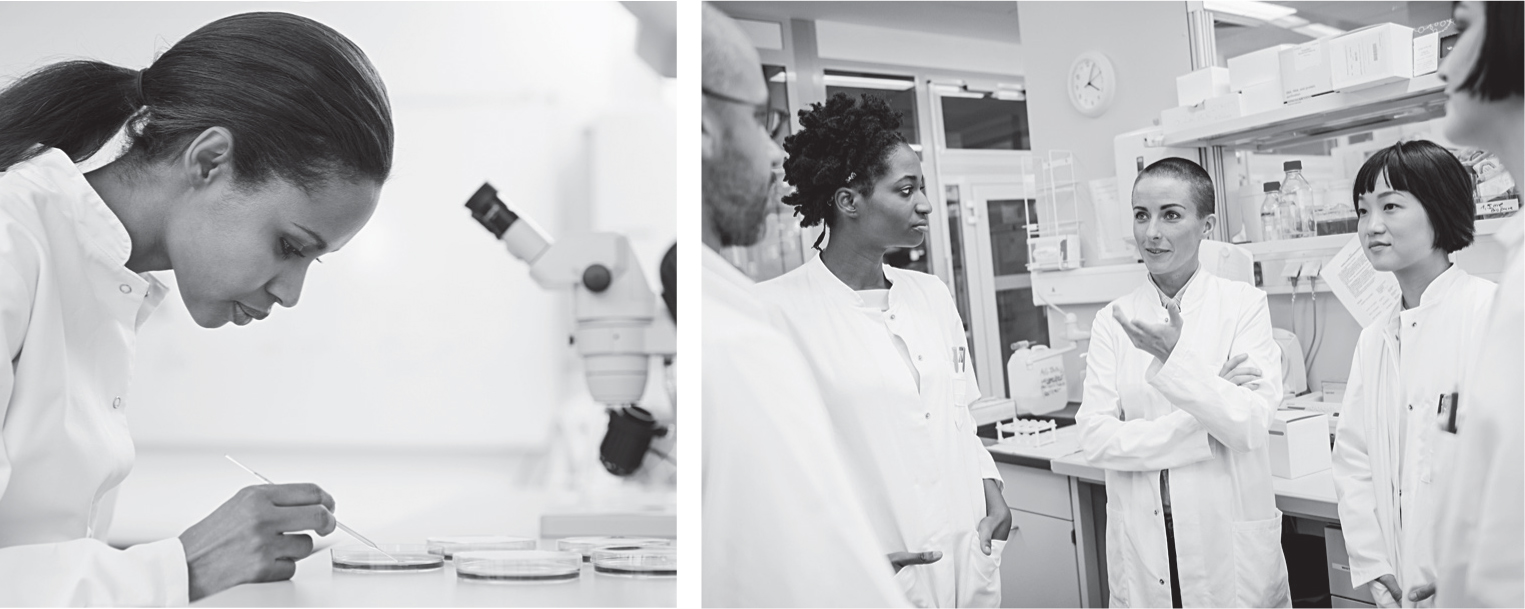
Which of these two images best represents your idea of the life of a scientist? Is it the woman on the left working alone, or the group of people working together on the right? Most people think that being a scientist involves working alone, but the reality is that scientists spend a lot of time collaborating with others.
Both women and men tend to think that STEM/EMCP careers involve working alone in a lab without much interaction with others. In other words, STEM/EMCP is perceived as being more about working with things than with people. Yet this stereotype is largely untrue. Being a scientist can be extremely collaborative and often involves working on a team and mentoring others. In fact, one study investigated the goal congruity hypothesis by having participants respond to statements describing the life of a scientist as either independent (e.g., “Do data analysis . . . and troubleshoot any problems that come up by myself”) or collaborative (e.g., “Mentor new members of my statistics group in doing data analysis”; Diekman et al., 2011, p. 910). When the work was described as independent, men were more interested in the career than women. When the work was described as collaborative, women were more interested than men.
The fact that women may not consider STEM/EMCP fields as valuable to them is reflected in research suggesting that it’s not women’s math scores, but their language scores, that predict whether they pursue careers in STEM/EMCP. One longitudinal study identified two groups of people with equally high math skills: those with high verbal abilities (mostly girls) and those with moderate verbal abilities (mostly boys; Wang, Eccles, & Kenny, 2013). While only 34% of those with both high math and verbal skills went into a STEM/EMCP field, 49% of those with high math but only moderate verbal abilities did so. Because girls with high math skills are also more likely than boys to have high verbal skills, they have more options. Given these greater options, girls may prefer to choose careers that they regard as valuable and in which they feel welcomed and comfortable.
Discrimination
In what ways do girls and women experience discrimination in STEM, and how can being a token exacerbate this?
Another factor that decreases women’s expectations for and likely success in STEM/EMCP fields is discrimination. It can interfere with a woman’s confidence that she will succeed in STEM/EMCP as well as the value she places on it. After all, why would she choose a field in which she’ll probably experience discrimination? These attitudes are acquired early in a girl’s academic career. For example, in high school, girls with physical disabilities may not have the same opportunities to engage with STEM/EMCP fields as able-bodied students (Lunsford, & Bargerhuff, 2006; Rankel, Amorosi, & Graybill, 2008). Labs may not be accessible for people using wheelchairs or other assistive devices, and research shows a tendency for teachers to ask visually impaired students to simply listen to summaries of experiments rather than being involved and analyzing data themselves (Rankel et al., 2008). When these factors are added to the sexism that girls already encounter in STEM/EMCP fields, it increases the barriers they face.
Discrimination also occurs among peers. In one study, researchers asked primarily Asian American and White biology students to nominate the strongest students in the class (Grunspan et al., 2016). Male students were nominated more frequently than female students, especially if they were outspoken. For example, in one class, an outspoken male student with a 3.6 GPA received 52 nominations while an outspoken female student with a 4.0 GPA received only 9 nominations. Male students were particularly likely to see other men as the stars of their class.
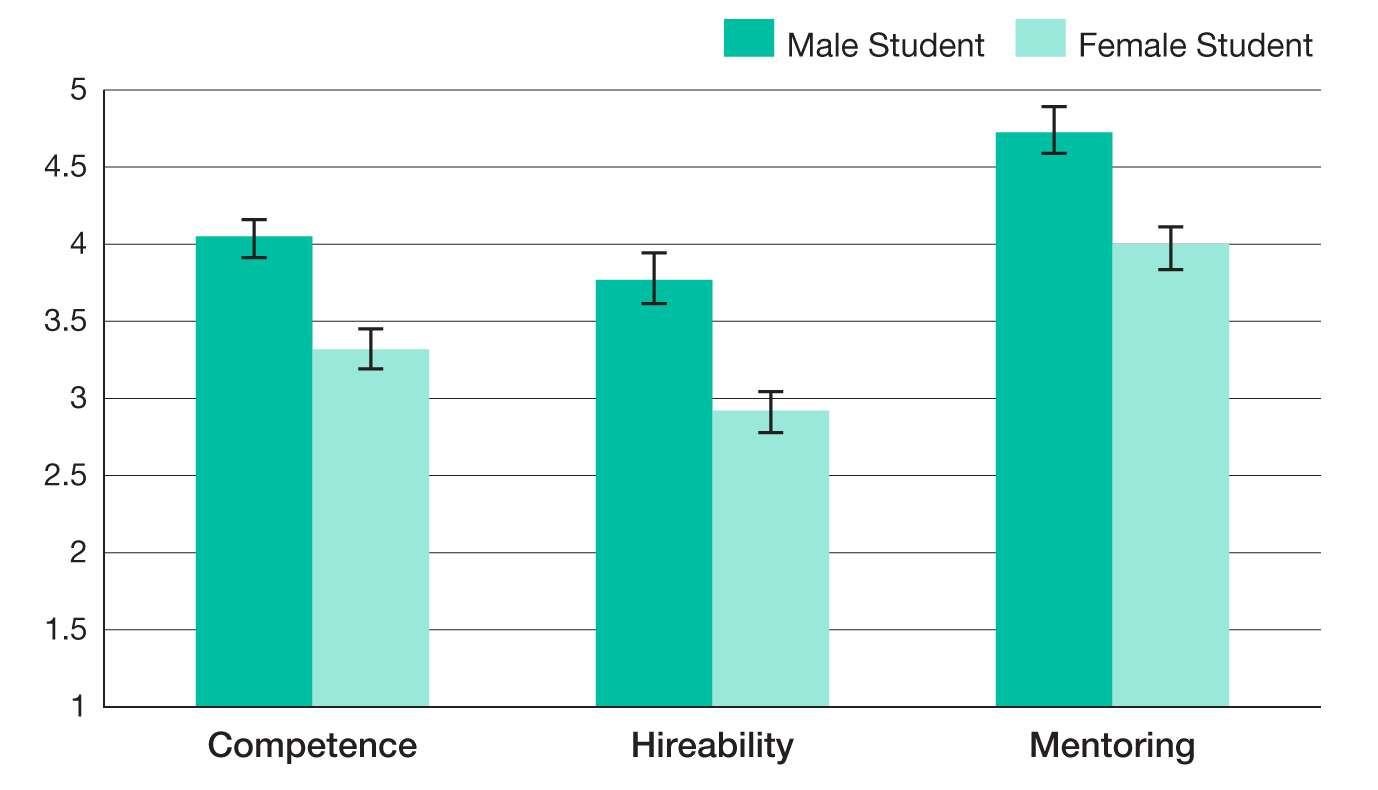
Discrimination may continue after students graduate from college. In one study, researchers sent identical applications with identical resumés for a position as a laboratory assistant to science faculty at large research institutions (Moss-Racusin, Dovidio, Brescoll, Graham, & Handelsman, 2012). The hiring faculty were randomly told that the application was from either a female student (Jennifer) or a male student (John). Both female and male faculty said John was more competent. They also expressed greater willingness to mentor him and said they would pay him $3,730 more than Jennifer per year (see Figure 3.4).
Image Description
Overview
The vertical axis shows the values from 1 to 5 in increments of 0.5 and the horizontal axis shows the categories Competence, Hireability, and Mentoring.
Graph Data
The approximate data depicted in the graph is as follows:
Competence: Male, 4.1 and female, 3.4
Hireability: Male, 3.8 and female, 2.9
Mentoring: Male, 4.7 and female, 4.0.
Error bars are also shown on each bar depicting the standard errors measuring approimately 0.25.
Figure 3.4 Scientists at research-intensive universities were randomly assigned to rate application materials from either a woman or a man for a laboratory assistant position. The only difference was the applicant’s name. When the application was from a male student, scientists rated the applicant as more competent, were more likely to want to hire him, and were more likely to offer mentoring than if the application was from a female student. All questions were asked on a 1–7 scale where higher numbers represented higher perceptions of competence and greater likelihood that the participant would hire or mentor the applicant. Error bars represent Standard Errors. (After Moss-Racusin et al., 2012)
As we’ll discuss in Chapter 10, workplace discrimination is very common, especially in fields where women are a minority. Since women are a minority in STEM/EMCP fields, the conditions there are ripe for workplace discrimination (Ceci et al., 2009). Results from a survey of approximately 1,300 scientists indicated that 53% of female respondents had personally experienced sex/gender bias during their careers (American Association for the Advancement of Science, 2010; see Shen, 2013, for a review). Only 2% of men reported the same. Further, racialized gender biases may prevent women of color from advancing in the field. In one study comparing White female scientists with female scientists of color, White women reported higher levels of influence in their departments than did the women of color (Settles, Cortina, Stewart, & Malley, 2007). Another study showed that Latinx female scientists were far more likely than other groups of women to report that their colleagues expected them to manage the office, including making coffee and providing emotional support to colleagues and students (Williams et al., 2014). Given this atmosphere, women who enter STEM/EMCP fields may not remain in them.
It’s also noteworthy that women working in STEM/EMCP fields are often one of very few women in their lab or division. A member of a socially marginalized group whose group makes up less than 15% of the workforce in a workplace setting is known as a token (Kanter, 1977; Yoder, 1994). When tokens are members of lower-status groups (e.g., women or Latinx), negative effects can occur. For example, tokens have increased visibility, so their work is more carefully scrutinized (Williams et al., 2014). In one study of STEM professors working at colleges and universities, 43% of women of color reported feeling under close scrutiny as compared with 33% of White women and 18% of White men (Hollenshead & Thomas, 2001).
When a woman is a token, she feels considerable pressure not to make mistakes because her work is viewed as representing that of all people like her. She may also feel socially isolated and likely to be seen in sex/gender-stereotyped ways—such as a temptress or a mother (King, Hebl, George, & Matusik, 2010). Race and ethnic background can exacerbate women’s experience of tokenism. In one study, researchers found that Black and Asian American women reported tokenism more often than Latinx and White women (Williams et al., 2014). However, conditions do improve as more members of that group enter the field as a whole or in a given workplace. For example, as the number of women in a science department increased, women in that department felt more comfortable and were more likely to believe their department valued the advancement of women (Hillard, Schneider, Jackson, & LaHuis, 2014).
An excellent example of how discrimination can marginalize women in STEM/EMCP fields is found in the 2016 book and subsequent Oscar-nominated movie Hidden Figures (Shetterly, 2016). Both relate the stories of three women of color—Katherine Johnson, Dorothy Vaughan, and Mary Jackson—who conducted important mathematical analyses for NASA during the space program’s early years. These women were systematically discriminated against, required to use a separate bathroom far from their work area, and had their work dismissed as unimportant. Their work was, in fact, vital to the success of the space program, but they didn’t receive any public recognition for it until 2016.
In sum, sex/gender differences in abilities cannot sufficiently account for the disproportionately small number of women in STEM/EMCP fields. The situation is much more complicated. What starts as a negligible or small difference between girls and boys can develop into a large difference, especially considering how other structural pressures (e.g., racism) influence girls’ and women’s success in these fields.
The idea that expectations for how someone is going to behave influence that person’s behavior so that the expectations are fulfilled, making the prophesy come true.
The perception that a given minority group is an ideal example of a minority group—for example, the perception that Asian American students are hard-working, smart, and over-achieving.
The idea that when people think their social group does poorly on a certain task (or think that others believe this is true), their anxiety about confirming that stereotype can actually undermine their performance.