What are some dominant beauty norms, and how does culture impact these norms?
What does it mean to be beautiful? The term means different things to different people and can differ across cultures and time frames. More generally, though, beauty norms are shared standards for attractiveness, whether implicitly or explicitly stated, that are held by members of a given social group. Sometimes these standards are taught explicitly by being stated outright—for example, young girls may be told to brush their hair before leaving the house. At other times, these standards are taught implicitly—they’re never clearly stated, but girls figure them out from cues in their environment and from seeing how others behave. For example, girls might learn that straight hair is beautiful because they see other women using flat irons in a locker room (or that curly hair is beautiful because they see others using curling irons). Like other social norms, these standards convey information about what is accepted, expected, and valued, and these are generally well known and fairly uniform within a given group (Zones, 2000). Would you say, for example, that Beyoncé is an attractive woman? Some people may find her somewhat more or less appealing, but most would probably admit that she’s beautiful.
Beautiful = Racialized
A serious limitation of research on beauty is that not all beauty norms have received equal attention. The vast majority of studies on body image and body satisfaction have used samples consisting primarily of White women and have been conducted mostly by White researchers (Striegel-Moore & Smolak, 2000). Therefore, the results may only reflect patterns among and concerns of White women. Many studies also use White women as a comparison group, which limits the ways in which researchers can understand beauty norms within groups of women who aren’t White.
In fact, several studies have shown that White women are more dissatisfied with their bodies than Black women are (Grabe & Hyde, 2006; Kronenfeld, Reba-Harrelson, Von Holle, Reyes, & Bulik, 2010). One reason why Black women may report greater body satisfaction is that the norms most frequently investigated—particularly the norm of thinness (a topic we discuss below)—may be less central to their perception of beauty (Beauboeuf-Lafontant, 2003; Capodilupo, 2015; Hesse-Biber, Howling, Leavy, & Lovejoy, 2004; Hall, 1995b).
Given this consideration, researchers may not be focusing on the concerns of and beauty norms relevant for women or any other specific group. For example, one factor that contributes to body dissatisfaction among women experiencing homelessness is lack of consistent access to hygiene products (Mitchell, Ramsey, & Nelson, 2018). Women who have the privilege not to think about this, however, may never consider that this factor could contribute to body image.
Skin Color and Colorism Women of color may have different sources of dissatisfaction about their bodies that stem from a history of racism. In fact, there has been a long history of colorism, or preference for lighter skin, both within the United States as a whole and among the Black community itself (Kerr, 2005; 2006). For example, in an interview for The New Yorker, Nobel Prize–winning author Toni Morrison talked about the “paper bag test,” something she encountered as a student at Howard University (Als, 2003). She explained that having skin “darker than the paper bag put you in one category, similar to the bag put you in another, and lighter was yet another and the most privileged category” (p. 68). Essentially, Morrison was saying, the closer one is to having “White” skin, the more privileged one is. In this context, both skin color and hair texture have been highlighted as aspects of appearance that may be particularly important for Black girls and women (Awad et al., 2015; Hall, 1995b; Hesse-Biber et al., 2004; Neal & Wilson, 1989). Several studies have shown that when women of color are satisfied with their skin color, they also tend to be satisfied with their bodies and have higher self-esteem (Falconer & Neville, 2000; Thompson & Keith, 2001).
In one study involving women of color, concern about the color of their skin was related to higher general levels of body shame (Buchanan, Fischer, Tokar, & Yoder, 2008). Likewise, Asian and Asian American women have also identified skin color as a beauty concern (Brady et al., 2017; Chen, Yarnal, Chick, & Jablonski, 2018; Hall, 1995a), and skin-whitening creams are popular—particularly in Asia (Karnani, 2007). Many Asian cultures have traditionally viewed light skin as a sign of femininity, purity, and upper-class status (Chen et al., 2018; Kawamura & Rice, 2009). This perspective has been linked to the fact that wealthier Asian women didn’t have to work outside in agricultural and other labor-intensive jobs (Chen et al., 2018; Jones, 2013). So in addition to racism, the focus on light skin reflects classist views that have influenced beauty norms.
Hair Texture and Facial Features Black women’s potential dissatisfaction with hair texture has also been related to a White beauty ideal of longer, straight or wavy hair rather than the very curly or kinky hair that’s more common among Black women. The terms good hair and bad hair have been used to refer to the ease with which Black women can straighten and style their hair, and good hair more closely resembles the hair of White women (Bellinger, 2007; Robinson, 2011). After being dismayed by his Black daughter’s desire to have straight hair, a White writer for Sesame Street wrote a song called “I Love My Hair” for a Muppet with an Afro and darker “skin” to sing (Darden, 2010).
Not all Black women who straighten their hair do so just to conform to White beauty norms—after all, everyone has opinions as to what styles best suit them (Hall, 1995b). Likewise, Black women who wear their hair “natural” often view this choice as making a statement about their political views and pride in their racial identity (Bellinger, 2007; Neal & Wilson, 1989), and others may do so to avoid daily styling and costly salon treatments (Okazawa-Rey, Robinson, & Ward, 1987; Robinson, 2011). In fact, this is big business—Black hair-care product sales were estimated to be $2.56 billion in 2016 (Easter, 2017).
Researchers studying body satisfaction have been less likely to study aspects of appearance that may be of concern to women of color (e.g., hair texture, skin tone) than aspects that concern White women. How could an intersectional framework address this gap?
Facial features have also been identified as another potential focus of dissatisfaction for women of color. In one study, researchers found that Chinese, Japanese, and Asian Indian college students reported greater dissatisfaction with their facial features, being particularly self-conscious about their eyes, as compared to White college students (Mintz & Kashubeck, 1999). Larger and rounder eyes became the aesthetic ideal because they’re associated with White people. Asian American women (and men) have reported that they’ve experienced discrimination because of their facial features (Kawamura & Rice, 2009; Root, 1990). Given this finding, it’s no surprise that eyelid surgery has become the most common plastic surgery procedure selected by Asian American individuals (American Society of Plastic Surgeons, 2014). Further, rhinoplasties (“nose jobs”) have increased in popularity among Latinx American and Asian American girls and women, although the procedures have been declining among Jewish American girls and women (Baker, 2012).
Beautiful = Able-Bodied
Research on beauty norms has reflected an able-bodied perspective. For example, women with chronic illnesses, those who have experienced serious injuries, and those with visible disabilities have unique concerns about their bodies that aren’t captured in typical body image research. Although there hasn’t been much research on the body image concerns of these groups of women, studies have generally shown that women with disabilities report dissatisfaction with their bodies (e.g., Mathias & Harcourt, 2014; Taleporos & McCabe, 2001; Wolman, Resnick, Harris, & Blum, 1994), as do women with visible scarring from burns (Connell, Coates, Doherty-Poirier, & Wood, 2013). Women with disabilities have also reported more negative attitudes about their bodies compared to women without disabilities (Cromer et al., 1990; Moin, Duvdevany, & Mazor, 2009; Wolman et al., 1994). However, other research has found no real differences in body image between women with and without disabilities (Ben-Tovim & Walker, 1995). Still other research has shown more complex relationships, reflecting a need for more research about the experience of people with different disabilities. For example, in one study, researchers found that poor body image was related to dissatisfaction with prosthetics among amputees (Murray & Fox, 2002).
Beautiful = Cisgender
For transgender and gender non-conforming individuals, body satisfaction may be tied to their perceived sense of congruence between body presentation and gender identity (Kozee, Tylka, & Bauerband, 2012). And there can be serious negative consequences for transwomen who don’t pass as women. In a review of hate crimes against transgender people in the United States, researchers found that the vast majority of violence was perpetrated specifically against transgender women (Currah & Minter, 2000). Because the threat of violence is real, beauty norms can play a particularly important role in the lives of transwomen.
Yet not everyone can afford all the many things needed to conform to conventional beauty ideals. The financial resources and access to medical treatment that are necessary in order to meet these ideals aren’t available to most transwomen because these individuals are among the poorest demographic group in the United States (Talusan, 2015). In fact, the popular media took up the economics of passing as a source of discussion following Caitlyn Jenner’s glamorous debut on the front cover of the July 2015 issue of Vanity Fair. Meredith Talusan (2015), a writer and editor, made this observation: “If we accept Jenner because she fits our understanding of the gender binary, then we’re celebrating not just her transition but her economic privilege” (p. 1). When media outlets selectively feature transwomen who not only meet, but exceed, beauty ideals, this practice sets an impossible standard for most transwomen.
Beautiful = Symmetrical
Image Description
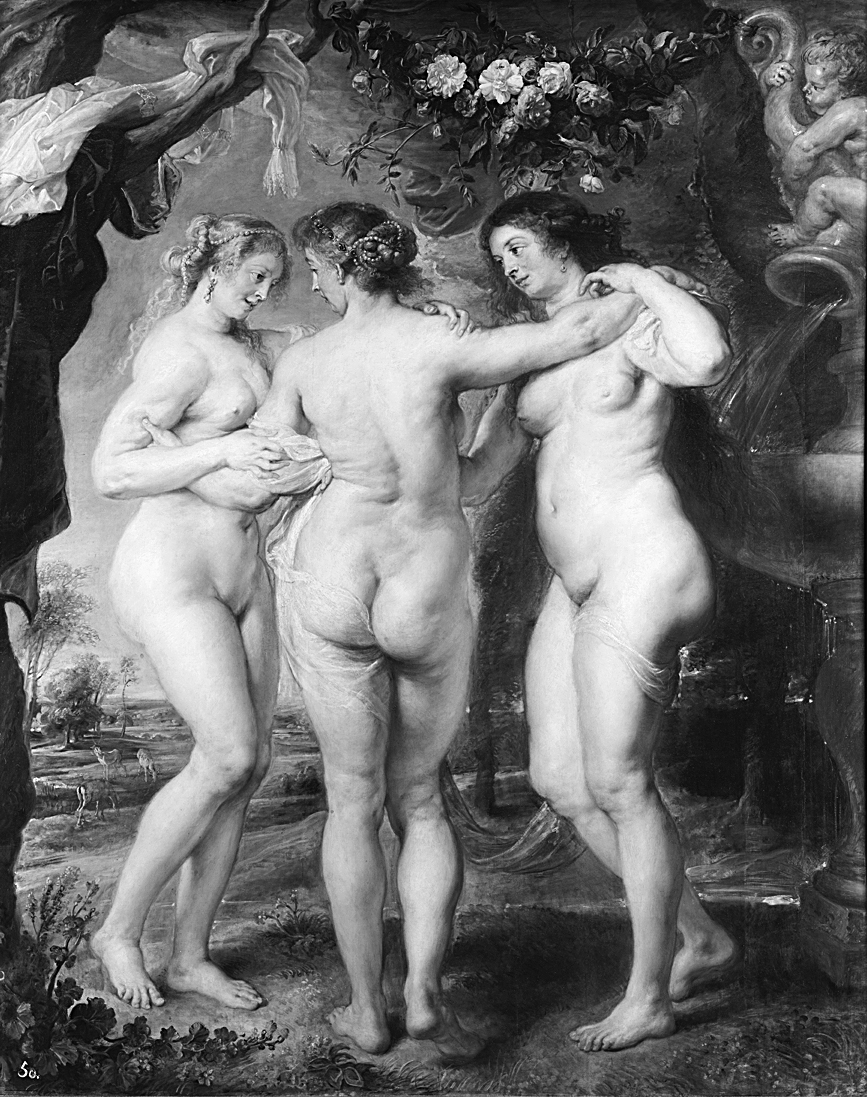
The painting shows three voluptuous women standing in a garden, completely naked except for a fine, transparent fabric partially adorning their legs. The women are shown forming a circle with one of them having her back to the viewer.
During the 17th century, the Flemish artist Peter Paul Rubens depicted idealized female beauty through his paintings of voluptuous women, like those in this work titled The Three Graces. Do you consider the three women depicted here to be beauties? Why or why not? Why might others have a different view from yours?
One characteristic frequently linked to perceived attractiveness is facial symmetry. A symmetrical face has features that are the same size and shape and in the same location on each side of the face—with the right and left sides essentially being mirror images. But most people don’t have symmetrical faces. One eyebrow might be higher than the other, a nose may lean slightly to the left, or one corner of the mouth may pull a bit higher than the other. Researchers who study facial symmetry often use computer programs to generate images of faces that are symmetrical and then ask participants to rate the attractiveness of various faces that differ in the degree of symmetry. Using techniques like this, many studies have found that symmetrical faces are consistently rated as more attractive (e.g., Fink, Neave, Manning, & Grammer, 2006; Grammer & Thornhill, 1994; Jones, DeBruine, & Little, 2007; Rhodes, 2006). Investigators aren’t sure why this effect occurs, however. Some have suggested that evolutionary preferences for selecting a potential mate underlie this preference (Grammer, Fink, Møller, & Thornhill, 2003). Symmetrical faces may signal good health and good genes, and one study showed that individuals with symmetrical faces were perceived as being healthier than those with less symmetrical faces (Fink et al., 2006).
Beautiful = Thin
While facial symmetry is a beauty standard that’s relatively consistent across cultures and through time (Rhodes, 2006), the standard of thinness shows much more cultural variation. For many centuries, heavy women were considered beautiful. This is evident, for example, in art from ancient Greece, the Renaissance, and the 17th century—the time when Rubens painted highly sexualized pictures of heavy women (Polivy, Garner, & Garfinkel, 1986). In fact, being heavy was considered a sign of wealth, status, and sexuality (Polivy et al., 1986). However, standards have changed, so now thinness is considered a sign of beauty for women (Calogero & Thompson, 2010). Furthermore, the gap between the body size of an average woman and that of a model has grown. In 1975, a female model weighed only 8% less than the average woman; now a model weighs 23% less (Ross, n.d.). Given the influence of advertising images, it’s no surprise that many women are dissatisfied with their bodies and want to be thinner. Researchers have even found a desire to be thinner among girls just starting elementary school (Lowes & Tiggemann, 2003).
Image Description
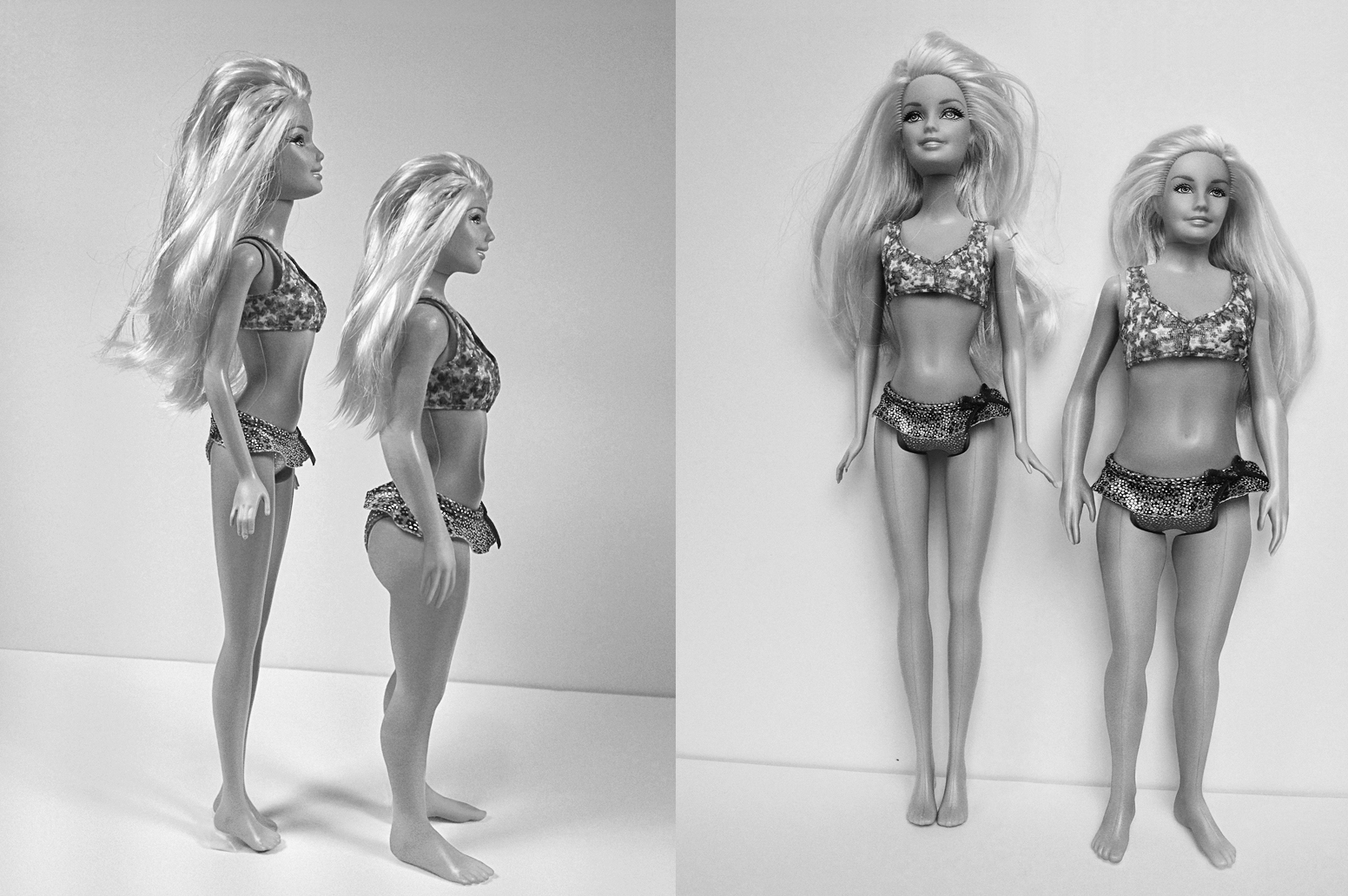
One of the dolls appears taller, has longer legs and neck, larger bust, and smaller waist in comparison to the other doll. The first photo shows a side profile and the second photo shows a front profile of the two dolls.
The Barbie doll may be viewed as a representation of an ideal woman’s body. However, these pictures show a Barbie doll next to a doll that reflects the measurements of an average 19-year-old girl—the age Barbie is supposed to be. Barbie is taller and has longer legs and a longer neck than the average 19-year-old. If she were scaled up to human size, her bust would be 4 inches larger and her waist would be 13 inches smaller than that of the average girl.
However, being thin isn’t enough. Women—especially young, White women—are supposed to be thin with no obvious body fat, have well-defined but sleek muscle tone, and have voluptuous breasts (Calogero, Boroughs, & Thompson, 2007; Thompson & Tantleff, 1992). Each of these standards can be difficult, if not impossible, to achieve, but trying to meet all three adds additional challenge. After all, muscle adds bulk and can make the body appear less thin, and breasts are partly made of fat tissue. What are the implications of these beauty standards? In essence, girls and women are receiving a message that they should reduce their caloric intake to become thinner, increase their physical activity to become more muscular, and undergo surgery to have larger breasts—all in an effort to achieve an “ideal” body that (almost) no one has.
try it for yourself
Violating any social norm usually leads to feeling uncomfortable. To better understand the effect that beauty norms have on you, try violating one or more of them by changing your behavior. If you normally wear makeup, try going without it for one full day while still doing all your normal activities (classes, work, etc.). If you’re able to do a day, try it for a week . . . maybe even a month.
Maybe makeup isn’t your thing. How about removing body hair? If you identify as a woman and typically remove leg and/or underarm hair, don’t do this for at least a week—and try stretching it to a month or even to the end of the semester. If you identify as a man and typically don’t remove body hair below your neck, try removing all your body hair from the neck down, and continue for at least a week. You could even make this more challenging by doing it while wearing clothing (e.g., tank tops, skirts, and shorts) that allow others to see your body hair (or lack thereof).
How does the idea of these challenges make you feel? How does actually doing them make you feel? Did engaging in these exercises change the extent to which you thought about your appearance? What about the way you thought about your appearance (or yourself in general)? How did others react—positively, negatively, or some of each?
Thanks to Dr. Mala Matacin and Dr. Breanne Fahs for sharing their suggestions for similar activities.
Beautiful = Hairless
A particular beauty norm that has received a lot of attention lately is that of women having little to no body hair below the neck. Actually, this isn’t a new norm. Ads in the United States promoting products to help women remove body hair have been around since 1915 (Hope, 1982). By 1945, ads no longer had to focus on convincing women to remove leg and underarm hair; they just focused on the benefits of using a given product. Numerous studies have shown that most women in the United States, the United Kingdom, and Australia regularly remove body hair (Basow, 1991; Tiggemann & Hodgson, 2008; Tiggemann & Kenyon, 1998; Toerien, Wilkinson, & Choi, 2005), and younger women may be those most likely to do so (Toerien et al., 2005). However, hair removal isn’t a universal norm. For example, there’s less pressure for women to remove body hair in some European countries (Toerien et al., 2005). Also, while many feminists opt to remove body hair, there is evidence that feminists are less likely to remove it than women who don’t identify as feminists (Basow, 1991).
More recently, the decision to remove some or all of one’s pubic hair has become a topic of research as an ideal of hairless female genitalia has developed (McDougall, 2013). For example, in one study of women in Canada, 50% of respondents reported removing some pubic hair (e.g., at their bikini line), and 30% reported removing all pubic hair (Riddell, Varto, & Hodgson, 2010). Some women remove pubic hair because they view it as unattractive (Braun, Tricklebank, & Clarke, 2013; DeMaria & Berenson, 2013). However, all women are not equally likely to engage in this practice. Research has shown that older women are less likely than younger women to regularly remove pubic hair and that they remove less hair when doing so (DeMaria & Berenson, 2013; Herbenick, Schick, Reece, Sanders, & Fortenberry, 2010). Another study showed that White women were more likely than Black or Latinx women to report removing pubic hair, and this practice was more common among women with higher incomes (DeMaria & Berenson, 2013).
There are, of course, more beauty norms that we haven’t specifically explored—such as having clear skin and straight teeth. Moreover, there’s still much to learn about the beauty norms that are most relevant for different women, as well as the complex relationships that women can have with their bodies for a host of reasons. Regardless, it’s clear that beauty norms do affect most women on a daily basis.
A preference for lighter skin that stems from a history of racism and greater privilege for those with light skin and/or those who are perceived as White.