What is the tripartite model of social influence, and how does each component contribute to our understanding of beauty norms?
There is no one source from which people learn beauty norms. Instead, messages come from different sources at different points throughout the lifetime, and this information is combined to influence perceptions of norms. The tripartite model of social influence is based on the idea that the combination of parents, peers, and the media constitutes the key influence on body image (Keery, van den Berg, & Thompson, 2004; Shroff & Thompson, 2006). These three external factors influence whether we internalize beauty norms and judge ourselves against them.
Parents
Parents, particularly mothers, influence how girls and women feel about their bodies. For example, mothers’ discomfort with their own bodies and weight has been related to decreased body esteem—the degree to which people view their bodies positively—among their daughters (McKinley, 1999; Smolak, Levine, & Schermer, 1999). How people feel about their bodies is also related to their relationships with their parents in general. Research with a racially and ethnically diverse sample has shown that feeling as though one doesn’t communicate well with one’s mother was related to higher levels of body dissatisfaction (Taniguchi & Aune, 2013). Problematic communication with fathers was also related to body dissatisfaction, but the relationship was stronger for poor communication with mothers.
Sometimes parents communicate with their children in ways that imply a criticism of their child’s body. Encouragement to lose weight by both mothers and fathers has been shown to be related to a desire to be thinner (Thelan & Cormier, 1995), and girls have been found to receive more information about weight and dieting from their parents than boys do (Phares, Steinberg, & Thompson, 2004). Research has also shown that comments, criticism, and teasing from family about weight and appearance are linked to decreased body satisfaction among girls (Levine, Smolak, & Hayden, 1994; Neumark-Sztainer et al., 2010).
your turn
What sort of messages did your parents give you about weight and attractiveness? Did you get different messages from your mother and your father (or other key adult figures in your life)? Do you think your mother (or other key female figures in your life) is satisfied with her own appearance? Does this affect your view of yourself? If you have siblings with a gender identity that’s different from yours, did they receive the same messages you did?
Parents can positively influence their children’s body image, though. Research with a racially and ethnically diverse sample of girls highlighted that having parents who didn’t discuss their own weight-related concerns and who emphasized healthy eating and exercise for fitness rather than dieting was associated with high levels of body satisfaction (Kelly, Wall, Eisenberg, Story, & Neumark-Sztainer, 2005). However, other research has shown that peer influence is often more important among adolescents than parental influence (Sheldon, 2013).
Peers
Many girls and women compare their bodies to those of their peers, and when girls and women judge themselves as less attractive than those around them, they report greater body dissatisfaction (Bailey & Ricciardeli, 2010). Moreover, body dissatisfaction isn’t limited to girls with low social status. In fact, in one study of adolescent girls, researchers found that popularity was actually associated with more negative attitudes toward eating and feeling more negatively about their bodies (Lieberman, Gauvin, Bukowski, & White, 2001). Beauty and appearance can be common topics of conversation among women as they share beauty tips and techniques as well as advice about products and services. Research shows that those who talk about appearance more frequently with friends are more concerned with beauty norms and are generally more dissatisfied with their bodies (Jones, 2001; Jones, Vigfusdottir, & Lee, 2004).
Often, the way girls and women talk to each other about their bodies involves negative body talk, or fat talk. Such talk usually occurs in informal conversations among friends in which one or more of the girls or women involved express dissatisfaction with their bodies, especially in terms of weight or body size/shape. For example, if two teenage girls are in a store dressing room, one who looks quite thin might say, “I look so fat in this shirt.” The other girl might reply, “No you don’t. You look great, but my thighs are so huge in these pants!” Research suggests that interactions like this happen frequently (Britton, Martz, Bazzini, Curtin, & LeaShomb, 2006; Garnett et al., 2014; Jones, Crowther, & Ciesla, 2014; Salk & Engeln-Maddox, 2011), that they happen across racial groups (Engeln-Maddox, Salk, & Miller, 2012; Katrevich, Register, & Aruguete, 2014), and that they happen regardless of body size (Salk & Engeln-Maddox, 2011). Moreover, fat talk doesn’t just happen in person; it also occurs on social media (Lee, Taniguchi, Modica, & Park, 2013). In fact, talk like this is so normative that participants in one study thought a conversation was more realistic when it contained fat talk rather than positive body talk (Barwick, Bazzini, Martz, Rocheleau, & Curtin, 2012).
The purpose of fat talk appears to be to elicit a positive response from peers. After someone calls herself fat, the usual response is for someone else to contradict her and either give her a compliment or insult herself. But what is the consequence of fat talk? Does it boost self-esteem if it results in a compliment? The answer appears to be no; there’s nothing positive about fat talk. In several studies, it has been associated with body dissatisfaction (Engeln-Maddox et al., 2012; Ousley, Cordero, & White, 2007; Salk & Engeln-Maddox, 2011), and it’s possible that the fat talk causes the dissatisfaction, rather than the dissatisfaction causing the fat talk.
Even listening to fat talk can have detrimental effects. Researchers have found that hearing other women engage in fat talk leads to increased body dissatisfaction, even among those who felt good about their bodies in the first place (Corning, Bucchianeri, & Pick, 2014; Salk & Engeln-Maddox, 2012). In other words, if a girl were in a locker room next to two girls participating in fat talk, she would probably feel worse about herself as a result. Even though it increases body dissatisfaction, some women may enjoy participating in it because it invokes a friend telling them they aren’t fat (Salk & Engeln-Maddox, 2011). For this and many other reasons, fat talk can be a difficult cycle to stop.
your turn
Do you engage in fat talk? If so, how frequently? Does it make you feel better or worse about yourself? Who do you engage in fat talk with? What do you do when you hear women initiate fat talk? If you do engage in fat talk, does reading about its negative consequences inspire you to stop?
Fat talk isn’t the worst social interaction one can have about one’s body, though. Explicitly negative interactions such as teasing, bullying, and making weight-related comments are all key ways that peers may influence perceptions of beauty norms. Peer teasing has repeatedly been found to relate to levels of body dissatisfaction, as well as to more serious problems such as eating disorders (Cash & Henry, 1995; Fabian & Thompson, 1989; Gleason, Alexander, & Somers, 2000; Menzel et al., 2010; Thompson, Cattarin, Fowler, & Fisher, 1995). We also know that the effects of negative comments about appearance don’t just affect girls during childhood; these effects can persist into adulthood (McLaren, Kuh, Hardy, & Gauvin, 2004; Murray, Touyz, & Beumont, 1995; Paxton, Schutz, Wertheim, & Muir, 1999). Positive comments can also be problematic—at least when they occur in the context of weight loss (Lieberman et al., 2001). When a woman loses weight and receives compliments (“Wow, you look great, did you lose weight?”), this can set her up for continuing to feel bad about her body, especially if the weight loss isn’t sustained, and to be increasingly concerned about how she looks.
The tripartite influence model has been extended to include the influence of romantic partners in addition to parents and peers. Women’s reports that their romantic partners criticize their weight or pressure them to change their appearance are associated with feeling worse about their bodies (Befort et al., 2001), thinking they’re supposed to look like models in magazines (Johnson, Edwards, & Gidycz, 2015), and having disordered eating behaviors (Eisenberg, Berge, & Neumark-Sztainer, 2013; Shomaker & Furman, 2009).
The Media
While parents and peers convey important information and feedback about beauty norms, the media’s influence is unparalleled (Hardit & Hannum, 2012; Harrison, 2003; Shroff & Thompson, 2006). Female beauty, particularly thinness, has been a dominant theme in representations of women across all forms of media (Levine & Harrison, 2004). Most models and actresses are far thinner than the average American woman. Moreover, digital editing (e.g., photoshopping) is often used to “improve” a woman’s appearance by smoothing out wrinkles, plumping up her breasts, shaving inches from her waist, and so on (Kilbourne, 1999). This is routine practice in advertisements, fashion spreads, magazine covers, and movie posters. The use of body doubles is also routine in movies. Given these practices, even beauty icons aren’t meeting societal expectations of beauty and attractiveness.
The more we’re exposed to media, the more the images we see seem realistic and believable. This effect is known as cultivation theory (Gerbner, Gross, Morgan, & Signorielli, 1994). For example, if girls and women constantly see images of thin, toned, young women with blemish-free skin, they’re likely to believe that this is typical, and they’ll desire this type of appearance themselves. Research shows that the more a woman is exposed to media images, the worse she feels about her body (Ferguson, 2013; Grabe, Ward, & Hyde, 2008). For example, women who watch more TV are more likely to perceive themselves as overweight, regardless of their actual weight (McCreary & Sadava, 1999). Other research has involved showing female participants images of women who conform to the thin ideal and then having the participants complete surveys or perform tasks. After seeing the thin ideal images, participants report more negative feelings about their own bodies and appearance (Dittmar, Halliwell, & Stirling, 2009; Yamamiya, Cash, Melnyk, Posavac, & Posavac, 2005). Women have also been found to eat less in the presence of others after being exposed to these images (Harrison, Taylor, & Marske, 2006).
Some of the most compelling data on the influence of media come from a field study done by Anne Becker, an anthropologist and psychiatrist, and her colleagues in Fiji in the 1990s (Becker, 2004; Becker, Burwell, Herzog, Hamburg, & Gilman, 2002). They surveyed Fijian girls during the first few weeks after television was introduced in 1995 and then collected data from another group of girls three years later. After being exposed to TV, Fijian girls had higher rates of disordered eating and an increased desire for thinness. (We’ll return to the topic of disordered eating in Chapter 13.)
The media constitute one of the primary vehicles for the objectification of women. One extreme manifestation of objectification occurs when a woman’s body is displayed literally as an object (e.g., like a bottle) or when only parts (usually sexualized parts) of the body are displayed. For example, in May 2017, Dove started packing body wash in a series of bottles that varied in shape to, theoretically, represent women’s diverse bodies (Calfas, 2017). Researchers have systematically examined magazines and identified that women are more likely than men to be objectified by being shown in dismembered ways (e.g., just legs or breasts) rather than the full body or just the face (Conley & Ramsey, 2011).
Image Description
The first photo shows a medium shot of Lupita Nyong’o captured from around her waist to the top of her head. The second photo shows a portrait of Chadwick Boseman depicting his head and shoulders.
These pictures of Lupita Nyong’o (left) and Chadwick Boseman (right) were taken at the premiere of Black Panther in January 2018. Notice how the image of Nyong’o is framed from a distance, showing more of her body, while Boseman’s picture is largely focused on his face. This pattern, demonstrating face-ism, is typical in shots of women and men.
A particular area of investigation has focused on face-ism in advertising. Initially, this term described a tendency to have greater facial prominence (i.e., a larger proportion of the image devoted to the face) in depictions of men, while body prominence is more typical for images of women (Archer, Iritani, Kimes, & Barrios, 1983). Subsequent research extended this idea to race, finding that White individuals are more likely to be portrayed with facial prominence as compared to Black individuals, and that Black women have the lowest rates of facial prominence (Zuckerman & Kieffer, 1994). Evidence of this practice hasn’t been limited to photographs and print ads (e.g., Dodd, Harcar, Foerch, & Anderson, 1989; Sparks & Fehlner, 1986); men also have been found to receive greater facial prominence in television (Copeland, 1989). Even in political headshots (which are only supposed to show the face and shoulders), men’s faces are more prominently displayed, while pictures of women focus more on their bodies (Konrath, & Schwartz, 2007; Konrath, Au, & Ramsey, 2012). Why does this matter? In some studies, facial prominence has been linked to higher ratings of competence, intelligence, ambition, and dominance (Archer et al., 1983; Schwarz & Kurz, 1989; Zuckerman, 1986; Zuckerman & Kieffer, 1994)—all positive, and masculine, traits that can be helpful in the professional world.
Invisibility Not all women are portrayed in the media in the same way or at the same rate. Many, such as fat women, old women, and women with disabilities, are largely missing from the media. However, when women who don’t meet typical beauty norms are shown, it’s often in a negative light.
When fat women are shown, they’re often depicted in stereotypical, negative, and stigmatizing ways (e.g., eating, not exercising). In one study, researchers found that 72% of images of larger-bodied individuals were negative (Heuer, McClure, & Puhl, 2011). This is noteworthy because other research has shown that anti-fat attitudes increased when viewing these types of negative images (McClure, Puhl, & Heuer, 2011; Pearl, Puhl, & Brownell, 2012), and that research participants didn’t want to be physically or socially close to individuals portrayed in this way (Pearl et al., 2012; Puhl, Luedicke, & Heuer, 2013). Moreover, stigmatization of fat and fatness is common in media, and it has been suggested that obesity is one of the contexts in which joking is “fair game” (Burmeister & Carels, 2014, p. 223).
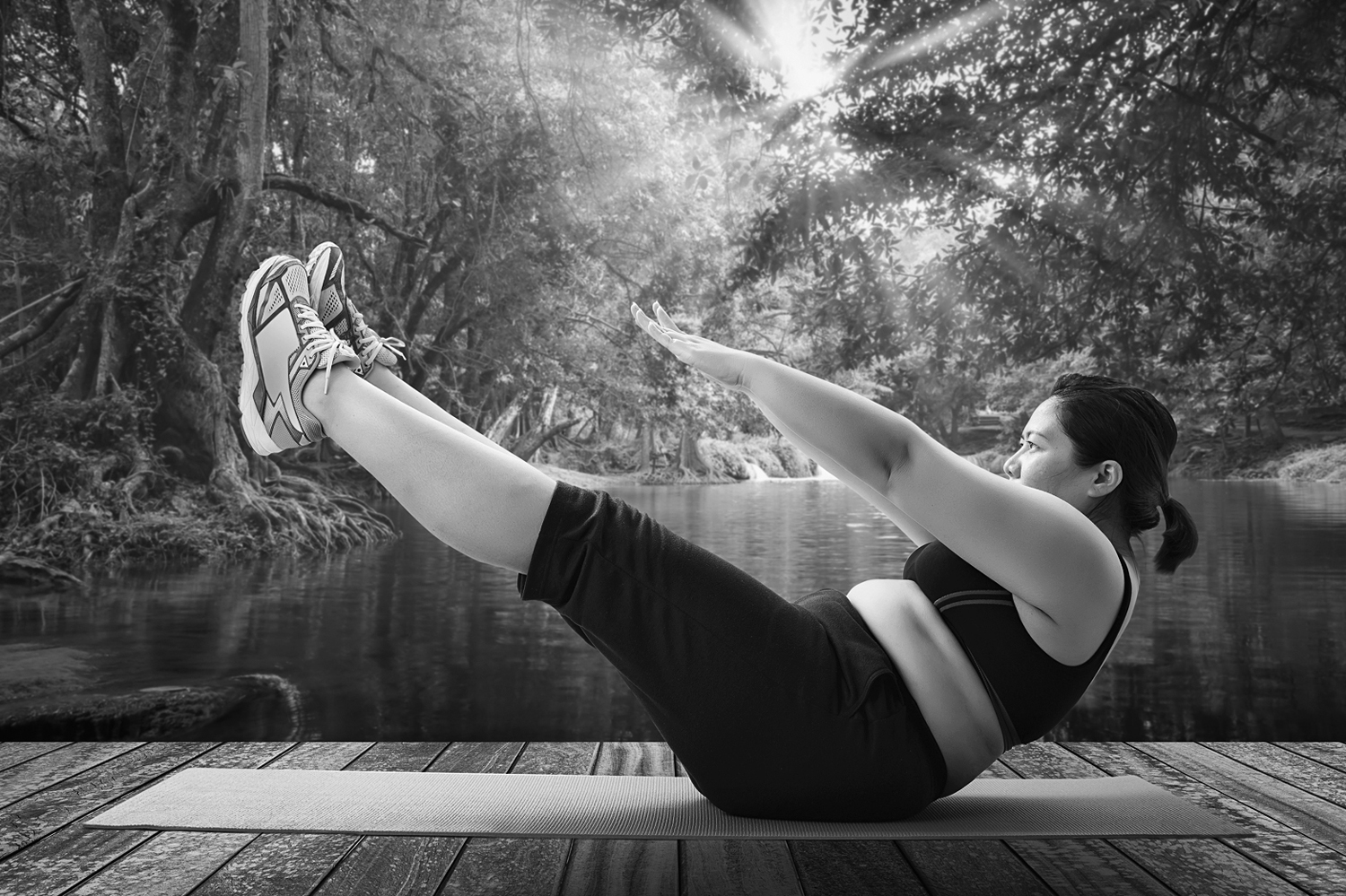
When you picture a woman exercising, what does she look like? Does the woman in this picture look like the one you imagine? If not, why not?
Movies and television are full of jokes at the expense of fat people. For example, Burmeister and Carels (2014) used several movie clips in their study of the relationship between anti-fat attitudes and weight-related humor. One was from the 2007 movie Norbit in which a fat woman is depicted as gaining so much momentum on a water slide that she lands far away in a different pool and causes all the water to splash out. Not surprisingly, participants who found such clips funny were more likely to have disparaging attitudes toward higher-weight people.
Fat women are by no means the only women who are hard to find in the media. Individuals with disabilities are rarely portrayed (Darke, 2004; Riley, 2005). When they are, they’re usually depicted in stereotypical ways that involve a focus on either impairment or courage (e.g., overcoming limits). Little research has focused specifically on the representation of women with disabilities (Meekosha & Dowse, 1997). Given the rarity of including women with disabilities in the media, no real attention has been paid to the way in which these women, and their bodies, may be objectified. Invisibility like this can, itself, become problematic. After all, many women with disabilities report greater body dissatisfaction than those without disabilities (Cromer et al., 1990; Moin et al., 2009; Wolman et al., 1994). The experience of almost never seeing someone who looks like oneself in the media may add to this dissatisfaction.
Older women are also under-represented in the media as compared to their presence in the population. In a study published in 2003, individuals over age 50 were found to make up 27% of the population, but only 18% of the characters in commercials appeared to be over age 50 (Ganahl, Prinsen, & Netzley, 2003). Moreover, since women live longer than men, they make up a larger percentage of the older population, yet men accounted for 66% of the representations of those over the age of 50. Other research has found that older women are dramatically under-represented in both prime-time television (Greenberg & Worrell, 2007; Kessler, Rakoczy, & Staudinger, 2004; Lauzen & Dozier, 2005a) and movies (Lauzen & Dozier, 2005b). Essentially, then, youth is itself a beauty norm for women. This, in turn, reflects a double standard for aging: Men become distinguished, and women just get old. (We’ll return to these ideas in Chapter 11.)
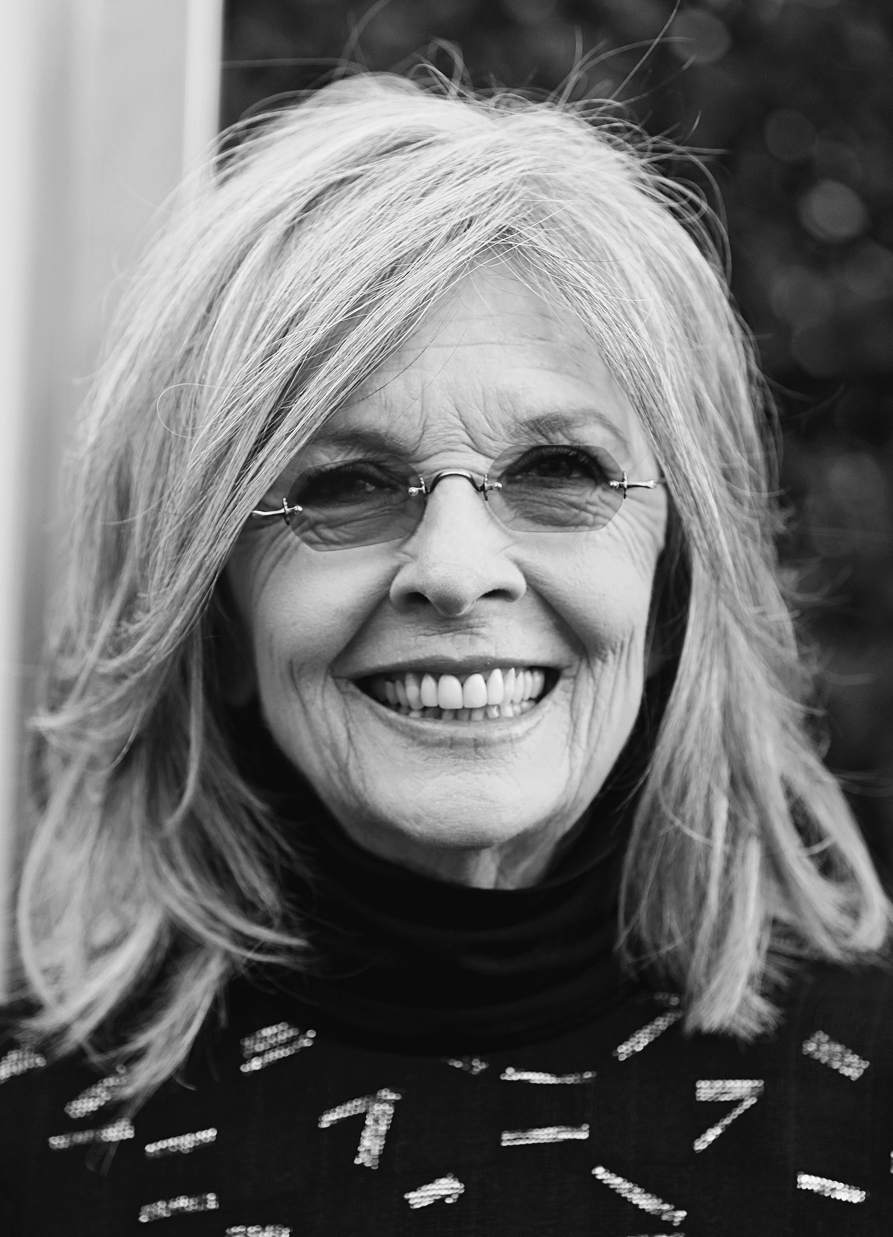
In 2014, the extent to which digital retouching can play a role when older women are shown in the media was apparent when Diane Keaton, then age 68, accepted an award on behalf of Woody Allen at the Golden Globes ceremony. In the next ad break, a L’Oréal ad featuring Keaton was shown. At the Golden Globes, she had visible wrinkles (as shown here), as one would expect for someone of this age; in the ad, however, her skin was completely smooth.
Another study, one that compared rates of representation in women’s magazines to population data, showed that White women were over-represented (73% in the Census vs. 91% in the magazines), while Black (12% vs. 6%) and Latinx (10% vs. 1%) women were under-represented (Covert & Dixon, 2008). In another study, researchers found similar issues with ads from Cosmopolitan and Family Life (Sanchez-Hucles, Hudgins, & Gamble, 2005). This study did find, however, that magazines targeting specific ethnic groups had a majority of ads featuring individuals from that group (e.g., 64% of ads in Latin Girl featured characters identified as Latinx). Studies of televisions ads have also shown that Black, Asian, Latinx, and Native American individuals are under-represented (Coltrane & Messineo, 2000; Mastro & Stern, 2003). Similar patterns of under-representation of women of color have been found in television shows, although there is evidence that rates are improving for Black women—but not for women who are members of other racial/ethnic groups (Greenberg & Worrell, 2007). Invisibility isn’t only about numbers; it’s also about how women are portrayed when they are present, and women of color are often portrayed in stereotypical, and sexualized, ways (Sanchez-Hucles et al., 2005). We’ll return to these ideas in Chapter 7 when we explore the sexualization of women.
Negative body talk, usually in informal conversations, in which people, typically girls and women, express dissatisfaction with their bodies, especially in terms of weight or body size/shape.
A tendency to have greater facial prominence (i.e., a larger proportion of the image devoted to the face) in depictions of men, while body prominence is more typical in images of women.