Noticing Microaggressions
2.3 Prejudice and Discrimination
What types of discrimination do women commonly experience, and why can it be challenging to identify instances of discrimination?
Whereas stereotypes are beliefs about what members of social groups are like, prejudice is a negative attitude toward someone because of their actual or perceived membership in a certain social group. Typically, when people think of sexism, they come up with examples of overt sexism, or unequal treatment of women that’s easily identifiable and therefore easily documented. Discrimination is a manifestation of prejudice that occurs when someone is treated unfairly because of actual or perceived membership in a social group that is less powerful than the dominant group. For example, not hiring a woman for a leadership position simply because she’s a woman would be an example of sex/gender discrimination. An example of overt discrimination would involve telling a woman during a job interview that the company doesn’t like to hire young women because they tend to quit to have babies, and then not giving her the job. As a result of many antidiscrimination laws, including the Civil Rights Act of 1964 and the Pregnancy Discrimination Act of 1978, these types of practices are illegal in the United States.
Modern Sexism, Cissexism, and Subtle Discrimination
Although overt sexism still exists, women are now much more likely to experience modern sexism, or gender bias that is communicated in subtle or indirect ways (Swim et al., 1995). Modern sexism often leads to more subtle or covert discrimination. For example, a woman who doesn’t get a job offer might not know whether gender played a role in the hiring decision. As we’ll discuss in Chapter 10, it’s not always easy to prove discrimination when this happens. One reason that modern sexism is so hard to identify and therefore change is that much of it is implicit. Explicit bias is conscious and deliberate—such as someone saying they won’t see a female doctor because they doubt they’d get quality care. In contrast, implicit bias occurs outside of conscious awareness and can be unintentionally directed toward specific groups. An example might be someone assuming that a woman in scrubs working in the ER is a nurse rather than a doctor.
More information
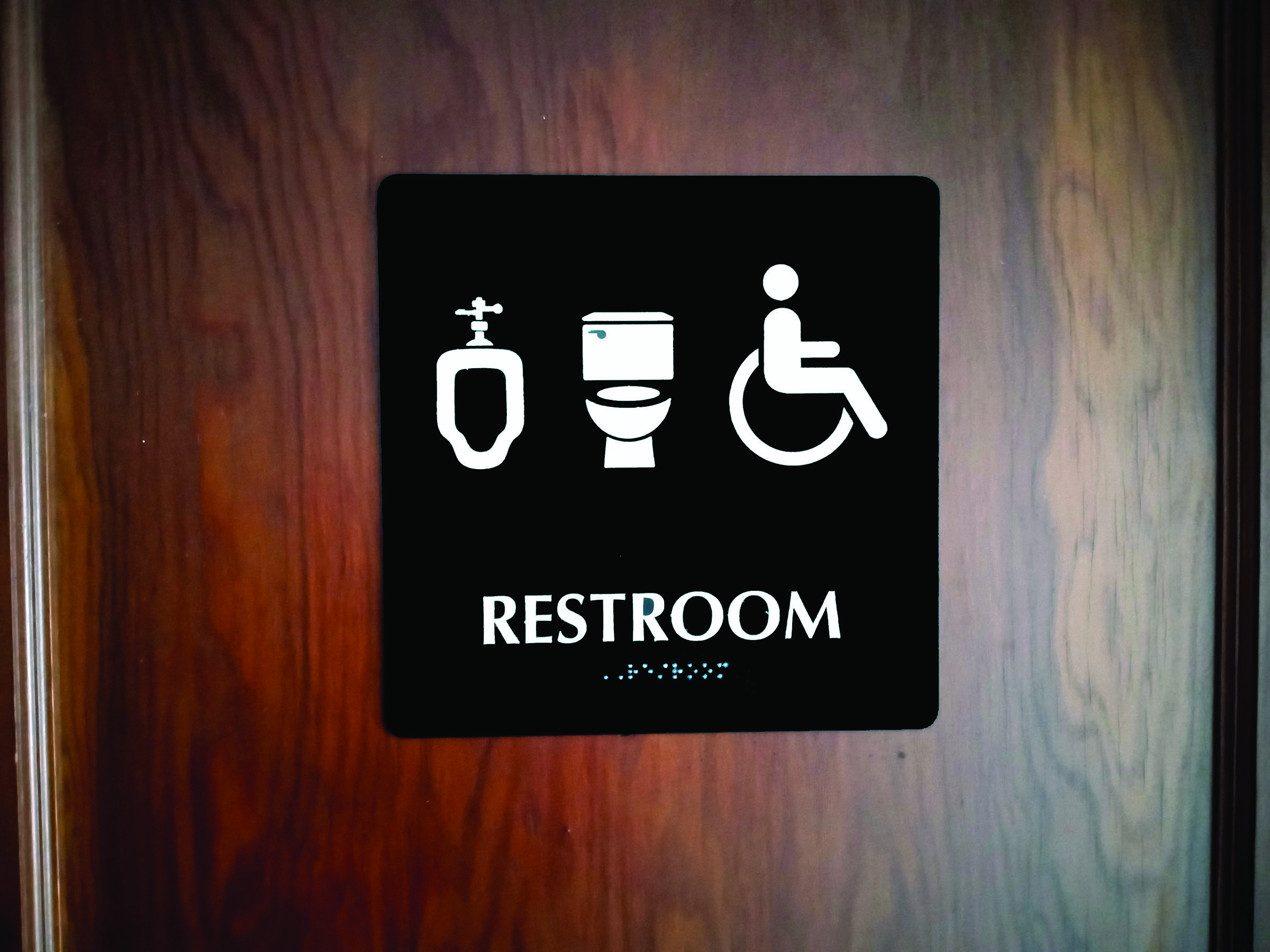
A sign on a door shows a urinal, a toilet, and a person in a wheelchair with the word “restroom” and braille reading restroom written below the images.
Figure 2.5 Gender-Inclusive Restrooms
Have you ever seen a sign like this for a public bathroom? How can signs like this contribute to dismantling cissexism?
Another subtle way in which bias occurs is through expressions of cissexism, a type of sexism that stems from the assumption that cisgender people’s identities, gender expressions, and bodies are more legitimate than those of trans people (Serano, 2007). Underlying this bias is a belief that there are only two sexes/genders that are mutually exclusive and that those who fit outside this binary are deviant or pathologized (Kuehnle, 2021). Everyday examples of cissexism include greetings like “boys and girls” or “ladies and gentlemen” and questionnaires that require a person to identify their gender but only provide the options “female” and “male” (Kuehnle, 2021) (Figure 2.5).
Because these sexist attitudes are often implicit, a central feature of modern sexism is the denial of discrimination (Lewis, 2018; Swim & Campbell, 2001). That is, if people assume that gender equality has been achieved, they’re likely to see any failure to succeed as a result of a person’s own shortcomings rather than systematic disadvantage (Swim et al., 1995). People who hold modern sexist views are often resentful of demands for equality; they see these as coming from people who expect special treatment. However, denial of discrimination is considered sexist because it justifies ignoring gender inequalities and maintaining the status quo while also blaming people for their lack of equality and social mobility (Hayes & Swim, 2013).
Modern sexism can be harmful because it prevents social change and can have negative consequences. Women who experience modern sexism have been found to report greater anxiety and insecurity than women who don’t report experiencing modern sexism, and they’re also more likely to engage in self-defeating behaviors (Barreto & Ellemers, 2005; Ellemers & Barreto, 2009). Some women also engage in denial of personal discrimination (Crosby et al., 2003). They acknowledge that sexism exists, but they feel they don’t personally experience it—at least, not often. Psychologists suggest that this denial may be a form of self-protection because it’s difficult to accept that one is disadvantaged by virtue of having a particular identity (Barreto & Ellemers, 2005; Ruggiero & Taylor, 1997). Such denial makes it less likely that they will engage in collective social action, and their failure to do so in turn maintains the status quo (Ellemers & Barreto, 2009; Wright, 2001).
Microaggressions
Modern sexism and the resulting subtle gender discrimination can be so unobtrusive that they begin to seem like normal parts of life (Swim & Cohen, 1997), so guesswork is often involved in deciding whether gender bias is occurring. Let’s consider a male boss telling a female employee, “You look nice today.” Does he make the same type of comment to male employees? He might be paying her a compliment, but he might also be cultivating a work environment in which female employees, but not male employees, are noticed for their appearance. Gender microaggressions are brief, everyday acts of sexism, whether intentional or unintentional, that demean and insult a person based on that individual’s sex/gender (Sue, 2010). These everyday acts are frequently perpetrated by people with good intentions who most likely don’t see themselves as prejudiced (Sue, 2010; Swim & Cohen, 1997), an idea we’ll revisit later in this chapter.
Microaggressions are often the result of stereotyping. For example, researchers found that people with disabilities frequently experienced microaggressions based on stereotypes (Keller & Galgay, 2010). They were often infantilized (i.e., treated as children), patronized (e.g., praised for doing mundane tasks), and desexualized (e.g., punished for displaying sexual interest). In another study, researchers found that compared with Latine men, Latine women experienced more microaggressions that were based on racialized gender stereotypes (Nadal, Mazzula, et al., 2014). Other microaggressions reported by women of color include feeling as though they were sexual objects and being treated as if they were a nanny instead of a mother (Nadal et al., 2015). One study showed that Black women at predominantly white institutions experienced gendered racial microaggressions based on stereotypes such as the angry Black woman (Lewis et al., 2016).
Other research has shown that microaggressions may be hard to identify (Cortina et al., 2017). An example is selective incivility—the tendency to make rude and/or condescending comments and engage in ostracizing acts toward women, people of color, or members of other socially marginalized groups that violate norms of respect (Cortina, 2008). Because acts of selective incivility (e.g., using a condescending tone, ignoring or interrupting a colleague) don’t appear obviously related to gender or race, they aren’t necessarily identified as sexist or racist acts (Cortina et al., 2017). Rather, they’re often attributed to the personality or carelessness of an individual instigator rather than seen as indicating a hostile climate. However, incivility can often be a manifestation of bias.
What’s your reaction to this video? Are you amused? Do you feel awkward? Are you confused? Flipping the script and demonstrating microaggressions targeted toward members of socially privileged groups as opposed to members of socially marginalized groups can help people understand how uncomfortable it can feel to be the recipient of such interactions—even if the intent is “well-meaning.” It can also help people realize how common microaggressions are.
Identifying and addressing microaggressions
Although the idea of subtle, unintended slights toward members of socially disempowered groups isn’t new, microaggressions are a relatively new focus of research. As a result, there are still inconsistencies in how microaggressions are operationalized, which make it hard to draw clear conclusions about outcomes and impacts (Williams, 2020). When we leave the lab and look to the real world, then, it’s no surprise that microaggressions are hard to document and that many people don’t notice when they’re taking place. The Everyday Sexism Project created #everydaysexism in order to more regularly document and promote awareness of sex/gender microaggressions. People continue to post on social media using this hashtag, showing women’s experiences with microaggressions. For example, one mother posted a picture of a sign in her son’s classroom that listed all the children’s names under the category of either Gorgeous Girls or Brilliant Boys. A waitress in her forties posted that while waiting on a table of businessmen she was referred to as a “good girl” for clearing the table. A college student explained that she was groped in a bar by a man who later apologized to her two male friends while simultaneously ignoring her.
Microaggressions can also be difficult to address. For example, if someone calls a woman “a girl” or inappropriately stares at her body, she has to decide whether it’s better to ignore or confront it. This process can be stressful: She simultaneously has to discern the truth, protect herself from additional insults, and decide whether to take action (Cadinu et al., 2005; Salvatore & Shelton, 2007; Sue, 2010). For a woman of color, the process can be more complex because she also has to take into account negative racialized stereotypes. One Black woman described how a man at a club told her to “shake her booty” (Lewis et al., 2016, p. 769). She wanted to tell him that he was being inappropriate but censored herself because she feared being labeled as an angry Black woman.
People can have a hard time deciding whether to directly address microaggressions or to use other strategies. This indecision may result from concerns about the consequences associated with responding to microaggressions or from not knowing what to say (Kahn, 2015; Sue & Capodilupo, 2008). In one study, researchers found that Black women used a variety of strategies to deal with microaggressions based on their power in the situation (Lewis et al., 2013). If the perpetrator was a boss or professor, participants reported withdrawing in order to be self-protective. They deliberately did not address the incident because given the power difference, they couldn’t safely predict the outcome of the situation. Other strategies included actively resisting Eurocentric standards of beauty (e.g., wearing their hair naturally, rejecting thin ideals), leaning on strong social support systems, and speaking out.
Addressing microaggressions is particularly challenging because people from dominant groups often dismiss and negate the experiences of people from marginalized groups when they try to speak up (V. E. Johnson et al., 2021). Some might blame the person who experienced the microaggression and/or accuse them of overreacting. Bystanders may notice that a microaggression has occurred but choose not to intervene—or fail to notice it at all. When this happens, it can function as a secondary microaggression because the person who experienced the first microaggression feels invalidated and silenced.
Microaggressions put people with socially marginalized identities in a difficult situation. If they confront the microaggression, they may experience additional harm, but if they don’t confront it, they can feel invalidated and often report shame and regret (Sue et al., 2007). When microaggressions go unaddressed, there can be psychological costs, including decreased self-esteem and increased anger and frustration (Sue, 2010). In one study, researchers found that Asian American women who were exposed to microaggressions reported more negative mental and physical outcomes than their male counterparts, who were more likely to be affected when they were exposed to overt forms of discrimination (Hahm et al., 2010). This finding suggests that microaggressions motivated by both racism and sexism are likely to be particularly problematic because the person being targeted has to do additional work to determine whether the attack is motivated by race, gender, or some combination of both.
Your Turn
Have you or has anyone you know ever experienced an act of sexism or a microaggression? Can you think of a time when you inadvertently said or did something that you didn’t intend to be offensive, but that was perceived as offensive? If so, how did you handle that situation? Would you handle a similar incident the same way in the future? Why or why not? Have you ever confronted someone about a microaggression? If so, what kind of response did you get?
Ambivalent Sexism: Hostility and Benevolence
What are hostile and benevolent sexism, and how do they work together to maintain gender hierarchies?
Sexism is often hard to notice because it can be cloaked in a positive context. As we’ve discussed, stereotypes can include both positive and negative components, and the positive aspects can cloak the negative ones. For example, people don’t usually go around saying, “I hate women. They’re horrible.” In fact, many sexist beliefs arise from the assumption that women (at least women who conform to traditional gender roles) are wonderful, virtuous, and warm. This idea is related to the stereotypes about women being communal and men being agentic discussed earlier in this chapter. Ambivalent sexism is a term that describes the ways in which contemporary sexism includes two related but complementary components: hostility and benevolence (Glick & Fiske, 1997). Hostile sexism consists of negative and derogatory beliefs about girls and women. Examples of hostile sexist beliefs are that women are incompetent, unintelligent, or sexually manipulative. In contrast, benevolent sexism takes a positive spin, suggesting that girls and women should be treated differently than men because they are special and worthy of being cherished and in need of protection. Examples of benevolent sexist beliefs are that women are pure, maternal, or intuitive. One can say that benevolent sexism puts women on a pedestal and hostile sexism puts women in the gutter (Begun & Walls, 2015).
Hostile and benevolent sexism work together to create sexist environments (Glick & Fiske, 1997; Wood & Eagly, 2010). Hostile sexism operates by punishing women for challenging traditional gender expectations; benevolent sexism rewards women for maintaining the gender status quo. One tool for assessing people’s endorsement of hostile and benevolent sexism is the Ambivalent Sexism Inventory (ASI; Glick & Fiske, 1997), and sample items for each type of sexism are shown in Table 2.4. Research with 15,000 women and men from 19 countries using the ASI showed that levels of hostile and benevolent sexism could reliably predict the status of girls and women (Glick et al., 2000). In countries with high levels of both hostile and benevolent sexism, women were found to be less likely than men to hold high-ranking government positions, experience pay equity, or have equivalent levels of education to their male counterparts.
|
TABLE 2.4 Sample Items from the Ambivalent Sexism Inventory |
|
|
Hostile Sexism |
Benevolent Sexism |
|
Many women are actually seeking special favors, such as hiring policies that favor them over men, under the guise of asking for “equality.” |
Women, as compared to men, tend to have a more refined sense of culture and good taste. |
|
Most women interpret innocent remarks or acts as being sexist. |
No matter how accomplished he is, a man is not truly complete as a person unless he has the love of a woman. |
|
Most women fail to appreciate fully all that men do for them. |
Every man ought to have a woman whom he adores. |
|
Women seek to gain power by getting control over men. |
A good woman should be set on a pedestal by her man. |
|
Once a woman gets a man to commit to her, she usually tries to put him on a tight leash. |
Men should be willing to sacrifice their own well-being in order to provide financially for the women in their lives. |
|
Note: The entire Ambivalent Sexism Inventory is provided in Glick and Fiske (1997). Respondents are instructed to rate the extent to which they agree with each item using a 6-point scale ranging from Strongly disagree to Strongly agree. |
|
Benevolent sexism is based in paternalistic chivalry, the idea that women should be protected and cherished—at least, as long as they conform to traditional gender roles (Figure 2.6). Many women find it flattering to be put on a pedestal, and the appeal of benevolent sexism is what makes it insidious and hard to change. However, a pedestal is a tight place to stand, and being there traps women within a narrow range of acceptable behavior. Also, hostile and benevolent sexism go hand in hand. In fact, people who hold negative beliefs about women (as evidenced by hostile sexism) tend to hold positive beliefs about women who conform to traditional gender expectations (as evidenced by benevolent sexism; Hopkins-Doyle et al., 2019). Given this relationship, it can be easy to switch between hostile and benevolent sexism. This kind of shift occurs, for example, when a man who cherishes his girlfriend calls her a slut after they break up. It also occurs in the cases of men who worship their mothers but are very hostile to sexual women—a phenomenon known as the Madonna/whore complex (Tanzer, 1985; Tavris & Wade, 1984). This phenomenon stems from the fact that some men see the women they care for and respect and the women they desire as being in mutually exclusive categories, so men will engage in both benevolent and hostile sexism—but toward different women (Tavris & Wade, 1984).

More information
A photo shows a man holding a door open for a woman carrying bags.
Figure 2.6 Benevolent Sexism
Benevolent sexism is based on the idea that women should be protected and cherished. Regardless of gender identity, it can be nice when people open doors for us or carry heavy objects, but benevolent sexism places women in a “less than” position in relation to men and has been shown to have detrimental effects on girls and women.
Although women are likely to reject hostile sexism, they often do endorse benevolent sexism (Glick & Fiske, 2001). In fact, one study has found that women are more likely to endorse benevolent sexism in countries where men endorse high levels of hostile sexism (Glick et al., 2000). This may, in part, be a self-protective response (Fischer, 2006). If a woman is in danger of being persecuted because she deviates from gender norms, it would be to her advantage to internalize the importance of staying within gender norms. Another study of Black and white undergraduate women and men showed racial differences in endorsements of benevolent sexism (Davis et al., 2022). Black women and men endorsed benevolent sexism more highly than white women and men; however, white men endorsed benevolent sexism more than white women. For Black women, religiosity and racial identity were related to their higher levels of benevolent sexism.
People appear to differentially apply benevolent sexism across groups of women, however. In one online study with primarily white participants, researchers found that participants expressed more benevolent sexism toward white women than toward Black women (McMahon & Kahn, 2016). However, when Black women were described as chaste, the participants expressed more benevolent sexism toward them. The researchers concluded that when Black women conform to traditional expectations of femininity, a possible outcome would be experiencing benevolent sexism.
Your Turn
Students frequently ask us, “What’s wrong with chivalry? Isn’t it nice for men to hold doors for women and pay for dinner?” The problem isn’t the act of opening a door for someone else—it’s the fact that it only involves men opening doors for women. After all, how common is it for a man to open a door and stand to the side so another man can enter? How do men react when a woman opens a door for them in this way? Were you raised in a family that valued chivalry? Was it framed as men needing to be chivalrous toward women or as all people needing to be kind? Where do you think the line falls between chivalrous behavior reflecting sexism versus simply acting out of kindness and concern for others?
Negative outcomes of sexism
It may seem obvious that hostile sexism is detrimental. Studies show that those who more strongly endorse hostile sexism make less favorable attributions about career women and are less likely to believe a woman’s claim about sexual harassment in the workplace (Carli, 2001; Heilman et al., 2004). Those who more highly endorse hostile sexist attitudes also hold negative attitudes toward feminine men (Glick et al., 2015). Among men, hostile sexist attitudes are also associated with finding sexist jokes amusing rather than offensive, minimizing the seriousness of rape, and thinking that a woman is to blame for being raped if she was wearing revealing clothing or had too much to drink (Gosetti & Manoussaki, 2021). In one study, hostile sexism was significantly associated with more negative evaluations of a female job candidate and with lower recommendations that she be employed as a manager (Masser & Abrams, 2004). Women and men high on hostile sexism were also likely to evaluate male candidates more favorably than female candidates.
In some cases, it’s harder to see that benevolent sexism is detrimental. Benevolent sexism assumes that women need men’s protection, an attitude that places women in a dependent position in relation to men. Because many people see male protection as natural and even beneficial, benevolent sexism is often not considered sexist. In fact, during the 1970s, the justification for not ratifying the Equal Rights Amendment (ERA) was based on benevolent sexist principles. Opponents of the ERA claimed that equality would actually disadvantage women because it would eliminate protections that had been put in place for them (Sue, 2010). More recently, politicians have used benevolent sexism to justify limiting military women’s participation in active combat by suggesting that women are weaker than or not as capable as their male counterparts; such restrictions would also prevent women from advancing in the military (Choma, 2016). Furthermore, accepting benevolent sexist beliefs has been linked to negative attitudes toward trans individuals, especially among women (Rye et al., 2019).
When women are exposed to benevolent sexism, they may show increased levels of stress. In one study, a racially diverse group of women was asked to complete a challenging problem-solving task before being exposed to a male researcher who made either a benevolent, a hostile, or a nonsexist comment (Salomon et al., 2015). In the benevolent condition, he said, “Girls don’t like the hard section, so I’m going to go ahead and get rid of it for you. I’m willing to sacrifice a little data, so I don’t make another girl upset about how hard the last section is” (p. 472). Compared with women who weren’t exposed to benevolent sexism, the women who were had increased cardiovascular activity that took longer to return to baseline. This outcome indicates that the women who were exposed to benevolent sexism experienced the stress of the problem-solving task for longer than the women who were exposed to either the hostile sexist or the nonsexist comment. In another study, women who simply witnessed a benevolent sexist act (a man offering to pick up a box for a woman) felt more self-conscious about their bodies than those who didn’t witness such an act (Shepherd et al., 2011). These findings suggest that merely witnessing benevolent sexist acts has detrimental effects.
Benevolent sexism can even interfere with women’s thinking. In one study, researchers examined women’s brains while they completed a memory task after hearing a male researcher make a benevolent sexist statement, a hostile sexist statement, or a neutral statement (Dardenne et al., 2013). When the women were exposed to the benevolent sexist statement, the brain regions associated with stopping intrusive thoughts (e.g., bilateral, dorsolateral, prefrontal, and anterior cingulate cortex) reacted. This finding indicated that those in the benevolent sexism condition shifted attention from the task to block out intrusive thoughts. Since this wasn’t true for those exposed to the hostile sexist statement or the neutral statement, benevolent sexism may be particularly detrimental to women’s performance.
Glossary
- prejudice
- A negative attitude toward someone because of that person’s actual or perceived membership in a certain social group.
- overt sexism
- Unequal treatment of women that is identifiable and therefore easily documented.
- discrimination
- A form of prejudice that involves the unfair treatment of an individual on account of being part of a social group that is less powerful than the dominant group.
- modern sexism
- Gender bias that is communicated in subtle or indirect ways.
- cissexism
- A type of sexism that stems from the assumption that cisgender people’s identities, gender expression, and bodies are more legitimate than those of trans people.
- gender microaggressions
- Brief, everyday acts of sexism, whether intentional or unintentional, that demean and insult a person based on that individual’s gender.
- selective incivility
- The tendency to make rude and/or condescending comments and engage in ostracizing acts that violate norms of respect; these comments and/or behaviors are directed toward women, people of color or members of other socially marginalized groups.
- ambivalent sexism
- A form of sexism that includes the two related, but complementary, components of hostility and benevolence.
- hostile sexism
- A component of ambivalent sexism that consists of negative and derogatory beliefs about girls and women.
- benevolent sexism
- A component of ambivalent sexism that consists of beliefs that girls and women should be treated differently than boys and men because they are special and in need of protection.
- paternalistic chivalry
- The idea that women should be protected and cherished—at least, as long as they conform to traditional gender roles.