What are different ways that language is used to maintain gender hierarchies?
Many cissexist and patriarchal assumptions are conveyed through language in both obvious and subtle ways. When internalized, these messages can further reinforce sexist attitudes and behaviors (Menegatti & Rubini, 2017), and psychologists have identified biased language as a form of microaggression (Nadal, 2013; Sue, 2010; Woodford et al., 2013). Yet in the same way that people may not notice benevolent sexism, people often don’t notice the problematic messages in everyday conversations. However, research shows that people who use more gender-biased language are more likely to hold sexist beliefs (Wasserman & Weseley, 2009).
Hidden Bias in Language
Language has a strong cisgender bias, most notably in the use of pronouns. In English, there is no gender-neutral third-person singular pronoun. Only the third-person plural pronoun (they) is gender neutral. Gender-specific pronouns create two problems. First, people who wish to identify outside of the gender binary do not have a default pronoun to use. Second, repetitive use of binary pronouns encourages people to think the binary is natural and reinforces expectations about what’s “normal” (Stokoe, 2004). Another problem is that he has historically served as the human generic (McHugh & Hambaugh, 2010).
Throughout the English language, the generic human is often represented as masculine. Man is often used interchangeably with human, and this usage reinforces the idea that male characteristics and actions are representative of all humans. In fact, classic studies have shown that when participants receive no other information, they tend to associate the generic word person with a white, heterosexual, able-bodied, young man (Fiske, 1998; Stroessner, 1996). In one study, college students most frequently assumed that a person named “Chris” was a man, and white college students were more likely than students of color to label “Chris” as a white man (Merrit & Harrison, 2006). A review of the research on this bias found that people are more likely to assume that a typical person, an American, a voter, an unspecified book character, and even a stuffed animal are male (Bailey et al., 2019).
The problem with the generic use of he and the tendency to assume that generic people are men have led to shifts in language use. Most writers today don’t use he to refer to all people; instead, they may use he or she. However, this usage doesn’t acknowledge individuals whose gender identity falls outside the binary. Interestingly, the singular use of they was much more common until 1850, when the British Parliament required that all official documents use only masculine pronouns (McCurdy, 2013). The change was made because, according to Parliament, men could represent all people because of their superior status. Although some grammar enthusiasts might argue otherwise, use of the generic he in English was a political decision. In this way, pronoun use can be seen as a way to reinforce cultural assumptions (McCurdy, 2013; Zimman, 2015). However, these standards are changing; the American Psychological Association has started recommending the use of singular they instead of he or she “because it is inclusive of all people and helps writers avoid making assumptions about gender” (Lee, 2019, para. 6). Moreover, the increasing number of people who use pronouns in fluid and flexible ways (e.g., she/they; they/he) indicates that pronouns are not fixed—even for a given person (Cohen, 2021) (Table 2.5).
TABLE 2.5
Possible First-Person Pronouns in Different Grammatical Forms
Subjective
Objective
Possessive
Reflexive
Usage Examples
She
Her
Hers
Herself
She is a student.
I am friends with her.
This book is hers.
He
Him
His
Himself
He is a student.
I am friends with him.
This book is his.
They
Them
Theirs
Themself
They are a student.
I am friends with them.
This book is theirs.
Ze
Hir/Zir
Hirs/Zirs
Hirself/Zirself
Ze is a student.
I am friends with hir.
This book is zirs.
In other ways as well, language prioritizes men. For example, Shakespeare didn’t title his play Juliet and Romeo. We don’t refer to royalty as queen and king, and teachers generally don’t address their classes as girls and boys (Formanowicz & Hansen, 2022). Researchers have found that participants habitually named men first in heterosexual pairings, men’s names tend to appear before women’s names on google searches, and couples in searches are usually pictured with men on the left and women on the right (Bailey et al., 2019). In fact, even in psychological journal articles, men are placed above women in text and tables almost three quarters of the time (Hegarty & Buechel, 2006). We also tend to use marked language to refer to people in nondominant groups. Unmarked terms like host or actor could refer to someone of any gender, but people generally assume that the person being referred to is male (McHugh & Hambaugh, 2010). However, the comparable marked terms, hostess and actress, are only used to refer to women.
Our tendency to only mark the “other” also applies to socially marginalized groups besides women. For example, those who are “hearing impaired” are marked, while those who are “unimpaired” are not; left-handers are marked, while right-handers are not (Brekhus, 1998). This marking also happens in research studies. Many studies of crime mark when crimes are committed by Black or Latine individuals but don’t comment on race when the crimes are committed by white individuals (Brekhus, 1998). More recently, at a school board meeting, one of this book’s authors noticed that parents complained that many books were tagged LGBTQ+ without realizing that the vast majority of the romance novels on the shelf were heterosexual but unmarked as such.
Gender-fair language, or language that refers to all people with inclusive linguistic forms, has been found to promote gender equality (Sczesny et al., 2016). This type of language avoids male generics by using terms like they instead of he as a singular pronoun or first-year student instead of freshman (Figure 2.7). Further, gender-fair language seeks to reduce stereotypes. Instead of saying “Dear Mothers, please bake cookies for the bake sale,” a gender-fair alternative would be “Dear Parents, please bake cookies for the bake sale.” Gender-fair language is less common in everyday talk than gendered language is, but research shows that women are more likely to use gender-fair language than men (Koeser et al., 2015). In another study, when men were made aware of sexist language, their use of gender-fair forms did increase, but they tended to return to sexist language when tired or distracted (Koeser & Sczesny, 2014; Koeser et al., 2015).
More information
A photo shows an auditorium full of people with a person standing on stage.
Figure 2.7 Language Matters
People often open events by saying “Welcome, ladies and gentlemen.” How could you address people at a formal event using gender-fair language?
One example of a move toward gender-fair language is use of the word Latine, meant to be a gender-neutral alternative to Latina and Latino. People who use Latine are part of a linguistic movement seeking to reject gender binaries, be inclusive, and modify the language and traditions of Europeans that relate to people of Latin American descent (Salinas, 2020). Some critics, however, feel that this linguistic change is respectful to the Spanish language, which is linguistically gendered. In Spanish, nouns are gendered—for example, guitar is feminine and is preceded by the article la instead of el—but there is evidence that gendered nouns reinforce sexist beliefs. In one study, when bilingual high school students were randomly assigned to complete a survey addressing sexist attitudes in either English or a language with a grammatical gender (French or Spanish), students in the English condition expressed less sexist attitudes than those in the French or Spanish conditions (Wasserman & Weseley, 2009). Further, because language is such a central part of everyday experience, the repetition can normalize these subtle forms of sexism and cissexism.
What’s in a Name?
Names also reveal hidden biases. For example, while traditional male nicknames often imply strength, large size, hardness, and maturity (e.g., Champ, Digger, Stud, Maddog), female nicknames are more associated with beauty, pleasantness, kindness, and goodness (e.g., Angel, Babe, Munchkin, Honey; Phillips, 1990). Subordinate status shows up again with the use of formal titles. In formal settings, the probability of being addressed by a professional title is greater for men than for women. One study showed that students were more likely to refer to male professors than female professors by a formal title (e.g., Dr.; Takiff et al., 2001). However, when female professors were addressed by title, students perceived them as less accessible—a pattern that didn’t hold for male professors. Moreover, professors who are women of color are often referred to as Ms., while their colleagues are referred to as Doctor or Professor (Berry, 2014).
Names are central to people’s identity. A large proportion of women who marry men change their last name. This practice originates from the traditional family structure in which, upon marriage, a woman became her husband’s property (Suarez, 1996). In an analysis of wedding announcements published in the New York Times from 1982 to 2002, 71% of all women changed their names, while 29% chose to keep their birth name or hyphenate it (Hoffnung, 2006). However, only 39% of women of color changed their names. The percentage of men who hyphenated or changed their names was not reported in the study—likely because it was so low. The practice of taking a husband’s name varies considerably by country. In Spain, Latin American nations, and China, women typically keep their birth name after marriage and are likely to give hyphenated names to their children (Chapman & Ciment, 2015). Women’s level of education can also be a factor. According to results from one study, women with a master’s degree were nearly three times more likely to use their birth name than those without a bachelor’s degree, and those with a doctorate were nearly 10 times more likely to do so (Gooding & Kreider, 2010). Research has also suggested that women with more hostile sexist beliefs were more likely to support marital surname change (Chayinska et al., 2021).
Your Turn
If you’re married, did you change your name? Why did you make the choice you did? If you’re not married, have you considered your options in regard to surnames if you were to get married? What do you think you will do? Ask a diverse group of people these questions. What patterns do you see? Are men less likely to change or consider changing their surname? What do you think explains the patterns you observe?
The decision to take a spouse’s name is less common among non-heterosexual couples. In one study, lesbian and gay couples reported that they kept their own surnames in order to maintain their personal and professional identities, reject heterosexual customs, and avoid the cost and inconvenience of having to change their names (Clarke et al., 2008). However, more recent research has suggested that lesbian and gay couples are increasingly interested in having one or both members of the couple change their name in order to promote a sense of family unity (Underwood & Robnett, 2021).
Marriage is not the only time when people may change their names. Many people who are trans or have a nonbinary gender identity choose names that better reflect their identity than those given to them at birth (Russell et al, 2018). However, names can also be used to harass and demean trans and nonbinary people. Deadnaming is a practice in which a person uses a trans and/or nonbinary person’s name given at birth—or any name other than their chosen name—without their consent. In one study, adolescents, particularly adolescents of color, reported deadnaming as one of the most common forms of bullying (Earnshaw et al, 2020). In another study, deadnaming was associated with symptoms of depression and self-harming behaviors among young adults (Russell et al, 2018).
Denigrating names also reflect a double standard about sexuality. There are many slang words that are meant to harm women (e.g., bitch and slut). Equivalent derogatory words for men aren’t nearly as harmful (e.g., tool and stud). Most notably, slang words that are used to describe women are disproportionally sexualized. One linguist found that North American English has 220 words for a sexually promiscuous woman but only 20 for a sexually promiscuous man (Lei, 2006). Moreover, when men deviate from gender-typical behaviors, they’re often described in terms of female genitalia (Fair, 2011). Referring to someone by terms associated with male genitalia, while not nice, still conveys status and power, which is why men don’t consider it as offensive as a homophobic slur (Saucier et al., 2015). Also, when someone does something courageously, it’s common to say, “That took balls”—slang for men’s testicles. Ironically, the testicles are actually very sensitive, whereas the uterus is the strongest muscle in the human body (Norton, 2010). So maybe people should start saying, “That took uterus!”
Conversation
How do talking styles, speech use, and interrupting reflect power differentials?
We can also see how language reflects status and power by examining the different ways sex/gender operates in conversation. It’s a popular stereotype that women are more talkative than men, but numerous studies have debunked this myth (Ghilzai & Baloch, 2015; Mehl et al., 2007). One study showed that men take up to 75% of talking time in a mixed-group setting (Karpowitz & Mendelberg, 2014). This is an example of a subtle form of sexism since it’s generally not noticeable when men take up conversational space, but it’s very noticeable when women do so. The tendency for men to dominate most of a conversation is consistent with the theory of communicator status, which holds that individuals with higher status are perceived as having more credibility and expertise than those with lower status. This translates into men talking more and having more control over conversations than women.
EMPOWERING OR OPPRESSING?
SHOWHIDE
Reclaiming Words
Can misogynistic words ever be used in ways that are empowering? Reappropriation occurs when a person or group of people from a subordinate group intentionally reclaims a slur that was previously used by a dominant group to oppress or stigmatize them (Galinsky, Hall, & Cuddy, 2013). The ability to reclaim negative words has been hotly debated within feminist circles, and much like other feminist discussions, there is tremendous diversity in how people think about it.
For some feminists, words like bitch and slut are hateful terms that perpetuate denigration and rape culture. From their perspective, these words—and others that are generally considered even more offensive—are sexist, plain and simple. According to those who hold this perspective, it’s important to advocate for the complete elimination of their use because such words cause harm, particularly when normalized as acceptable parts of everyday language (Hodge, 2012). Some scholars have even suggested that such words qualify as hate speech and should be taken as a literal threat, particularly when used by someone in a dominant position (Popa-Wyatt & Wyatt, 2018).
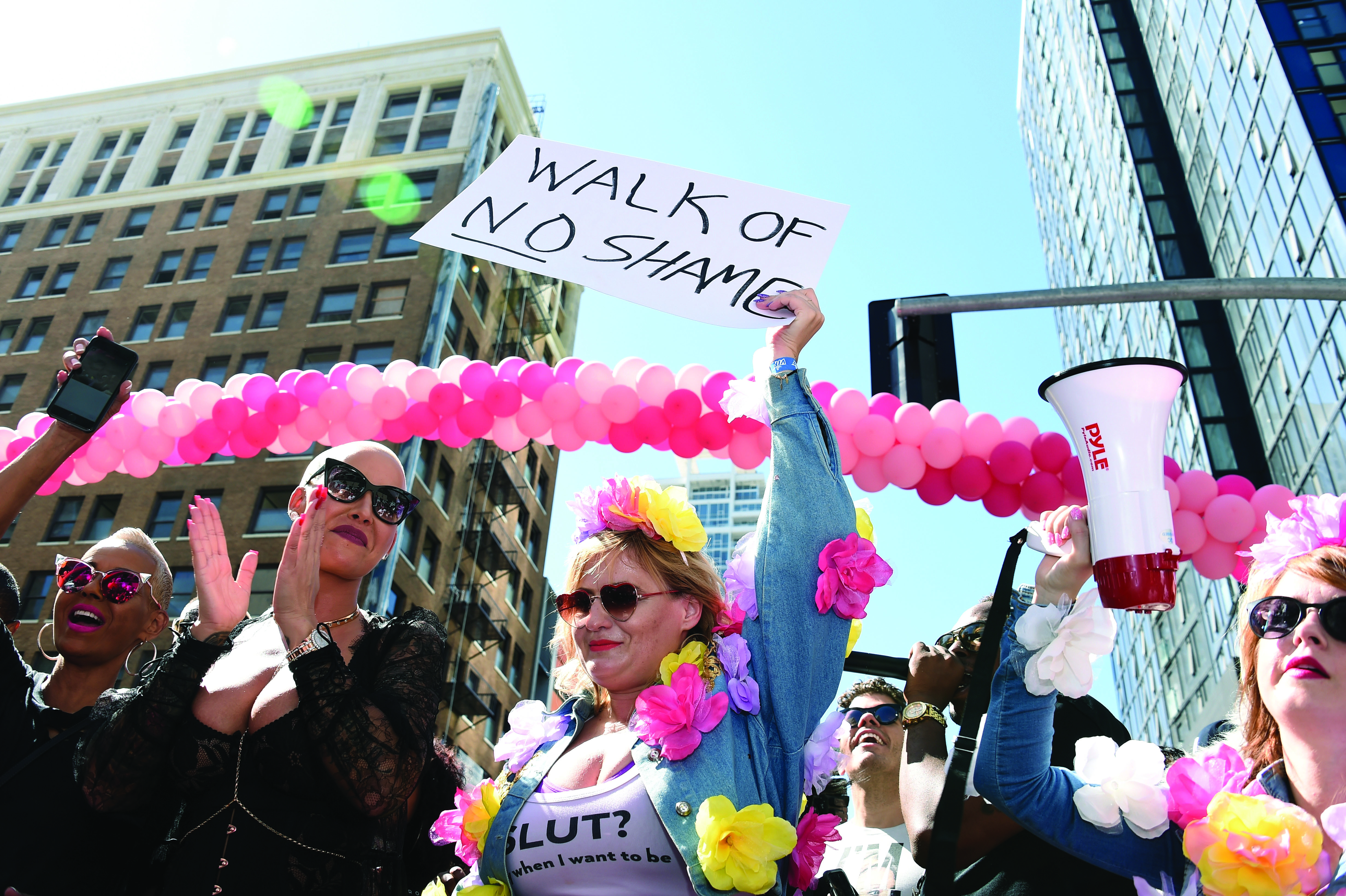
Despite this view, slurs are used by many women to build solidarity and to mobilize for political purposes. As an example of reappropriation, we can think of the enthusiasm around the “pussy” hats worn during the 2017 Women’s March. Before that, starting in 2011, activists used the provocative title SlutWalk to protest against the ways in which law enforcement routinely suggests that women invite rape by wearing revealing clothing (Figure 2.8). In the play The Vagina Monologues, one very popular monologue encourages the audience to repeat a word for women’s genitalia that many find particularly offensive as a way to destigmatize it and gain power.
More information
A photo shows women marching, one of whom holds a sign that reads, “Walk of no shame” and wears a shirt that says “slut? When I want to be.” There are flower decorations and a balloon arc.
Figure 2.8 SlutWalks
SlutWalks began in 2011 in Toronto in response to a police officer telling a group of college women that in order to prevent sexual assault, they shouldn’t dress “like sluts.” The comment sparked a worldwide campaign. Although many people supported the goal of ending rape culture, not everyone was comfortable with the name “SlutWalks.”
There is also evidence that reappropriation can be successful under the right conditions (e.g., Croom, 2018; Galinsky et al., 2013). In one experiment, participants were exposed to the term slut in different contexts (Gaucher et al., 2015). Women were less likely to endorse common rape myths after being exposed to the word in the context of a protest march (e.g., SlutWalk) than they were if they heard it on the street. Further, within the context of SlutWalk marches, use of the word did not significantly lower women’s feelings of empowerment, and women were more likely to refer to themselves and friends as sluts after participating in the event (Wang et al., 2017).
What are your thoughts about this debate? Is the use of slurs empowering or oppressing, and why? Are there certain situations in which it may be politically beneficial to do so? Does it matter who uses the slurs? Are there ways in which other variables (e.g., racism or classism) might determine whether the use of a slur is empowering or oppressing?
This theory has very real implications because talking time influences so many outcomes—ranging from whose thoughts are heard, to who influences major decisions in meetings, to who gets opportunities for active learning in a classroom. For example, studies have shown that male students speak more frequently in college classrooms and that professors are more likely to listen to them than female students (Basow, 2004; Litosseliti, 2013; Swann, 1992). In school, boys are more vocal and raise their hands in more disruptive ways, which results in more teacher attention (Spencer et al., 2003). Men appear to dominate media conversations too. In 2012, the OpEd Project determined that men wrote 80% of traditional opinion pieces, 67% of online opinion pieces, and 62% of college newspaper opinion pieces (Yaeger, n.d.). One study on academics in medicine found that men had more social media followers and were re-tweeted and liked at almost double the rate of women (Zhu et al., 2019).
In her now-classic book Language and Women’s Place, the feminist linguist Robin Lakoff (1975) was one of the first to offer an explanation for the way power operates in conversations. People with lower status are taught to be polite and to speak in ways that are unconfident and powerless. In particular, Lakoff proposed that women often use tentative speech forms, including hedges (e.g., mostly), hesitations (e.g., um), tag questions (e.g., right?), and intensifiers (e.g., very). For example, a woman may say “I . . . um . . . don’t really like it” rather than “I don’t like it,” or “I just wanted to check the time, okay?” rather than “I’m checking the time.”
Several studies have examined conversations in order to assess whether women use these speech patterns more than men, and the results have been mixed. Overall, results do show that women are somewhat more likely than men to use tentative speech (Palomares, 2009). However, many linguists are concerned that these small findings have led to overgeneralizations, particularly about women. For example, most women in most contexts will not use tentative speech; however, when they do use tentative speech, people notice it, contributing to confirmation bias (Palomares, 2009). In other words, people selectively attend to stereotypical behaviors and then conclude that those behaviors are characteristic of the whole group. One sociolinguist has referred to this phenomenon as “naming and shaming” (Liberman, 2007, para. 2).
Further, Lakoff’s original claim that tentative speech reflects powerlessness may not be true. In fact, tentative speech may improve connection and increase power in certain social contexts. In one study, women were more likely to use tentative styles of speaking in longer versus shorter conversations, in research labs versus other settings, and in groups versus dyads (Leaper & Robnett, 2011). Furthermore, women may use tentative speech because they are evaluated harshly when they don’t. In one study, researchers asked businesswomen and businessmen to evaluate the competence of chief executives who voiced their opinions (Brescoll, 2011). Male executives who spoke up were often rewarded with higher ratings of competence; in contrast, when female executives spoke with more frequency, both women and men punished them with lower ratings. We’ll talk more about how women and men are perceived differently in work contexts in Chapter 10.
More information
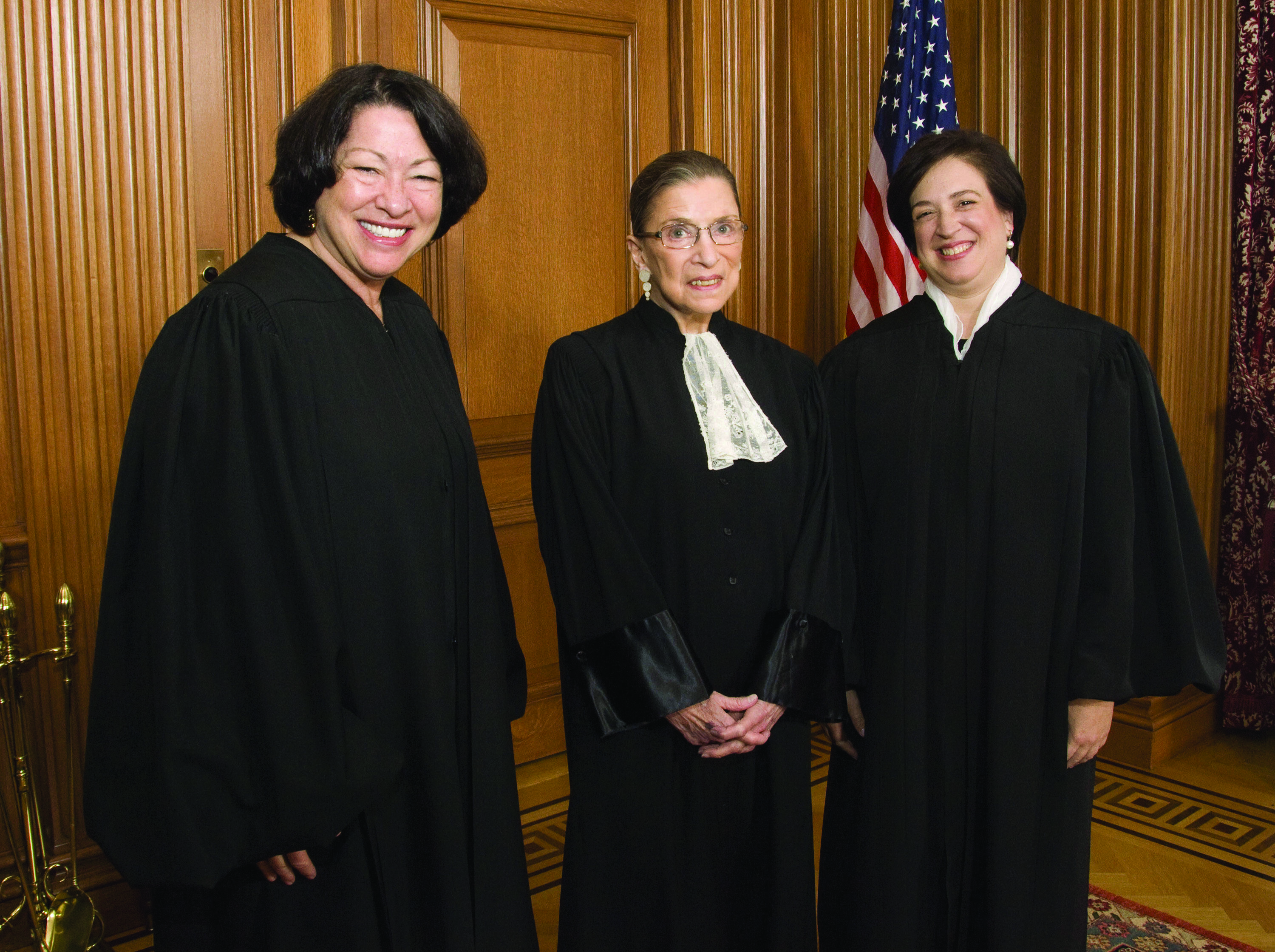
A photo shows justices Sotomayer, Ginsburg, and Kagan standing next to each other in a courtroom.
Figure 2.9 Justices Sotomayor, Ginsburg, and Kagan
An analysis of arguments in the U.S. Supreme Court from 2006 to 2020 found that when a female justice (Ruth Bader Ginsburg, Sonia Sotomayor, and Elena Kagan during this period) was speaking, she was more likely to be interrupted in a hostile and uncooperative manner than a male justice when he was speaking (Lepp & Levow, 2020).
Another manifestation of power in language is that people with power interrupt others more often (Figure 2.9). In one study, when researchers transcribed the conversations of 20 women and men in pairs, they found that in a three-minute conversation women interrupted men just once, on average, but they interrupted other women 2.8 times (Hancock & Rubin, 2015). Men interrupted their male conversational partner twice, on average, and interrupted female partners 2.6 times. A comprehensive review of 43 studies found that men were likely to interrupt women with the intent to assert dominance in the conversation—that is, to take over the conversation When women interrupted, however, it was because of increased enthusiasm or interest in the speaker’s topic (Anderson & Leaper, 1998).
Body Language
How do people use body language to demonstrate their social status?
Language is not only spoken, and power is regularly performed in nonverbal ways (Hall et al., 2005). Nonverbal communication is communication without words. It includes gestures, expressions, body posturing, eye contact, and physical appearance (LaFrance & Vial, 2016). Much like spoken communication, nonverbal cues reflect a social hierarchy (Hall et al., 2005). High-status people tend to say whatever they want without concern for social approval, appear more relaxed, take up more space, and make eye contact when speaking as opposed to listening (Renninger et al., 2004; Tiedens & Fragale, 2003). They are also more likely than lower-status people to display nonverbal cues of disengagement (e.g., doodling, self-grooming) and less likely to show nonverbal cues of engagement (e.g., laughing, nodding, raising their eyebrows; Kraus & Keltner, 2009).
More information
A photo shows a man on a subway sitting slouched back with his legs spread open between two other passengers.
Figure 2.10 Manspreading
Have you noticed instances of manspreading like the one illustrated here? How do you think people would react if a woman sprawled into a neighboring seat this way?
Women have been found to be more likely than men to exhibit behaviors that reliably predict low status (Palczewski et al., 2023). In one study, girls and women were found to smile more, gaze more, exhibit more expressive gestures, speak with a softer voice, and maintain smaller interpersonal distances (Hall et al., 2000). The same study showed that men appeared to engage in behaviors that display dominance. This finding was indirectly supported in 2014 when the New York Metropolitan Transportation Authority released a series of public service ads targeting men’s tendency to engage in manspreading, a sitting style characterized by spreading the legs wide into a V-shaped slouch, effectively occupying two seats (Figure 2.10) (Fitzsimmons, 2014). Moreover, the tendency to take up space isn’t limited to public transportation. If you look around the next time you’re sitting in class, you’ll probably notice some degree of manspreading on the part of male students, while female students are likely to be sitting with legs crossed and body turned inward, a low-status position.
Smiling, in particular, seems to be something women do more than men (Hall, 2006). A comprehensive review of several studies that explored smiling showed that girls and women smile 66% more than boys and men (Hall, 2006). This tendency appears to reflect a feeling of obligation rather than a display of authentic positive emotion (LaFrance & Vial, 2016). Smiling is an excellent example of doing gender since it conforms to gender-role stereotypes that girls and women should be nurturing and communal—“nice” and “sweet” rather than “strong” (Bosak et al., 2008). If you google men telling women to smile, you’ll find several hundred links, suggesting that this phenomenon is a popular topic. Particularly when the request comes from a stranger, women report accommodating because of fear of retaliation (Glaser, 2014). Smile requests can be considered a form of street harassment, a problem that disproportionately affects women of color (Nielsen, 2000). In fact, artist Tatyana Fazlalizadeh unveiled a series of public art displays in 2013 entitled Stop Telling Women to Smile in order to draw attention to this problematic practice.
The process of a person or group of people from a subordinate group intentionally reclaiming a slur that was previously used by a dominant group to oppress or stigmatize them.