Personality refers to an individual’s characteristic patterns of thought, emotion, and behavior, together with the psychological mechanisms—hidden or not—behind those patterns. This definition gives personality psychology its unique mission to explain whole persons. Of course, personality psychologists may not always succeed at this job. But that is what they are supposed to be doing—putting together the pieces of the puzzle contributed by the other subfields of psychology, as well as by their own research, to assemble an integrated view of whole, functioning individuals in their daily environments.
Mission: Impossible
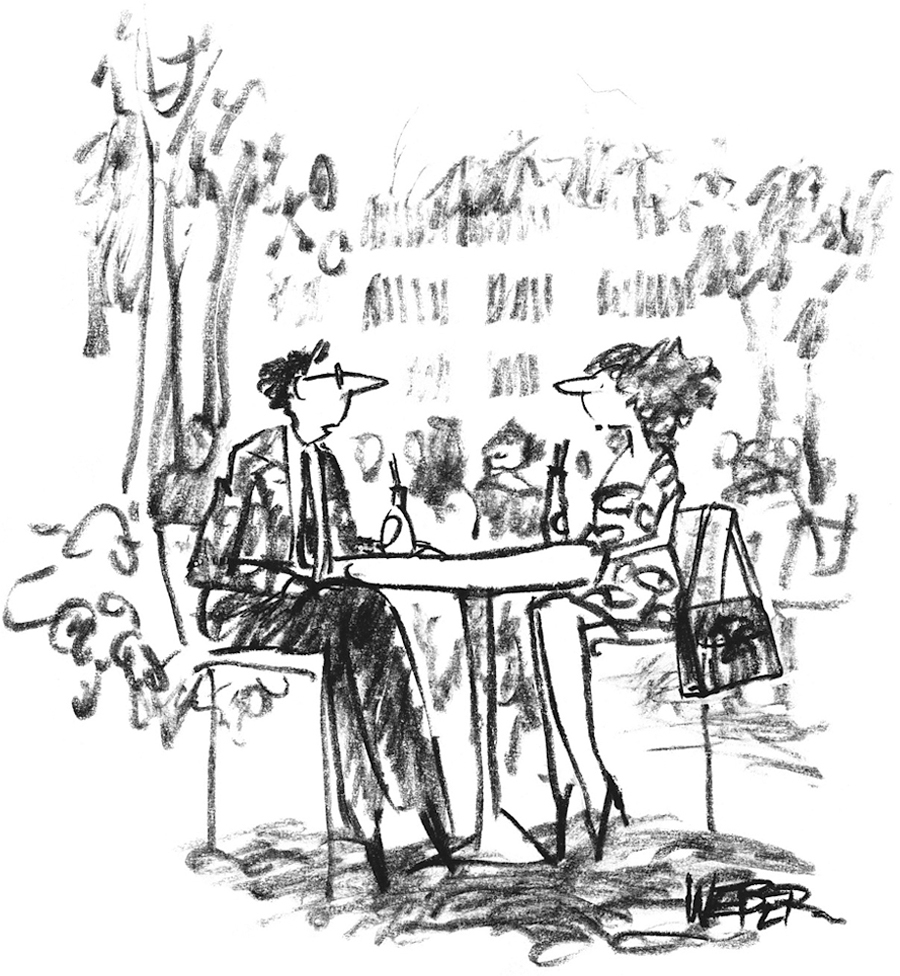
“Do you mind if I say something helpful about your personality?”
There is only one problem with this mission: It is impossible. In fact, this interesting mission is the source of personality psychology’s biggest difficulty. If you try to understand everything about a person at once, you will immediately find yourself completely overwhelmed. Your mind, instead of attaining a broad understanding, may go blank.
The only way out is to choose to limit what you look at. Rather than trying to account for everything at once, you must search for more specific patterns. This search will require you to limit yourself to certain kinds of observations, certain kinds of patterns, and certain ways of thinking about these patterns. A systematic, self-imposed limitation of this sort is what I call a basic approach (another commonly used term is paradigm). Personality psychology is organized around several different basic approaches.
The most all-encompassing tradition in personality psychology, the trait approach (the reference is to personality traits), focuses on the ways that people differ psychologically and how these differences might be conceptualized, measured, and followed over time. This is by far the largest and most dominant approach in contemporary personality psychology, and it helps to organize the other approaches, because individual differences are central to pretty much everything.
Table 1.1BASIC APPROACHES TO PERSONALITY AND THEIR FOCAL TOPICS
Basic Approach
Focal Topics
Trait approach
Conceptualization of individual differences
Measurement of individual differences
Consequences of individual differences
Personality development
Personality change
Biological approach
Anatomy
Physiology
Genetics
Evolution
Psychoanalytic approach
Unconscious mind
Internal mental conflict
Phenomenological approach
Conscious awareness and experience
Free will
Humanistic psychology
Cross-cultural psychology
Learning and cognitive approaches
Behaviorism
Social learning theory
Cognitive personality psychology
One specifically focused way to understand individual differences is in terms of the body, concentrating on biological mechanisms such as anatomy, physiology, genetics, even evolution. This is the biological approach to personality.
A very different way to understand people is to try to investigate the unconscious mind, and the nature and resolution of internal mental conflict. This is the psychoanalytic approach.
Existential anxiety, creativity, and free will are important psychological topics, but of no concern to your dog.
Or, one can choose to focus on people’s conscious experience of the world, their phenomenology, and so follow a phenomenological approach. In current research, an emphasis on awareness and experience can lead in one of two directions. The first program of theory and research, called humanistic psychology, pursues how conscious awareness can produce such uniquely human attributes as existential anxiety, creativity, and free will—which are important, but of no concern to your dog. The other phenomenological direction emphasizes the degree to which psychology and the very experience of reality might be different in different cultures. Interest in this topic has led to an explosion in recent years of cross-cultural personality research.
Yet another way to study the ways people differ from each other is to concentrate on how people change their behavior as a result of rewards, punishments, and other experiences in life, a process called learning.3 Classic behaviorism focuses tightly on overt behavior and the ways it can be affected by rewards and punishments. Behaviorism evolved over the years into a related point of view called social learning. Social learning theory draws inferences about the ways that mental processes such as observation and self-evaluation determine which behaviors are learned and how they are performed. Over the past couple of decades, social learning theory has, in turn, evolved into an influential and prolific new field of personality research focused on cognitive processes that applies insights and methods derived from the study of perception, memory, and thought. Taken together, behaviorism, social learning theory, and cognitive personality psychology comprise the learning and cognitive processes approaches to personality.
Competitors or Complements?
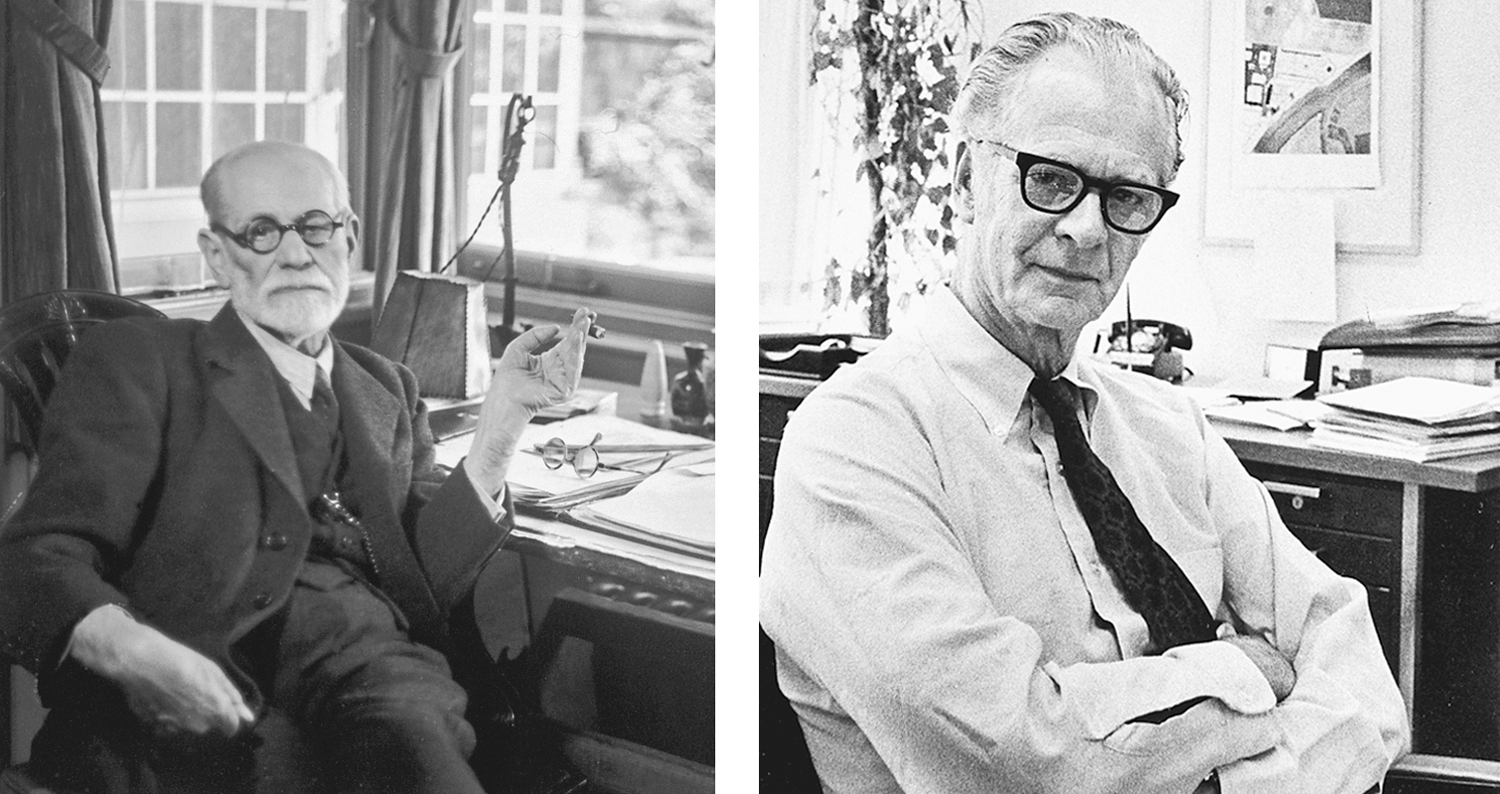
The different approaches to personality are often portrayed as competitors, and for good reason. The original, famous champion of each typically made his mark by announcing to the world that his approach finally accounted for everything anybody would ever want to know about human nature, and that all other approaches were pretty much worthless. Sigmund Freud, for one, was vocal in claiming that his version of the psychoanalytic approach was the one true path and even ostracized erstwhile followers, such as Carl Jung, who dared to differ with him on seemingly minor points. B. F. Skinner, with his very different view of human nature, was not much of an improvement in the modesty department. He announced that behaviorism explained everything worth knowing about psychology, and he delighted in denouncing all of the other approaches and their presumptions that people might have traits and thoughts, or even freedom and dignity.
This kind of arrogance is not limited to approaches like psychoanalysis and behaviorism that have been closely associated with famous individual founders. Biologically inclined psychologists have been known to proclaim that everything about personality reduces to a matter of genes, physiology, and brain anatomy. Trait, cognitive, and humanistic psychologists likewise have insisted their approach is the one that covers it all. In fact, major advocates of every basic approach have claimed frequently and insistently not only that their favored approach can explain everything worth explaining, but also that the others are all dead wrong.
Figure 1.1Freud and Skinner Sigmund Freud and B. F. Skinner had completely different views about human nature, but each insisted that his perspective accounted for everything that was important to know about personality.
Claims like these certainly can help make someone famous, and are perhaps even necessary to attract attention to a point of view. But their rhetorical smoke screen obscures an important fact. It is not obligatory, and I believe it is not helpful, to regard these approaches as mutually exclusive and forever locked in competition. They complement rather than compete with each other because each one addresses a different set of questions about human psychology.
A manager trying to choose a new employee, for instance, must compare individuals to one another; you can’t hire everybody, and you can’t reject everybody, either. The manager’s problem is addressed by the trait approach. When a morally crusading televangelist is arrested for soliciting prostitutes, questions might be raised about his motivation, especially at the unconscious level; a psychoanalytic approach seems necessary here. A parent worried about aspects of a teenager’s behavior and how best to make a difference probably could profit from a behavioral approach. A philosopher contemplating the vicissitudes of free will, or even a student considering career plans and wondering about what is really important in life, might find useful insights in the humanistic approach. And so on. Each approach to personality psychology can be useful for handling its own key concerns.
At the same time, each one typically and rather disconcertingly tends to ignore the key concerns of the others (and, as I already mentioned, often denies they are even important). For example, psychoanalysis has a lot to say about the origin of dreams, but contributes next to nothing to understanding behavior change. On the other hand, the principles of behaviorism can be used to teach your dog an amazing variety of tricks but will never explain why she sometimes barks and whines in her sleep.
Distinct Approaches Versus the One Big Theory
By now, the following question may have occurred to you: Why doesn’t somebody come up with One Big Theory (you could call it the OBT) that explains everything that the trait, biological, psychoanalytic, humanistic, and learning/cognitive approaches now account for separately? Maybe someday somebody will—and if you become a personality psychologist, it could be you!
In the meantime, you might consider a time-honored principle of engineering: A device that does one thing well tends to be relatively poor at doing anything else. An excellent toaster is completely worthless if what you really need is to make coffee or listen to music. The converse, equally true, is that a device that does many things at the same time will probably do none of them especially well. A combination toaster, coffeemaker, and clock radio—I am sure somewhere there really is such a thing—will probably not be as good at toasting bread, making coffee, or playing music as a more modest appliance that aspires to serve only one of these functions.4 This principle seems also to be true within psychology, as it describes the inevitable trade-off faced by personality theorists. A theory that accounts for certain things extremely well will probably not explain everything else so well. And a theory that tries to explain almost everything—the OBT—would probably not provide the best explanation for any one thing. Maybe dreams, learning curves, free will, and individual differences in job performance could all be squeezed into one theory, but the result probably wouldn’t be pretty.
If you find the welter of approaches to personality confusing, you are in good company. Personality psychologists have worked on this dilemma for decades and still have not come to a solution that satisfies everybody. Some really would like to develop the OBT that explains everything at least fairly well. A surprising number believe that their own currently favored approach is the OBT (they are wrong). Others, instead of developing a whole new theory, would like to organize all the current approaches into a single elegant framework (e.g., Mayer, 1998, 2005). Still others, like me, persist in believing that the different basic approaches address different sets of questions, and that each approach generally has the best answers for the questions it has chosen to address.
If you agree with—or at least understand—this final belief, then you will appreciate why this book for the most part considers each basic approach separately. Personality psychology needs to look at people from all of these directions and utilize all of these approaches because different issues—for example, dreams, rates of learning, and individual differences in job performance, as I just mentioned—are best viewed from different perspectives. For the present, I believe it is most useful to teach and apply these approaches one at a time and in their entirety. Perhaps someday they will become fully integrated. In the meantime, as you will see, each approach has many interesting, important, and useful things to say about the aspects of personality on which it has chosen to focus.
Advantages as Disadvantages and Vice Versa
In the introduction to his novel Mother Night, Kurt Vonnegut does his readers the unusual service of telling them the moral of the book they are about to read. “I don’t think it’s a marvelous moral,” he writes, “I just happen to know what it is” (Vonnegut, 1966, p. v). My guess is that he hoped to save hundreds of English classes thousands of hours of trying to figure out what he “meant to say.” (I doubt he succeeded.)5
As a writer, I do not much resemble Vonnegut (though I wish I did), but I, too, think I know the moral of my book, or at least one of its major themes: In life and in psychology, advantages and disadvantages have a way of being so tightly interconnected as to be inseparable. Great strengths are usually great weaknesses, and surprisingly often the opposite is true as well. Sometimes I enjoy calling this observation Funder’s First Law (there will be several other such “laws” in this book).6 This first law applies to fields of research, theories, and individual people.
Personality psychology provides an excellent example of Funder’s First Law. As I already noted, personality psychology’s biggest advantage over other areas of psychology is that it has a broad mandate to account for the psychology of whole persons and real-life concerns. This mandate makes the study of personality more inclusive, interesting, important, and even more fun than it would be otherwise. But guess what? This mandate is also personality psychology’s biggest problem. In the wrong hands it can lead to overinclusive or unfocused research. Even in the best hands, personality psychology can seem to fall far short of what it ought to accomplish. The challenge for a personality psychologist, then, is to maximize the advantages of the field’s broad mandate and try to minimize the disadvantages, even though the two are related and perhaps inseparable.
The same is true about the various approaches within personality psychology. Each is good at addressing certain topics and poor at addressing others. Actually, as we have already discussed, each basic approach usually just ignores the topics it is not good at explaining. For example, one reason that behaviorism is so effective at changing behavior is that it ignores the possibility of free will, whereas the phenomenological approach is able to offer a coherent account of free will because it overlooks how rewards and punishments can shape behavior. The strong points come with—and are even sometimes a consequence of—the weak points, and vice versa.
This connection between strengths and weaknesses even occurs within individuals. According to one analysis, the personality and ethical “flaws” of several presidents of the United States were precisely the same attributes that allowed them to attain and effectively use power (Berke, 1998). For example, a certain amount of shiftiness—generally considered a character flaw—might enable a president to respond flexibly to changing circumstances. A certain amount of stubbornness—also usually considered a flaw—might enable a president to remain steadfastly committed to important principles. On the other hand, some traits usually considered virtues, such as truthfulness and consistency, might sometimes actually be a handicap in trying to be an effective president. Particular traits can cut both ways as well. Presidents rated as high in narcissism (excessive self-regard; see Chapter 6) have tended to be good at public persuasiveness, crisis management, getting votes, and passing legislation. On the other hand, they have also been more likely to be accused of unethical conduct and impeached (Watts et al., 2013).
The same principle applies to other areas of life, such as basketball coaching. Bobby Knight, the longtime coach at Indiana University (and later at Texas Tech), was once described as vulgar, sarcastic, and intimidating—and also, in the same newspaper article, as “loyal, intelligent, charitable, and [a] principled perfectionist who graduates more players than most college basketball coaches” (T. Jones, 2003, p. 6E). Are these two aspects of Knight’s character connected? They certainly are, in the sense that they both belong to the same person. A university that hired one of these Bobby Knights got the other one for free. One could speculate that both aspects of this character derived from his passion for perfection, which sometimes led him to constructive behaviors, and sometimes to destructive ones. In any case, everybody’s personality comes as a package deal. Personality is coherent; each part stems from and depends on the others (J. Block, 2002).
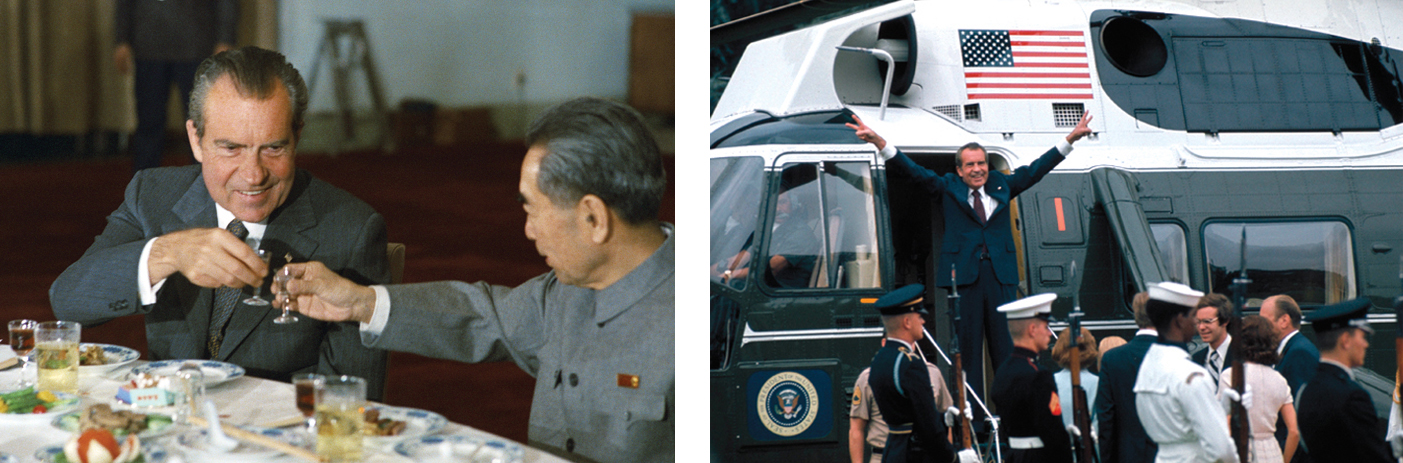
Figure 1.2Great Strengths Can Be Great Weaknesses President Nixon’s devious nature allowed him to surprise the world with a breakthrough in relations with China, but also led to the Watergate scandal that drove him from office.
You may or may not ever become president or a Big 10 basketball coach yourself, but take a moment and think about your own strongest point. Is it ever a problem for you? Now think about your own weakest point. What are its benefits for you? Given the necessary trade-offs, would you really like to lose all of your weaknesses and keep all of your strengths? Given the way your strengths and weaknesses are interconnected, is this even possible?
Personality psychology is perpetually faced with a similar dilemma. If its scope were narrowed, the field would be more manageable and research would become easier. But then the study of personality would lose much of what makes it distinctive, important, and interesting. Similarly, each basic approach to personality has made a more or less deliberate decision to ignore some aspects of psychology. This is a heavy cost to pay, but so far it seems necessary in order for each approach to make progress in its chosen area.
A theoretical view of personality that focuses on some phenomena and ignores others. The basic approaches are trait, biological, psychoanalytic, phenomenological, learning, and cognitive (the last two being closely related).
The theoretical view of personality that emphasizes experience, free will, and the meaning of life. Closely related to humanistic psychology and existentialism.
Great strengths are usually great weaknesses, and surprisingly often the opposite is true as well.
Notes
3. This narrow use of the term learning by behaviorists should not be confused with its broader everyday meaning.
4. Cell phone cameras, for example, have gotten pretty good, but devices that are only cameras are still better, even now.
5. For the record, Vonnegut wrote that the moral of his novel is that “we are what we pretend to be, so we must be careful about what we pretend to be” (Vonnegut, 1966, p. v). Come to think of it, this would not be a bad moral for a psychology textbook.
6. Please don’t memorize these laws. They are just my attempt to distill a few of my favorite observations into fortune-cookie-sized sayings.