Can personality change? In one respect, the answer is clearly “yes.” As we have already seen, ample evidence shows that, overall, personality does change. Look again at Figure 7.1, which shows personality traits moving around quite a bit, on average, across the years from adolescence to adulthood to old age. But when people ask, “Can personality change?” the inevitable consequences of the passing years are probably not what they have in mind. Instead, what they are asking is: Can personality be changed? Can I change my own personality? Or can I change the personality of my child, or my spouse, or anyone, for that matter?
The Desire for Change
According to one survey, almost everybody would like to change at least one of their Big Five traits at least somewhat—the estimates range from 87 percent to 97 percent, depending on the trait. Neuroticism was the trait that the most people wanted to change; fewer wanted to change their agreeableness (Hudson & Roberts, 2014). Another survey asked more than 15,000 college-age people in more than 60 countries a slightly different (and more demanding) question, “Is there an aspect of your personality that you’re currently trying to change?” Sixty-one percent said “yes” (Baranski, 2018). Slightly more women reported trying to change (63%) than men (56%). Around the world, the highest percentage of people who were trying to change was in Thailand (81%) and Russia was not far behind (81%). The smallest percentage of “yes” answers was in Israel, where only 29% of the participants reported trying to change anything about themselves. In the United States, the proportion was about 50/50. These differences between women and men and among countries are interesting, but I do not know what they mean.13 Do you have any ideas?
Not surprisingly, the change people wanted was almost always in the socially desirable direction. People would like to be a bit higher in extraversion, conscientiousness, agreeableness and openness, and lower in neuroticism.14 Interestingly, these traits match almost exactly what most people desire in their romantic partners: They would prefer mates who are more conscientious, extraverted, and agreeable, and lower in neuroticism than they are themselves (Figuredo, Sefcek, & Jones, 2006). I guess most people really are seeking their “better half.”
One question that might arise about both of these studies concerns their participants. They were almost all undergraduate college students. Do these results just mean that the personalities of people in this age range (mostly 18–22) are still in the “design stage” (as was noted in Chapter 4), making them more amenable to change than people who are older and more set in their ways? Good question, but the answer appears to be No. A study conducted over the Internet surveyed 594 people from the ages of 18 all the way to 74, and found an almost 0 correlation (r= .024 to be exact) between age and the desire to change (Baranski, Morse, & Dunlop, 2017).
In the college student studies, the main reason for wanting to change appeared to be the hope that having a different personality might make life better. The people who most wanted to be more extraverted were those who were dissatisfied with their friendships, emotions, recreational activities, or sex lives. Those who most wanted to be more conscientious were unhappy with how things were going at work or at school (Baranski et al., 2017; see also Hudson & Roberts, 2014).
Maybe there is hope for these people. A small amount of research that suggests personality actually can be changed has been around for decades. In just the past few years, a number of studies and theoretical models have added to this evidence. Current research suggests that four methods have the potential to change personality: psychotherapy, general intervention programs aimed at life outcomes, targeted intervention programs aimed at specific traits, and life experiences.
Psychotherapy
Psychotherapy has long been used as a route for attempting to change personality. The pioneering psychologist Carl Rogers proposed that if a “client” (Rogers never used the word “patient”) was vulnerable or anxious, it was enough for a therapist to experience and express unconditional positive regard to the client, and desirable change would then occur (Rogers, 1957). To this day, many therapists use techniques inspired by Rogers’ approach (see Chapter 12), as well as approaches such as cognitive-behavioral therapy that combine developing insight with “homework” practicing more adaptive emotional responses and behaviors. So, does any of this work?
As long ago as 1980, a major literature review concluded that psychotherapy—almost regardless of the specific technique used—can indeed produce long-term behavior change (Smith, Glass, & Miller, 1980). A much more recent review of 207 studies that tracked personality change during psychotherapy concluded that “marked” increases were seen in emotional stability and extraversion over (on average) a 6-month period (Roberts et al., 2017). But psychotherapy might have a downside as well. Another review found that being in therapy was associated with increases in chronic stress, depression, and neuroticism, and decreases in self-esteem and conscientiousness (Chow et al., in press). These are surprising and disturbing findings, to say the least. But they might have arisen because the people undergoing therapy in these latter studies were not necessarily willing participants; the sample included people getting therapy under court order, in a probation process, or even as part of a child custody dispute. Still, the findings serve as a bit of a caution that perhaps psychotherapy isn’t always good for everybody.
To an increasing degree in recent years, psychotherapy is conducted in conjunction with the prescription of psychiatric drugs, such as fluoxetine (Prozac). As will be discussed in Chapter 8, fluoxetine and related drugs are not only useful (in some cases) for treating depression, they also have an overall effect, in many people, of making them more extraverted and less anxious. Just one dose of the hallucinogenic drug psilocybin (when taken in a medically controlled setting) can lead to increases in openness to experience that last a year or more (MacLean, Johnson, & Griffiths, 2011). And if you just want to be more extraverted for a little while, alcohol can do it (Winograd, Steinley, Lane, & Sher, 2017). But, of course, all drugs have side effects and that definitely includes alcohol. And, as we just saw, intensive psychotherapy might have side effects as well. Fortunately, there are several other routes to changing personality.
TRY FOR YOURSELF 7.1
The Change Goals Inventory
Instructions
How much do you want to change yourself? Here are a number of personality traits that you may or may not want to change within yourself. Please rate the extent to which you want to change each trait.
Response Scale
All items are rated using the following response scale (Note: “Am” must be changed to “do” when grammatically required by the item text—e.g., “I want to have an assertive personality”):
Much more than I currently am (+2)
More than I currently am (+1)
I do not want to change in this trait (0)
Less than I currently am (–1)
Much less than I currently am (–2)
Items
I want to be talkative.
I want to be reserved.
I want to be someone who is full of energy.
I want to be someone who generates a lot of enthusiasm.
I want to be someone who tends to be quiet.
I want to have an assertive personality.
I want to be sometimes shy, inhibited.
I want to be outgoing, sociable.
SCORING: Reverse the scores for items 2, 5, and 7—that is, multiply your answers to each of these items by –1. Then add up the eight scores and divide the total by eight. The average response is approximately .80. A score below 0 is very low, and a score above 1.5 is very high.
Source: Hudson & Roberts (2014), p. 62.
General Interventions
Many intervention programs have tried to improve the lives of children and adolescents in a wide variety of ways. Typically, they are aimed not at “changing personality” as such, but at important outcomes such as completing education, lessening criminal behavior, and improving prospects for employment. Such programs can be expensive, but if they work, they can be worth the cost. One example was a large-scale attempt to affect the development of a group of 3- to 4-year-old preschool students living in a high-risk, low-income area of a major city (Reynolds, Template, Robertson, & Mann, 2001). The program included intensive instruction in reading and writing, diverse learning experiences in one-to-one and group settings, parenting programs, home visits, and health and nutrition services. The researchers also made sure that the class sizes for these children were small—no more than 17 students for every two teachers.
As you can see, this program was ambitious and expensive. What were the results? A follow-up 15 years later showed some pretty dramatic effects. The children in the program—compared to similar children not enrolled—grew into adolescents and young adults who were more likely to have completed high school (49.7 percent versus 38.5 percent) and less likely to have been arrested (16.9 percent versus 25.1 percent). The program was especially beneficial for boys.
Was it worth it? The answer is almost certainly yes. Just in sheer financial terms, consider the cost of arresting even just one young man and putting him through the court and jail system, and the further costs when later in life he can’t find a job or support a family. And, on a human level, such an outcome is a tragedy. Still, it is important to remember that interventions like this do not always succeed. A large-scale program in Finland attempted to develop social skills and employment possibilities in youths who had been arrested between the ages of 15 and 17 (Huttunen, Kerr, & Mällkönen, 2014). The program appeared to make re-arrest less likely for a year or so, but after that its effect wore off. Comparing these two programs raises the following question: Is age 15 too late for this kind of intervention? For a program intended to avert delinquency, maybe earlier is better. More research on this important question is definitely needed.
Targeted Interventions
Intervention programs can also be tailored to address personality traits. For example, we saw earlier that openness to experience is a Big Five trait that tends to decrease somewhat in old age. Can this tendency be changed? A 30-week training program tried to do this with a group of men between the ages of 60 and 94 (Jackson, Hill, Payne, Roberts, & Stine-Morrow, 2012). The program included practice in inductive reasoning, and working on crossword and Sudoku puzzles. The results were that the men who received this training actually increased in openness. This is one of the first studies, if not the first, to show that the trajectory of openness to experience can be changed late in life, without the use of drugs. And this conclusion was supported by a later study of more than 7,000 people in the Netherlands from ages 16 to 95, which found that making “cultural investments” such as going to the opera or visiting museums was positively associated with increases in openness (Schwaba, Luhmann, Denissen, Chung, & Bleidorn, 2017).
One program of research suggests that writing “self-affirmations” can lead to lasting personality change (Cohen & Sherman, 2014). In the usual procedure, people are asked to identify one or more values that are important to them, and then to write a brief essay about when and why these values matter the most. Typical essays talk about relationships with friends and family, but also include values such as humor, kindness, and religion. The sheer act of writing essays like these appears to lead to greater tolerance for stress and a decrease in defensiveness. The reason seems to be that when you remind yourself about what is really important, other hassles don’t matter so much.
Another program attempted to reduce the future risk of anxiety disorders in high-risk children, but had the interesting additional result that it seemed to reduce later overall neuroticism (Barlow, Sauer-Zavala, Carl, Bullis, & Ellard, 2014). The intervention focused on the children’s parents, teaching them about the general nature of anxiety and also giving them specific tools such as techniques for managing behavior and for thinking about anxiety-provoking topics in less-threatening ways (Rapee, Kennedy, Ingram, Edwards, & Sweeny, 2010). The parents were even given lessons on how to avoid being overprotective. For example, one set of parents was urged not to allow their son to “avoid situations that made him anxious, such as attending parties and new activities. They were also encouraged to give [the child] the opportunity to speak for himself rather than answering for him” (Rapee et al., 2010, p. 1523). The overall result was an impressive reduction in the tendency of high-risk children to develop generally neurotic tendencies, and the difference between the treated and untreated groups actually seemed to increase over a three-year time period. This last result hints that the program might really have succeeded at beginning to produce lasting personality change.
The problem with narcissists isn’t that they can’t appreciate the feelings of others; it’s that they don’t want to.
Even the notoriously difficult trait of narcissism (see Chapter 6) may be amenable to change. Narcissists in general do not feel much empathy for the problems of others. However, this tendency was (at least temporarily) changed in one experiment by simply instructing them to “imagine how [the other person] feels. Try to take her perspective . . . imagining how she is feeling about what is happening” (Hepper, Hart, & Sedikides, 2014, p. 1084). Apparently, the problem with narcissists isn’t that they can’t appreciate the feelings of others; it’s that they don’t want to.
Another trait that might be particularly important to change, if you could, is “self-control.” This trait is associated with all sorts of good outcomes both in childhood and adulthood. Children with better self-control do better in school and have fewer altercations with their classmates (Kochanska & Knaack, 2003); adults with better self-control have more stable occupational lives and personal relationships (Kern et al., 2013).
Can self-control be improved? One major literature review surveyed programs aimed at children younger than 10 years of age (the presumption may have been that after that, it’s too late). Exercises used to help develop self-control included meditating, relaxing, and learning to think differently about temptations and frustrations. The results showed consistent effects such that in adolescence, children who had received training experienced fewer delinquency and behavior problems (Piquero, Jennings, & Farrington, 2010). There is also recent evidence that you can work to improve your own self-control, even if you are older than 10. Techniques of “mindfulness meditation” appear to be able to increase self-control and compassion, at least in the short term. In one study, individuals who had completed a meditation course were more likely to jump up and offer their seat to a person who approached on crutches, seemingly in pain (Condon, Desbordes, Miller, & DeSteno, 2013); another study showed that similar training made people more altruistic when playing a game where they had a chance to give something to another person (Weng et al., 2013).
Many years ago, while I was a graduate student at Stanford University, I took a course by the distinguished psychologist Albert Bandura titled “Principles of Personality Change.” Ironically, given the title, the course wasn’t really about personality; it was about how techniques based on social learning theory could be used to change specific problematic behaviors (see Chapter 14). Two behaviors of particular interest were agoraphobia (the fear of going outside) and fear of snakes. Stanford had an experimental clinic that would run occasional newspaper ads offering free treatment and would always be immediately deluged with calls. In particular, Palo Alto, California (where Stanford is located), had a surprising number of housewives who were so afraid of snakes they couldn’t go outdoors, thus combining the two phobias. I can personally testify that I lived in Palo Alto for more than four years and never saw a single snake. Yet it turned out to be easier to train these clients not to fear snakes than it was to convince them that in Palo Alto, there really aren’t any.
A client who graduated to the point of being able to comfortably handle a boa constrictor was able to go home and, for the first time, confront her landlord and get her toilet fixed.
The treatment involved “systematic desensitization,” in which clients are induced to perform the feared behavior through small, incremental steps. One day Dr. Bandura told our class about a recent client who graduated to the point of being able to comfortably handle a boa constrictor. After that, she was able to go home and, for the first time, confront her landlord and get her toilet fixed. I recall asking whether that didn’t show that the snake phobia treatment had an effect on her trait of assertiveness. My recollection of Dr. Bandura’s answer is less clear, but I do recall that he didn’t care much for any sort of reference to personality traits. As we saw in Chapter 4, the concept of the “trait” was (and in some quarters still is) a construct some psychologists prefer to avoid. He preferred to talk of things like “generalization gradients” (landlord = snake?).15 But I thought then, and I think now, that it is simpler, clearer, and just plain correct to think about an effect like this in terms of traits. If you could change a trait, you might be able to change a lot of behaviors all at the same time.
This is exactly the perspective of an intriguing new theory called the “sociogenomic trait intervention model” (Roberts, Hill, & Davis, 2017). According to this model, the first step in personality change is to identify specifically the thoughts, feelings, and behaviors that the person wants to change. Then, the person needs to be challenged to do things outside her comfort zone to act out those changes, over and over, until they become habitual and automatic. Even a behavior as simple as regularly doing one’s homework can lead to beneficial personality change (Göllner et al., 2017). It is also important to make sure that the environment the person is in is structured to support the change; family members need to be encouraging, for example.
One demonstration of this process worked with a man who had serious problems with substance abuse, with his job, and in relations with his family (Magidson, Roberts, Collado-Rodriguez, & Lezuez, 2012). The psychologists persuaded him to identify the goals that were important to him and to identify the behaviors that would help him to reach these goals. As a result, he began to show up for work on time, he spent more time socializing with his family, and he began to do these things instead of using substances such as cocaine. In other words, he began to develop an enhanced trait of conscientiousness, which spilled over in a beneficial way to all areas of his life, sort of like the snake phobic who increased her assertiveness and was finally able to confront her landlord.
Surely this is all easier said than done. One successful intervention does not prove that it will work with all people or for all problems. But it does provide an encouraging indication that such interventions are possible, and should spur research to find out more about how to make them work better and for more people.
Behaviors and Life Experiences
You don’t necessarily need to enter psychotherapy or receive a formal intervention to change your personality. Even something as simple as exercise can make a difference. People who are physically active in midlife can change the way their personality develops in old age (Stephan, Sutin, & Terracciano, 2014). The personalities of exercisers remain more stable, and show less of the typical late-life decline otherwise seen in conscientiousness, extraversion, openness, and agreeableness.
Certain life experiences have the potential to affect personality as well. Starting college is often associated with a drop in self-esteem, but the recovery is fairly quick. By the time of graduation, self-esteem is usually higher than it was at the beginning (Chung et al., 2014). Another study showed that entering college, starting a job, or beginning a new, serious relationship were all associated with increases in conscientiousness (Leikas & Salmela-Aro, 2014). Trying drugs was associated with increased neuroticism, and the onset of a chronic disease was associated with increases in both neuroticism and conscientiousness. What do you think the reason is for this last finding?
An event that happens to many people at some point in their lives is becoming unemployed. Does this have an effect on personality? One recent study, conducted in Germany, found that it does (Boyce, Wood, Daly, & Sedikides, 2015). People who lost their jobs—both men and women—became less agreeable, conscientious, and open to experience over a four-year period. However, if they found another job, their personality traits quickly rebounded to where they used to be.
Some events have lasting results that increase over time. One study looked at the effects of negative life experiences over a 16-year period in a sample of young adults (their mean age was 34) in the Netherlands (Jeronimus, Riese, Sanderman, & Omel, 2014). The negative events included health crises, losing a job or having other problems at work, educational difficulties, financial setbacks, and relationship problems. The perhaps not-surprising finding was that experiences like these tended to increase individuals’ scores on neuroticism. The more interesting finding is that the reverse was true as well. In other words, negative experiences lead to an increase in neuroticism, but being higher in neuroticism also makes a person more prone to encounter negative experiences such as the ones just listed. These findings illustrate the long-lasting nature of the person-environment transactions described earlier in this chapter, which can amount to a feedback loop by which life events affect personality, and vice versa, in a spiral that becomes stronger as time goes on.
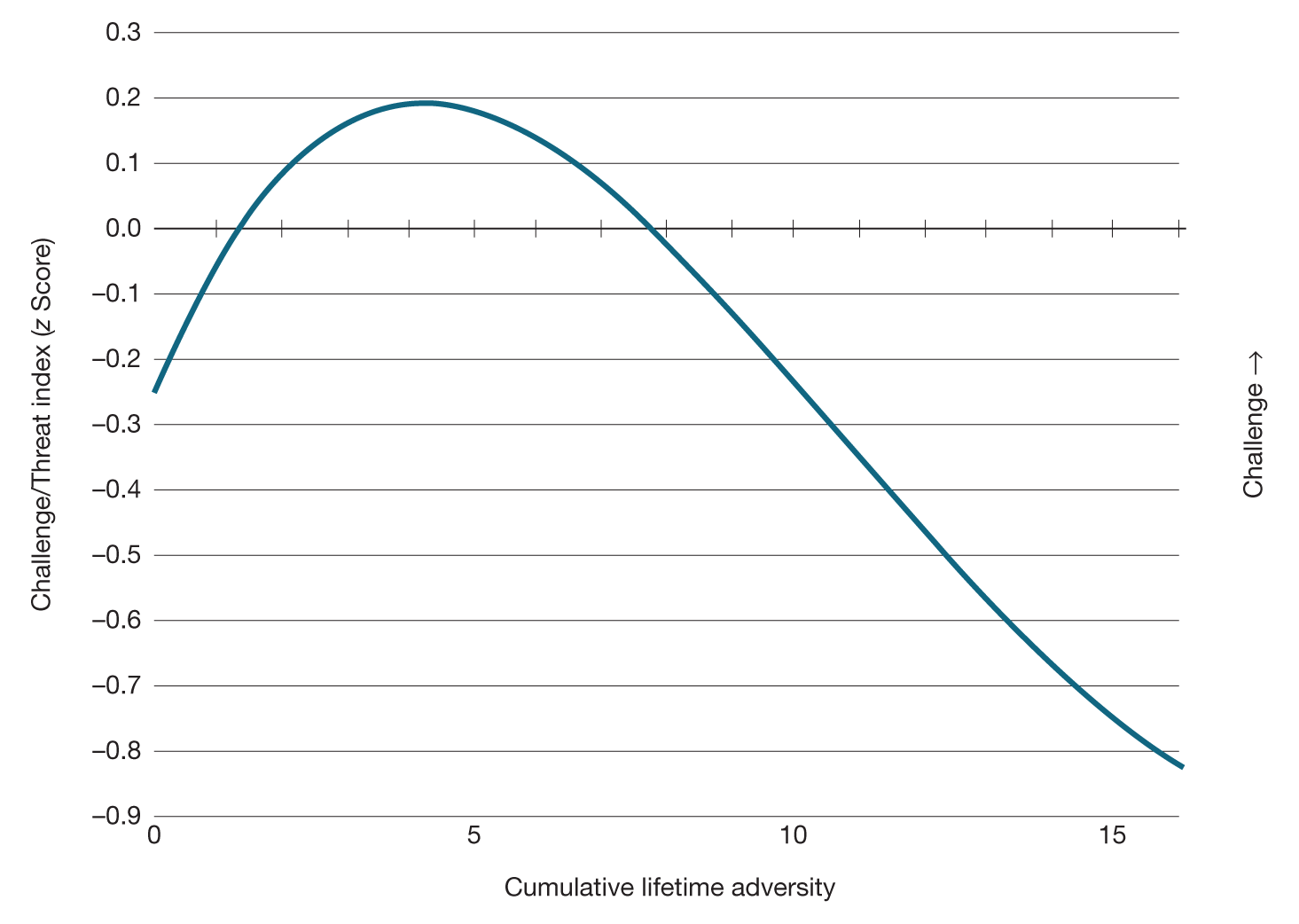
However, there might be such a thing as too little stress in one’s life. One study looked at the number of negative events that had accumulated in participants’ lives, and compared that with their ability to handle stress in laboratory tasks such as placing their hands in cold water or being warned they were going to “take an important test of nonverbal intelligence” (Seery et al., 2013, p. 1186). The results showed that people who had accumulated some adverse experiences did better than those who had encountered almost none. However, beyond a certain point the effect of adversity became harmful, a finding consistent with the study, cited earlier in the chapter, that showed a moderate—but not excessive—amount of stress in early life helped buffer reactions to events later in life (Ellis & Thomas, 2008). Figure 7.3 shows the relationship between lifetime negative experiences and cardiovascular stress responses to the threatened test.
Figure 7.3Relationship Between Lifetime Adverse Experiences and Cardiovascular Reactivity to StressThe figure shows that the cardiovascular “challenge/threat index,” which is interpreted as a resilient response to stress, was highest for people who had experienced a moderate number of negative life experiences—not too few or too many. Source: Seery et al. (2013), p. 1187.
Events that might change personality can happen long after childhood is over. One study looked at older adults (65 and up) who had just finished an extended period of time caring for a spouse with terminal lung cancer. After this grueling ordeal finally ended, the former caregivers experienced increases in interpersonal orientation, sociability, and favorable attitudes toward other people (Hoerger et al., 2014).
Figure 7.4A Classic Advertising Slogan This is a claim about one way personality can be changed. Is it true?
Another, more pleasant example of an adult experience that can change personality is travel. Many people have joined institutions such as the Peace Corps to see the world16 and an extended “overseas experience” (OE) is a tradition for young people from New Zealand. What is the long-term? People report, informally, that they feel they learned confidence and social skills from interacting with people from around the world, and recent research would seem to bear them out. Studying abroad for a year, while in high school, has been found to raise self-esteem (Hutteman, Nestler, Wagner, Egloff, & Back, in press). “Sojourners”—college students who lived abroad for a time—showed an increase in openness and agreeableness, and a decrease in neuroticism (Zimmerman & Neyer, 2013). Yet another study showed that the experience of living temporarily in another culture leads to measurable increases in creativity later (Maddux & Galinsky, 2009; see Chapter 13).
Joining the military is another experience long suspected of producing personality change. The American military used to have a recruiting slogan that promised, “The Marine Corps builds men.”17 The implication was that if you joined the Marines, you wouldn’t just learn how to fix a bayonet or make your bed so tightly that a coin would bounce on it. You would also develop stereotypically masculine traits such as confidence and dominance.
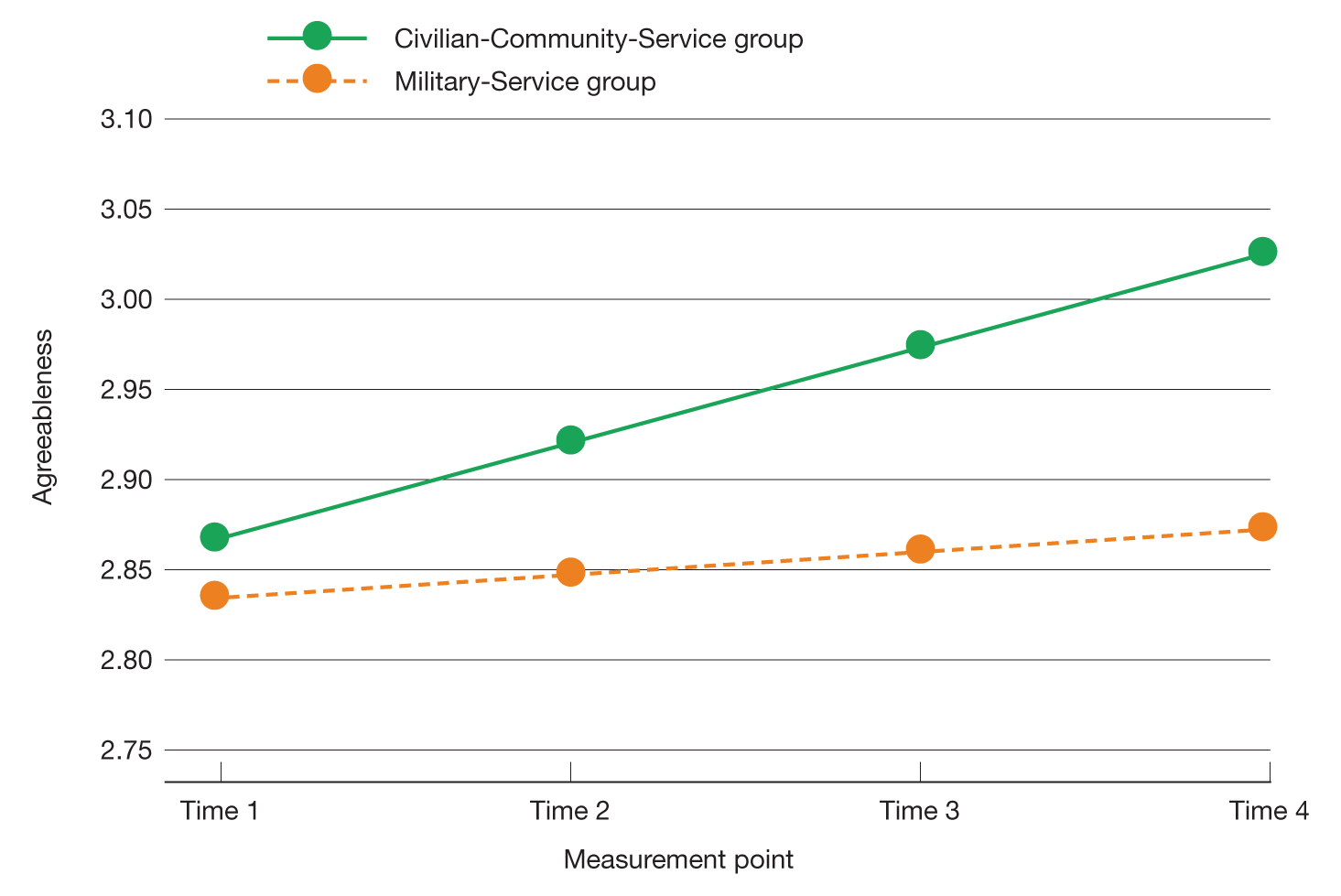
There may be something to the idea that military service can affect personality. A recent study looked at the effects of military training in young Germans (Jackson, Thoemmes, Jonkmann, Lüdtke, & Trautwin, 2012). In Germany, every young adult is required to perform some kind of service for a couple of years, but can choose whether this involves working on community projects or joining the military. The study—which looked only at young men—found that those who chose to join the military were lower on agreeableness, neuroticism, and openness to begin with, compared with those who selected other options. So they started off different. But the effect of the military experience appeared to be to widen these gaps. Over a five-year period, all participants, on average, increased in agreeableness. This is consistent with the general age trends seen in Figure 7.1. But the Germans who had performed community service increased in agreeableness more than did those who received military training, making the difference between them larger as time went on (see Figure 7.5).
Figure 7.5Changes in Agreeableness Over Time In a sample of young Germans, agreeableness was first assessed prior to beginning either community or military service (Time 1), and then reassessed at two-year intervals. Source: Jackson, Thoemmes, Jonkmann, Lüdtke, & Trautwein (2012), p. 274.
Overcoming Obstacles to Change
Despite the evidence for the malleability of personality just summarized, it would be a mistake to conclude that change is easy. Several obstacles lie in the way (Hennecke, Bleidorn, Denissen, & Wood, 2014).
First, most people like their personalities pretty much the way they are (Wortman & Wood, 2011). The widespread desire to improve one or more Big Five traits to at least some degree, mentioned earlier, should not be taken to mean that very many people are hoping for wholesale change. And the kind of change some people need the most probably amounts to more than just small changes on the Big Five. One study that showed that introverts, in particular, often do not realize how much more fun their social lives could be if they just would act more extraverted (Zelinski et al., 2013). But this is difficult for them to do. Acting in a way contrary to one’s traits takes effort and can be exhausting (Gallagher, Fleeson, & Hoyle, 2011). As was mentioned earlier, resistance to change can be especially strong in people, such as narcissists, whom others wish would change. They seem to underestimate how much better life could be for themselves and everyone around them if they would just quit being so annoying.
Second, people have a tendency to blame negative experiences and failures on external forces rather than recognizing the role of their own personality. For example, they might blame the fact that they frequently get into arguments on the obnoxious people who surround them, rather than recognize the role of their own disagreeableness. This blind spot creates problems for psychotherapists, who often have difficulty persuading their clients that the root cause of their problem is their own maladaptive behavior.
Change requires learning new skills, going new places, meeting new people, and acting in unaccustomed ways. That can make it uncomfortable.
Third, people generally like their lives to be consistent and predictable (Swann, Rentfrow, & Guinn, 2003). Change requires learning new skills, going new places, meeting new people, and acting in unaccustomed ways. That can make it uncomfortable.18
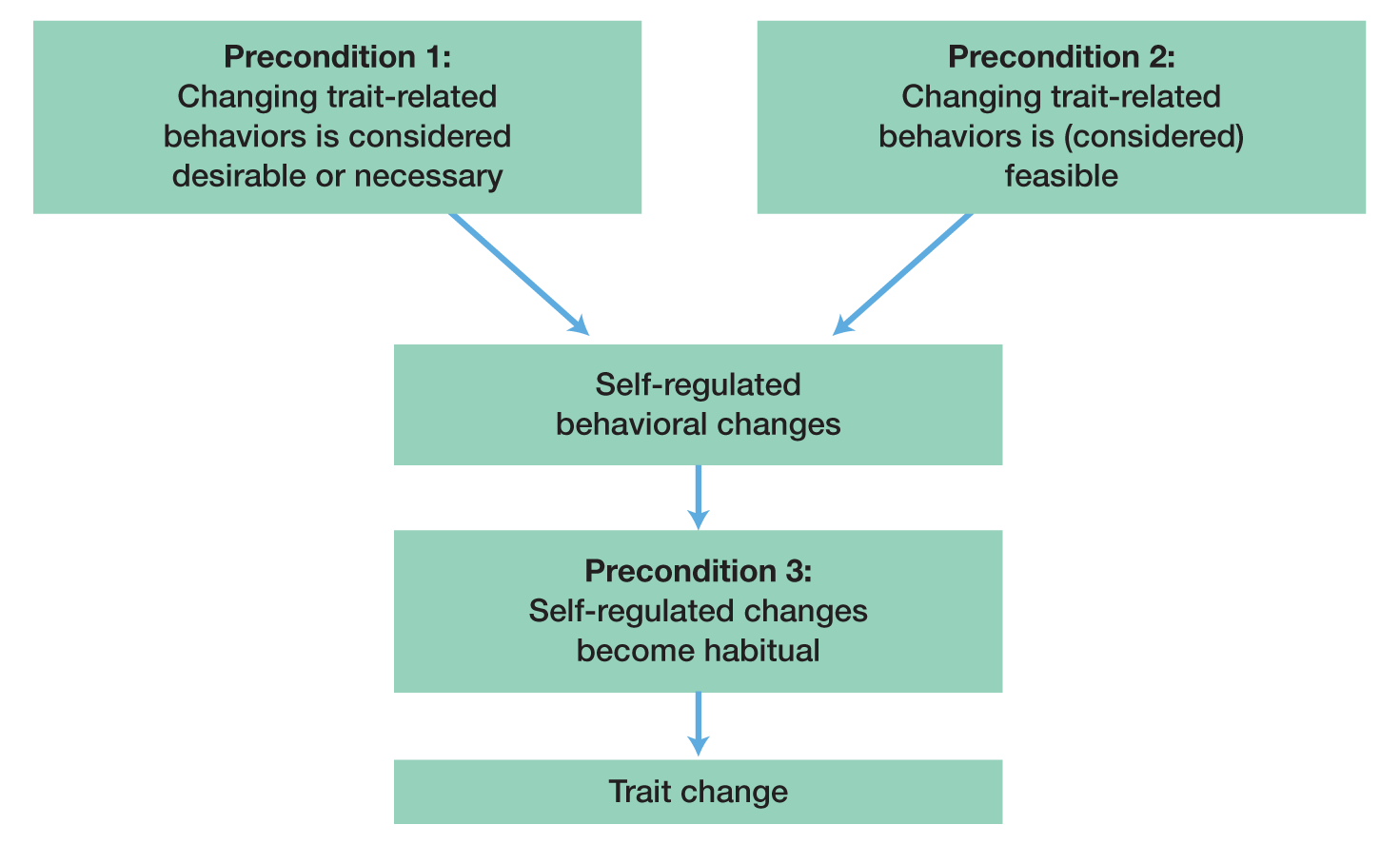
Still, with effort, these obstacles can be overcome. According to one recently developed theoretical model, personality change can happen if several conditions are met (Hennecke et al., 2014; see Figure 7.6). First, the person must think that changing some aspect of personality is desirable, and that such change is possible. For example, imagine a person who is in danger of flunking out of college because of her low conscientiousness. To do something about this, she has to recognize the source of problem and want to change—which, for the reasons just summarized, may be difficult or even painful to acknowledge (Allemand & Flückiger, 2017). (In many cases, students who are failing in college are quite creative at finding ways to blame everything except their own behavior for what is happening.) She also must believe that she is capable of changing (Dweck, 2008; see Chapter 14). Second, the person must follow up by beginning to change her relevant behaviors, one by one. She has to work to get her next assignment in on time, attend class regularly, study rather than party on the night before the big exam, and so forth. Over time, if all goes well (and that’s asking a lot), such behaviors will become habitual. Finally, in the ideal outcome, she will find that her trait of conscientiousness has stabilized at a higher level than it was at before. She might even clean her room!
Figure 7.6Steps to Personality Change According to this theoretical model, the first steps are to want to change, and to believe change is possible. Then one can begin to perform the necessary new behaviors, which, over time, become habitual and lead to lasting personality change. Source: Hennecke et al. (2014), p. 290.
Notice how this approach to personality change works in a way contrary to what we might ordinarily expect. Rather than changing personality in order to change behavior, the prescription outlined in Figure 7.6 advises changing behavior first in order to change personality! One recent study suggests that this tactic can indeed be effective, especially if the person develops a plan of the specific behaviors to work on (Hudson & Fraley, 2015). For example, a person trying to become more extraverted might make an effort to “call Andrew and ask him to lunch on Tuesday”; someone trying to be less neurotic might set the goal of “if I feel stress, then I will call my mom to talk about it” (Hudson & Fraley, 2015, p. 8). As these actions, and behaviors like them, become habitual, then the patterns become “calcified” (to use the authors’ term) into changes in traits that, in turn, produce long-lasting and broad changes in behavior.
14. To be exact, they wanted to be higher in emotional stability, which is the inverse of neuroticism.
15. A generalization gradient, in behaviorist terminology, reflects the degree to which a response learned to one stimulus is also elicited by other, similar stimuli.
17. This was before the Marines began recruiting women. The Army used the slogan even earlier (see Figure 7.4).
18. Psychoanalytic theory (see Chapters 10 and 11) includes the idea of the “flight from health,” which is that patients are so accustomed to their neuroses that they sometimes actively resist improvement.