PEOPLE ARE INCONSISTENT
You can judge or measure the degree to which someone is shy, conscientious, or dominant, but whatever you conclude the truth to be, there will be exceptions. The individual may act shy with strangers but be warm, open, and friendly with family members. Or the individual may be conscientious at work but sloppy and disorganized at home, dominant with people of the same gender but deferential to people of a different gender, or vice versa. This kind of inconsistency is seen all the time.
Casual observation is enough to confirm that personality traits are not the only factors that control behavior; situations matter as well.
Casual observation, therefore, is enough to confirm that personality traits are not the only factors that control behavior; situations matter as well. People will act more or less shy, more or less careful, more or less friendly, and more or less dominant, depending on the situation they are in. This is because situations vary according to who else is present and the implicit rules that apply (Wagerman & Funder, 2007). We act differently at a party than at a house of worship because some pretty specific, albeit usually implicit, rules of decorum limit acceptable behavior in a religious setting. Parties have implicit rules, too, but they offer more leeway.
If situations are so important, then how important is personality? One possible answer is: not very. Perhaps individuals’ behavior is so inconsistent and apt to change according to the situation that there is little use characterizing them in terms of broad personality traits. If this answer is correct, it implies not only that the personality tests considered in Chapter 2 are a colossal waste of time, but also that much of our everyday thinking and talking about people is fundamentally wrong. You should consider the possibility, therefore, that traits do not exist, that people continually change who they are according to the situation, and that everybody is basically the same.
More information
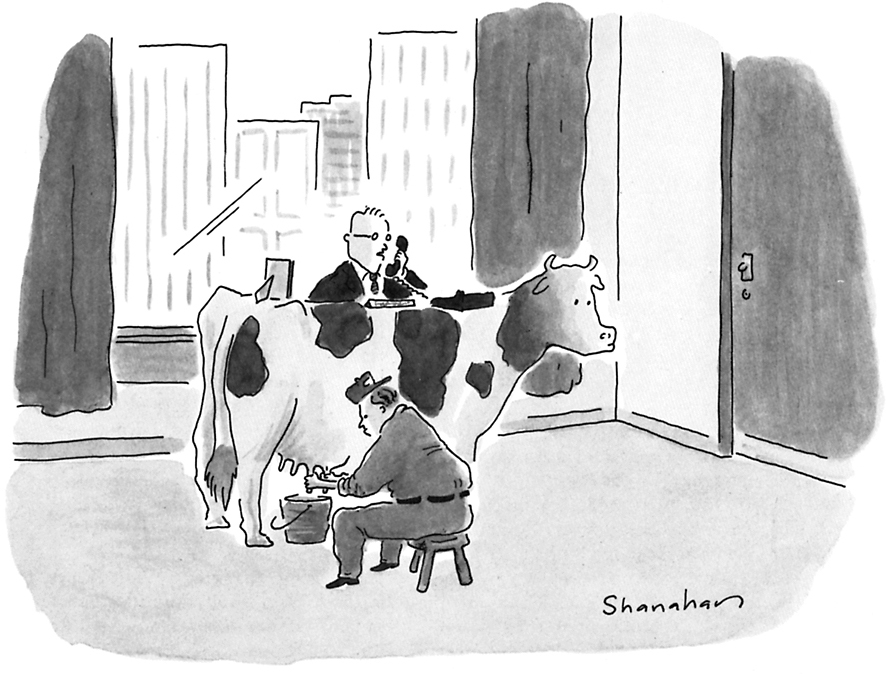
A comic shows a cow and two men inside an office space. One of the men is in a uniform sitting on a stool milking the cow’s milk into a pail. The other man is in business clothes standing behind the cow, and he is using the cow’s back as a desk with a telephone, a standing picture frame, and a name plate. He is talking into the telephone. The caption reads, “Can I call you back, R.B.? I’ve got a situation here.”
“Can I call you back, R.B.? I’ve got a situation here.”
Do you find this idea outrageous? The answer you give may depend on your age and stage in life. Research shows that the stability of the differences between people increases with age: 30-year-olds are more stable across time than are children and adolescents, and people between the ages of about 50 and 70 are the most stable of all (Caspi et al., 2005; McCrae, 2002; see Chapter 6 for more details). Older persons who have embarked on a career track, started families, undertaken adult roles and responsibilities, and established consistent individual identities may find it hard to imagine (or remember) the fluctuating, even erratic, identities they were trying on for size when they were younger. In contrast, younger persons who are still in the process of forming their adult identity might not find it so unreasonable to think that individual differences are unimportant because how you act depends solely on the situation. Indeed, they may wonder why anybody would make a fuss. After all, their personalities are still in the design stage (Roberts et al., 2006).
What I am proposing, therefore, is that people differ in the degree to which they have developed a consistent personality. This difference might be related to psychological adjustment as well as age: Several studies suggest that the consistency of personality is associated with maturity and general mental health. People whose behavior is relatively consistent are less neurotic, more controlled, more mature, and more positive in their relations with others (Donnellan et al., 2007; Roberts et al., 2001; Sherman et al., 2010).