ACCURATE SELF-KNOWLEDGE
As we have seen, making accurate judgments of other people is possible, but also fairly difficult, because of the various problems of bias, incomplete information, and complex inferences. Is knowing yourself any easier? Maybe not. Socrates, among other wise ancient Greeks, advised that it was important to “know thyself.” The very existence of this well-known aphorism suggests that knowing yourself is not completely straightforward. And there are good reasons to thinks it’s important.
Accurate self-knowledge has long been considered a hallmark of mental health (Jahoda, 1958; C. R. Rogers, 1961) for two reasons. First, people who are healthy, secure, and wise enough to see the world as it is, without the need to distort anything, will tend to see themselves more accurately as well. People with higher self-esteem have more accurate internal images of what their faces look like (Maister et al., 2021). Second, a person with accurate self-knowledge is in a better position to make good decisions on important issues ranging from what occupation to pursue to whom to marry (Vogt & Colvin, 2005). To choose the right major and the right occupation requires accurate knowledge of your own interests and abilities. To choose the right relationship partner, you need to know at least as much about yourself as you do about your partner.
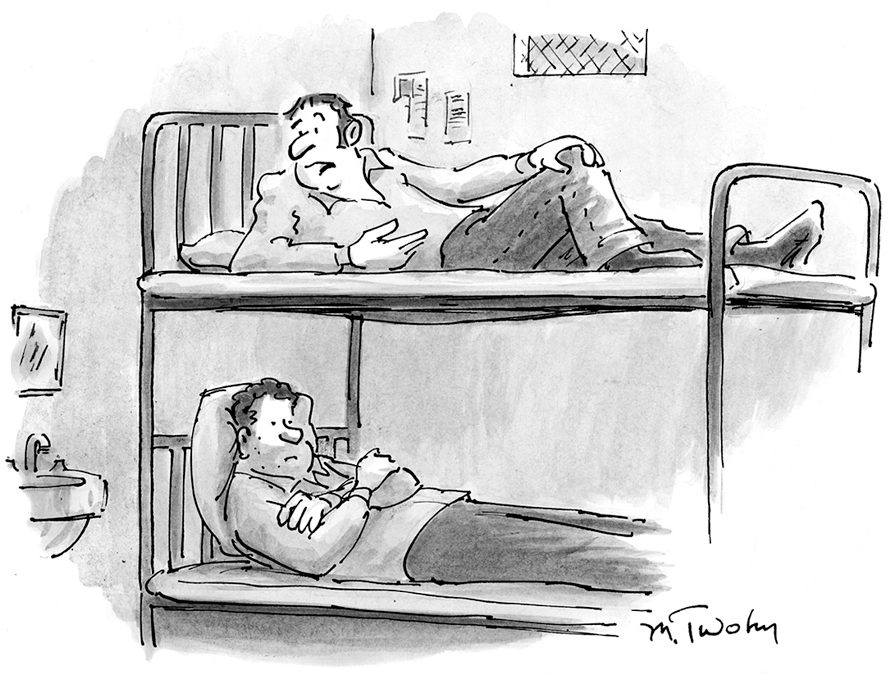
More information
A comic from the perspective of inside a prison cell shows two male prisoners lying on a bunk bed. The one, who lies on the top bed, leans and reclines on his right and the other, who is on the bottom bed, reclines on the head of the bed and folds his hand. The text reads, “It’s interesting—with each conviction I learn a little bit more about myself.”
“It’s interesting—with each conviction I learn a little bit more about myself.”
Accurate self-knowledge requires that you perform behaviors and experience feelings that reveal who you are (relevance), that you perceive and become aware of these actions and feelings (availability and detection), and that you interpret them correctly (utilization). In an important sense, you are just one of the people you happen to know and, to some degree, you come to know yourself the same way you find out about anybody else—that is, by observing what you do and trying to draw appropriate conclusions (Bem, 1972). This is probably harder than it sounds.
Self-Knowledge Versus Knowledge of Others
Research indicates that, not surprisingly, we have better insight into our personal emotional experience than anyone else does (Spain et al., 2000; Vazire, 2010). But when it comes to overt behavior, the picture is somewhat different. In a study that obtained personality judgments from both the participants and their close acquaintances, the acquaintances’ judgments more accurately predicted behavior than did the self-judgments in nearly every comparison (Kolar et al., 1996). For example, acquaintances’ judgments of assertiveness correlated more highly with later assertive behavior observed in the laboratory than did self-judgments. The same was true for talkativeness, initiation of humor, feelings of being cheated and victimized by life, and several other characteristics. Research by psychologist Simine Vazire (Figure 4.9) found similar results when self- and others’ judgments were used to predict behavior outside the laboratory, in normal daily life. Close acquaintances were as accurate as the self, and the average ratings of two or three acquaintances are sometimes even more accurate (Vazire & Mehl, 2008), especially when it comes to visible, desirable traits like intelligence or charm (Vazire, 2010).

More information
A photo shows a headshot of psychologist Simine Vazire with a black dog.
One reason for these surprising findings may be that paying attention to yourself can actually be rather difficult. As you move around all day observing the world from inside your head, you plan your next moves in response to the situations that confront you, one after another. And the only behavior you can observe is what you decide to do, not what other people would do. In terms of RAM, problems arise at both the relevance and detection stages. But when you view others, from the outside, you are in a better position to compare what they do with what others do and, therefore, may be better able to evaluate their personality traits, which, as you will recall from the beginning of this chapter, are relative constructs. Trait judgments entail comparing one person with another. If you can see two different people responding to the same situation in two different ways, this is an ideal opportunity to judge differences in their personalities.
For example, imagine you are standing in a long line at an airline counter and, when it is finally your turn, the clerk is rushed and somewhat rude to you. You do your best to ignore the clerk’s behavior, take your boarding pass, and leave. Whatever you learn about yourself from this episode is necessarily limited. Now imagine you get a chance to watch two other people who happen to be ahead of you in line. The first person speaks to the clerk, shrugs, takes a boarding pass, and leaves. The second person begins to talk to the clerk and quickly becomes angry, turning red in the face, shaking a finger, and talking in a raised voice. Now you are in an excellent position to compare the personalities of these individuals because you saw them react differently to the same stimulus.
One of the great misperceptions many people have about their own behavior is that it is the natural response to the situation and is therefore what anyone would have done (Ross et al., 1977).14 You probably know people who are hostile, deceitful, or unpleasant, who firmly believe they are just responding normally to the situations at hand. On the flip side, you may also know people who are consistently easygoing, kind, diligent, or brave, who are unaware that their behavior is in any way distinctive.
In January 1982, an ice-covered airliner plunged into the Potomac River in Washington, DC, near the heavily traveled Fourteenth Street Bridge. Dozens of onlookers at the scene and thousands of television viewers watched as the handful of survivors clung to bits of floating wreckage amid the ice. Lenny Skutnik, a government clerk who stopped on his way home, saw one survivor begin to lose her grip and slip into the water; he kicked off his shoes, tore off his coat, and plunged in, pulling the woman to safety. Later, Skutnik was reluctant to take credit, saying that he had simply acted without thinking when he saw someone in need.15 The critical fact, obvious to everyone but him, was that he acted differently from the dozens of others standing on the shore (Figure 4.10). Like the hero of Tiananmen Square portrayed in Figure 4.1, he acted while others stood by.
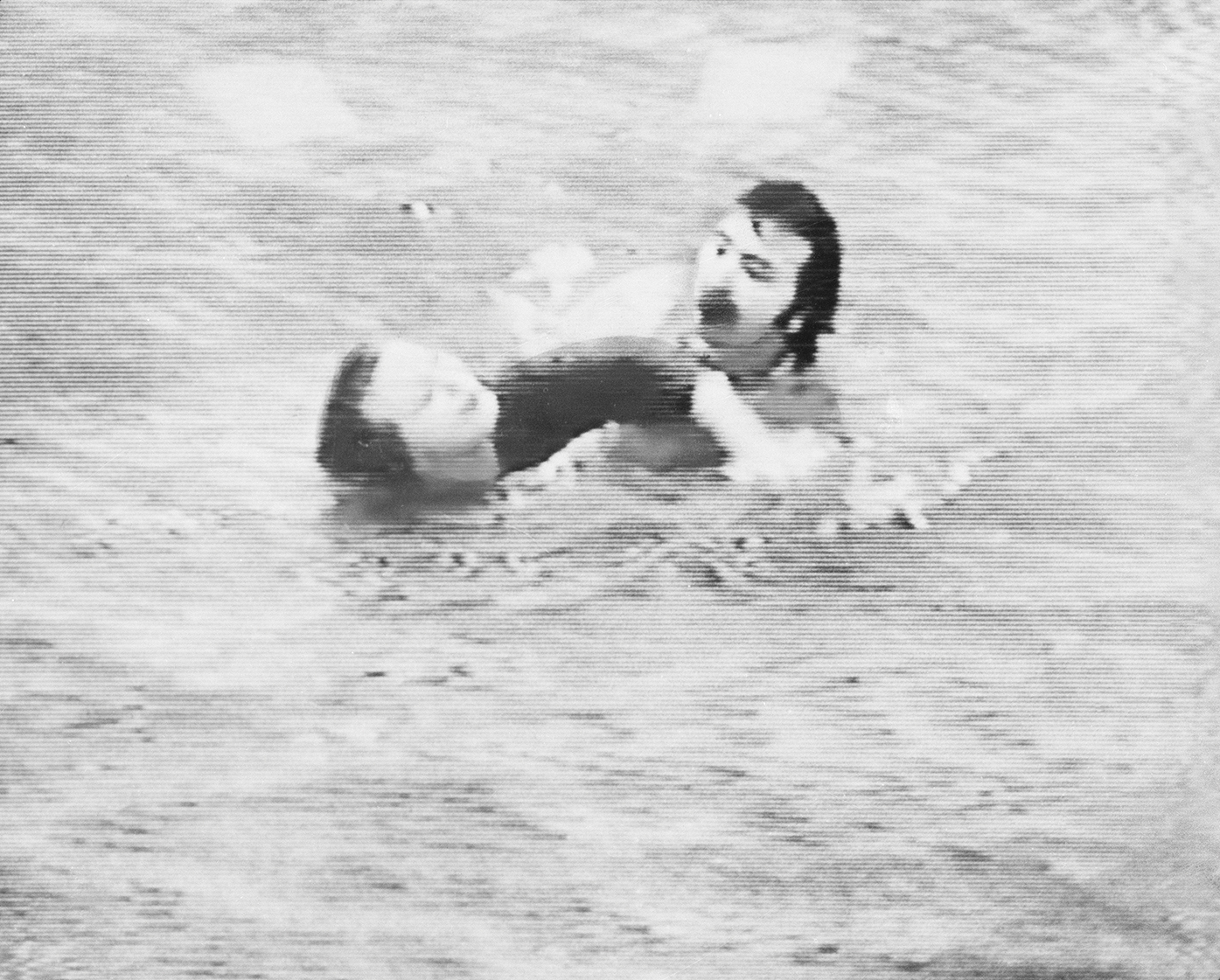
More information
A black and white, low resolution photo shows a man in water saving a drowning woman.
Author James Brady, who has written about the World War II soldiers who raised the flag on Iwo Jima and other historical topics, has commented that
it’s the observer who sees a hero. . . . I’ve talked to Medal of Honor winners and everybody says the same thing: “I didn’t do anything that anyone else wouldn’t do.” . . . [A soldier who rescued a companion under fire] didn’t see the bullets, he just saw a man that needed his help. It’s the people on the outside who see the heroic stuff. It’s all in the perspective. (as cited in J. Fisher, 2004)
Occasionally, it might be possible to take an outsider’s view on your own behavior. One such occasion might be when you use your memory to survey your past behaviors and see retrospectively how each of your actions fits into a pattern that may have been invisible to you at the time, and how your choices differed from those of others in the same situations. Perhaps Lenny Skutnik realized later how exceptional his behavior was; at the time, he was too focused on someone in need to wonder whether his action was typical, or to contrast it with that of the other people at the scene who were just standing around.
In a very different example, when a person with an alcohol use disorder explains the cause of a recent drinking relapse, he16 is likely to attribute it to a stressful day at work, a fight with a spouse, and so on. But as more time passes, he becomes more likely to view the relapse as part of a chronic pattern of behavior (McKay et al., 1989). Time can give perspective.
The purpose of psychotherapy is often to try to gain a broad view of one’s own behavior to discover where one’s strengths and weaknesses lie. Therapists encourage the client to review past behavior and identify patterns, rather than continuing to see maladaptive behaviors as inevitable responses to momentary pressures. The person with an alcohol use disorder, for example, needs to recognize drinking as a chronic and characteristic behavior pattern, not a normal response to situational stress. The next step is to find and use the inner strength that can help overcome this pattern.
Improving Self-Knowledge
In what ways can you improve how well you know yourself? There are three basic routes. First, and perhaps most obviously, you can look into your own mind and try to understand who you are. Second, you can seek feedback from other people who—if they are honest and they trust you not to be offended—can be an important source of information about what you are really like, including aspects of yourself that might be obvious to everybody but you. Third, you can observe your own behavior and try to draw conclusions from those observations much as anyone else, observing the same behaviors, would do (Bem, 1972).
The most important implications of RAM for self-knowledge lie at the first stage: relevance. As with getting to know another person, you can evaluate yourself only on the basis of what you have observed yourself do, and this is limited by the situations you have experienced and even by restrictions you may have put on yourself. Lenny Skutnik had a chance to observe himself in a situation few have encountered, even though he was reluctant to draw conclusions. Rather than wait for something similarly dramatic to happen, some people test themselves with bungee jumping or mountain climbing, thus allowing themselves to discover attributes they might not otherwise have known they have. I am not really recommending that you go bungee jumping, but it might be worthwhile to consider how you could learn a lot about yourself by going to new places, meeting new people, and trying new things.
I am not really recommending that you go bungee jumping, but you could probably learn a lot about yourself by going to new places, meeting new people, and trying new things.
Self-knowledge can also be limited by family or culture rather than by geography. Some families (and some cultural traditions) curb the individual self-expression of young people to a significant degree (see Chapter 12). One’s education, occupation, and even spouse may be chosen by others. More commonly, families may exert strong pressures on children to aim for certain educational objectives and follow certain career paths. My university, like many others, has numerous freshman premed students. Strangely, by senior year there are far fewer. In the most difficult kind of case, a student feels pressured by family expectations to be premed, and then by junior year realizes the skills, the interest, or both are missing and that it’s time to decide on a new major, a new occupation, and a new path in life, which are all decisions that are better when they are based on self-knowledge rather than expectations from others.
Endnotes
-
Social psychologists identify the false consensus effect as the tendency of people to see their own behavior as more common than it really is (see Ross et al., 1977). The present discussion can be compared to research on the actor-observer effect (E. E. Jones & Nisbett, 1971), which found that people typically see their own behavior as a response to momentary, situational pressures, whereas they see the behavior of others as consistent and as a product of their personality attributes. The present discussion differs from this research by not following the traditional assumption that the actor is correct in thinking their behavior is caused by the situation and the observer is wrong in thinking the person was the cause. I suspect that people more often tend to be blind to consistencies in their own behavior, which are better observed from an external perspective (see Funder, 1982; Kolar et al., 1996).Return to reference 14
- A lesser-known hero of that day was passenger Arland Williams, who refused several times to accept a rescue line while passing it to others. He drowned when the piece of wreckage he was clinging to sank. We don’t know what he would have said about his behavior, but my guess is it would have been much the same.Return to reference 15
- The study summarized in this paragraph was conducted by the U.S. Veterans Administration on male veterans of the armed forces.Return to reference 16