WHITENESS
As should be clear from the preceding examples, the United States, since its inception, has been a nation that placed supreme value on whiteness. This is a term—“whiteness”—which we do not use much. Perhaps this is because many people have the tendency to assume that race is about people of color. But race is a fundamentally relational concept: we cannot understand the meaning of Hispanic, Asian, Native American, or black without simultaneously understanding the meaning of white. But white is not “just another” racial category: it is the dominant category, that with which all other categories are compared and contrasted. Whiteness, then, is racial domination normalized. This normalization produces and reproduces many cultural, political, economic, and social advantages and privileges for white people and withholds such advantages and privileges from nonwhite people.
The Race That Need Not Speak Its Name
Think, for a moment, about who you are. What qualities are most salient to your identity? Perhaps think about three characteristics that best describe your makeup.
Chances are that if you are white, you probably did not list your race as one of the characteristics most important to you. You might have listed your ethnicity—Irish, Italian, Jewish—or your religion, gender, sexual orientation, or political affiliation. On the other hand, if you are not white, there is a good chance that you listed your race as an important characteristic. You might have identified as a “Black woman Christian” or as an “Asian American gay man.”50
What explains this difference? Why are white people more unlikely than people of color to identify themselves in racial terms? Sociologists have shown that many white people have a hard time coming to terms with their whiteness. In fact, many white people seem to believe they do not belong to a racial group. They see themselves, simply, as “normal.”51 And herein lies the power of whiteness. By refusing to speak its own name, whiteness presents itself as normality.
In our popular culture, history books, and political discussions, whiteness is treated as the standard. For instance, if you are wandering the aisles of your local bookstore searching for titles by Ralph Ellison, Toni Morrison, or Richard Wright—three of America’s most accomplished novelists—you probably will not find what you are looking for in the “Literature” section. Ellison, Morrison, and Wright most likely are to be found in the “African American” section. There, too, you will find historical treatises on slavery, segregation, and the Civil Rights Movement. Novelist Leslie Marmon Silko and Pulitzer Prize–winning poet N. Scott Momaday probably are shelved in the “Native American” section; there, too, you will find historical books on the creation of reservations and tribal culture. In the “Literature” section, you will find shelves full of white authors: Jack Kerouac, Jane Austen, Herman Melville, and so forth. And in the “History” section, you will find book after book about white people: this one about Benjamin Franklin; that one about the Dust Bowl of the 1930s. Why, then, are not these sections respectively labeled “White Literature” and “White History”?
Consider some other examples of how whiteness is held up as the status quo:
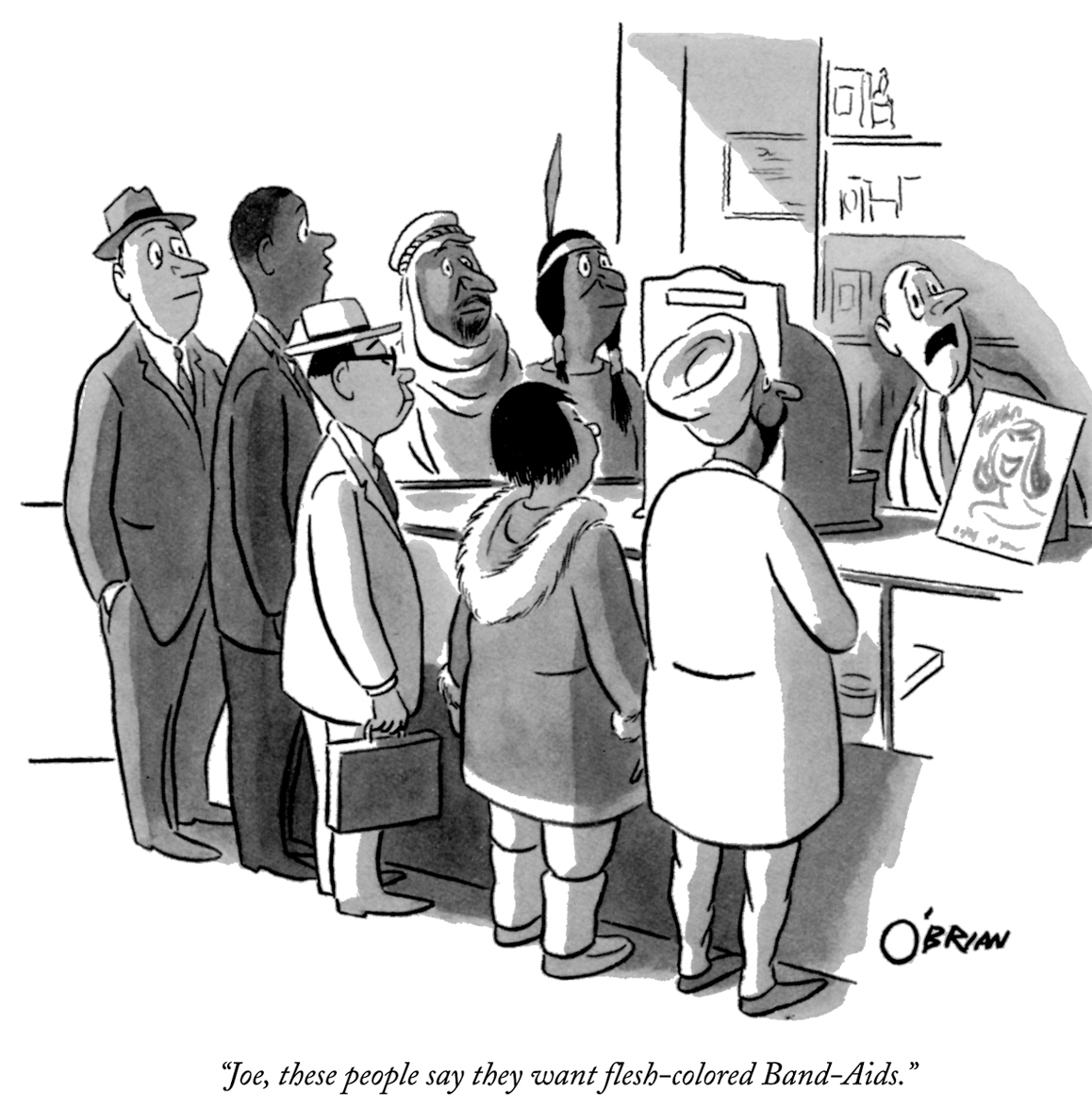
- We often hear of “black churches.” Seldom do we hear churches described (or describing themselves) as “white churches,” even though their congregations are primarily white. These are simply “churches.”
- Certain television shows, such as Empire or Black-ish, are considered “African American television.” Popular shows such as The Marvelous Mrs. Maisel or Game of Thrones are made up of majority- or all-white casts, but those shows are not called “white television.”
- There are “black ghettos,” “Mexican barrios,” “Chinatown,” and “Native American reservations,” but gated suburban communities, many of which are nearly all white, are simply referred to as “gated communities” or “suburbs.”
- College courses that focus on Anglo-European history, literature, music, art, or architecture are not called “white studies,” but many courses are listed under “African American studies,” “Chicano studies,” or “Asian American studies.”
These examples—and one could think of many more—demonstrate how whiteness surrounds us though it often goes unnamed. Whiteness positions itself against blackness, indigenousness, Asianness, Hispanicness, and Arabness; in so doing, it fades into the background by highlighting the differences of nonwhites. This is what we mean when we say that whiteness is racial domination normalized.
White Privilege
Although whiteness permeates all areas of society—we breathe it in every day—it seems weightless to many of us. Like fish in the ocean, who fail to feel the weight of the water, whites tend to take their whiteness for granted. Conversely, for many who are not white, whiteness is very much a visible reality. As one sociologist has put it, “whiteness, as a set of normative cultural practices, is visible most clearly to those it definitively excludes and those to whom it does violence. Those who are securely housed within its borders usually do not examine it.”52
Though they may not notice it, many white people benefit from belonging to the dominant race. White privilege is the collection of unearned cultural, political, economic, and social advantages and privileges possessed by people of Anglo-European descent or by those who pass as such. One need not look far to find substantive evidence of it. At the cultural level, white privilege marks the reactions even of those reading this book. “I am so tired of hearing all of this,” some might say. “I am so tired of opening up this book—or walking into this classroom—and hearing continually about racism!” Most of the time, white students are the ones who voice this complaint, a complaint that itself is a product of white privilege. (For this reason, they are not to blame for it! One must conceive of white privilege as so deeply ingrained as to be almost automatic; hence the importance of thoughtful, critical self-reflection, which this work, in a constructive and problem-solving spirit, aims to stimulate.) Nonwhites, whose own livelihood depends on overcoming racial domination, do not have much of a choice in the matter; their weariness comes not from discussions of racial domination but from the thing itself.
Yet another way in which white privilege manifests itself is through the discomfort many whites feel simply at being spoken of as “whites” or as “white people.” “I am an individual,” they reply. “I am a human being. Why are you racially categorizing me?” Sometimes the very description “white people” feels to them like an accusation or a hostile gesture, as if a racial rebuke—“You white people are all racists!”—were soon to follow. And sometimes whites’ awkwardness at being described this way shifts into aggression: “You must not like us! Perhaps you yourself are anti-white! Perhaps you yourself are the racist!” Again, nonwhites do not have the privilege of denying or repudiating their own designation as racialized beings.
White privilege also is evident in the tendency of many whites to deny that certain circumstances or events are “racial” to begin with. The maddening thing about race is that it often is impossible to know with complete certainty whether something is really “about race.” You are treated rudely at a restaurant. Is it because you are Mexican American or because you are a woman or because the server is having a bad day—or all three? You get pulled over by the police. Is it because you are a young black man or because you were speeding—or both? Because it often is impossible to say, smart and good-natured people often heatedly disagree about whether certain interactions really were about race—what we often refer to as “microaggressions” in contemporary discourse. And maybe what is most revealing about those disagreements is not who is right or who is wrong, but what about our own experiences makes us think one way or another. Because many white people often go about their lives without feeling the weight of race on their shoulders, they sometimes are more reluctant to see how race might color a situation. Similarly, because many nonwhite people have had multiple experiences guided by their minority status, they may be more likely to suggest that, yes, you were treated rudely or pulled over because of the color of your skin. Our experiences give us a frame through which we see the world, and that frame can tell us a lot about the way we have been uniquely privileged or disadvantaged. There is nothing wrong with thinking that something really is or is not about race, but we need to be thoughtful about why we think the way we do—and we need to wonder, too, if our understanding of the world jibes with general social patterns and with history.
It is important to recognize that however significant these aspects of white privilege may be, its benefits by no means are limited to the ability to engage in cultural denial. Social scientists also have amassed a substantial amount of evidence that whites, strictly because of their whiteness, reap considerable advantages of a more material kind—for instance, when buying and selling a house, choosing a neighborhood in which to live, getting a job and moving up the corporate ladder, securing a first-class education, and seeking medical care. Whites accumulate more property and earn more income than do members of minority populations, possess immeasurably more political power, and enjoy greater access to the country’s cultural, social, medical, legal, and economic resources: these are well-documented, and indisputable, historical and sociological facts.53
Consider the links between race, neighborhoods, and safety. Even after adjusting for income and occupation, whites are far less likely to be exposed to toxic chemicals and pollutants than are Latinos or African Americans. One reason for this is white neighborhoods are far less likely to house institutions of pollution, such as garbage dumps, trash incinerators, and chemical plants. (In Houston, Texas, 100 percent of the city’s garbage dumps are located in black neighborhoods!) We can also see white privilege at work within the criminal justice system. Although most drug addicts are white, African Americans are four times more likely to be arrested on drug charges than are whites. In the federal prison system, whites receive sentences that are, on average, 20 percent shorter than those given African Americans guilty of the exact same crime.54 We will explore in detail how white privilege pervades other realms of social life throughout this book.
Peggy McIntosh understands white privilege as “an invisible package of unearned assets which I can count on cashing in each day, but about which I was ‘meant’ to remain oblivious. White privilege is like an invisible weightless knapsack of special provisions, assurances, tools, maps, guides, codebooks, passports, visas, clothing, compass, emergency kit, and blank checks.”55 McIntosh, a white woman, goes on to provide a list of “special circumstances and conditions” attached to her own skin-color privilege.
This list demonstrates many ways in which white people benefit from their skin privilege. And, in turn, if white people benefit from their skin privilege, people of color are disadvantaged by it. Whites have accumulated many opportunities as a result of racial domination, but people of color have suffered from disaccumulation. If we talk about “black poverty,” then we must also talk about white affluence; if we speak of “Hispanic unemployment,” then we must also keep in mind white employment; and if we ponder public policies for people of color, then we must also critically examine the public policies that directly benefit white people. In all cases, one group’s privilege results in other groups’ disadvantage.56 It is precisely for this reason that, when asked by a reporter his views on America’s “Negro problem,” African American novelist Richard Wright replied, “There isn’t any Negro problem; there is only a white problem.”57
White Antiracists
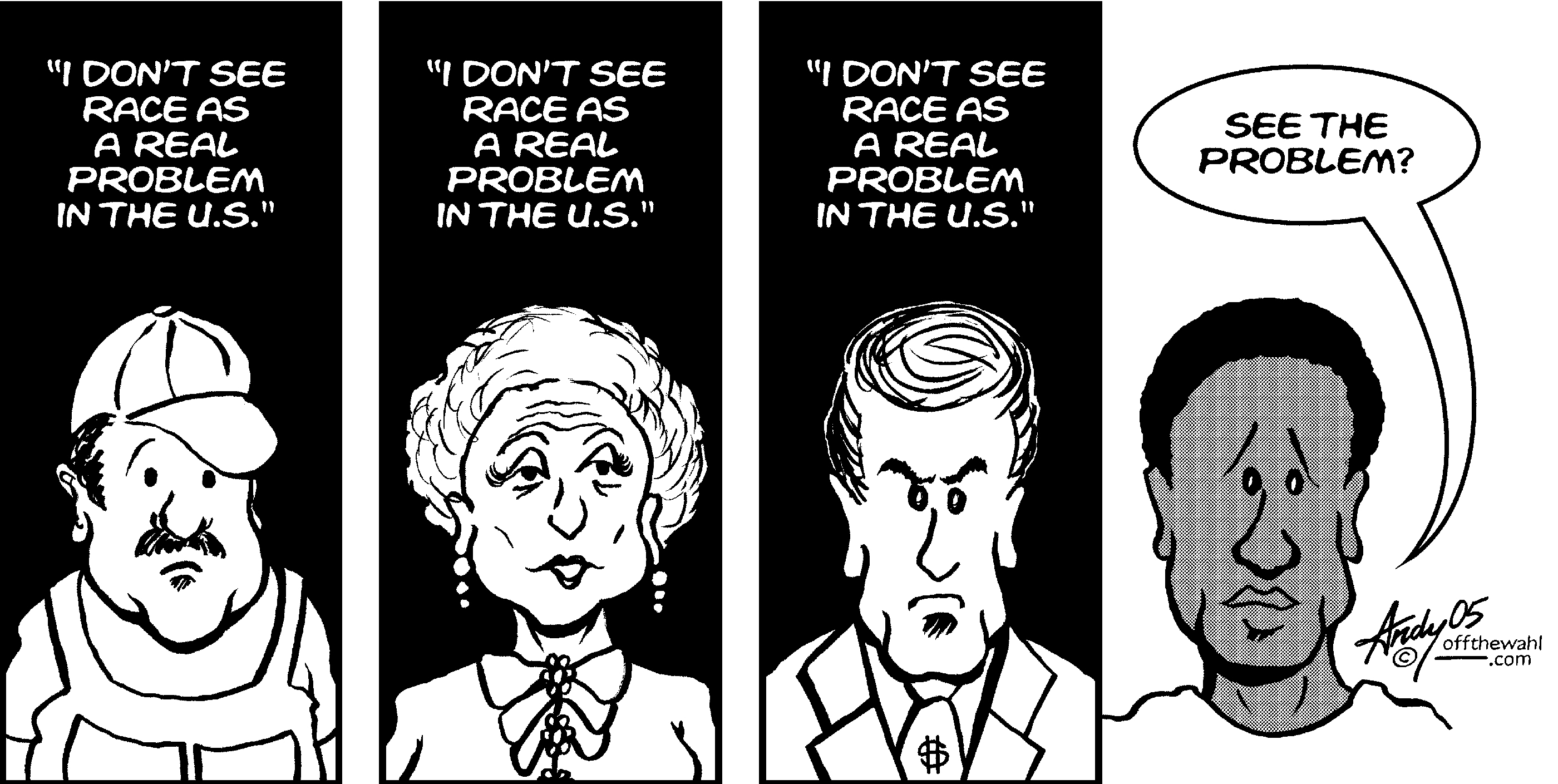
Some white people are fully aware of how the current system of racial domination benefits them and work to uphold such a system: they intentionally invest in their whiteness. Many others, who do not recognize their privilege, unknowingly support a system of racial domination that disadvantages people of color, unintentionally investing in their whiteness. Important here is the ideal of color-blindness. While some confuse physical differences with obvious racial differences, as we discussed earlier, others err in the opposite direction by claiming to ignore all racial markers. “I don’t see color at all,” they declare. “I’m color-blind!” Such avowals usually are well intentioned—indeed, many of us have been taught, since childhood, to “ignore race”—but, upon closer inspection, we realize that color-blindness is an illogical proposition, for it requires the simultaneous recognition and nonrecognition of racial markers (such as skin color).
Color-blindness would be the ideal response to a society unaffected by racial domination.58 But, sadly, ours is not such a society. Accordingly, color-blindness is not only a self-contradictory code—“At once I see and fail to see your blackness”—but also a fundamentally wrong response to racial injustice. The opposite of color-blindness is not a kind of racial exaggeration, where all you notice about a person is her or his race. Nor is it a demobilizing sense of racial guilt, where you wallow in the stereotypes you harbor. Learning about racial domination and about whiteness and white privilege can lead many whites in particular to think their reaction ought to be “I am guilty! I am the bearer of racial sins!” But nothing could be further from the truth—or further from our own intentions in writing this textbook. Racial guilt is a faulty emotion for two reasons. First, it rests on an erroneous premise; namely, that responsibility for racial injustice is a collective matter that can be passed on across generations and, indeed, through one’s blood. There is no such thing as collective guilt. Each person is responsible—and culpable—for his or her own actions, not for anyone else’s. Second, racial guilt is problematic because it is a destructive, not a constructive, emotion. It does not stimulate forward-looking, problem-solving modes of reflection and action. It does not lead in a positive direction.
If racial exaggeration and racial guilt are not the answer, then what is? The opposite of color-blindness is simple honesty: honesty about our modes of perception and racialized ways of thinking, as well as about the true nature of our world, a world rife with racial inequality. Noticing race means observing a long history of misery, exploitation, and inequality; recognizing systems of social meanings that have affixed themselves to different skin pigments; and perhaps confronting stereotypes and misunderstandings we hold deep inside. At bottom, it means shifting from a nonracist stance (“I don’t have a racist bone in my body!”) to a proactively antiracist one.
Some whites recognize their own white privilege and disavow—in some cases, actively struggle against—the racial structures from which they draw their privilege. In fact, they leverage their very advantages in the fight to dismantle racial domination. As one sociologist has aptly said with white antiracists in mind, “We do not choose our parents, but we do choose our politics.”59 Throughout the history of the United States, some whites have fought racism. Charles Sumner was one such person. Sumner served in the U.S. Senate in the mid-nineteenth century and was recognized widely as a powerful orator and a radical abolitionist. Advocating a civil rights bill that sought to ensure equal treatment for African Americans after the fall of slavery, Sumner once addressed the Senate with these stirring words: “There is beauty in art, in literature, in science, and in every triumph of intelligence, all of which I covet for my country; but there is a higher beauty still—in relieving the poor, in elevating the downtrodden, and being a succor to the oppressed. There is true grandeur in an example of justice, making the rights of all the same as our own, and beating down prejudice, like Satan, under our feet.” The civil rights bill did not succeed, but Sumner doggedly pursued his mission. On his deathbed, surrounded by friends and fellow politicians, Sumner repeated an urgent message three times over: “You must take care of the civil rights bill—my bill, the civil rights bill—don’t let it fail!”60
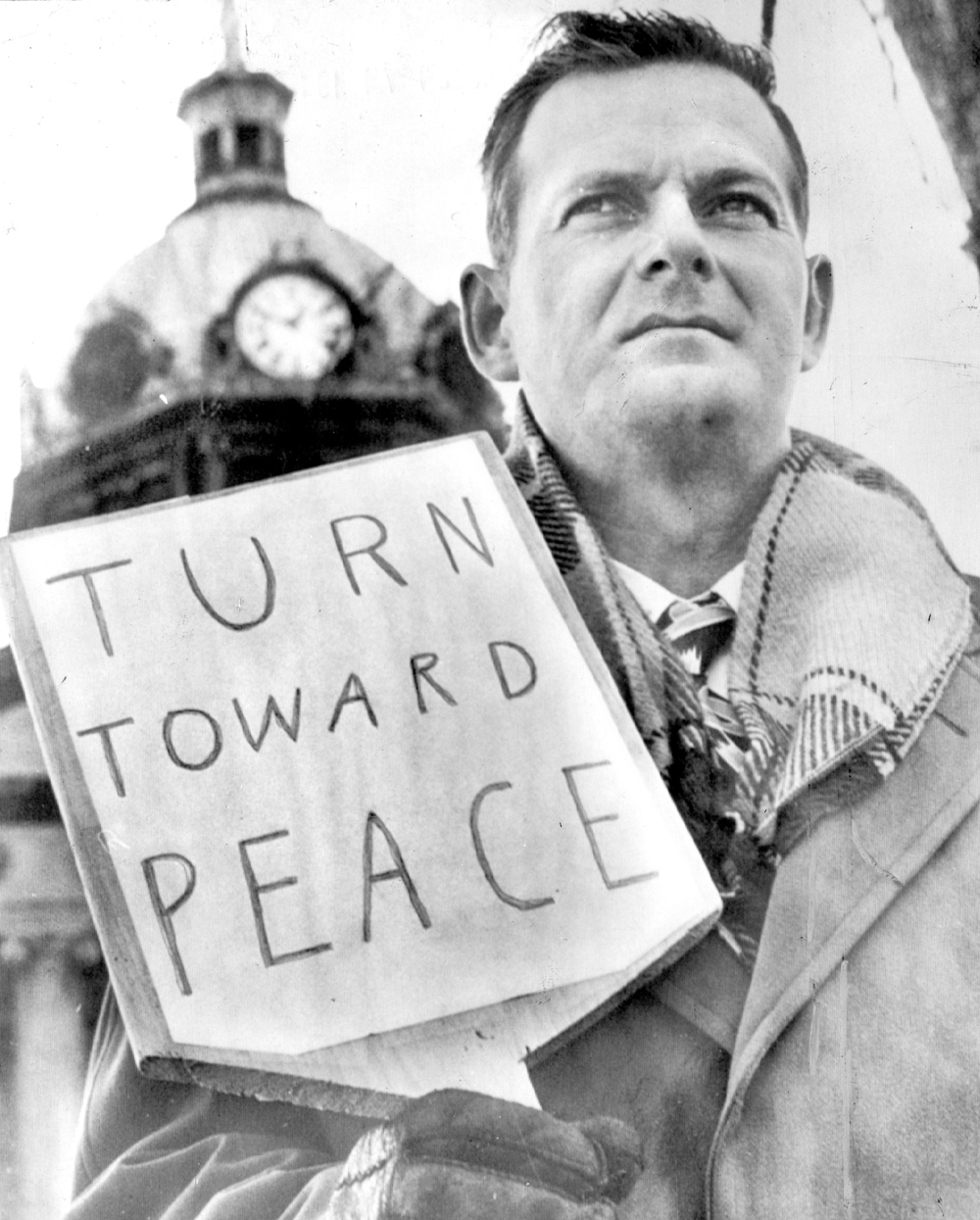
There was also Bill Moore, a white postman working in Baltimore during the Civil Rights Movement. When the governor of Mississippi, Ross Barnett, refused to desegregate the University of Mississippi, Moore staged a one-man march from Chattanooga, Tennessee, to Jackson, Mississippi. Playing up his identity as a letter carrier, Moore sought to “deliver a letter” arguing for integration to Governor Barnett. Wearing two placards on his back and chest—one reading “Equal Rights for All: Mississippi or Bust,” the other, in reference to segregated diners, reading, “Black and White: Eat at Joe’s”—Moore began his march on April 21, 1963.61
He was murdered three days later. Found dead and abandoned next to a northern Alabama highway, Moore had been shot twice in the head and once in the neck at point-blank range. He was thirty-five and a father of three. Likewise, Charles Sumner paid dearly for threatening white supremacy. In 1856, two days after delivering a speech that criticized proslavery groups in Kansas, Sumner was beaten unconscious by Preston Brooks, a congressman from South Carolina. Brooks approached Sumner as he worked at his desk in the nearly empty Senate chamber and smashed his thick wooden cane over Sumner’s head. Brooks continued to assault Sumner until his cane broke. Sumner suffered massive head trauma and would not return to the Senate for three years.
The sacrifices made by Sumner and Moore should not overshadow the sacrifices borne by hundreds of nonwhite women and men who fought against slavery, segregation, and other racist structures. For every white person beaten or killed for fighting against racism, there are hundreds of people of color who suffered equally. We speak here of the passion of Charles Sumner and Bill Moore only to illustrate that throughout the history of the United States, white people have aligned with people of color to struggle against racial domination.
Endnotes
- Dalton Conley, “Universal Freckle, or How I Learned to Be White,” in The Making and Unmaking of Whiteness, ed. Birgit Brander Rasmussen, Eric Klinenberg, Irene Nexica, and Matt Wray (Durham, NC: Duke University Press, 2001), 25–42. Return to reference 50
- Amanda Lewis, “‘What Group?’ Studying Whites and Whiteness in the Era of ‘Color-Blindness,’” Sociological Theory 22 (2004): 623–646; Amanda Lewis, Race in the Schoolyard: Negotiating the Color Line in Classrooms and Communities (New Brunswick, NJ: Rutgers University Press, 2003); Ruth Frankenberg, White Women, Race Matters: The Social Construction of Whiteness (Minneapolis: University of Minnesota Press, 1993); Stephanie Wildman, Privilege Revealed: How Invisible Preference Undermines America (New York: New York University Press, 1996). Return to reference 51
- Frankenberg, White Women, Race Matters, 228–229. Also see Ruth Frankenberg, “The Mirage of an Unmarked Whiteness,” in Rasmussen et al., The Making and Unmaking of Whiteness, 72–96. Return to reference 52
- Douglas Massey and Nancy Denton, American Apartheid: Segregation and the Making of the Underclass (Cambridge, MA: Harvard University Press, 1993); Devah Pager, “The Mark of a Criminal Record,” American Journal of Sociology 108 (2003): 937–975; Tonry, Malign Neglect; Bruce Western, Punishment and Inequality in America (New York: Russell Sage Foundation, 2006); Melvin Oliver and Thomas Shapiro, Black Wealth, White Wealth: A New Perspective on Racial Inequality (New York: Taylor & Francis, 2006); Dalton Conley, Being Black, Living in the Red: Race, Wealth, and Social Policy in America (Berkeley: University of California Press, 1999). Return to reference 53
- George Lipsitz, Possessive Investment in Whiteness: How White People Profit from Identity Politics (Philadelphia: Temple University Press, 1998), 8–10. Return to reference 54
- Peggy McIntosh, “White Privilege and Male Privilege: A Personal Account of Coming to See Correspondences through Work in Women’s Studies,” in Critical White Studies: Looking behind the Mirror, ed. Richard Delgado and Jean Stefancic (Philadelphia: Temple University Press, 1997), 291–299. Return to reference 55
- Brown et al., White-Washing Race, 22. Return to reference 56
- Cited in Kenneth Kinnamon and Michel Fabre, Conversations with Richard Wright (Jackson: University Press of Mississippi, 1993), 99. Return to reference 57
- K. Anthony Appiah and Amy Gutmann, Color Conscious: The Political Morality of Race (Princeton, NJ: Princeton University Press, 1996), 109. Return to reference 58
- Lipsitz, Possessive Investment in Whiteness, viii. Return to reference 59
- Quoted in W. E. B. Du Bois, Black Reconstruction in America, 1860–1880 (Cleveland, OH: Meridian, 1965 [1935]), 592–594. Return to reference 60
- Lipsitz, Possessive Investment in Whiteness, viii–ix. Return to reference 61
Glossary
- whiteness
- The constructed dominant racial category that normalizes racial domination and reproduces advantages for white people, while withholding such advantages from nonwhite people.
- white privilege
- The collection of unearned advantages possessed by people of Anglo-European decent or by those who pass as such.