Distinguish between institutional, organizational, and interpersonal racism, and understand how these types of racism often interpenetrate and inform one another.
RACIAL DOMINATION
We have spent a significant amount of time talking about what racial domination or racism is not. We have yet to spell out what it is. Racial domination is the arrangement of racial life in such a way that its ordinary, everyday workings serve to benefit certain racial groups (in our society, predominantly White Americans) at the expense of others (in our society, predominantly nonwhites). Far from always involving overt coercion or violence, as in the days of slavery, racial domination is a matter of how institutions ordinarily operate, how interpersonal exchanges (within and across racial divides) typically unfold, and even how individuals (Whites and nonwhites alike) unthinkingly come to see themselves and their place in the racial order.
Institutional, Organizational, and Interpersonal Racism
Specific manifestations of racial domination are institutional, organizational, and interpersonal racism. Institutional racism is systematic White domination of people of color, embedded and operating across legal systems, political bodies, cultural life, and other social collectives. Institutional racism involves many types of power: the symbolic power to classify one group of people as “normal” and other groups of people as “abnormal,” the political power to withhold basic rights from people of color and marshal the full power of the state to enforce segregation and inequality, the social power to deny people of color full inclusion or membership in associational life, and economic power that privileges White people in terms of wealth and property accumulation. Organizational racism is a subset of institutional racism carried out in corporations, workplaces, and other organizations where people come together to create, work, or worship. It is manifest in terms of job placement (who is more likely to be a manager or worker), hiring discrimination, promotions, and general esteem in workplaces, schools, and churches.27
Informed by centuries of racial domination, institutional and organizational racism withholds from people of color opportunities, privileges, and rights that many White people enjoy. Examples of institutional racism include the prevalence of law enforcement practices that target people of color, especially African Americans and Arab Americans, as criminals or terrorists, and the over-policing of communities of color, including police brutality. Organizational racism includes the tendency of schools and universities to support curricula that highlight the accomplishments of European Americans, ignoring the accomplishments of non-European Americans; the disproportionate numbers of White people in high-ranking political, economic, and military posts, and the ongoing exclusion of people of color from such posts. In all three of these examples, racial domination is carried out above the level of individuals, sometimes despite the motives or attitudes of the people working in those institutions. Because structural racism operates outside the scope of individual intent, many people do not recognize institutional and organizational racism when they experience it.
Below the level of institutions and organizations, yet shaped by the workings of those institutions, we find interpersonal racism. This is racial domination manifest in everyday interactions and practices. Interpersonal racism can be overt, as in old-fashioned bigotry (old-fashioned but not outmoded, as the examples at the start of this chapter indicate). In such instances, people act out their prejudices, giving direct expression to their negative attitudes guided by their demeaning stereotypes of others. However, most of the time, interpersonal racism is covert: it is found in the habitual, commonsensical, and ordinary practices of our lives. This is part of the reason why racial problems are so challenging: they extend far beyond the confines of straightforward, conscious bigotry. Our racist attitudes, as author Lillian Smith remarked in Killers of the Dream, easily “slip from the conscious mind deep into the muscles.”28 Since we are disposed to a world structured by racial domination, we develop racialized dispositions—some conscious, many more unconscious—that guide our thoughts and behaviors.
We may talk slowly to an Asian woman at the farmer’s market, unconsciously assuming that she speaks poor English. We may inform a Mexican woman at a corporate party that someone has spilled his punch, unconsciously assuming that she is a janitor. We may unknowingly scoot to the other side of the elevator when a large Puerto Rican man steps in, or unthinkingly eye a group of Black teenagers wandering the aisles of the store at which we work, or ask to change seats if an Arab American man sits down next to us on an airplane. Many miniature actions such as these have little to do with one’s intentional thoughts; they are orchestrated by one’s practical sense and one’s habitual know-how, and informed by institutional racism.
“Can people of color be racist?” This question is a popular one in the public imagination, and the answer depends on what we mean by racism. Institutional racism is the product of years of White supremacy, and it is designed to produce far-reaching benefits for White people. Institutional racism carries on despite our personal attitudes. Thus, there is no such thing as “Black institutional racism” or “reverse institutional racism,” since there is no centuries-old socially ingrained and normalized system of domination designed by people of color that denies Whites full participation in the rights, privileges, and seats of power of our society.29 Interpersonal racism, on the other hand, takes place on the ground level and has to do with attitudes and habitual actions. It is certainly true that members of all racial groups can harbor negative attitudes toward members of other groups. An African American may hold ill feelings toward Jews or Koreans. An Asian American may be suspicious of White people. And such prejudiced perceptions often are rampant within racial groups as well, as when a Cuban American feels superior to a Mexican American, a Japanese American feels uncomfortable around Chinese Americans, or dark-skinned African Americans profess to be “more authentically Black” than light-skinned African Americans. Indeed, some nonwhite groups have a deep, conflict-ridden history with other nonwhite groups. One thinks here of the Black-Korean conflict, the so-called Black-Brown divide, bitter relations among Latino subgroups, and animus among various Native American nations.
People of color, then, can take part in overt and covert forms of interpersonal racism. That said, we must realize that interpersonal racism targeting dominated groups and interpersonal racism targeting the dominant group do not pack the same punch. Two young men, one Black, the other White, bump into each other on the street. The Black man calls the White man a “honky.” In response, the White man calls the Black man a “boy.” Both racial slurs are racial slurs and should be labeled as such, and both reinforce racial divisions. However, unlike “honky,” “boy” connects to the larger system of institutional racial domination. The word derives its meaning (and power) from slavery, when enslaved African men were stripped of their masculine honor and treated like children. “Boy” (and many other epithets aimed at Black people) invokes such times—times when torturing, whipping, and raping enslaved Black people were not illegal acts. Epithets toward White people, including “honky,” have no such equivalent. (“Honky” comes from derogatory terms aimed at Bohemian, Hungarian, and Polish immigrants who worked in the Chicago meatpacking plants.)30 “Boy” also reminds the Black man how things stand today. If the confrontation escalates and the police are called, the Black man knows that the police officers will probably be White and that he might be harassed or looked on as a threat; if the two men meet in court, the Black man knows that the lawyers, judge, and jurors will possibly be mostly (if not all) White; and if the two men are sentenced, the African American man knows, as do many criminologists, that he will get the harsher sentence.31 “Boy” brings the full weight of institutional racism—systematic, historical, and mighty—down on the African American man. “Honky,” even if delivered with venomous spite, is powerless by comparison.

More information
The sign conveys that a person who enters the establishment must be thirty years old and should have proper I D. The dress code does not allow baggy pants hung low, doo rags, hoods, and caps worn backward. Drugs and weapons are prohibited.
A neutral dress code or something more?
Moreover, sociologists have shown that, unlike White people, people of color are confronted with interpersonal racism on a regular basis, sometimes daily. For people of color, there is a cumulative character to an individual’s racial experiences. These experiences do not take place in isolation. Humiliating or degrading acts are always informed by similar acts that individuals have experienced in the past. Scholars note that these daily occurrences of interpersonal racism can “get under the skin,” impacting the health of people of color. Exposure to racism causes stress, which increases the release of cortisol, commonly called the stress hormone. Repeated releases of cortisol take a toll on the body, literally causing faster aging. Arline Geronoimus, a researcher whose work has focused on these processes, dubbed the phenomenon “weathering,” likening it to the ways water passing over rocks slowly but steadily erodes them. Weathering can take years off the lives of people of color, as racism slowly wears down their immune system.32
Institutional racism and interpersonal racism are not altogether distinct phenomena, however useful it may be to distinguish them analytically. When Stokely Carmichael and Charles Hamilton first brought the concepts into race studies in their 1967 classic, Black Power, they affirmed that those who “would and do perpetuate institutionally racist policies”—and who would do so “deliberately”—are driven as much by racism as are the perpetrators of interpersonal acts of insult and humiliation.33 For instance, the judge who sentences a person of color to a prison term longer than what a White person would receive enacts institutional racism yet also engages (in an indirect and mediated way) in an interpersonal interaction. Likewise, cemetery owners who put out a sign forbidding the consumption of food on their premises also interact, after a fashion, with visiting family members of color, whose ritual practices the owners specifically are targeting—some nonwhite groups consider bringing food to a cemetery a long-standing cultural practice—even as these authorities lay down their impersonal organizational rules in the isolation of their executive offices. Carmichael and Hamilton easily could have made the inverse point as well; namely, that every act of interpersonal racism also carries with it the force of institutional racism. Not only do institutions shape the perpetrator through past practices of socialization, but institutions also authorize the perpetrator’s racist actions in the present. Institutional and interpersonal forms of racism interpenetrate and support one another: whenever one comes to light, the other’s shadow can be found alongside it. Their common root is a social psychology of racial animus, dispositions and habits of thought, perception, feeling, and action that leads one to denigrate the racial Other. This especially is important to note in light of the tendency to invoke institutional racism in ways that absolve racial dominants of their culpability. As originally conceived, it may have been useful for finding ways to talk about the historical legacy of racial inequality, yet it also allows personal responsibility to be neutralized. After all, someone did lay down those prison sentences; someone did write up those cemetery rules.
Symbolic Violence
Elaborating on the nature of “unconscious racism,” law professor Charles Lawrence has observed,
Americans share a common historical and cultural heritage in which racism has played and still plays a dominant role. Because of this shared experience, we also inevitably share many ideas, attitudes, and beliefs that attach significance to an individual’s race and induce negative feelings and opinions about nonwhites. To the extent that this cultural belief system has influenced all of us, we are all racists. At the same time, most of us are unaware of our racism. We do not recognize the ways in which our cultural experience has influenced our beliefs about race or the occasions upon which those beliefs affect our actions. In other words, a large part of the behavior that produces racial discrimination is influenced by unconscious racial motivation.34
Take note of the italicized sentence. Why didn’t Lawrence write, “To the extent that this cultural belief system has influenced all of us, all White people are racists?” The answer is that such a statement would be inaccurate.
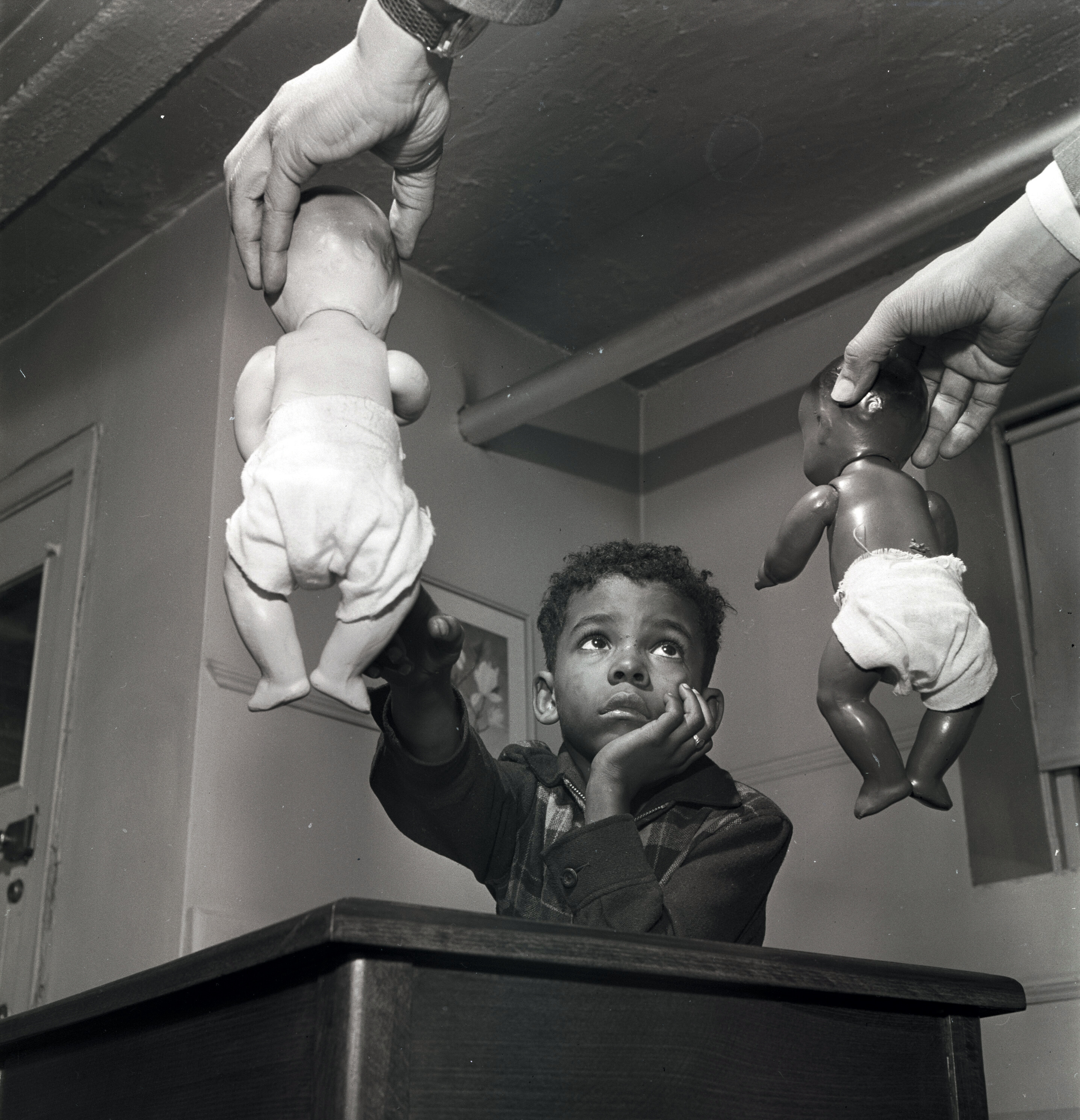
More information
The Black boy is offered two dolls, one white and the other black. The boy points to the white doll.
Nonwhite children learn to associate light skin with positive attributes. Credit: Untitled, Harlem, New York, 1947. Photograph by Gordon Parks.
Racism surrounds us. To borrow an analogy developed by psychologist and educator Beverly Tatum, racial domination is like polluted air. On some days, the pollution is weighty and visible, while on other days, it is virtually invisible—“but always, day in and day out, we are breathing it in.”35 Because racism infuses social life, nonwhites and Whites alike develop thoughts and practices molded by racism; nonwhites and Whites alike develop stereotypes about other racial groups.
In fact, people of color may internalize prejudice aimed at their own racial group, unintentionally contributing to the reproduction of racial domination. Psychologists have labeled this phenomenon “internalized oppression” or “internalized racism.” Following the work of French sociologist Pierre Bourdieu, we label it “symbolic violence”—“violence which is exercised upon a social agent with his or her complicity.”36 In the case of racial domination, symbolic violence refers to the process by which people of color unknowingly accept and support the terms of their own domination.37 “So we learned the dance that cripples the human spirit,” laments Lillian Smith, “step by step by step, we who were white and we who were colored, day by day, hour by hour, year by year until the movements were reflexes and made for the rest of our life without thinking.”38
The pervasiveness of symbolic violence presents a challenge to all students of color who might read this textbook—or any other work on race in America—and feel they have little to gain from it, as if the study of race were merely a way of enlightening their peers who are White. Regrettably, symbolic violence operates everywhere. It can be found among White people, to be sure, who perhaps out of racial guilt repudiate their own Whiteness by engaging in misguided attempts, say, to “act Black.” We shall have more to say about this in Chapter 10. However, symbolic violence also is found among nonwhites who learn from an early age that nonwhiteness is devalued.
A good example of symbolic violence is the nearly worldwide acceptance of European standards of beauty. The false aesthetic separation between “White beauty” (epitomized by long, straight, blond hair, blue eyes, and pale skin) and “Black ugliness” (epitomized by short, curly, black hair, brown eyes, and dark brown skin) grew out of slavery. Features associated with the African American phenotype were demonized. Since the “Black Is Beautiful” movement of the 1960s, many African American women have resisted such standards, taking pride in their curly hair and their ebony-colored skin. Nevertheless, many others have internalized White standards of beauty, using costly and painful methods to straighten and dye their hair and, less frequently, to lighten their skin. In fact, Madam C. J. Walker, the first Black millionaire, mentioned earlier, made her fortune developing a product to straighten Black women’s hair! Today, many Black women, to borrow a philosopher’s line, have been “poisoned by the stereotype others have of them.”39
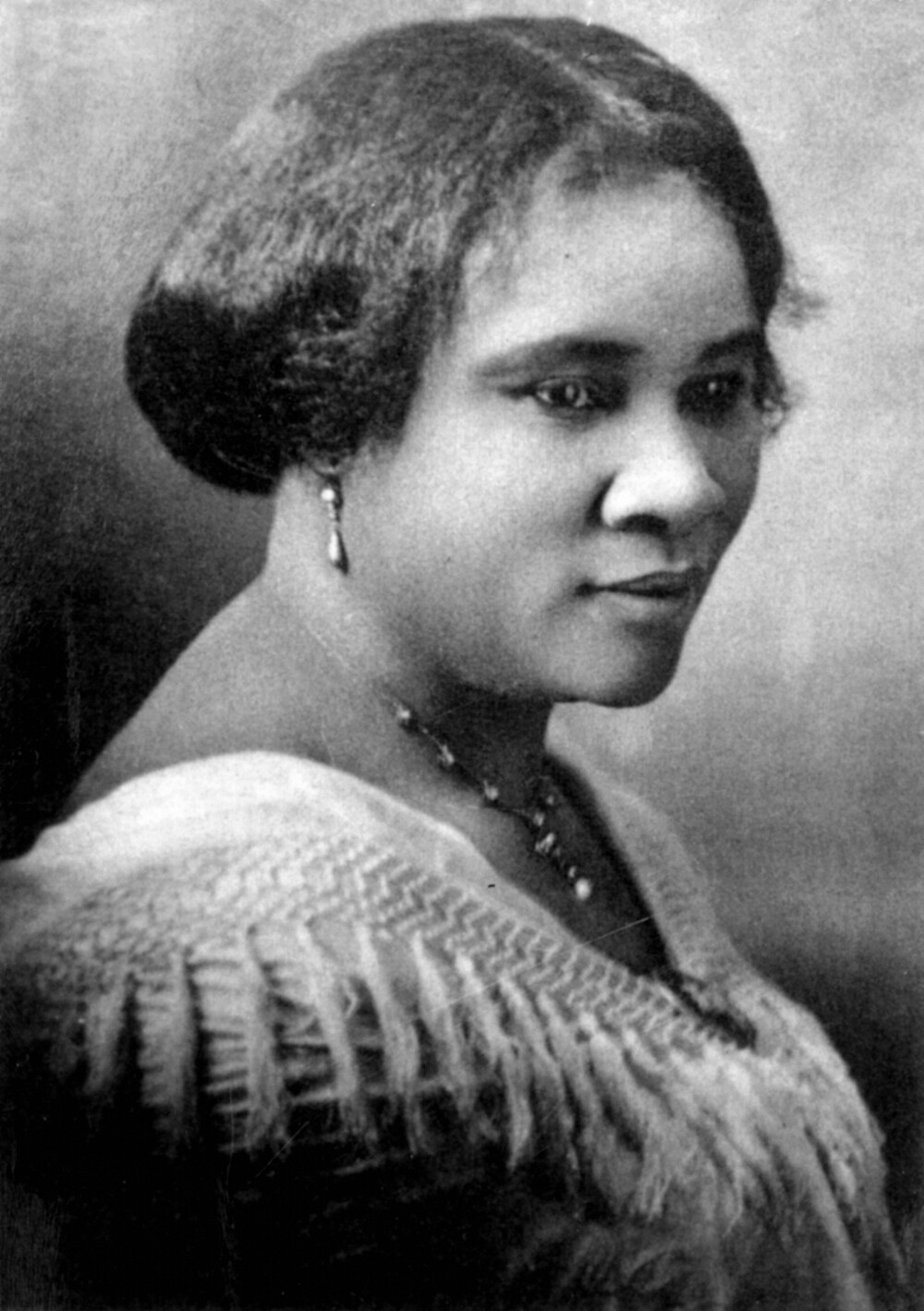
More information
A portrait of Madame C.J. Walker with short, straightened hair.
Madam C. J. Walker, known as the first African American millionaire, made her fortune developing a product to straighten Black women’s hair.
Colorism, or intraracial discrimination based on skin tone, eye color, or other phenotypic features, is another example of symbolic violence. Scholars have shown that lighter-skinned African Americans are likely to have better health outcomes and job prospects, as well as receive lighter prison sentences, and are less likely to face the death penalty.40 The extent of this stratification is profound, with the lightest-skinned Black men approaching income parity with White men.41 This type of symbolic violence can be psychologically painful, because lighter-skinned members of minority communities face questions about their authenticity. Historically, scholars trace this type of stratification to the plantation, where the mixed-race offspring of enslaved women and their enslavers were more likely to be released from slavery and to receive resources from their enslaving fathers.42 Colorism is sometimes considered a taboo subject among Black Americans, as some feel public discussions of in-group favoritism for lighter skin shouldn’t be discussed within the community.
Racism is a global system. Thus, skin-tone discrimination is by no means limited to the United States. Skin-lightening creams are popular across parts of Africa and Asia, in spite of the fact that they often contain harmful chemicals, including mercury (a neurotoxin linked to aggression, depression, hallucinations, and a host of other ailments). In this way, symbolic violence segues into actual harm, as individuals adopt dangerous practices that devalue dark skin.
Symbolic violence operates by virtue of the fact that the dominated perceive and respond to the structures and processes that dominate them through modes of thought (indeed, also of feeling) that are themselves the products of domination. The racial “order of things” seems to them natural, self-evident, and even legitimate. This in turn has an important practical implication. What is required is a radical transformation of the social conditions that produce embodied habits, dispositions, tastes, and lifestyles that lead people to become actively complicit in their own domination. The only way to bring about change that does not entail merely replacing one modality of racial domination with another is to address specifically and undo the mechanisms of de-historicization and universalization—“always and everywhere it has been this way”—that enable arbitrary workings of power to continue.
Glossary
- institutional racism
- The systemic oppression of people of color, embedded in and operating through corporations, universities, legal systems, political bodies, cultural life, and other social collectives. (Ch. 1)
- organizational racism
- A type of institutional racism carried out in corporations, workplaces, and other such organizations and manifested in terms of job placement, hiring discrimination, promotions, and general esteem. (Ch. 1)
- interpersonal racism
- Racial domination that manifests overtly or covertly in everyday interaction and practices. (Ch. 1)
- symbolic violence
- The process by which people of color unknowingly accept and support the terms of their own domination. (Ch. 1)
Endnotes
- Victor Ray, “A Theory of Racialized Organizations,” American Sociological Review 84, no. 1 (2009): 26–53. Return to reference 27
- Lillian Smith, Killers of the Dream, rev. ed. (New York: Norton, 1961), 96. Return to reference 28
- Joe R. Feagin, Hernan Vera, and Pinar Batur, White Racism: The Basics, 2nd ed. (New York: Routledge, 2001), 3. Return to reference 29
- David G. Embrick and Kasey Henricks, “Discursive Colorlines at Work: How Epithets and Stereotypes Are Racially Unequal,” Symbolic Interaction 36, no. 2 (2013): 197–215. doi: 10.1002/symb.51. Return to reference 30
- See, for example, Michael Tonry, Malign Neglect: Race, Crime, and Punishment in America (New York: Oxford University Press, 1995). Return to reference 31
- Arline T. Geronimus, Margaret Hicken, Danya Keene, and John Bound, “‘Weathering’ and Age Patterns of Allostatic Load Scores among Blacks and Whites in the United States,” American Journal of Public Health 96, no. 5 (2006): 826–833. doi: 10.2105/AJPH.2004.060749. Return to reference 32
- Stokely Carmichael and Charles V. Hamilton, Black Power: The Politics of Liberation in America (New York: Random House, 1967), 5, 22. Return to reference 33
- Charles Lawrence, III, “The Id, the Ego, and Equal Protection: Reckoning with Unconscious Racism,” Stanford Law Review 39 (1987): 317–388, 322, emphasis added. Return to reference 34
- Beverly Daniel Tatum, “Why Are All the Black Kids Sitting Together in the Cafeteria?” and Other Conversations about Race (New York: Basic Books, 1997), 6. Return to reference 35
- Pierre Bourdieu and Loïc Wacquant, An Invitation to Reflexive Sociology (Chicago: University of Chicago Press, 1992), 167. Return to reference 36
- Also see Pierre Bourdieu, Masculine Domination (Stanford, CA: Stanford University Press, 2001 [1998]). Return to reference 37
- Smith, Killers of the Dream, 96. Return to reference 38
- Jean-Paul Sartre, Anti-Semite and Jew (New York: Grove, 1960 [1946]), 95. Return to reference 39
- Ellis P. Monk, “The Cost of Color: Skin Color, Discrimination, and Health among African-Americans,” American Journal of Sociology 121, no. 2 (2015): 396–444; Jill Viglione, Lance Hannon, and Robert DeFina, “The Impact of Light Skin on Prison Time for Black Female Offenders,” Social Science Journal 48, no. 1 (2011): 250–258; Jennifer L. Eberhardt, Paul G. Davies, Valerie J. Purdie-Vaughns, and Sheri Lynn Johnson, “Looking Deathworthy: Perceived Stereotypicality of Black Defendants Predicts Capital-Sentencing Outcomes,” Psychological Science 17, no. 5 (2006): 383–386. Return to reference 40
- Arthur H. Goldsmith, Darrick Hamilton, and William Darity, “Shades of Discrimination: Skin Tone and Wages,” American Economic Review 96, no. 2 (2006): 242–245. Return to reference 41
- Franklin Frazier, Black Bourgeoisie (New York: Simon and Schuster, 1957). Return to reference 42