The Villanovans
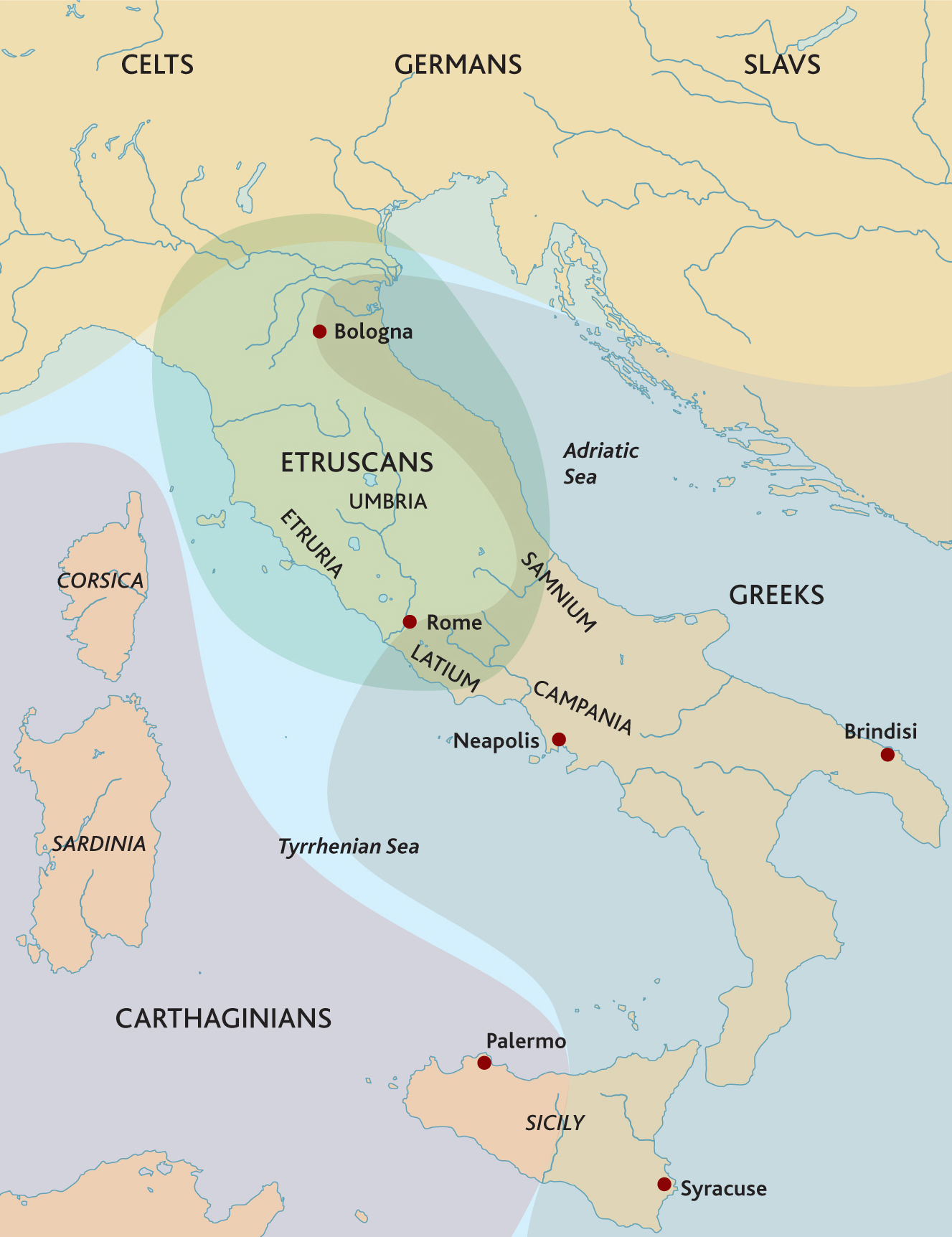
When traders from Greece and Carthage first arrived on the Italian peninsula [1.1], they found an Etruscan culture in its early stage—one that archaeologists have termed “Villanovan.” The name comes from a site near Bologna, which is actually to the north of Etruria proper, but the customs it describes extended south as far as Latium (a region of central west Italy that includes Rome). These people are known from their graves: simple “pozzo” burials that look similar to wells, in which the cremated remains of the deceased were interred in characteristic cinerary urns and accompanied by other possessions, such as vases, jewelry, and weapons [1.2].
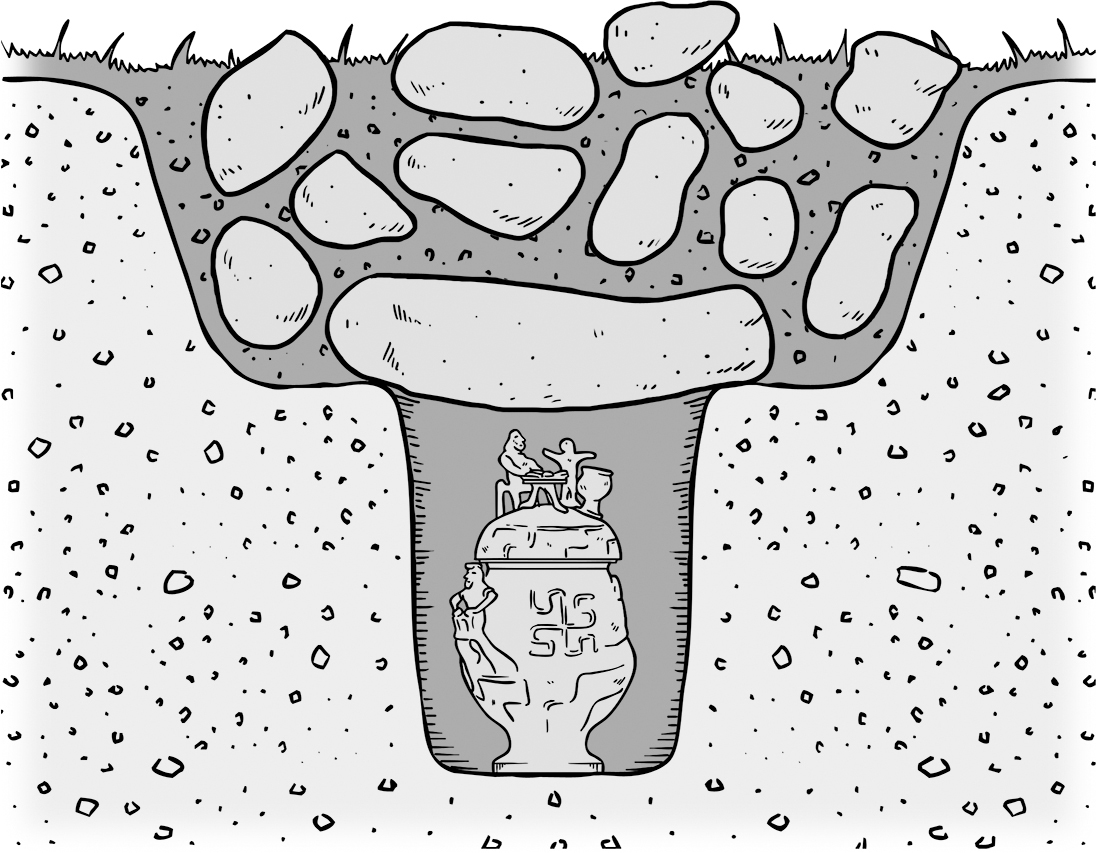
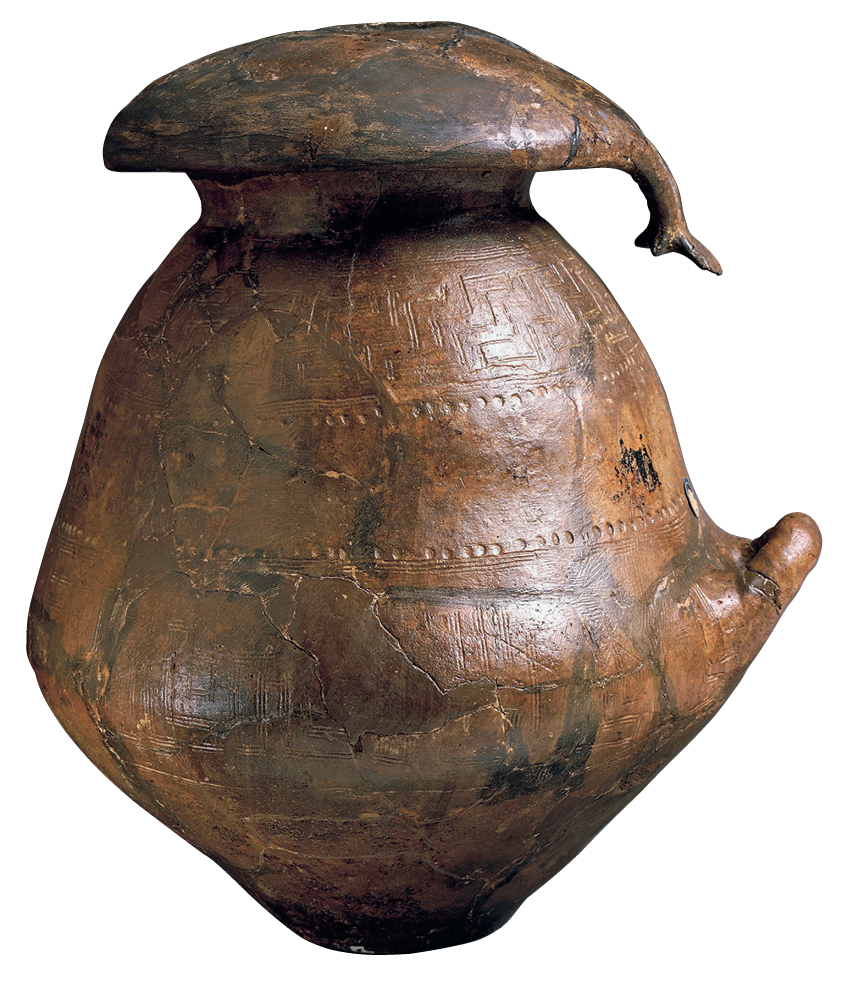
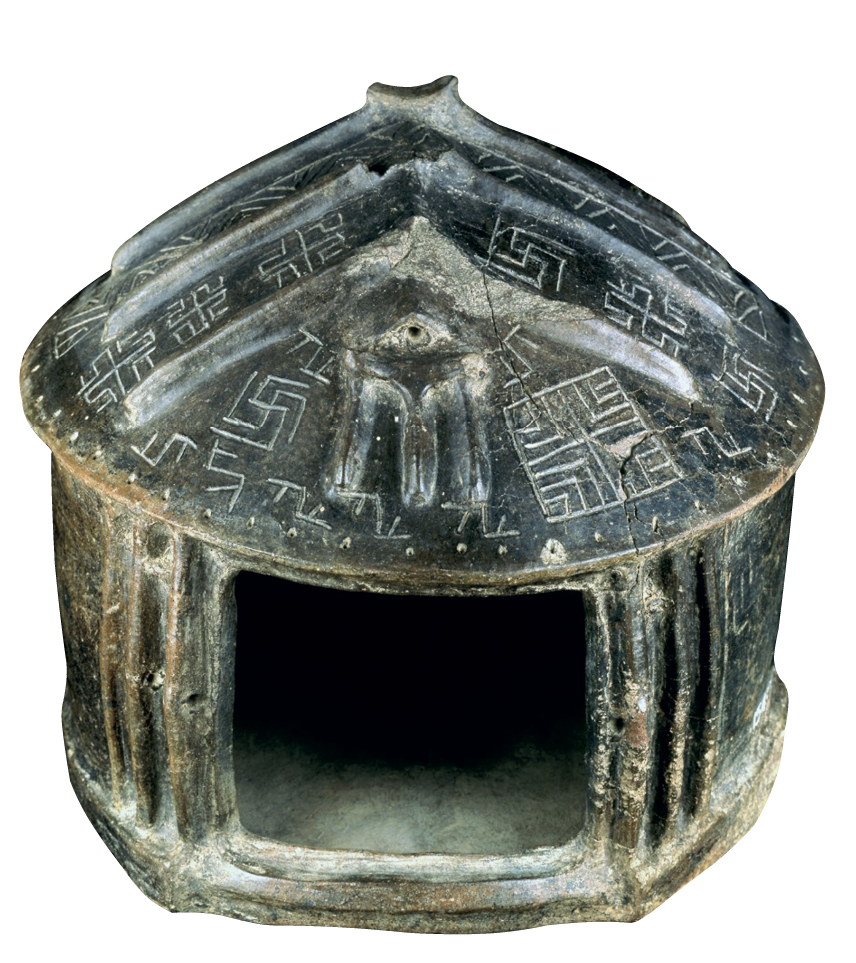
The container of choice was the biconical urn—a handmade (as opposed to wheel-thrown) pot that approximates, in shape, two cones attached at their wider ends [1.3]. The material from which the urn is made is called impasto, a thick grayish-to-black clay; the decoration is limited to incised marks (scratched into the surface before firing), mostly abstract motifs. Another kind of ash-container was modeled in the form of the thatched-roof huts in which these “proto-Etruscans” lived [1.4]. Even at this early date, the association between the grave and the domicile was close, as would continue to be the case to the end of Etruscan history.
The technique of using incision to decorate Villanovan pottery can also be seen on metal objects found in the same burials, and there is every reason to believe that these crafts had been developed locally. By the end of the eighth century BCE, though, vases of a very different sort began to be made here. These were thrown on a potter’s wheel, rather than built up by hand, and were decorated with painted, rather than incised, ornament. Although made of local clay, and surely of local manufacture, these vases are strongly reminiscent of the famous monumental funerary vases that served as grave markers in the cemeteries of eighth-century BCE Greece. Yet such Greek vases were not easily, or often, exported. Therefore, and given the difficulty of this ceramic technique and the expertise it demanded, it is highly probable that the Italic vases were the work of immigrant Greek potters established at Etruscan centers. Occasionally, vases of Villanovan shape were rendered in this Hellenic technique [1.5], suggesting that this early Italic culture was open to outside influences, while at the same time prone to modifying foreign prototypes to suit native stylistic preferences and accommodate local traditions. Much the same can be said for the later Etruscans and Romans as well.
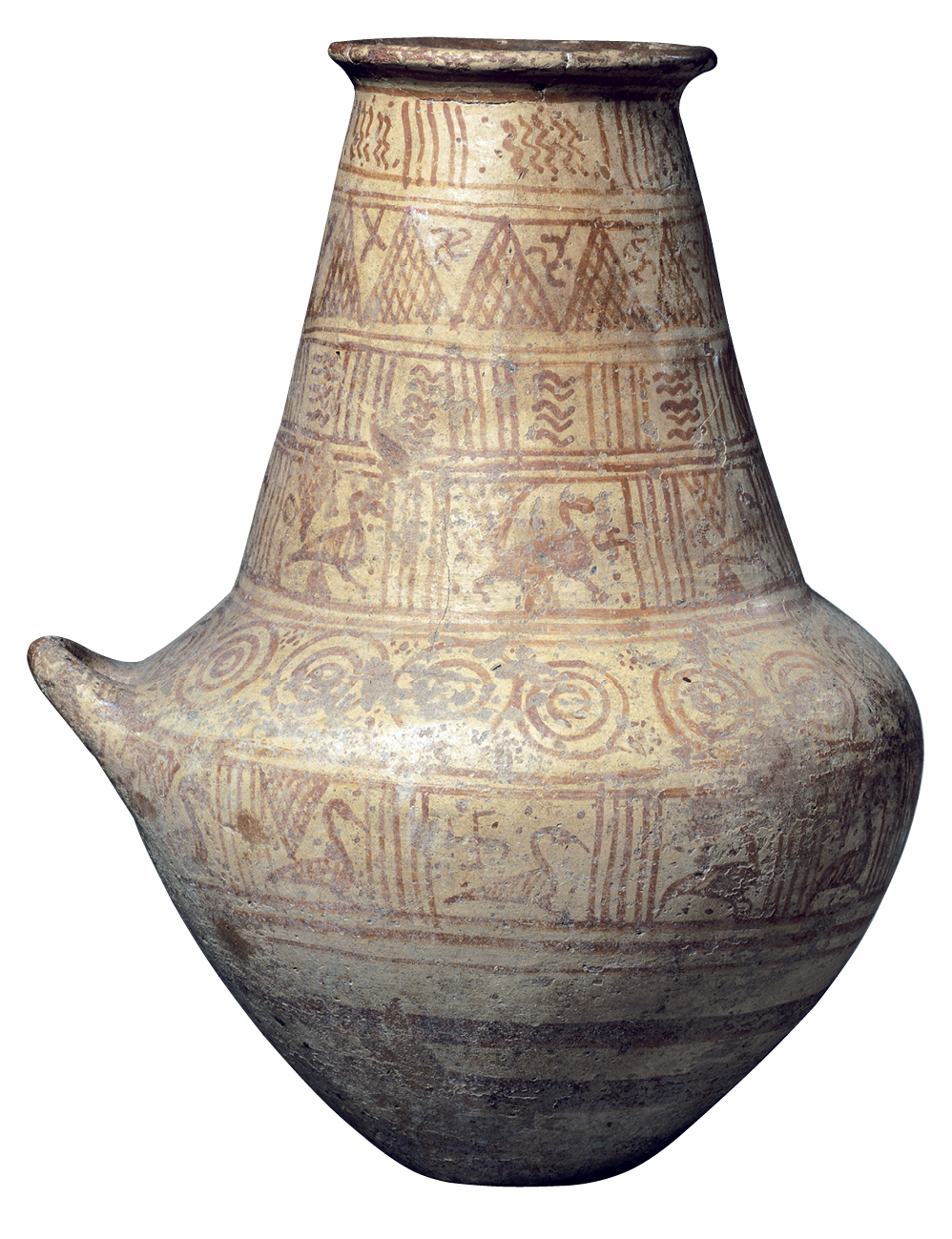
The impact of the foreign traders who arrived in Italy during the eighth century BCE was substantial. Carthage would spread its mercantile activity along the shores of the Tyrrhenian Sea, off the west coast of Italy. Greek culture was more pervasive still. Although, as far as can be discerned, the earliest visitors were primarily seeking to trade goods, by the end of the eighth century BCE dozens of Greek colonies had been established in southern Italy and Sicily. Within another century, the entire Italian coast from the Bay of Naples to Apulia, and all but the westernmost point of coastal Sicily, were entirely populated by Greek colonists. Through this expansion of trading routes, the Greeks came into ever-greater contact with people and goods arriving from the Levant, in the eastern Mediterranean. The influence of this contact would soon become evident in the subjects and motifs that characterize Etruscan art and traditions.
There are two fundamental differences between the seventh-century BCE Etruscans and their Villanovan forebears. The first is that the Etruscans were considerably wealthier, and the second is that the Etruscans lived in a culturally broader and more diverse world. The simple pozzo graves of the Villanovans gave way to elaborate, usually multi-chambered, tombs that were hollowed into the earth where the bedrock would permit, or built above ground where it would not. The majority of our knowledge of the Etruscans comes from the objects found in their tombs. Surviving Etruscan texts consist entirely of short inscriptions—no literature was later transmitted by Roman or medieval scribes—and so the range of written information is extremely limited. A reconstruction of Etruscan religious, economic, and social history can be gleaned from the descriptions that writers in other cultures, especially Greeks and Romans, saw fit to mention, but most of what we know about the Etruscans comes from archaeology.
Glossary
- cinerary urn
- Vessel used to hold ashes in cremation burials.
- biconical
- Shaped like two cones joined at their wide ends.
- impasto
- Coarse dark gray or black pottery common in northern Italy during the ninth and eighth centuries BCE.