OCEAN VUONGIMMIGRATING INTO ENGLISH
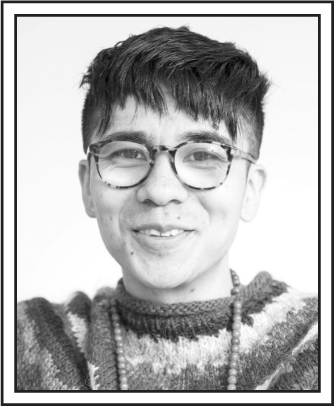
OCEAN VUONG (b. 1988) is a poet, essayist, and best-selling novelist. He was born in Ho Chi Minh City, Vietnam, and immigrated to the United States in 1990 after spending a year as a refugee in the Philippines. He is the first person in his family to learn how to read. A graduate of Brooklyn College, where he majored in British literature, Vuong earned an MFA from New York University and teaches creative writing at the University of Massachusetts–Amherst. His collection of poems, Night Sky with Exit Wounds (2016), won the T. S. Eliot Prize, along with numerous other awards. In the same year that he received a MacArthur Fellows “Genius” Grant, Vuong published the best-selling novel On Earth We’re Briefly Gorgeous (2019). “Immigrating into English,” first published in the New Yorker magazine, is a literacy narrative that tells the story of Vuong’s early experiences with learning English and writing one of his first poems.

1READING AND WRITING, like any other crafts, come to the mind slowly, in pieces. But for me, as an E.S.L.1 student from a family of illiterate rice farmers, who saw reading as snobby, or worse, the experience of working through a book, even one as simple as “Where the Wild Things Are,”2 was akin to standing in quicksand, your loved ones corralled at its safe edges, their arms folded in suspicion and doubt as you sink.
2My family immigrated to the U.S. from Vietnam in 1990, when I was two. We lived, all seven of us, in a one-bedroom apartment in Hartford, Connecticut, and I spent my first five years in America surrounded, inundated, by the Vietnamese language. When I entered kindergarten, I was, in a sense, immigrating all over again, except this time into English. Like any American child, I quickly learned my ABCs, thanks to the age-old melody (one I still sing rapidly to myself when I forget whether “M” comes before “N”). Within a few years, I had become fluent—but only in speech, not in the written word.
How to develop an interesting plot out of ordinary events is discussed on p. 133.
3One early-spring afternoon, when I was in fourth grade, we got an assignment in language-arts class: we had two weeks to write a poem in honor of National Poetry Month. Normally, my poor writing abilities would excuse me from such assignments, and I would instead spend the class mindlessly copying out passages from books I’d retrieved from a blue plastic bin at the back of the room. The task allowed me to camouflage myself; as long as I looked as though I were doing something smart, my shame and failure were hidden. The trouble began when I decided to be dangerously ambitious. Which is to say, I decided to write a poem.
4“Where is it?” the teacher asked. He held my poem up to the fluorescent classroom lights and squinted, the way one might examine counterfeit money. I could tell, by the slowly brightening room, that it had started to snow. I pointed to my work dangling from his fingers. “No, where is the poem you plagiarized? How did you even write something like this?” Then he tipped my desk toward me. The desk had a cubby attached to its underside, and I watched as the contents spilled from the cubby’s mouth: rectangular pink erasers, crayons, yellow pencils, wrinkled worksheets where dotted letters were filled in, a lime Dum Dum lollipop. But no poem. I stood before the rubble at my feet. Little moments of ice hurled themselves against the window as the boys and girls, my peers, stared, their faces as unconvinced as blank sheets of paper.
Page 135 explains when to use the past perfect (“had been”) instead of the simple past (“was”).
5Weeks earlier, I’d been in the library. It was where I would hide during recess. Otherwise, because of my slight frame and soft voice, the boys would call me “pansy” and “fairy” and pull my shorts around my ankles in the middle of the schoolyard. I sat on the floor beside a tape player. From a box of cassettes, I chose one labeled “Great American Speeches.” I picked it because of the illustration, a microphone against a backdrop of the American flag. I picked it because the American flag was one of the few symbols I recognized.
For a selection from a major speech by King, read “The Other America,” pp. 576–84.
6Through the headset, a robust male voice surged forth, emptying into my body. The man’s inflections made me think of waves on a sea. Between his sentences, a crowd—I imagined thousands—roared and applauded. I imagined their heads shifting in an endless flow. His voice must possess the power of a moon, I thought, something beyond my grasp, my little life. Then a narrator named the man as a Dr. Martin Luther King Jr. I nodded, not knowing why a doctor was speaking like this. But maybe these people were ill, and he was trying to cure them. There must have been medicine in his words—can there be medicine in words? “I have a dream,” I mouthed to myself as the doctor spoke. It occurred to me that I had been mouthing my grandmother’s stories as well, the ones she had been telling me ever since I was born. Of course, not being able to read does not mean that one is empty of stories.
7My poem was called “If a Boy Could Dream.” The phrases “promised land” and “mountaintop” sounded golden to me, and I saw an ochre-lit field, a lushness akin to a spring dusk. I imagined that the doctor was dreaming of springtime. So my poem was a sort of ode to spring. From the gardening shows my grandmother watched, I’d learned the words for flowers I had never seen in person: foxglove, lilac, lily, buttercup. “If a boy could dream of golden fields, full of lilacs, tulips, marigolds . . .”
8I knew words like “if” and “boy,” but others I had to look up. I sounded out the words in my head, a dictionary in my lap, and searched the letters. After a few days, the poem appeared as gray graphite words. The paper a white flag. I had surrendered, had written.
9Looking back, I can see my teacher’s problem. I was, after all, a poor student. “Where is it?” he said again.
10“It’s right here,” I said, pointing to my poem pinched between his fingers.
11I had read books that weren’t books, and I had read them using everything but my eyes. From that invisible “reading,” I had pressed my world onto paper. As such, I was a fraud in a field of language, which is to say, I was a writer. I have plagiarized my life to give you the best of me.
FOR DISCUSSION
- A quick preview of Ocean Vuong’s essay would suggest that he is writing an immigration story. How does the NARRATIVE develop the basic idea of moving from one territory to another? Explain.
- “Where is it?” asks Ocean Vuong’s fourth-grade teacher (4). Vuong’s teacher assumes that his pupil’s poem is plagiarized and that he is hiding the source. Should the teacher have handled the situation differently? Why or why not? Explain.
- “Reading and writing, like any other crafts, come to the mind slowly, in pieces” (1). Based on your experience, is Vuong right about this? What are some specific examples, in your case, of the process of learning to read and write “slowly” and “in pieces”—or otherwise?
- “Of course, not being able to read,” says Vuong, “does not mean that one is empty of stories” (6). Writing is only about 5,000 years old. How long have people been telling stories? What kinds of stories?
- As a child, Vuong was fluent in both Vietnamese and English—“but only in speech, not in the written word” (2). Why does learning to read and write a language take children longer than learning to speak it?
STRATEGIES AND STRUCTURES
- “Literacy narratives” tell the story of some aspect of the author’s experience with reading and writing. In Vuong’s narrative, what specific aspects of literacy is he writing about?
- The CLIMAX of Vuong’s story is not the moment of discovery, when the teacher accuses him of plagiarism; it is the act of writing the poem, which came earlier. The climax of a story usually comes near the end. How and how well does Vuong solve this problem of chronology in telling his story?
- In Vuong’s narrative, what event leads to the climactic writing of “If a Boy Could Dream”? How did Vuong’s experience with his grandmother’s stories prepare him (and his readers) for this sequence of events?
- At the end of his narrative, Vuong speaks directly to his audience. How effective is this strategy? Why might he use it, and who is his intended audience?
WORDS AND FIGURES OF SPEECH
- Vuong says his decision to write a poem was “dangerously ambitious” (3). Why was it ambitious? Why was it dangerous?
- What is the function of the phrase “Weeks earlier” in Vuong’s narrative (5)? How does it help him to solve the problem of telling a story out of chronological order?
- Throughout his narrative, Vuong uses terms that are related to war and the military, for example: “camouflage” (3), “rubble” (4), “white flag” (8), “surrendered” (8). How appropriate is this language? What sort of battle is he telling about?
- Point out places in his essay where Vuong uses FIGURES OF SPEECH such as METAPHOR (“moments of ice”) and SIMILE (“as blank sheets of paper”) in the last sentence in paragraph 4. How and how well does the use of such figurative language fit in with Vuong’s account of the first poem he wrote?
- Plagiarism is the use of another person’s words or ideas without acknowledgment, as if they were one’s own. Wrongly accused of plagiarism by his fourth-grade teacher, Vuong nevertheless says at the end of his essay that he has “plagiarized” (11). What does he mean by this, and what is he implying about the nature of writing as he sees it?
FOR WRITING
- Do some research on Vuong, and in a paragraph or two, tell the story of how he came to be called “Ocean.”
- If your first language isn’t English, write a narrative telling the story of how you “immigrated” into English. If immigration isn’t the metaphor you would use for your English learning process, how would you describe it instead? Why? Be sure to give examples of particular words and phrases that inspired (or intimidated) you.
- Whatever language(s) you consider your native language, you learned to think in that language before you learned to read and write it. Write a preliteracy narrative about some aspect of your early language acquisition or of that of somebody you know, such as a younger sibling. Again, cite specific examples of words and phrases that you (or they) learned—and how.
- Children generally take longer to learn to read and write in Chinese than in languages like English, Greek, or Albanian. Do some research on the differences between learning alphabetical, syllabic, and logographic writing systems, and write an essay explaining why children the world over learn to speak at more or less the same age but not to read and write.
Glossary
- Climax
- An aspect of PLOT in NARRATIVE writing. The climax is the moment when the action of a narrative is most intense—the culmination, after which the dramatic tension is released.
- Figures of speech
- Colorful words and phrases used in a nonliteral sense. Some common figures of speech: Simile: A stated comparison, usually with like or as: He stood like a rock. Metaphor: A comparison that equates two objects without the use of a stated connecting word: Throughout the battle, Sergeant Phillips was a rock. Metonymy: The use of one word or name in place or another commonly associated with it: The White House [for the president] awarded the sergeant a medal. Personification: The assignment of human traits to nonhuman objects: The very walls have ears. Hyperbole: Conscious exaggeration: The mountain reached to the sky. Understatement: The opposite of hyperbole, a conscious playing down: After forty days of climbing the mountain, we felt that we had made a start. Rhetorical Question: A question to which the author expects no answer or that he answers himself: Why climb the mountain? Because it is there.
- Metaphor
- A direct COMPARISON that identifies one thing with another.
- Simile
- A COMPARISON that likens one thing to another, usually with like or as.
- Narration
- One of the four PATTERNS OF WRITING. An account of actions and events that happen to someone or something in a particular place and time. Because narration is essentially storytelling, it is often used in fiction; however, it is also an important element in almost all writing and speaking. The opening of Lincoln’s Gettysburg Address, for example, is in the narrative mode: “Fourscore and seven years ago our fathers brought forth on this continent a new nation . . .”
Endnotes
- Refers to students learning English as a “second language,” in addition to their own native language(s). Today, the acronym “ELL,” short for “English Language Learner,” is more commonly used.Return to reference 1
- Classic children’s book by Maurice Sendak, first published in 1963.Return to reference 2