Every social problems claim makes a persuasive argument; it is an effort to persuade others, to convince them that a particular troubling condition ought to be recognized as a social problem, that that problem has certain characteristics, that the problem demands attention, and that it should be addressed in a specific way. When we analyze claims as arguments or statements, it matters less whether the claims are true or false than whether the people who make the claims and the audiences for those claims find the reasoning convincing.
One of the lessons of this chapter is that claims tend to take standard forms, because people who share a culture are likely to find the same sorts of arguments persuasive. Claims need to be tailored to their audiences, but of course the people who make claims usually belong to the same society as their audience, so when they devise claims that they themselves find sensible, those claims are likely to persuade their audiences. For example, members of a highly religious society may find claims based on theological reasoning compelling, whereas members of another society may be more likely to be swayed by scientific evidence. As a result, within a given society, even claims about very different problems tend to be structured in similar ways. This means that a claim you find utterly convincing will probably contain persuasive elements that resemble those in a claim you consider completely unreasonable. Keep in mind that our topic is how claims work, and understanding this does not require knowing whether the claims are, in fact, true.
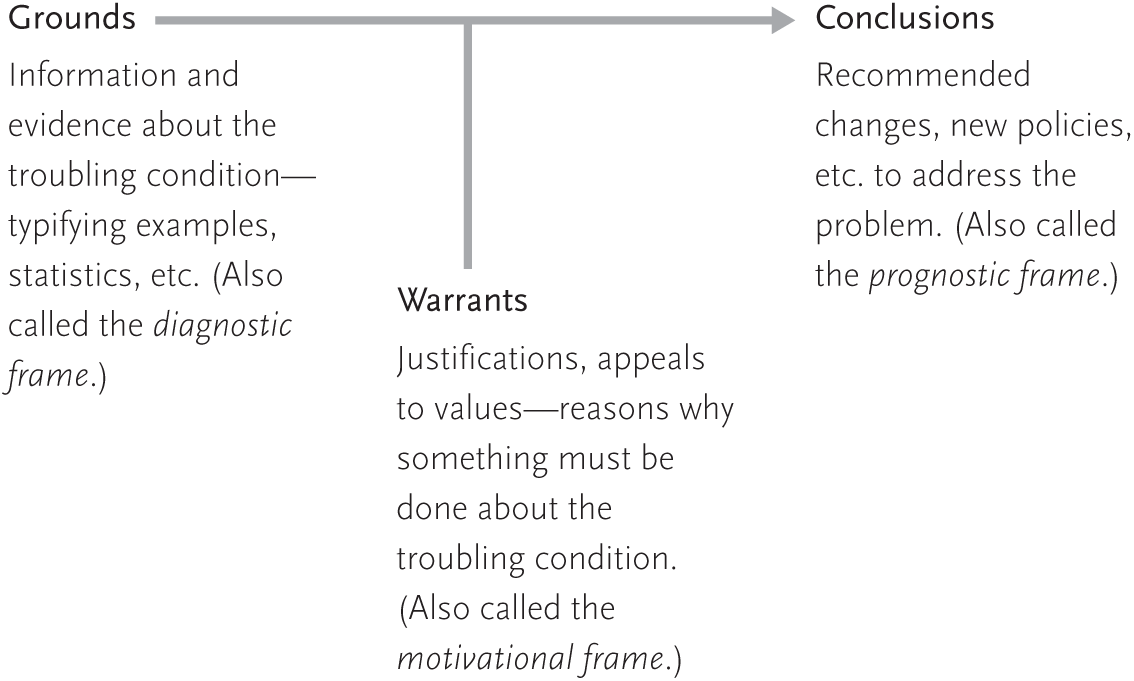
The study of persuasion is called rhetoric, and we can analyze the rhetoric of claims. Persuasive arguments share a rhetorical structure with three fundamental components: grounds, warrants, and conclusions (J. Best, 1990; Toulmin, 1958). In social problems claims, grounds are statements about the nature of the problem, warrants justify taking action, and conclusions explain what that action should be. Figure 2.1 illustrates the connections among grounds, warrants, and conclusions. We will consider each in turn.
FIGURE 2.1The Structure of Social Problems Claims
Sources: J. Best, 1990; Snow & Benford, 1988; Toulmin, 1958.
Grounds
Every social problems claim begins by identifying a troubling condition. Two sorts of statements are involved: those describing the condition and those explaining why it should be considered troublesome. The former are the grounds; the latter are the warrants (discussed in the next section).
The Basic Rhetorical Recipe. A claim’s grounds usually are assertions of fact; that is, they argue that the condition exists and offer supporting evidence. Claims in the contemporary United States often establish their grounds by following a rhetorical recipe containing three ingredients (see Box 2.1).
BOX 2.1
The Basic Recipe: Constructing the Burmese Python as a Social Problem
Burmese pythons are snakes that have been imported from Southeast Asia as pets. Some escape or are released by their owners; in South Florida, they can survive in the wild, and ecologists had long warned that pythons were becoming an invasive species because the Everglades offered them a favorable climate where there were few predators to control their numbers. However, pythons only attracted public attention after a 2009 incident in which a pet python that had not been properly fed or contained killed a two-year-old child. Politicians used this extremely atypical typifying example to campaign for banning pythons.
The python was now characterized not just as an invasive species, but as a “deadly predator” and a danger to people. There were claims that there was no safe way to keep them (although the vast majority of owners successfully kept their pythons where they could not escape or harm people). One member of Congress envisioned them “killing and consuming just about anything in their path.”
This frightening portrait was coupled with statistical estimates that South Florida was now inhabited by 150,000 invasive pythons. This figure was vastly larger than the estimate produced by researchers studying the area (who thought there might be about 5,000 pythons in the wild).
In short, claims about the python problem characterized it in a particular way that both severely exaggerated the threat to people and downplayed ecologists’ concerns about pythons’ invasive role in South Florida’s ecosystem.
Source: Moloney & Unnithan, 2019.
Typifying example. Claims often begin with a typifying example, a description of a particular instance of the condition. Typifying examples are, in fact, rarely typical. Usually they are chosen to illustrate the seriousness of the problem, so they tend to be especially extreme, dramatic, disturbing, memorable cases. For instance, claims about child abuse might start with an atrocity story, a description of a very young child who was beaten to death (J. M. Johnson, 1995). This would not be a typical case; most child abuse is not fatal. However, using a child’s death to typify abuse is compelling rhetoric; the example characterizes the problem in melodramatic terms, in that it depicts a vulnerable, innocent youngster being menaced by a more powerful, villainous adult. This example suggests that child abuse is a very serious problem, because it can involve real, terrible harm. Because the example is so disturbing, people are likely to pay attention, to start worrying about innocent children being threatened by this evil.
Name. Next the claim names the problem. The fatal beating in our example will be transformed from a horrific incident to an instance of the larger problem of child abuse (J. Best, 1999). Sometimes a new name is attached to an old behavior: bad driving has long been a familiar problem, but calling it road rage is a relatively recent development. In other cases, both the name and the troubling condition are new; sexting could not exist before technology made it possible. Note that naming a problem is not the same as defining it. Many claimsmakers avoid defining a problem by instead focusing on typifying examples. In spite of all the attention that child abuse and road rage have received in the media, it can be very difficult to find precise definitions of either term in that coverage. Rather, the people who make up the audience for these claims probably assume that they understand the nature of these problems because they are familiar with one or more typifying examples.
Statistic. A third ingredient in the basic recipe that establishes the grounds for many claims is some sort of statistic, a number that suggests the scope of the problem. In our child abuse example, we might be told that authorities receive nearly three million reports of suspected child abuse annually. In contemporary American culture, statistics imply accuracy and precision—that someone must have counted something. In practice, this is not necessarily true. When claimsmakers are first trying to draw attention to a social problem, they often argue that this problem has been neglected or overlooked. But if people have been ignoring a particular social condition, they probably haven’t been carefully measuring its extent, which means no one has been keeping accurate statistics. As a result, early claims often feature figures that are ballpark estimates or educated guesses (J. Best, 2013). And just as claimsmakers favor dramatic typifying examples, they usually prefer big numbers, statistics that suggest that the problem is widespread, because a big number implies there is a big problem. Particularly at the beginning of the social problems process, claims often feature big numbers that are really little more than rough estimates (see Box 2.2).
BOX 2.2
Straw Figures
In 2011, a nine-year-old boy contacted three American manufacturers of drinking straws, asked them to estimate the number of drinking straws produced each year, averaged their responses, and announced that Americans consume 500 million straws per day. This figure found its way into media coverage (often coupled with a video of a sea turtle having a straw removed from its nostril) as evidence of the problem of plastic pollution in the ocean.
There is good reason to question the 500 million figure. In 2011, the U.S. population was about 312 million, which would require every man, woman, and child to use 1.6 straws per day—which seems like a lot. Moreover, a firm that tracks trends in the food-service industry by surveying more than 1,000 restaurant operators estimated that restaurants used 172 million straws per day in 2016. That’s still a lot of straws, but it works out to about one straw per person every other day, which seems more reasonable, and of course the firm’s methods seem more likely to produce an accurate number. Some media sources have argued that this lower figure seems more credible, but the larger number lives on in media coverage.
Why does the less accurate number survive? It is a big, round number (half a billion straws each day), so it seems impressive and is easier to remember. But also note that reporters tend to treat numbers as facts as true, so they often feel free to repeat numbers. Careful wording, such as “By some estimates, Americans throw away 500 million plastic straws each day,” makes the statement true—after all, it is true that someone has made that estimate, even if there is good reason to doubt the number’s accuracy. Watch for other suspiciously big, round numbers in social problems claims.
Source: Britschgi, 2018.
The three ingredients in the basic rhetorical recipe—a disturbing typifying example, a name, and a big number—combine to create a troubling impression. For example, a description of a small child being beaten to death, coupled with both an explanation that this death is just one instance of the larger problem of child abuse and a statement that three million cases of suspected abuse are reported each year, conveys a sense that millions of children are in danger—possibly of losing their lives. This basic recipe offers a quick, compelling case for recognizing a new social problem. It is an effective rhetorical formula, one that can be spotted in many social problems claims.
Additional Grounds. Claims often feature grounds beyond the basic recipe’s three ingredients. Many different rhetorical devices can appear as grounds in social problems claims; what follows is just a sampling.
Worsening situation. Very often, claims insist that the problem is getting worse. Words like epidemic and crime wave convey a sense of urgency: the problem is spreading, and—unless something is done—it may soon spiral out of control.
Familiar type of problem. Claims often categorize a problem as being of a recognizable type, such as a crime or a disease. These types are characterized by familiar patterns: we think of crime as being perpetrated by a criminal who intentionally preys on an innocent victim, and diseases as striking vulnerable individuals who should not be considered responsible for getting sick. When a claim classifies the new problem as belonging to a particular type, the claim’s audience immediately has a sense of how to think about the problem.
Kinds of people involved. Most claims identify categories of people involved in the troubling condition, and explain how their involvement should be understood (Loseke, 2003). Among the most common person categories are victims (those harmed by the problem, who may be characterized as bearing no responsibility for their plight, and therefore meriting society’s support and sympathy) and villains (those responsible for the problem, usually depicted as deserving blame and punishment). Typifying examples often illustrate the principal categories of people involved in the troubling condition (such as an innocent, abused child and an abusive parent).
Range of people affected. Another popular ground for claims is the suggestion that the problem affects a broad range of people—rich and poor, white and black, and so on. Sometimes it is argued that the problem strikes “randomly” (J. Best, 1999). Of course, if a problem strikes at random, then it might affect anyone, including anyone listening to the claim. Such randomness suggests that each person who hears the claim has a personal interest in doing something to deal with the problem—before it affects him or her.
Challenge to older interpretations. Claims also may challenge existing or alternative interpretations of the social problem. For instance, students who don’t do well in school traditionally were held responsible for their poor performance, which was attributed to their inattention, lack of discipline or effort, and so on. But recent decades have featured claims that many students should not be blamed because their poor performance is due to biologically based learning disabilities that deserve accommodation (Conrad, 2007). Such claims challenge older, more familiar constructions. These challenges may be quite explicit; claims may list—and debunk—what they describe as “myths,” widely held beliefs about the problem that the claim dismisses as wrong. For example, claims that seek to reconstruct the problem of rape criticize “rape myths” for distorting people’s thinking about that crime (Suarez & Gadalla, 2010).
Again, these are just a few of the many kinds of grounds statements found in claims. Taken together, a claim’s grounds give a sense of the problem—its nature, scope, and future prospects. Effective grounds convince listeners that the condition is real, thereby setting the stage for the claim’s warrants.
Warrants
A claim’s warrants justify doing something about the troubling condition; they explain why something ought to be done. Warrants invoke values and emotions. That is, warrants argue that the condition identified in the grounds is inconsistent with what we value, and therefore we need to do something about it. Thus, claims suggest that the troubling condition violates our sense of justice, fairness, equality, or other values; in turn, we may experience anger, pity, or other emotional reactions.
Values tend to be expressed as vague principles that most—if not all—people can endorse. Most Americans can be expected to hold freedom, justice, equality, protecting the vulnerable, and humanitarianism as cherished values. But what does this mean in practice? It is not always clear how abstract values apply in real-world situations. It is not unusual for opponents in debates over social issues to endorse the same values, even as they support opposing policies. Thus, both those who favor and those who oppose restricting access to abortion tend to invoke rights: pro-life abortion opponents speak of the “unborn child’s right to life,” while pro-choice abortion advocates speak of a “woman’s right to choose.” Similarly, those who favor affirmative action argue that affirmative action programs foster equality by giving advantages to those who have been disadvantaged, yet affirmative action opponents insist that the programs subvert equality because they don’t treat everyone evenhandedly. Although virtually all Americans can be expected to affirm their beliefs in rights or equality, obviously they can disagree over how those abstract values should be translated into practical policies.
Warrants rise and fall in popularity. Sometimes new warrants—new ways of justifying claims—emerge, and change how social problems are characterized. For example, in recent years the rising costs of medical care have inspired a new warrant: arguments that some troubling conditions need to be addressed because they create costly health care burdens for the larger society. For instance, laws requiring motorcycle riders to wear protective helmets have been justified by the high costs of providing long-term medical care to head injury patients, just as campaigns to restrict smoking and reduce obesity have emphasized how those conditions add many millions of dollars to the nation’s medical costs.
Warrants based on medical costs seem to have emerged to counter arguments that defended motorcycle riding and other risky activities using another, older warrant: personal freedom. That is, motorcycle riders, smokers, and overweight individuals have long argued that they ought to have the freedom to make their own choices, even if those choices involve risks. American culture generally considers freedom an important warrant, particularly if the person taking the risks is not harming others. Using medical costs as a warrant tries to counter this older defense based on individual liberty by arguing that helmetless motorcycle riders and other risk takers are not just endangering themselves, but are also harming everyone else, in that their risky behavior raises health care costs across the board, and society has a right to try to discourage people from taking such costly risks.
Because people can be strongly attached to particular values, and because claims need to be compelling, claims’ warrants often inspire powerful emotional reactions, such as outrage, shock, sadness, or guilt. Effective claims move people to take action. While it may be possible to assemble a claim that relies on bloodless cost–benefit reasoning to convince people that it is in their best interest to respond to a social problem, it is often more effective to arouse emotional reactions, to make them feel that something must be done right away. This is why claims favor melodramatic typifying examples: it is harder to ignore the plight of innocent victims or of those who are especially deserving. Claims can make use of a wide range of emotional appeals (see Box 2.3).
BOX 2.3
The Meth Lab Formula
Once a social problem has been effectively constructed, people can use the construction to interpret events. Revier (2017) examined local and regional press coverage of the response to a meth lab explosion in which a woman in the building died from severe burns. Two men who had been cooking meth in the house were convicted of manslaughter.
Press coverage and the testimony at the trial revealed that this incident was interpreted as an instance of a standard, formula story about meth labs. This story featured villains (those who callously choose to break the law by manufacturing a drug that can lead to explosions if important precautions are ignored, which not only endangers those in the vicinity of the lab but also spreads a harmful drug in the community); victims (those who can be harmed by explosions or drug use, as well as relatives and other community members who suffer collateral damage from the drug’s effects); and heroes (law enforcers seeking to bring villains to justice).
Such formula stories seem to make sense because they use the heroes/villains/victims elements found in much of our thinking. But notice what gets lost in these apparently straightforward accounts. There is no sense of how larger social conditions might provide a context for such tales; of how, for instance, better understanding of rural unemployment, the decline in family farming, or the effects of welfare reform might help explain why meth labs began cropping up in rural America. Constructing a problem in terms of villains who make evil choices allows us to bypass asking why such villainy seems to crop up at particular times and in particular places. Formula stories help us see some things, but they also encourage us to ignore others.
Because claims can invoke many different values and emotions, and because those values are abstract and subject to conflicting interpretations, claims often feature multiple warrants so different people may agree that something needs to be done about a troubling condition even though they disagree on the reasons for taking action.
Conclusions
Every claim, then, offers a justification for taking action: the grounds identify a troubling condition, and the warrants explain why something should be done about it. Thus, all claims lead to conclusions, statements that specify what should be done, what action should be taken to address this social problem. The nature of the conclusions is shaped by the grounds and warrants. If a claim’s grounds have depicted a condition that causes terrible suffering, and the warrants speak to humanitarian concerns about the need to alleviate suffering, then the conclusions are likely to focus on ways to help the afflicted. On the other hand, if the grounds emphasize the terrible nature of a particular crime, and if the warrants focus on society’s need to protect its members from such evils, then the conclusions will probably advocate cracking down on this crime.
Often conclusions include both short-range and long-range goals. Within the short term, claimsmakers may be trying to arouse concern—to make others aware of the problem, to get people to join their campaign, or to encourage the media to cover the issue. Longer-range goals typically seek policy changes by arguing that policymakers need to pass a new law, fund a program, or otherwise deal with the troubling condition in a new, more effective way. Usually the short-range goals are seen as steps toward making these long-range changes possible.
Conclusions range from vague endorsements of change to extensive, detailed agendas for action. Early in the social problems process, when claimsmakers’ primary aim is to raise awareness of the troubling condition, grounds and warrants tend to receive more emphasis. At later stages in the process, when concern about the problem has become widespread, policy choices become a more central focus, and conclusions are likely to receive greater, more detailed attention.
Summary
Grounds, warrants, and conclusions, then, are standard elements in most arguments (Toulmin, 1958). In the case of social problems claims, this rhetorical structure explains what is wrong, why it is wrong, and what should be done about it. But who hears these claims? Which audiences are these claims meant to persuade, and how do they respond?