“The Money Question”: The Roots of Populist Revolt
What Lease described as a conspiracy between the federal government and capitalists, especially railroad company owners and bankers, had its roots in the Civil War itself, and in the federal government’s shifting policy toward the West. The transformation of the West fueled the American economy, but it also produced instability, especially given rampant land speculation and the popularity of railroad stocks and bonds, novel financial instruments issued by corporations and managed by the federal government. That instability contributed to a broader set of political concerns that became Mary Lease’s obsession, concerns known as “the money question” and traceable all the way back to Hamilton’s economic plan: Should the federal government control banking and industry?
More information
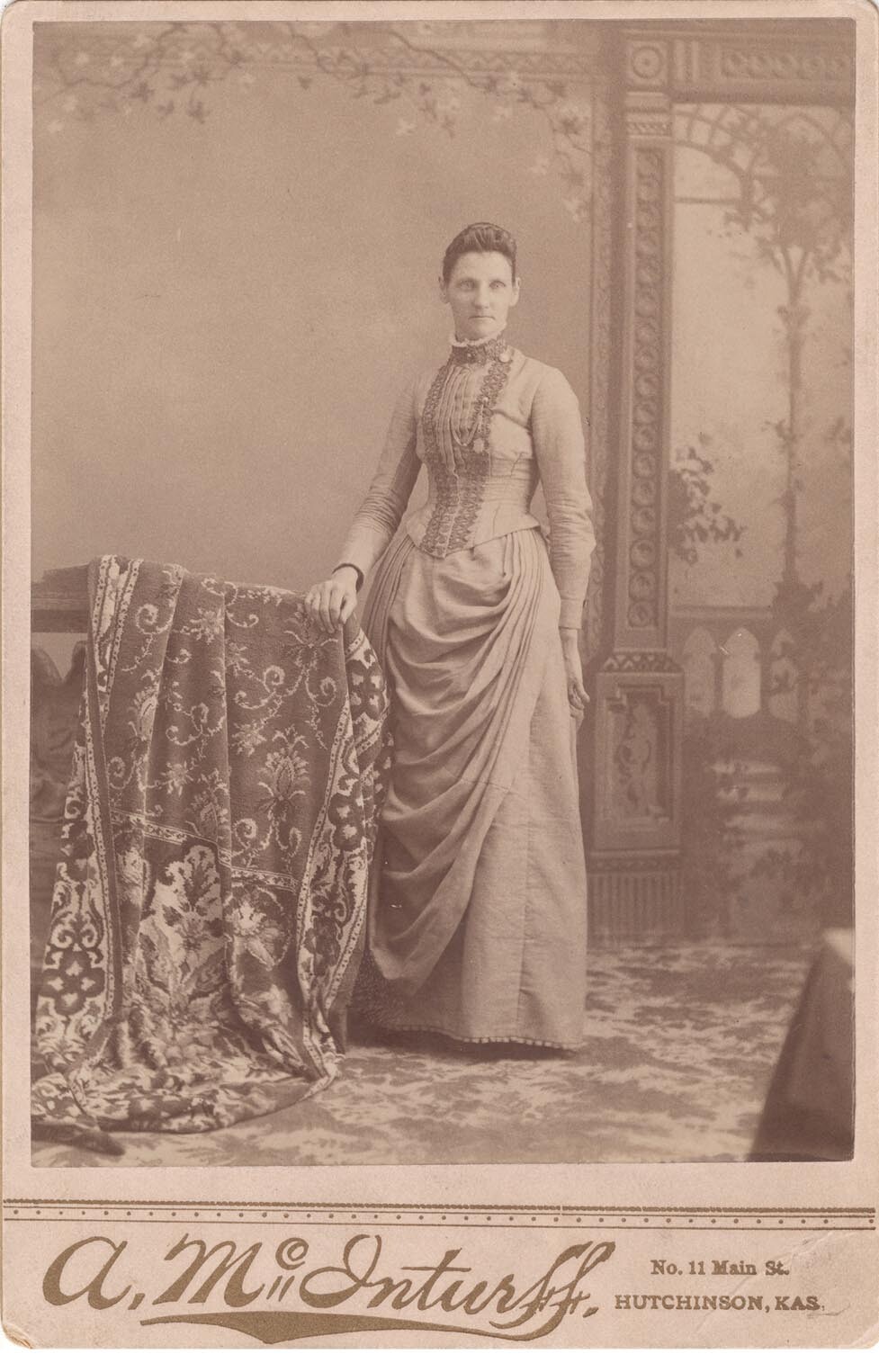
A formal photo portrait of Mary Elizabeth Lease, standing.
More information
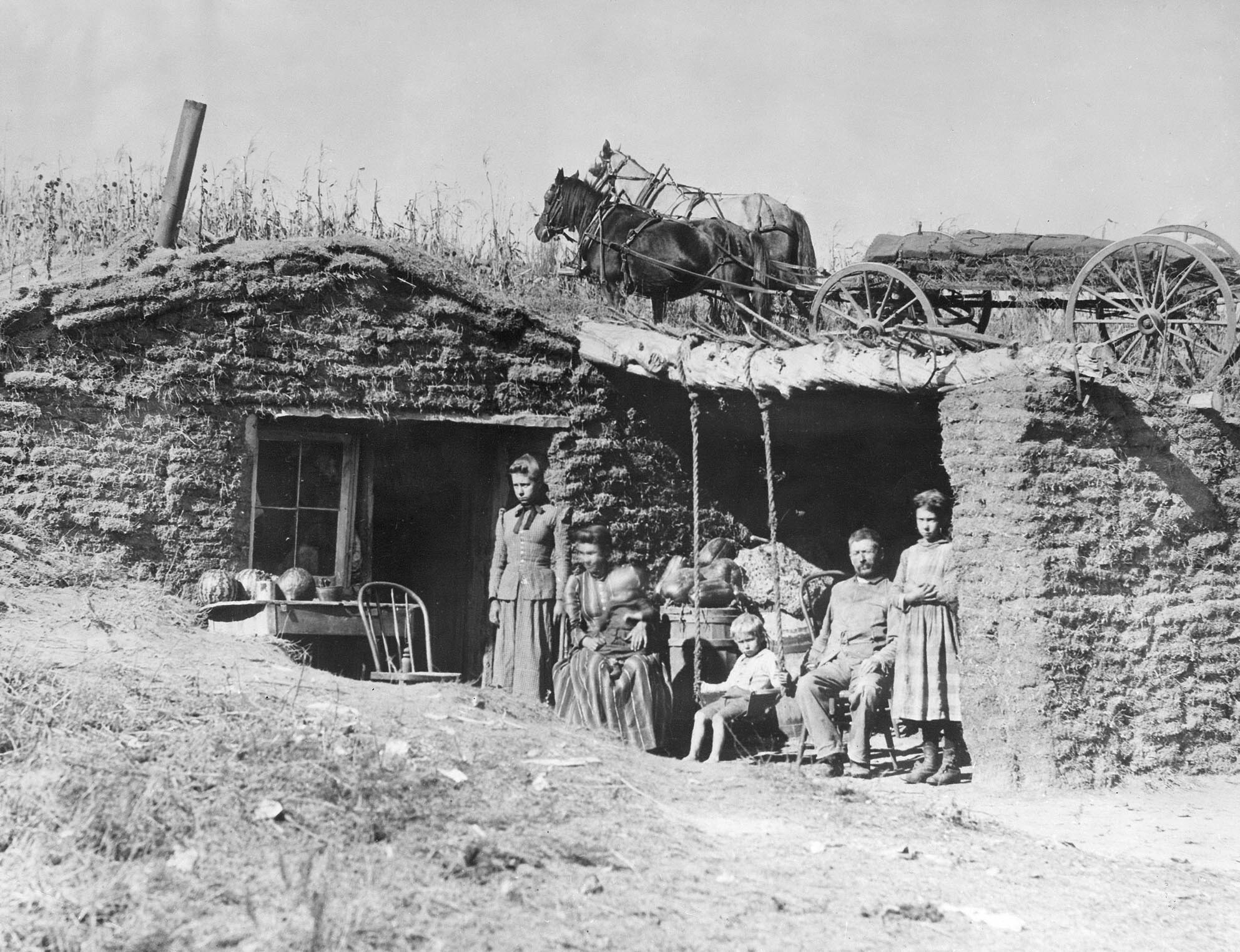
A family of six poses on the covered porch of their sod dwelling, which is built into the side of a slope. Above the house stands a team of horses harnessed to a cart loaded with more sod.
Agrarianism and Populism
This family in Nebraska (right), like so many other homesteaders, lived in a sod house as they struggled to make ends meet. After experiencing the same social and economic distress in her own life, Mary E. Lease (left) became a well-known activist.
Debt and Depression
Matters reached a crisis point in 1873, for Mary Lease and for the country, too. That spring, Lease and her family moved to Kingman, Kansas, onto land they’d acquired through the Homestead Act. The Leases got their Kansas land for free, but Mary’s husband, Charles, had to borrow hefty sums of money from a local bank to buy tools and pay land office fees. They lived in a sod house, where Mary pinned newspaper pages to the walls so that she could read while kneading dough. For a few months they scraped by, but within a year they were unable to repay their debts, and the bank repossessed their land. Life on a Kansas farm was like trying to raise corn on a beach of sand. Better to raise hell.
In suffering financial ruin in 1873, the Leases were not alone. That dire year saw the worst financial disaster since the Panic of 1837. Blame for the collapse rested on the desk of a white-whiskered Philadelphia banker named Jay Cooke, the latest in a long line of scoundrels that went all the way back to William Duer, whose swindling had brought on the Panic of 1792. Cooke had made a great deal of money during the Civil War, investing in federal war bonds and in the Northern Pacific Railway, chartered by Congress in 1864. His brother Henry had been placed in charge of the Freedman’s Savings Bank, chartered in 1865. Henry Cooke illegally invested the bank’s money—the savings of freedmen—in his brother’s railroad ventures. The proposed Northern Pacific was supposed to go through lands owned and occupied by the Sioux, who, in 1872, began fighting against the U.S. Army. Wealthy investors pulled out of Jay Cooke’s scheme when they discovered he had issued more bonds than the bank could cover. Henry Cooke’s savings bank collapsed.
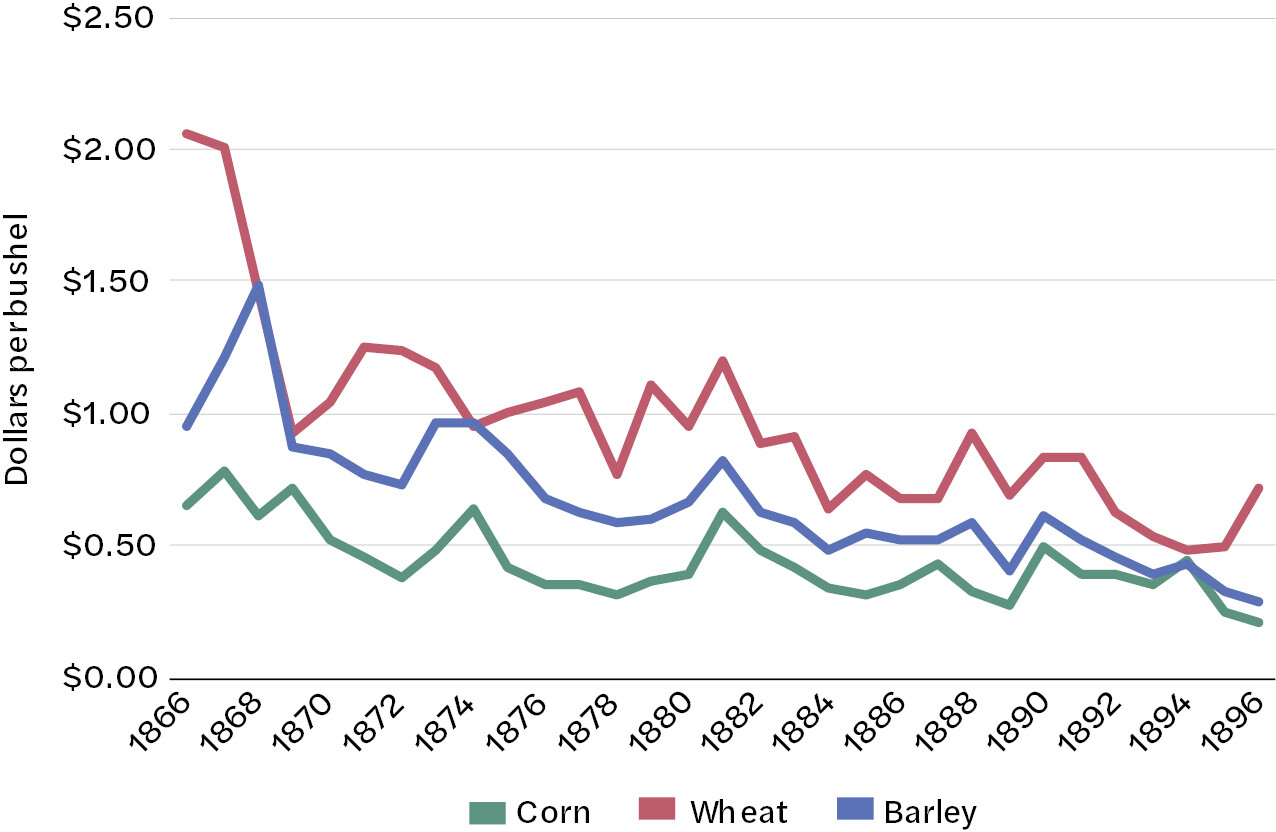
But the people who really lost out during this Panic of 1873 were the poor farmers and workers, including newly free men and women, who’d been keeping their scant savings in Cooke’s bank and lost it all. Jay Cooke & Company closed and declared bankruptcy, a bankruptcy that led to a nationwide depression. More than one hundred banks and nearly twenty thousand businesses failed. Even after the worst of the depression was over, the price of grain kept on falling. A farmer’s profit on a bushel of corn had been forty-five cents in 1870; by 1889, the profit on that same bushel had fallen to ten cents.
More information
A line chart of grain prices for the years 1866 to 1896. Wheat dropped from about $2 per bushel to $0.75. Barley dropped from $1 per bushel to $0.30. Corn dropped from $0.70 per bushel to $0.25.
Falling Grain Prices, 1866–1896
Amid an economic depression that made credit hard to come by, farmers were pinched for profits as grain prices fell, in part due to overproduction.
Source: Economic Research Service, U.S. Department of Agriculture, “Feed Grains Database.”
The Farmers’ Alliances
The populist revolt began when farmers started banding together and calling for cooperative farming, regulation of banks and railroads, and an end to corporate monopolies. Nearly a million small farmers in the South and the Midwest flocked to an organization called the Grange. On July 4, 1873, they issued a Farmers’ Declaration of Independence, calling for an end to “the tyranny of monopoly,” which they described as “the absolute despotism of combinations that, under the fostering care of government and with wealth wrung from the people, have grown to such gigantic proportions as to overshadow all the land and wield an almost irresistible influence for their own selfish purposes in all its halls of legislation.” They believed that corporations and the government were effectively conspiring against farmers.
The National Farmers’ Alliance formed in Texas in 1877 to fight for taxing of railroads and corporations, the establishment of farm cooperatives, and the removal of fences from public lands. Chapters of the Farmers’ Alliance soon spread into the Dakotas, Nebraska, Minnesota, Iowa, and Kansas. Populists, whether farmers or factory workers, for all their invocation of “the people,” tended to take a narrow view of citizenship. United in their opposition to the “money power,” members of the Alliance—like members of the Knights of Labor, who fought for Chinese exclusion—were also nearly united in their opposition to the political claims of Chinese immigrants, as well as of Black people. The Farmers’ Alliance excluded African Americans, who formed their own association, the Colored Farmers’ Alliance. Nor did populists count Native Americans within the body of “the people.”
The rhetoric of the American experiment soared and reached new heights with the voices of populists, claiming to be the true inheritors of the legacy of the American Revolution. But that inheritance, as ever, proved a battleground.
Glossary
- Panic of 1873
- A financial collapse triggered by President Grant’s efforts to withdraw greenbacks from circulation and transition the economy back to hard currency based on the gold standard. This caused a major New York brokerage house to collapse, causing other brokerages and banks to fail, followed by many railroad companies declaring bankruptcy.
- the Grange
- An organization that initially offered social and educational activities for isolated farmers and their families and that later promoted “cooperatives” where farmers could collectively buy, store, and sell their crops to avoid high fees charged by brokers and other middlemen. The organization also called for regulation of banks and railroads and an end to corporate monopolies.
- Farmers’ Alliance
- Like the Grange movement, this association sought to address the issues of small farming communities; however, Alliance chapters emphasized political action and called for the creation of a third party to advocate their concerns.