The Merest Parchment
More information
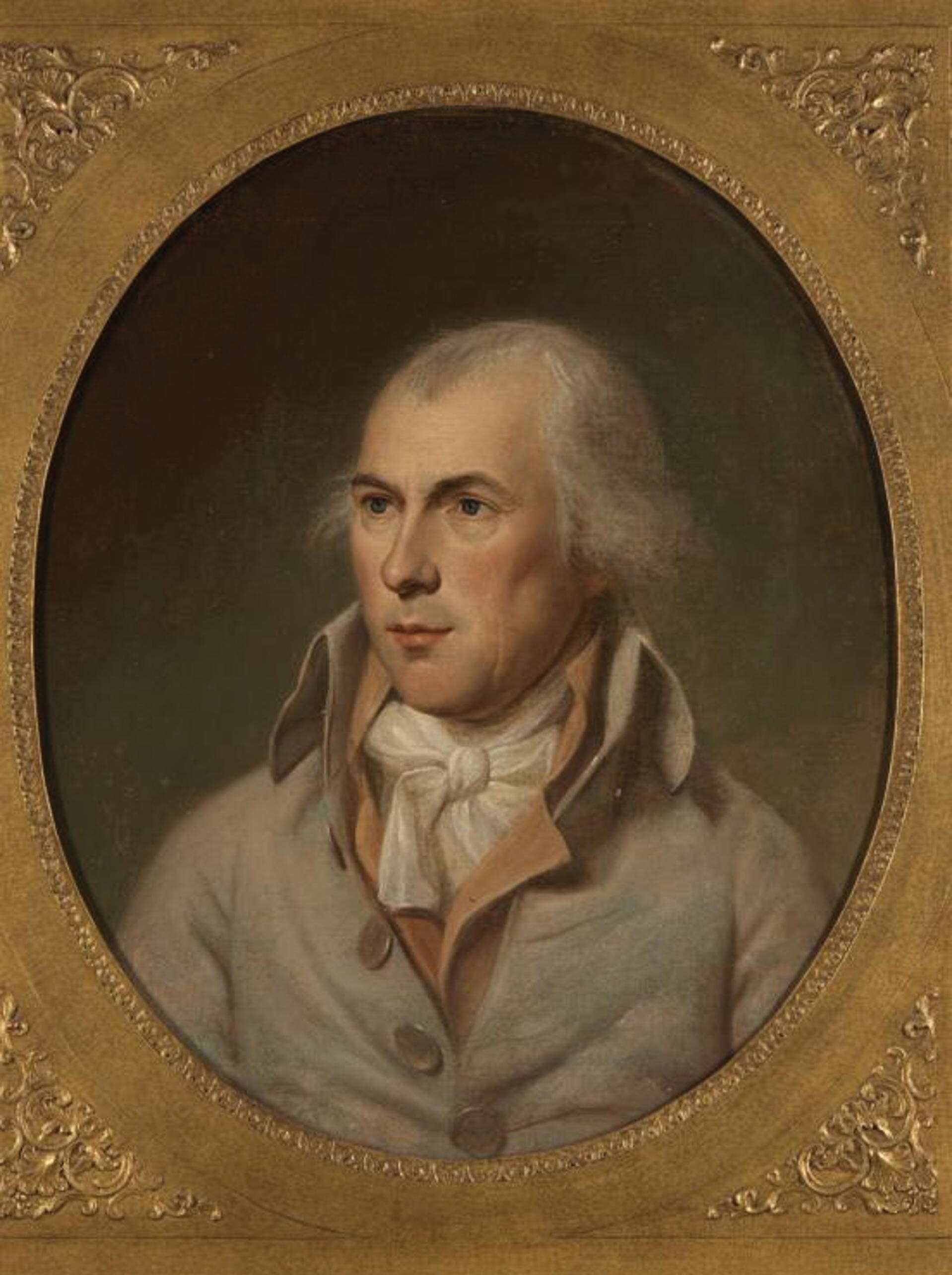
A portrait of James Madison.
James Madison
Part historian, part philosopher, part politician, Madison was a critical figure in the making of the U.S. Constitution.
The Constitution of the United States, drafted in 1787, is the oldest national written constitution still in existence, in the history of the world. The idea of writing down the system, or frame, of government had a long history, but most attempts at writing constitutions failed or didn’t last. And the idea that the people themselves had to ratify, or grant their approval to, a constitution—a process known as popular ratification—was an American invention. That had started in 1776, when the world’s first written, popularly ratified constitutions had been drafted by the American states. Having dismantled their own governments, they took seriously—literally—the idea that they needed to create them anew, as if they had been returned to a state of nature.
Wars, Constitutions, and Rights
The popular ratification of written constitutions defined the course of American history and came out of political philosophy. But these features of government and law-making had other origins, too, in the sprawling world wars, like the Seven Years’ War, that characterized much of the eighteenth century, all over the world.
Wars ravaged the Americas, ruining lives, razing settlements, and stopping trade. In the Declaration of Independence, Thomas Jefferson had blamed George III for having “plundered our seas, ravaged our coasts, burnt our towns, and destroyed the lives of our people.” In the Americas, independence movements—beginning with the revolution in thirteen of Britain’s North American colonies and that first written constitution, from New Hampshire in 1776, down through Venezuela’s first constitution in 1811—involved rejecting rulers’ demands for war-supporting taxes and erecting new governments with checks on those powers, if with mixed success. The second constitution written in the Americas, Haiti’s first constitution, in 1805, was drafted by Jean-Jacques Dessalines, a man formerly held in slavery. It went much farther toward an empire of liberty than had the U.S. Constitution. Haiti’s constitution declared the political equality of Africans and their descendants who, as Dessalines wrote in the constitution’s preamble, had been “so unjustly and for so long a time considered as outcast children.”
The memory of war cast a shadow over the deliberations in Philadelphia in 1787, too. Thirty of the fifty-five delegates to the constitutional convention had fought in the Seven Years’ War. Connecticut delegate Roger Sherman said there were four reasons to adopt a new constitution: defense against foreign powers, defense against domestic insurrections, treaties with foreign nations, and the regulation of foreign commerce. All relate to the cost of war.
State Constitutions: Laboratories of Democracy
Years before the constitutional convention began in Philadelphia, though, the states had begun to draft their own constitutions. Three had adopted written constitutions even before Congress declared independence from England, because they found themselves otherwise without a government. “We conceive ourselves reduced to the necessity of establishing A FORM OF GOVERNMENT,” a Constitutional Congress that convened in New Hampshire declared in January 1776, after the Loyalist governor of New Hampshire fled the state along with most members of his council. Eleven of the thirteen states devised constitutions in 1776 or 1777. The work of writing these constitutions, Jefferson noted in 1776, was “the whole object of the present controversy.”
Most state constitutions were drafted by state legislatures; others were written by men elected as delegates to special conventions. In the spring of 1775, the irascible John Adams had urged Congress “to recommend to the People of every Colony to call such Conventions immediately and set up Governments of their own, under their own Authority; for the People were the Source of all Authority and the Original of all Power.” In 1778, when the Massachusetts legislature drafted a constitution and presented it to the people for ratification, the people rejected it and called for a special convention, which was held in Cambridge in 1779; Adams, one of its delegates, was the chief author of a new constitution that the people of Massachusetts ratified in 1780. That this act—the people voting on the very form of government—represented an extraordinary break with the past was not lost on Adams, who wrote, “How few of the human race have ever enjoyed an opportunity of making an election of government, more than of air, soil, or climate, for themselves or their children!”
Each of the states was a laboratory, each new constitution another political experiment. Many state constitutions, like those of Virginia and Pennsylvania, included a Declaration of Rights. Pennsylvania’s, written in September 1776, began by echoing the preamble to the Declaration of Independence, establishing “That all men are born equally free and independent, and have certain natural, inherent and inalienable rights, amongst which are, the enjoying and defending life and liberty, acquiring, possessing and protecting property, and pursuing and obtaining happiness and safety.” The Massachusetts constitution insisted on a right to revolution, decreeing that when the government fails the people, “the people have a right to alter the government, and to take measures necessary for their safety, prosperity and happiness.”
For all the veneration of “the people,” the word democracy retained an unequivocally negative connotation. Eighteenth-century Americans borrowed from Aristotle the idea that there are three forms of government: a monarchy, an aristocracy, and a polity; governments by the one, the few, and the many. Each becomes corrupt when the government seeks to advance its own interests rather than the common good. A corrupt monarchy is a tyranny, a corrupt aristocracy an oligarchy, and a corrupt polity a democracy. The way to avoid corruption is to properly mix the three forms so that corruption in any one would be restrained, or checked, by the others.
Between a government too monarchical and a government too democratic, Massachusetts lawyer and later member of Congress Fisher Ames would have rather had the former. “Monarchy is like a merchantman, which sails well, but will sometimes strike on a rock, and go to the bottom,” Ames wrote in 1783, “whilst a republic is a raft, which would never sink, but then your feet are always in the water.”
Unlike the harrumphing Ames, many of the people who were drafting state constitutions apparently preferred to err on the side of democracy. In framing new governments, several states lowered property qualifications for voting. Under the terms of Pennsylvania’s new constitution, any man who had lived in the state for a year and paid taxes—any taxes—could vote: where earlier two-thirds of white men could vote, 90 percent now could. Yet many men of means found this development alarming, believing that poor men, like women, lacked the capacity to make good political decisions because, dependent on others, their will was not their own. The Massachusetts constitution included property qualifications both for office seekers and for voters. As Adams explained, “Such is the Frailty of the human Heart, that very few Men, who have no Property, have any Judgment of their own.”
Most states arranged a government of three branches, with a governor as executive, a superior court as judicial, and a Senate and House of Representatives as legislative. But some states, attempting to correct for colonial arrangements, in which a royally appointed governor and his appointed council wielded the preponderance of power over a weak elected assembly, granted the greatest weight to lower houses of the legislature rather than to upper houses or to an executive. Pennsylvania’s constitution, like its Quakers, was the most radical and, in the eyes of many observers, alarmingly democratic. It called for annual elections, no governor, and a unicameral legislature whose members served limited terms. Any proposed law had to be printed and distributed to the people, who would have a year to consider it before the legislature voted.
Ending Slavery in Some States
The states’ constitutions were political experiments in more ways, too. The Declaration of Rights in Vermont’s 1777 constitution specifically banned slavery: men might be indentured as servants till the age of twenty-one, or women till the age of eighteen, but no one past that age could be held in bondage. (This provision would have made Vermont the first state to abolish slavery—Pennsylvania had legislated only gradual abolition—except that in 1777 Vermont was not a state but an independent republic; it would not join the United States until 1791.)
More information
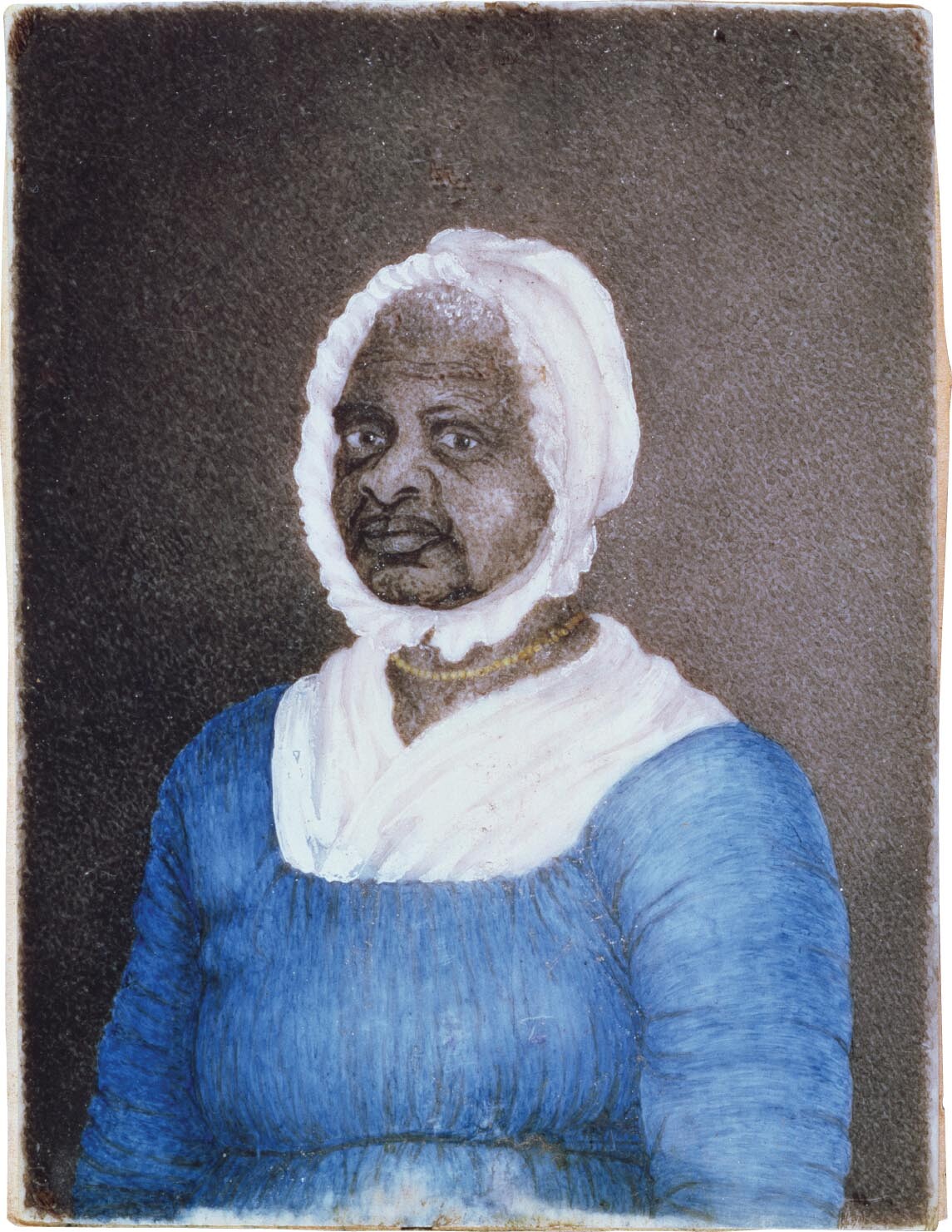
A portrait of Elizabeth Freedom. The painting shows a black woman wearing a blue dress and bonnet.
Declaration of Rights
In 1781, Elizabeth “Bett” Freeman won her freedom through the courts, by calling upon the new state constitution of Massachusetts to challenge the legality of slavery.
In 1781, Bett, a woman enslaved in Massachusetts whose husband had fought and died in the war, filed a suit in which she argued that the state’s new constitution had abolished slavery. Bett’s owner, John Ashley, was a local judge. She’d heard him talking about natural rights with twenty-six-year-old Theodore Sedgwick, one of his law clerks. When Ashley’s wife tried to strike Bett’s sister with a red-hot kitchen shovel, taken out of the hearth, Bett blocked the blow and was badly burned. Fleeing, she went to Sedgwick and decided, with his help, to sue for her freedom. “All men are born free and equal, and have certain natural, essential, and unalienable rights; among which may be reckoned the right of enjoying and defending their lives and liberties; that of acquiring, possessing, and protecting property; in fine, that of seeking and obtaining their safety and happiness,” Adams had written, in Article I of the Massachusetts constitution’s Declaration of Rights. Citing Adams, Bett won her case and her liberty and gave herself a new name: Elizabeth Freeman.
Two years later, the Massachusetts Supreme Judicial Court formally ruled that slavery was inconsistent with the state’s constitution, adding, “Is not a law of nature that all men are equal and free? Is not the laws of nature the laws of God? Is not the law of God then against slavery?”
Old American history textbooks sometimes asserted that southern slave owners like George Washington and Thomas Jefferson lived in a time when people did not understand that slavery was wrong. This is simply not true. Enslaved people certainly understood that it was wrong, and so did people who had escaped from bondage. Neither were they alone, as the evidence makes clear. Not only did some states abolish slavery, but antislavery societies formed and people from all ranks and in all parts of the country objected to the institution. For instance, in 1784, Pennsylvania’s Society for the Relief of Free Negroes Unlawfully Held in Bondage renamed itself the Pennsylvania Society for Promoting the Abolition of Slavery. That same year, a judge in Vermont ruled in favor of a runaway slave whose master had produced a bill of sale proving his ownership: the judge said that in order to retain his property in the form of another man he’d have to provide a bill of sale from “God Almighty.” That slavery was wrong was not unthinkable in the eighteenth century. To the contrary—to most people, it was obvious.
More information
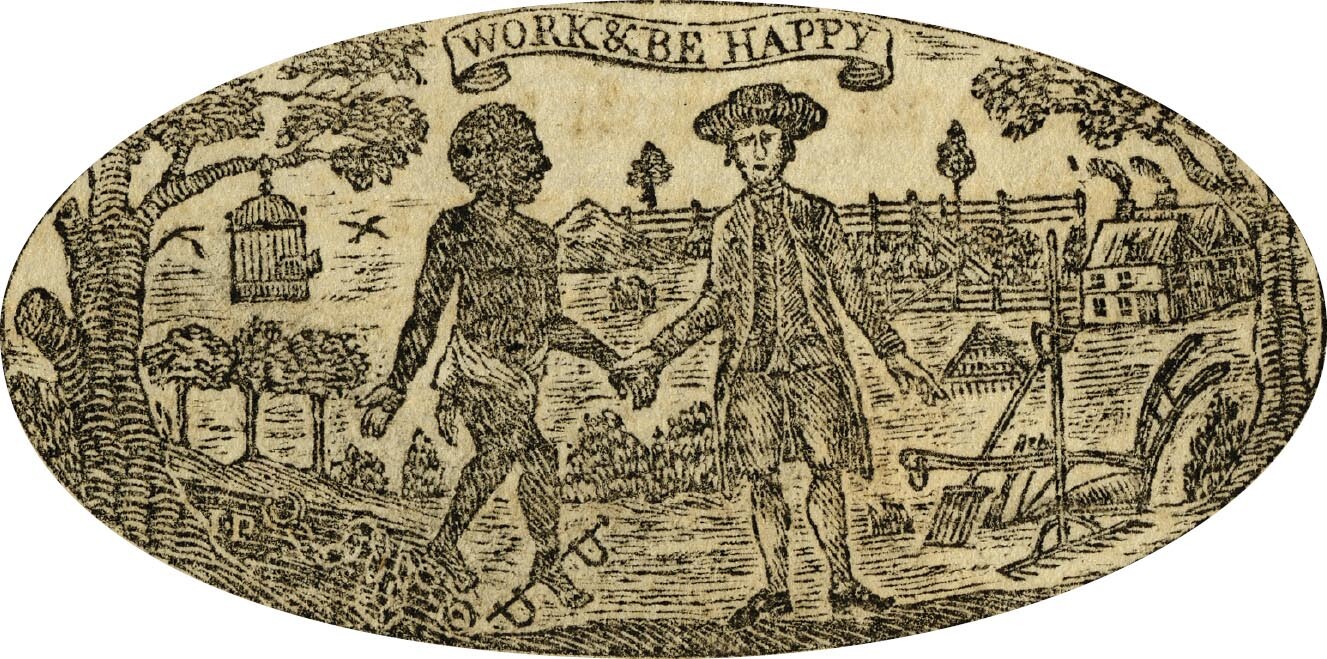
An illustration shows a white man and a black man holding hands. Above it says, work and be happy. The white man is wearing expensive attire and the black man is wearing few clothes. There is a farm in the background.
Abolition Societies
Initially founded by Quakers, the Pennsylvania Abolition Society (emblem pictured here) was one of a growing number of organizations, led by free Blacks and whites, that lobbied against slavery.
The Deficiencies of the Articles of Confederation
Inevitably, some state constitutions worked better than others. What clearly didn’t work well were the Articles of Confederation, which had been hastily drawn up by the Continental Congress for the purpose of waging war against Britain, and even this they did not do well (regiments went unfed, soldiers unpaid, veterans unpensioned). Drafted in 1777, the Articles weren’t ratified by the states until 1781—the delay was the result of the states’ competing claims to western land—and even after the Articles were adopted, those claims remained largely unresolved. Efforts to revise the Articles proved fruitless, even though its provisions left the Continental Congress with no standing to resolve disputes between states nor any authority to set standards or to regulate trade. The new nation was riddled, as a result, with thirteen different currencies and thirteen separate navies.
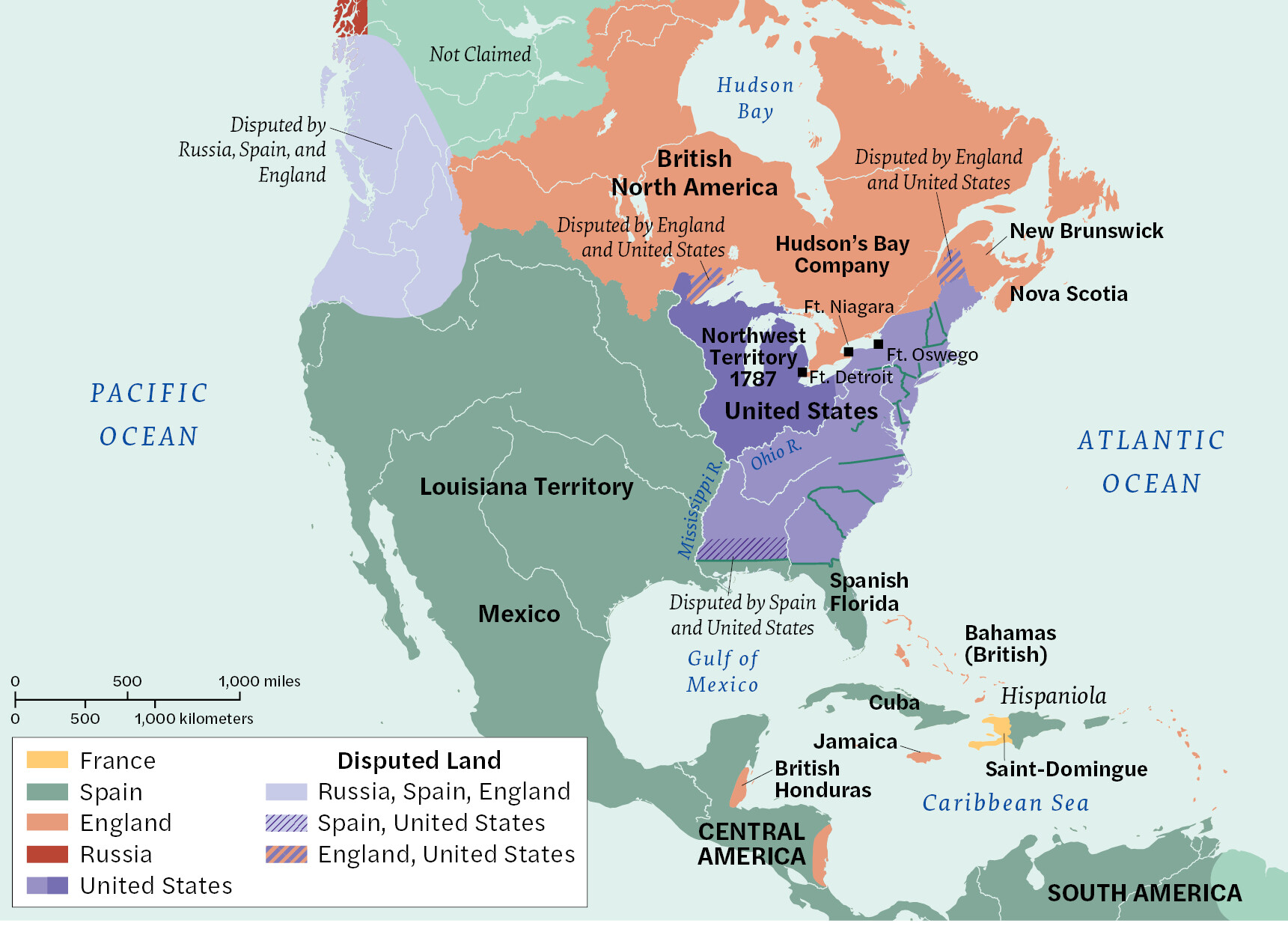
Most urgently, Congress lacked the authority to raise money, which it needed both to make good on its debts and to pay for troops in what came to be called the Northwest Territory, a swath west of the Alleghenies, north of the Ohio River, and east of the Mississippi. The 1783 Treaty of Paris had required that the states repay their debts, and when the states defaulted on those debts, Great Britain threatened to default on a commitment, also made under the terms of the peace, to surrender its northwestern forts—Oswego, Niagara, and Detroit—to the United States. Americans were keen to settle in the Northwest Territory, especially after Congress passed the Land Ordinance of 1785, which established mechanisms for the surveying and sale of 640-acre lots, arranged in square townships of 36 lots each, with 1 lot reserved for a school—a system of surveying, settlement, and education that would eventually characterize most of the continental United States.
More information
A map shows North America with different regions labeled for controlling countries. Spain owns most of South America, Central America, and the western half of North America. The Pacific Northwest and western Canada are both labeled for disputed by Russia, Spain, and England. The eastern half of the United States is labeled for United States, as is the region around the Great Lakes. Most of Canada is labeled for England. Small areas in the Caribbean are labeled for France and England as well.
North America, 1783–1787
To pay its war debts, the United States hoped to raise revenue by selling plots of land in the Northwest Territory.
Congress had managed to generate revenue by selling land in the western territories. How could it raise revenue among the states in the East? Even though Congress possessed the power to tax the states, how to calculate the tax burden of each state remained unsettled. Should each state pay in proportion to the size of its population or in proportion to its property? In much of the country, one kind of property took the form of people. For purposes of taxation, then, would slaves count as people or as property? In 1777, Pennsylvania’s Samuel Chase had argued that only white inhabitants should count as people because, legally, Blacks were no more people “than cattle.” This point seemed so essential to South Carolina’s Thomas Lynch that he had threatened that “if it is debated, whether their slaves are their property, there is an end of the confederation,” whereupon Benjamin Franklin made the wry observation that there was one plain way to tell the difference between people and property: “sheep will never make any insurrections.”
In 1781 and again in 1783, Congress tried to revise the Articles so as to grant itself authority to collect taxes on imports. This led to a return to the original debate about how to calculate each state’s tax burden: by the number of inhabitants or by the value of land. The value of land was difficult to calculate—acreage alone is a poor guide, since a field is worth more than a swamp—and, as Adam Smith had argued in The Wealth of Nations, “the most decisive mark of the prosperity of any country is the increase of the number of its inhabitants.” Population seemed both easier to calculate and a more sensible measure, for purposes not only of taxation but also of representation. This led to a compromise, involving a fraction. A committee on revenue proposed that “two blacks be rated as equal to one freeman.” Other proposals followed, until “Mr. Madison said that in order to give a proof of the sincerity of his professions of liberality, he would propose that Slaves should be rated as 5 to 3.”
It was very nearly arbitrary, this mathematical formula that would determine the course of American elections for seven decades. At the time, it was also moot: it was never implemented because the state legislatures refused to ratify any revenue-raising amendments. But the proposed ratio—three to five—was not forgotten.
War Debts and Shays’s Rebellion
The confederation limped along, weak and hobbled. France and Holland pressed for payment of debts—in real money, not the paper promises on which the Republic floated. “Not worth a continental,” a phrase used to describe the paper currency printed by Congress, entered the lexicon. Congress was unable to pay its creditors, and by 1786 the continental government was nearly bankrupt. The states, too, were in distress; they could levy taxes, but they couldn’t reliably collect them. Massachusetts had levied taxes to retire the state’s war debt; farmers who failed to pay could have their property seized and auctioned. Many of those farmers had fought in the war, and beginning in August 1786, they decided to fight again: well over a thousand armed farmers in western Massachusetts, angry and alienated and led by a veteran named Daniel Shays, protested the government, blockading courthouses and seizing a federal armory.
It seemed as if the infant nation might descend into civil war, beginning an unending cycle of revolution. “I wish our Poor Distracted State would atend to the many good Lessons” of history, Jane Franklin wrote to her brother, and not “keep always in a Flame.” Madison feared the rebellion would spread all the way to Virginia. Washington began to wonder whether the nation needed a king after all, writing to Madison, “We are fast verging to anarchy and confusion!” As Madison reported to Jefferson, Shays’s Rebellion had “tainted the faith” of even the most committed republicans.
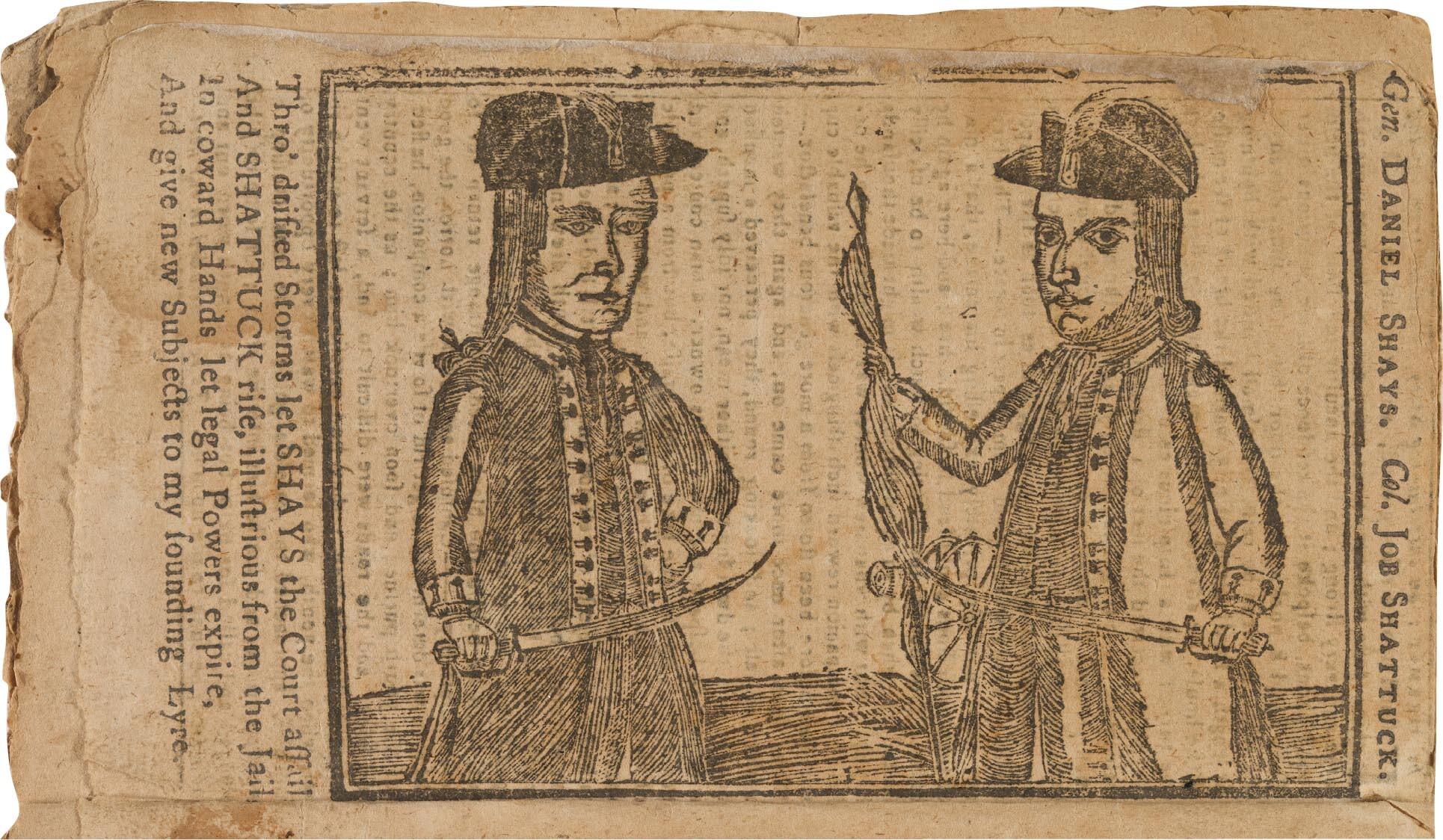
More information
An illustration shows two men, both holding swords.
A Cycle of Revolution
After the war ended, Daniel Shays (left), a farmer and veteran, led an armed insurrection in Massachusetts when the struggling state, unable pay its debts, raised taxes on its struggling citizens, unable to pay theirs.
A last-ditch effort to restore order by revising the Articles of Confederation was scheduled to begin on September 11, 1786, in Annapolis, at a special convention of delegates that included Madison, who had probably been behind the resolution to convene the meeting. To prepare, he threw himself into his reading of political history. He’d been assembling a library. In 1785, Jefferson shipped him crates of books from Paris. “Since I have been at home I have had leisure to review the literary cargo for which I am so much indebted to your friendship,” he wrote to Jefferson in March 1786, reporting that Virginia had so much snow that winter that the tops of the Blue Ridge Mountains were still white. While the snow melted that spring, Madison composed a long essay called “Ancient & Modern Confederacies,” an assessment of all the confederated governments he could discover in his reading: their structure, their strengths, and, above all, their weaknesses.
After an unusually wet spring, Madison left Virginia in summer and wended through fields of sodden crops of wheat and rye. He rode all the way to New York on business before turning around to head back down to Maryland, still mulling over his reading, and giving Jefferson still more instructions for books he’d like to add to his library. “If you meet with ‘Graecorum Respublicae ab Ubbone Emmio descriptae,’ Lugd. Batavorum, 1632, pray get it for me,” he pressed him.
A road-weary Madison arrived in Annapolis in September 1786, vastly discouraged. So frayed was the spirit of union and so weak was the federal government that delegates from only five of the thirteen states turned up for the convention. They met at George Mann’s tavern, a six-gabled brick hotel. Madison stabled his horse in Mann’s barn. Without anything close to a quorum, twelve men from five states agreed to a resolution drafted by Alexander Hamilton of New York that delegates—ideally from all thirteen states—would gather in Philadelphia the next year “to devise such further provisions as shall appear to them necessary to render the constitution of the Federal Government adequate to the exigencies of the Union.”
If more delegates had turned up for the Annapolis Convention, they’d most likely have proposed a single amendment to the Articles, granting Congress the authority to raise revenue. The bad turnout, ironically, opened the possibility for more sweeping action. Still, when the resolution reached Congress, which met, then, in New York, Congress failed for weeks to consider it. Arguably, it was only the course of events in Massachusetts that spurred Congress to act. In January 1787, the governor of Massachusetts sent a three-thousand-man militia across the state in an attempt to suppress Shays’s Rebellion and regain the federal armory (all of this without any authority from the federal government). The state instituted martial law. In New York, Congress finally acted, approving of the proposed Philadelphia convention “for the sole and express purpose of revising the Articles of Confederation.” No one said anything about drafting a constitution.
After Annapolis, Madison went home to Virginia and resumed his course of study. In April 1787, he drafted an essay called “Vices of the Political System of the United States.” It took the form of a list of eleven deficiencies, beginning with “1. Failure of the States to comply with the Constitutional requisitions. . . . 2. Encroachments by the States on the federal authority. . . . 3. Violations of the law of nations and of treaties.” And it closed with a list of causes for these vices, which he located primarily “in the people themselves.” By this last he meant the danger that a majority posed to a minority: “In republican Government the majority however composed, ultimately give the law. Whenever therefore an apparent interest or common passion unites a majority what is to restrain them from unjust violations of the rights and interests of the minority, or of individuals?” What force restrains good men from doing bad things? Honesty, character, religion—these, history demonstrated, were not to be relied upon. No, the only force that could restrain the tyranny of the people was the force of a well-constructed constitution. It would have to be as finely wrought as an iron gate.
Glossary
- Constitution of the United States
- The oldest written constitution still in use, written in 1787 and ratified in 1788; it outlines the federal system of government.
- popular ratification
- The process of confirming a constitution through the approval of the people.
- Northwest Territory
- An area located north of the Ohio River and comprising modern-day Indiana, Illinois, Michigan, Wisconsin, and much of Minnesota; it was organized into a U.S. territory in 1787 under the Northwest Ordinance—though it was largely occupied by Native Americans.
- Land Ordinance of 1785
- Legislation that directed the surveying of the Northwest Territory into townships of thirty-six sections (square miles) each; the sale of each township’s sixteenth section was to be used to finance public education.
- Shays’s Rebellion
- From 1786 to 1787, the blockading of courthouses and the storming of the Massachusetts federal arsenal by Daniel Shays and over a thousand armed farmers seeking debt relief from the state legislature through issuance of paper currency and lower taxes.
- Annapolis Convention
- In 1786, delegates from all thirteen states were invited to a convention in Annapolis to discuss commercial problems and revisions to the Articles of Confederation, but representatives from only five states attended. However, the convention was not a complete failure because the delegates decided to hold another convention, where they ultimately drafted the Constitution.