
The Near East: Great Powers and a Distinctive People (1100–330 BCE)
Until almost the middle of the first millennium BCE, the great powers of the Mediterranean world continued to be located in Egypt and Mesopotamia. After sharing in the collapse of the Near Eastern powers in the twelfth century, the Assyrians, in northern Mesopotamia, reemerged in the eleventh. Their kings became the rulers of a mighty military empire that dominated much of Mesopotamia. Great military leaders like Shalmaneser III (r. 858–824 BCE) led organized, effective campaigns. The states that had succeeded the Hittites, and other states as distant as the Levant, were conquered and governed as provinces of a new Assyrian Empire.
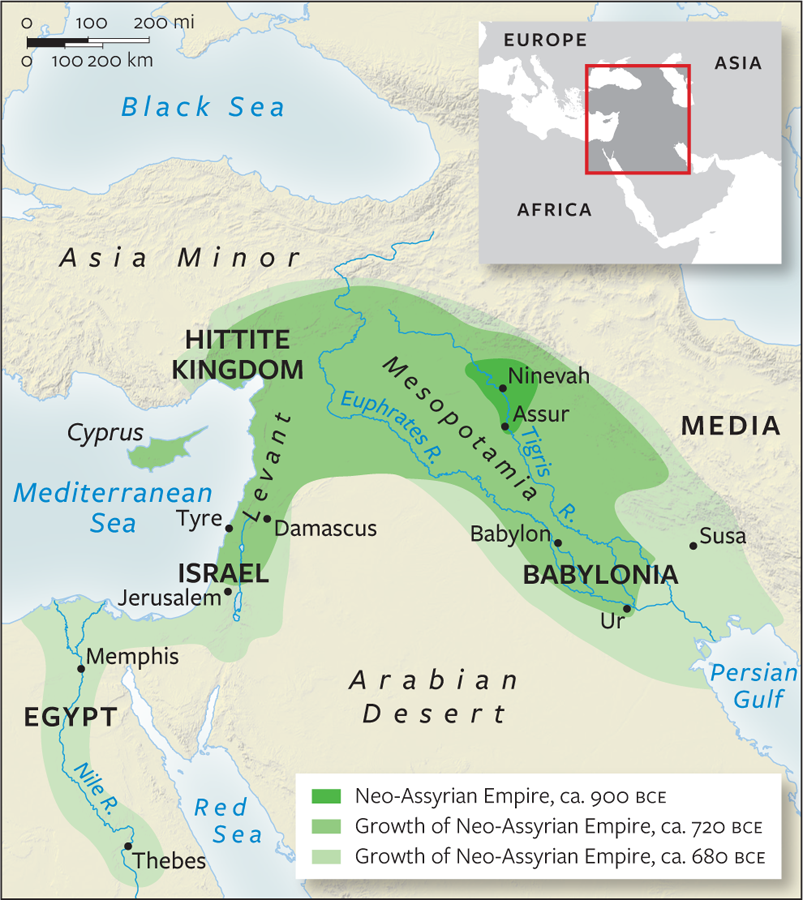
The Neo-Assyrians and Neo-Babylonians (11th–6th Centuries BCE)
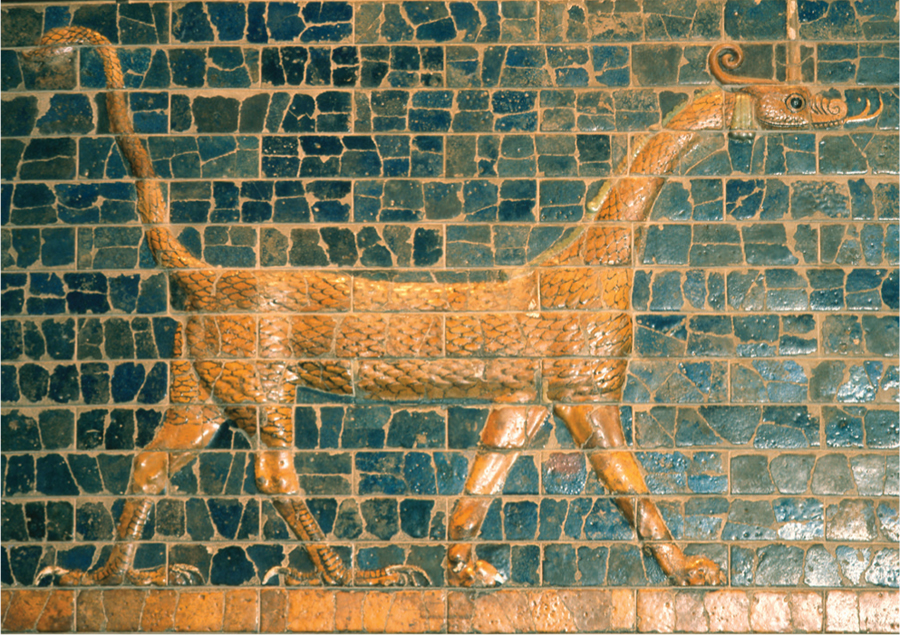
In this period, the kings of the Neo-Assyrian Empire built on a magnificent scale. Assurnasirpal II, early in the ninth century BCE, decorated his immense Northwest Palace at Kalhu with huge statues of winged elephants and lions, their heads human, carved from stone that had been carried from hundreds of miles away. His workers covered the palace walls with colorful glazed brick and spectacular sculpted reliefs. He also created schools of scribes and a vast library at Nineveh, a city north of Assur. Great powers, including Egypt itself in the seventh century BCE, fell to the Assyrians or fiercely resisted siege after siege.
But these wars and others—especially with the Medes, an Iranian people whose archers and cavalry could outmaneuver the Assyrians’ slower infantry and chariots—eventually exhausted them. At the end of the seventh century, the Chaldeans, a Semitic people who had gained control of Babylon, formed an alliance with the Medes and defeated the Assyrians decisively, even though Egypt tried to help Assyria in an effort to maintain the regional balance of power. Under Nebuchadnezzar II (r. 605–562 BCE), the Chaldeans consolidated a Neo-Babylonian Empire that enjoyed a brief period of preeminence in the Near East.
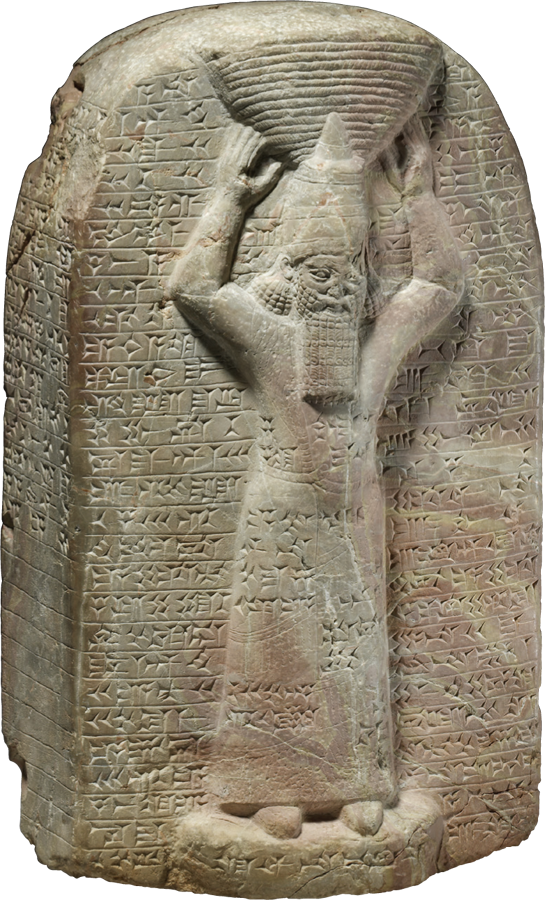
Nebuchadnezzar made Babylon perhaps the greatest city in the world. The huge Ishtar Gate, covered with brilliant deep blue tiles and vivid images of lions, bulls, and dragons, was only one of the formal entrances to the city. During this period Babylonian astronomy and astrology reached their peak, as we know from the lists of accurately dated eclipses of the moon and sun, and conjunctions of the planets, recorded over hundreds of years.
The Median and Persian Empires (678–330 BCE)
Yet Babylon in turn soon fell—as did the kingdom of the Medes, a short-lived Persian state established in 678 BCE—to the larger group of nomadic peoples who came together in the Persian Empire from the middle of the sixth century BCE on. Under the leadership of Cyrus the Great (r. 558–529 BCE), Persia would dominate more of the world than any other power before it.
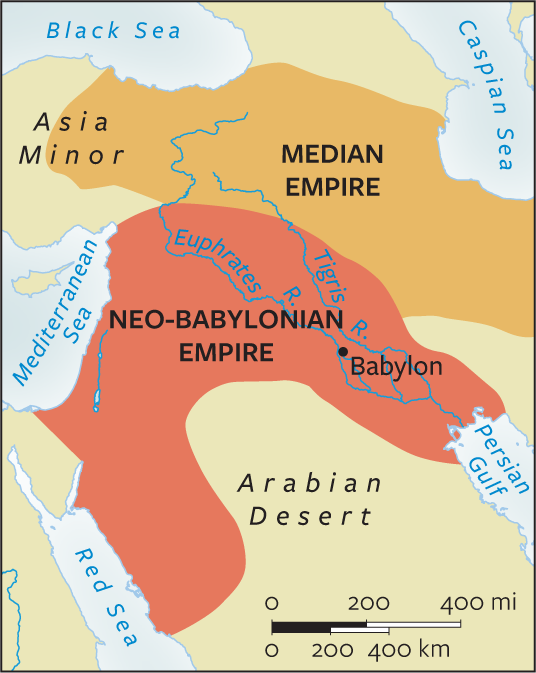
The Persians settled in the area of modern Iran around 1000 BCE. By the end of the eighth century BCE, King Achaemenes founded the Achaemenid dynasty, whose later members built the empire. Persepolis became the ceremonial center of their realm, and other cities developed as administrative centers. The empire’s vast armies, made up of peoples from many lands, were always anchored by highly trained Persian archers and infantry and supported by war wagons and scythed chariots. Cyrus and his successors wielded power that no other monarch could rival. He conquered the kingdom of the Medes and then the Neo-Babylonian Empire in turn, and his son, Cambyses II, conquered Egypt in 525 BCE. Their kingdom would remain a great power until 330 BCE, when it fell to Alexander the Great.
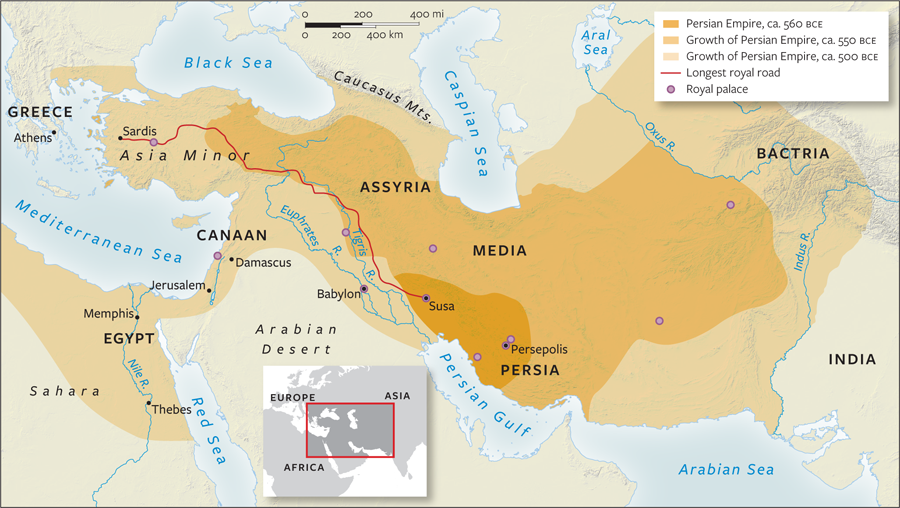
GOVERNANCE UNDER CYRUS AND DARIUS The Persian Empire at its height stretched from the Nile to the Indus. It was divided into administrative districts, each ruled from a palace by a Persian nobleman known as the satrap, who had his own staff of scribes and his own treasury. Royal roads, with rest houses to make travel easier, connected the satrapies to the capital: the longest one, from Sardis to Susa, stretched more than 1,550 miles. Personal representatives of the king, known as his “eyes,” ensured that these local powers did not grow too independent. Every province had to contribute its share of tribute to the royal treasury. This payment chiefly took the form of gold and silver but could also include horses, grain, and eunuchs (men castrated as boys). The Persian kings were immensely rich: when Darius, the third king of Persia, built a palace in the decades around 500 BCE, he imported craftsmen from Egypt and Greece alike, while Babylonians were hired to make the bricks.
For all its demands, the Persian Empire seemed to many of its subjects a model of good government. Kings improved agriculture by maintaining and developing irrigation systems and promoted trade. More important, perhaps, it was Persian royal policy to leave each subject people in possession of its gods and customs, and to communicate with them in their own languages—or at least in Aramaic, the Semitic language that was gradually replacing Akkadian as the common language of the Near East. In the palace at Persepolis, reliefs showed representatives of multiple peoples carrying the royal throne. In Babylon, Cyrus had himself represented as a Babylonian king. Cultural sensitivity and language skills—as well as efficient and honest administration, stern policing, and good roads—made the Persians more desirable rulers than most.
ZOROASTRIANISM It was within Achaemenid Persia that Zoroastrianism, a new religion with a powerful vision of the universe, took shape. In its earliest form, Zoroastrianism identified the god Ahura Mazda as a single “wise lord” who ruled the universe. Certain lesser figures aided him; others, the devas, came to be seen as evil. Early Zoroastrianism is often considered to be one of the first monotheistic religions.
In its later form, Zoroastrianism became dualist. Ahura Mazda, a god associated with light and the good, struggles with Angra Mainyu, a god of evil, whose powers are equally great. The Magi—the Zoroastrian priests—explained that the gods’ combat would end in a final cosmic battle. Human beings were created to aid Ahura Mazda, and after their deaths their souls would be judged and sent to paradise (if their good deeds outweighed the evil ones) or to hell (if they did not).
From Darius I in the early sixth century BCE onward, the rulers of Persia claimed the support of Ahura Mazda. They supported the Magi, but they also supported the priests of other gods and allowed their subjects to worship still other ones. Their efforts helped to sustain a religion that made powerful claims on the loyalty of its followers, that treated the universe as a battleground between good and evil, and that envisioned individual souls as immortal—all ideas that would take on new forms in Judaism and Christianity.
Israelite Kingdoms and the Jewish People (1200–582 BCE)
In the later centuries of the second millennium BCE, a new Near Eastern civilization began to take shape in Canaan, part of the Levant. This area, once studded with relatively wealthy Canaanite cities, was now partly in decline. It was largely controlled by New Kingdom Egypt, though the Phoenicians, based on the coast, used their position and their skills as navigators and sailors to become prosperous as trading intermediaries between the empires to their east and west. Jerusalem was a Canaanite city that recognized Egypt as its overlord. In the years around 1200 BCE, new peoples—some of whom came from near the Aegean Sea—established settlements in Canaan. So, apparently, did another one: a Semitic people who called themselves the children of Israel.
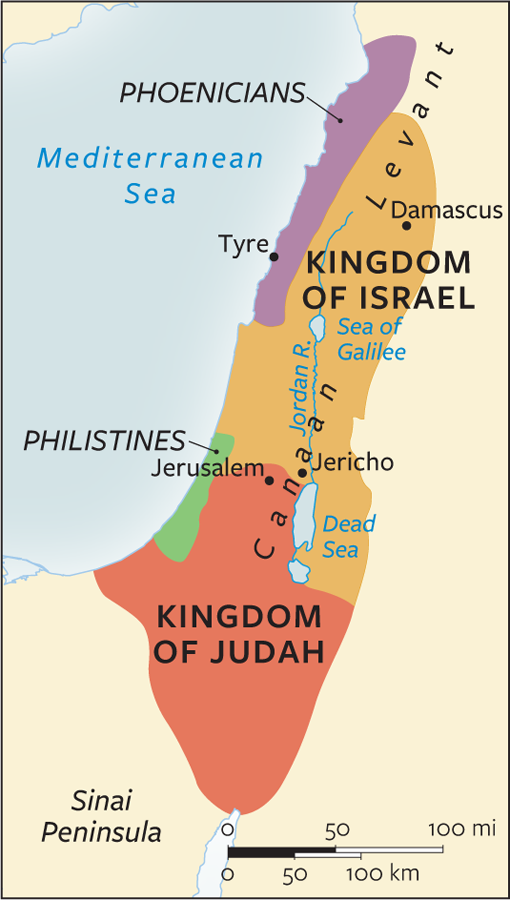
ISRAEL AND JUDAH (1000–582 BCE) Centuries later, the children of Israel would recall that this arrival in Canaan was not the first. Their ancestors had already inhabited the Levant, but in the seventeenth century BCE, they believed, they had moved to Egypt, impelled by drought. There they had originally lived in peace with the Egyptians, but over time they were forced to serve as slaves, working on the great building projects of the pharaohs. Only divine help and the leadership of a great man, Moses, brought them out of Egypt, perhaps in the thirteenth century BCE, and back to the land that their God had promised them. These stories are memorialized in the Five Books of Moses, the first part of the Hebrew Bible, which probably reached something like their current form in the period between 600 and 400 BCE, almost a thousand years after the events in question. They cannot be verified (or falsified) by historical and archaeological evidence.
Still, surviving evidence shows that by the tenth century BCE, Israel had emerged as a small but warlike kingdom in the Levant. It struggled with nearby powers such as Damascus and Tyre—and even more dangerously, with Assyria itself. In the ninth and eighth centuries, a second kingdom of the Israelites, called Judah, took shape in the south, centered on Jerusalem. There—so later tradition held—the inhabitants worshipped their God in a splendid Temple, ascribed to the tenth-century king Solomon and staffed by priests who alone could enter the most sacred chamber.
Originally, the Israelites lived simply, in families and tribes ruled by patriarchs. They supported themselves by a combination of pastoral activity and agriculture. Land was passed down through the male line, and women—who were often married off by their families for economic advantage—lived with their husbands’ kin. As the kingdoms developed, Israelite society became wealthier and more sophisticated. Potters developed new skill in turning and polishing their wares. Families, which had once lived in small houses with several generations in three or four rooms, began to split up, and a distinct group of leading figures who served as warriors and royal counselors took shape. To some extent, the Israelite states came to look like much smaller versions of other Near Eastern societies.
Late in the eighth century BCE, the Assyrians repeatedly invaded and finally shattered the Israelite kingdom, transporting its population to other parts of the empire—a standard imperial policy. Judah survived, probably by becoming an Assyrian vassal state, and the city of Jerusalem grew rapidly as Judah’s capital. The remains of walls, aqueducts, and jars with seals reveal an increasingly vibrant society. After Assyria finally collapsed, however, the Egyptian and Neo-Babylonian Empires fought over the Levant. Between 597 and 582 BCE, the Babylonians destroyed the kingdom of Judah. When Jerusalem fell, the Temple was destroyed—a calamity that Jews still remember and mourn today. Under Assyrian rule, Judah had been a major producer of olive oil, but the conquest destroyed this prosperity.
MONOTHEISM AND JEWISH RELIGIOUS CULTURE In one vital way, the Jews differed from virtually every other people. They believed, passionately, in a single deity who ruled the entire universe. Their God was not simply the most powerful among many, he was their only deity, and a being so radically superior to humans that he could not even be imagined in human form. In a world in which most states acknowledged and sacrificed to many gods, even Jews found it hard to maintain an active commitment to their hidden, abstract deity. From Moses to the kings of Israel and Judah, leaders found their followers all too eager to set up idols and sacrifice to them. And yet, monotheism became the very core of the Jews’ historic identity.
Priests and scribes held that God had chosen the Jews as his special people, leading them out of exile in Egypt and appointing the dynasty of Kings David and Solomon to rule them. The hand of God led and protected his people at all times. This vision of political theology gave the kings legitimacy and supported those kings and priests who insisted that their God was a jealous one who would not allow his people to worship idols at the shrines of the Canaanites.
By 582 BCE, once the Jewish states had been destroyed and the kings had been driven from their thrones and become vassals of the Babylonians, this comprehensive theology and history no longer matched reality. Prophets, priests, and scribes gradually came to grips with the new situation. Although they continued to believe in a single deity, the prophets asserted that it was wrong to expect that God would intervene at all times and places in favor of a single people, however dear to him they might be. According to the prophets, the Jews—as the histories that were woven together in exile showed—had often rejected their God and his teachings, and had suffered the punishment they deserved. The Jews must learn, so the prophets insisted, to maintain purity: to practice circumcision on all males, observe the Sabbath, and so on. Eventually God would send a Messiah, an anointed king, to rule over the world. For now, however, salvation lay in meticulous observance of the laws laid down by Moses and conveyed in his Five Books.
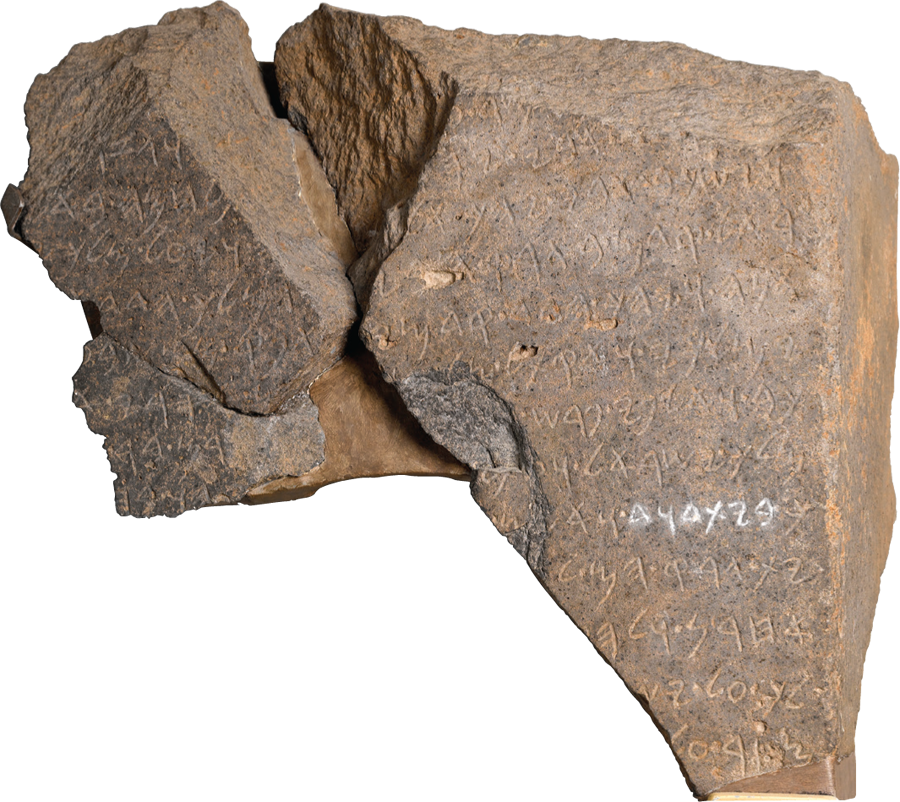
In a sense, two foreign rulers did as much as any Jewish ones to shape the religion of Israel and Judah. The Babylonian king Nebuchadnezzar II, who conquered Jerusalem in 587 BCE, forcibly transferred the Hebrew elite—from kings to priests and scribes—to his own country. The experience of Babylonian exile probably inspired these men to shape the Hebrew Bible into the series of richly human stories of departure and exile that it became in these centuries. They enriched it as well with the profound reflections of the prophets and the psalms—the sacred songs that the Israelites believed had been composed by King David.
The other foreign ruler who helped to shape Jewish tradition was the Persian Great King, Cyrus. In 538 BCE, for reasons that remain unclear, he released the Jews from their captivity in Babylon. Over time, the returned Jews reestablished their worship and compiled, from older sources, the books of the law of Moses, with which they tried to govern Jerusalem and Judah. The exact process by which scribes and priests restored these books is impossible to reconstruct in detail. But it seems likely that they gave the early books of the Hebrew Bible something like their final form. These books, and the larger Bible that took shape in Palestine over the next centuries, would influence the thinking and belief of readers in vastly different circumstances, as we will see, for thousands of years.
- Phoenicians
A seafaring Semitic people based on the eastern coast of the Mediterranean Sea whose culture was particularly vibrant from the Bronze Age through the classical Greek era.
- prophet
An individual who claims to have contact with the divine and acts as an intermediary between humans and God. Within the context of Judaism, prophets were religious reformers who argued that the Hebrew people were breaking their covenant with Yahweh and therefore needed to transform society in order to be more religiously pure.