
The Emergence of Greece: Building a Culture (2700–600 BCE)
M VIDEO: Conversation and Competition in Greek Life
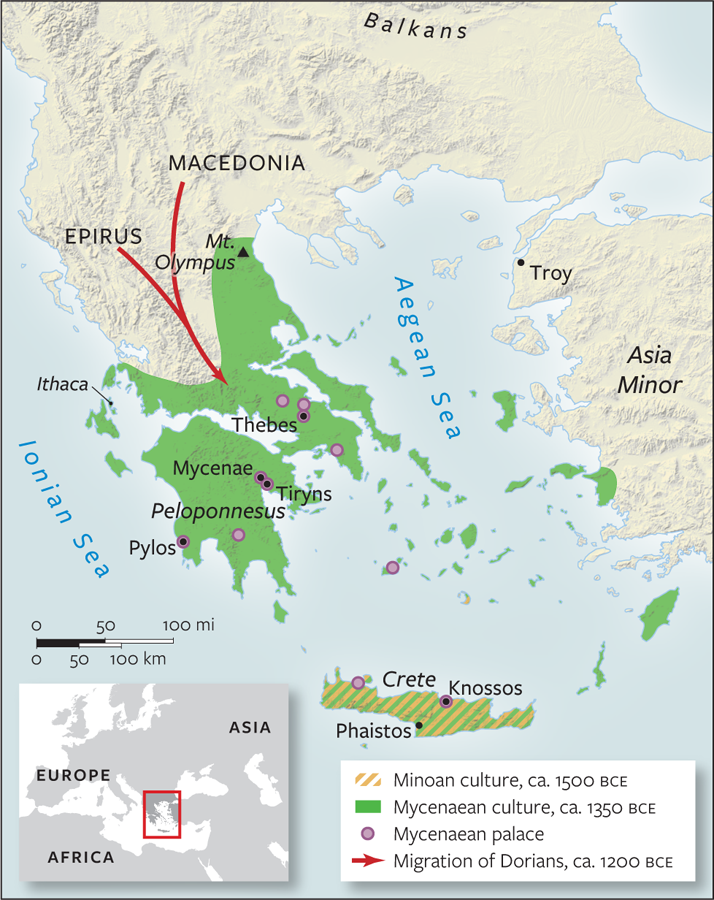
The kingdoms of the Near East were ancient by the early centuries of the third millennium BCE—the time at which the first substantial states took shape in what would later become Greece. Located on Crete, a large island in the Aegean Sea, the centralized Minoan state resembled, in some ways, the older and larger polities of the Near East. In contrast, Mycenae, the stronghold of a society based on the southern Greek mainland that flourished after the Minoan state fell, was one of several small states that cultivated alliances with similar states nearby. The Minoan and Mycenaean settlements marked the beginning of Greek society during the Bronze Age; but it was Mycenae, with its multiple small states, that first provided one of the central patterns of organization that the West would follow, in ever-changing conditions, through the centuries to come.
Bronze Age Greece: Minoans and Mycenaeans (2700–1200 BCE)
The Minoan and Mycenaean cultures were as complex and creative, in their own ways, as the empires of the Near East. By 2700 BCE, the Minoans had developed centers of trade and commerce on Crete, and built palaces at Knossos, Phaistos, and elsewhere. We know little about these early kingdoms, which went into crisis around 1700 BCE, when the palaces were destroyed and population fell. In the seventeenth and sixteenth centuries BCE, the Minoans rebuilt their palaces and developed a dazzling culture.
MINOANS Named after their legendary king, Minos, the Minoans were literate, but the script in which they kept records, Linear A, has not yet been deciphered. Their archaeological remains indicate that their society—the new as well as the old—centered on palaces. Centralized storehouses for grain ensured that there would be enough food for courts and for consumption in festivals. Gifted at crafts such as multicolored pottery and needlework, the Minoans were also skilled sailors. They traded with cities in Syria and Asia Minor, Egypt, and Sicily. But the products of their crafts were largely reserved for use in their own palaces.
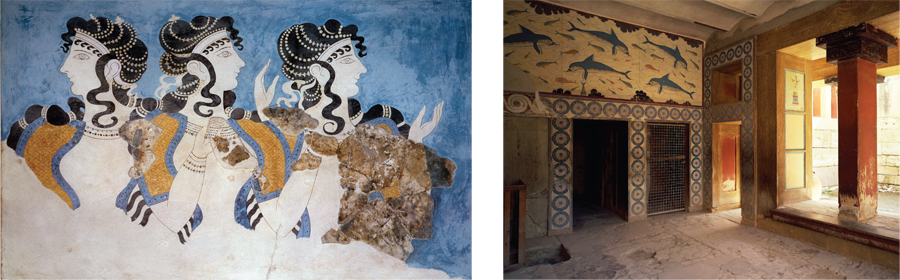
Decorated with magnificent frescoes depicting dances and religious rituals, the Minoans’ palace at Knossos rivaled the splendor, though not the size, of its Near Eastern and Egyptian counterparts. The palace incorporated an impressive stage for rituals and comfortable living conditions for its inhabitants: the Minoans devised ways of admitting fresh air and even created the first indoor plumbing. Smaller structures elsewhere on the island, especially along its coasts, indicate that the society had an extensive reach. In one respect in particular, Minoan society may have been distinctive: numerous statues of priestesses, and paintings of women taking part in the same sports as men, suggest that women’s status was higher there than anywhere else—perhaps on an equal level with men.
Mycenaeans Between 1450 and 1380 BCE, Knossos and the other Minoan palaces fell, probably to invaders from the Greek mainland. By then, however, another set of states centered on more modest palaces had come into being on the Greek mainland, in the Peloponnesus (the large peninsula that constitutes most of southern Greece), and on other islands in the Aegean Sea. At Mycenae, Tiryns, Thebes, and Pylos, the palaces—often heavily fortified—guarded the central administrations of small states. They were equipped with guardrooms and archives, and centered on a megaron (a great hall) surrounded by storerooms for oil, wine, and grain. The typical Mycenaean palace resembled nothing more than the large house Homer describes in the Odyssey as belonging to Odysseus.
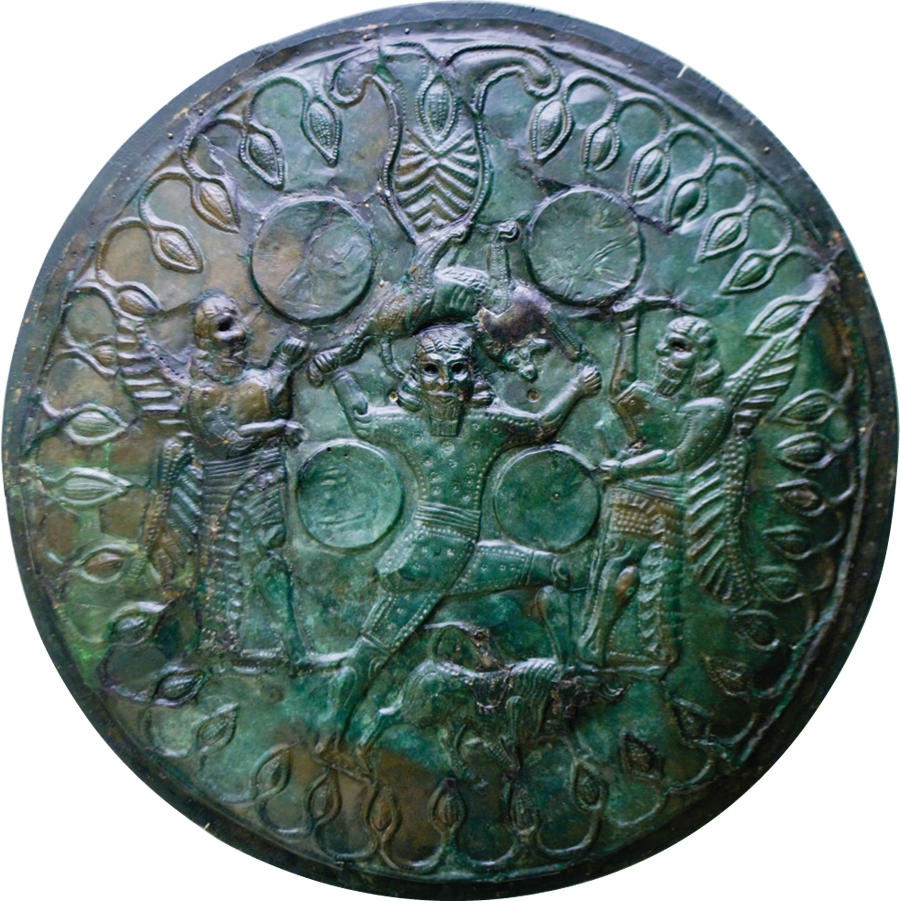
The Mycenaean palaces, like those of the Minoans, were splendidly decorated, many with images of the Mycenaeans fighting wild men, a legend from a now-lost past. On Crete, as well, the old palaces came back to partial life. This time, though, like the Mycenaean ones, they used Greek as their language of administration, perhaps because of conquest by or intermarriage with the leaders of the mainland states.
The inhabitants of these states worshipped some of the same gods who would emerge centuries later, in the writings of the poets Homer and Hesiod (ca. 750–700 BCE), as the gods of the Greek pantheon: Poseidon, god of the sea; the earth goddess, Demeter; and her daughter, Persephone. These Greek societies were aristocratic, ruled by men of high birth, and supported by sophisticated craftspeople and productive farmers. Artisans turned out handsomely decorated pottery, which would remain a specialty of the Greeks for centuries to come. Great men and women were buried sitting up, in beehive tombs (large circular chambers), with splendid gold masks and jeweled weapons.
These states were connected with the greater powers to the east and to the south by alliances maintained through complex diplomatic relations. And they made war, as those other powers did, with bronze arms and armor, using fighters on chariots as well as infantry and bowmen. Unlike the Near Eastern kingdoms and Egypt, however, the Mycenaean and Minoan kingdoms did not leave behind any body of literature—no poetry, no religious texts, no fables, no codes of law. Interpreting sites without written texts to illuminate the beliefs of those who lived in them is very difficult. There is no way to know, for example, if any or all of these states actually mounted an expedition to Troy, as depicted by the eighth-century BCE Greek poets, though some scholars insist that they did.
THE BRONZE AGE COLLAPSE (1250–1100 BCE) We do know that the Minoan and Mycenaean kingdoms underwent a final, shattering crisis in the thirteenth and twelfth centuries BCE, in much the same period that crises brought down Kassite Babylon and New Kingdom Egypt. Centuries later, Greeks told the story that the Dorians—one of the main groups of Greeks in later historic times—had come south to Greece from Macedonia and Epirus during this period, and that their arrival had meant war and dislocation. Raids and invasions certainly took place, as did natural disasters. The fragmentary surviving evidence does not as yet support any single explanation for the simultaneous collapse of so many societies. One point is clear: the world that the eighth-century BCE bards looked back to had been dead for a couple of centuries before they began composing their poems about it. Until more documents come to light and are deciphered, we will not know the Mycenaeans and Minoans nearly so well as we know those who lived in the cities of Babylon and Egypt.
Dark Age Greece (12th–9th Centuries BCE)
Starting in the twelfth century BCE, the Greeks lived, for the next three or four centuries, on a far simpler level. This period is often called the Dark Age of Greece. The Odyssey, written at the end of this time, includes details that correspond in part with what archaeologists have learned from Greek sites of this period. Telemachus is the son of a chief. His house has servants—women who maintain supplies and ply their crafts, and men who cultivate the land and look after the livestock. Its rooms include his father’s high-roofed treasure room, a broad space where bronze and gold lay in heaps
with clothing in chests and much fragrant olive oil.
There stood jars of old sweet wine,
full of drink unmixed and fit for the gods—
neatly laid out along the wall. . .
The Greeks’ society was made up of clans, their chiefs bound to one another by complex family connections and rules of hospitality, and educated above all for war. Noble men and women were buried, like Mycenaean lords, with jewelry, arms, and gold.
This world of small-scale communities dominated by powerful noble families was not narrow. Men like Homer’s hero Odysseus traveled both to trade and to raid. But communities were small, unlike the vast Mesopotamian cities of Nineveh and Babylon, and institutions were simple. After Telemachus calls a meeting in which the adult men of Ithaca discuss what to do about their king’s absence, a herald gives his staff to each speaker in turn, as a sign that he has the floor. But there are no governors or monarchs, no generals, and no police authority.
Religion also remained simple. During Telemachus’s assembly, Zeus—for Homer, the most powerful of the gods and the one who strives to preserve justice—sends two eagles as an omen after Telemachus finishes speaking. They wheel across the sky, attack one another, and disappear. Like other ancient peoples, Greeks saw the actions of birds as potentially freighted with meaning. In this case the poet leaves no doubt that Zeus had sent them. But there is no temple staffed with priests to interpret what the eagles’ conduct portended. One member of the assembly, Halitherses, warns the others that the gods are displeased. But one of the suitors mocks him, insisting that not all the motions of birds mean something. By the end of the poem—when Odysseus returns, reestablishes his marriage, and slaughters the suitors—it becomes clear that Halitherses had been correct. From the historian’s standpoint, though, the absence of institutions that could issue a strong verdict is even more striking. Families had their divine patrons, and family heads, rather than specialist priests, sacrificed to these patrons and invoked their aid.
the Iron Age and Revival: Toward Archaic Greece (1100–700 BCE)
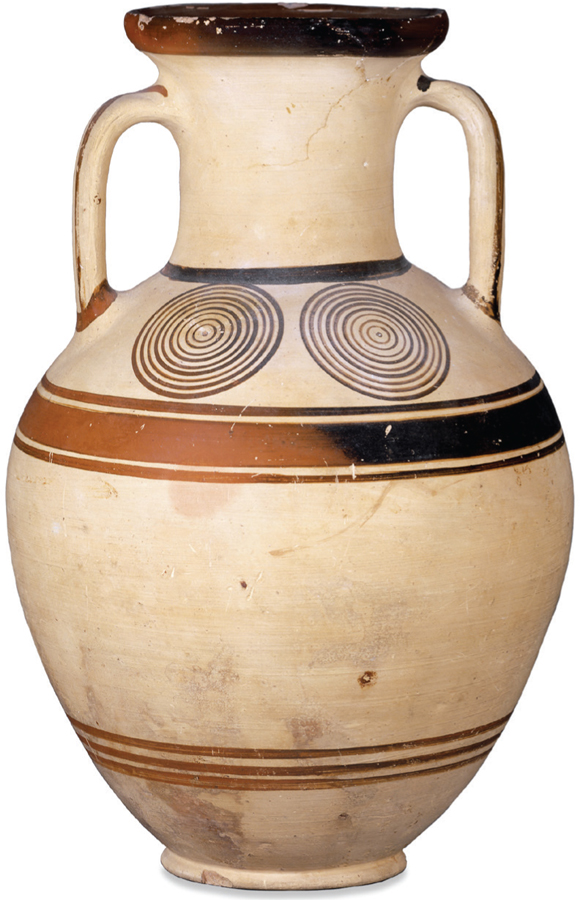
From the tenth century BCE onward, the world of Dark Age Greece began to change, for reasons that are not entirely clear. Graves increased in number, showing that the mainland population, which had collapsed after the fall of the Mycenaean kingdoms, began to expand again. By the beginning of the eighth century, burials—which had traditionally taken place within community boundaries—were pushed to the margins of settlements or beyond, as larger numbers of the living put pressure on the space once reserved for the dead. Cultivation of two crops that became central to Greek culture—olives and grapes—expanded. Pottery, which had degenerated after the collapse of the Mycenaean kingdoms, improved as well. Faster, more efficient wheels allowed potters to shape their vases more elegantly. New implements, such as compasses, enabled them to decorate their work with perfectly geometrical designs. Glazes became smoother and clearer. The pottery of this period, known as Proto-Geometric, was as elegant as it was simple.
A change in technology contributed to the general revival. In the Mycenaean world, as in the Near East and Egypt, the metal normally used for arms and armor had been bronze, an alloy of copper and tin. But new methods for molding bronze now developed. More consequential, smiths in Cyprus and the Levant learned how to smelt iron, which the Hittites had valued as a precious metal rather than for its practical applications. The Greeks adopted these techniques and began to make practical use of local deposits of iron ore. First weapons and then tools such as plows were tipped with the new, harder material. They proved more effective and durable than those made with bronze had ever been. Farming became more intensive. Warfare became more violent, as iron weapons with their hard edges became available to more warriors. So began the Greek Iron Age, which extended from roughly 1100 to 700 BCE.
As the recovery proceeded, the texture of Greek life began to change. The noble households of the Dark Age described in Homer maintained substantial herds of cows and pigs, and the inhabitants sacrificed—andate—a fair amount of meat. In the Archaic period, however, when populations grew, Greek communities turned increasingly to agriculture, raising the barley that was the staple of their diet and the flax that could be spun into linen cloth. The herds and the men who followed them decreased in number and moved into the hills.
Greek trade also revived. At the beginning of the first millennium BCE, Greeks were shipping their pottery to Cyprus and the Levant. Phoenicians and Greeks settled together in some trading stations. It is possible that the Phoenicians brought the Greeks back into international exchange networks in the tenth century and thereafter.
Archaic Greece (800–479 BCE): Near Eastern and Egyptian Influences
The impact of Near Eastern and Egyptian developments on Greek society and culture, sometimes mediated by the Phoenicians, was profound. We have seen that the states of Mesopotamia and Egypt had created systems of theology and law, built temple complexes, and produced works of art on a vast scale. From the ninth century BCE at the latest, the Greeks began to emulate their neighbors.
PHOENICIANS AND THE GREEK ALPHABET The alphabet came early from the Phoenicians, who spoke a Semitic language. As early as the middle of the second millennium BCE, the Phoenicians had devised a nonpictographic alphabet to represent the consonants in their language. They used it in inscriptions—for example, on the sarcophagi (stone coffins) of their rulers. Phoenician merchants used their form of writing for recording their transactions, thereby bringing it to the attention of other peoples. The Greeks, who had traded actively with the Phoenicians for centuries, adapted the alphabet to the sounds of their own language, including the vowels, which made their written language easier to read and write than the Semitic ones. Soon they had worked out how to use these letters for everything from signing their names on pots to chiseling inscriptions into stone.
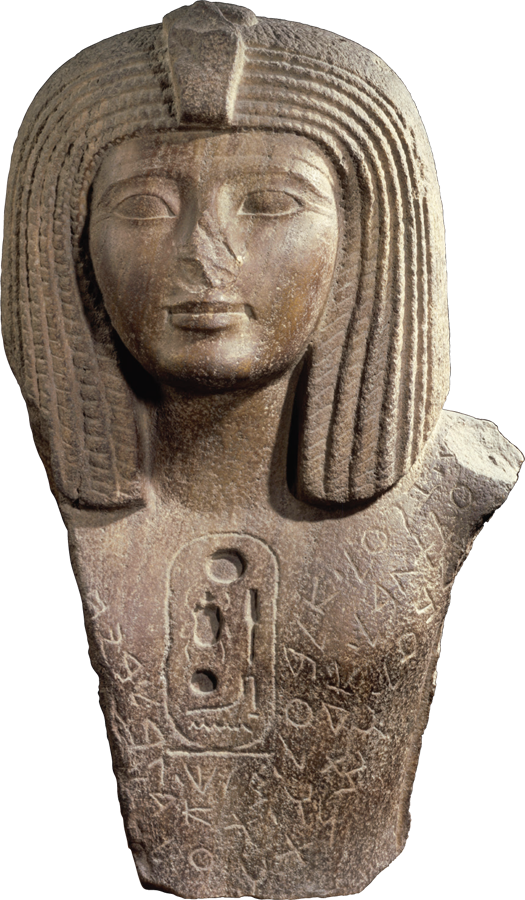
The Greeks’ fuller set of letters proved easy to master. Within fifty years after the alphabet came to Greece, early in the eighth century BCE, it had been used to create and record great poems. By the end of its first hundred years of existence, ordinary Greeks were using it to keep records, to label the mythological figures represented on their clay pots, and to sign their names as graffiti on the structures in Egypt and elsewhere where they served as mercenaries. Greece never developed a class or order of professional scribes like those who taught and practiced writing in the older states. It never needed to. Texts were written and read by ordinary people—and almost certainly sharpened their ability to observe and raise questions about the universe and human society.
THE INVENTION OF AUTHORSHIP: HOMER AND HESIOD It is possible that the poet of the Iliad actually invented the Greek alphabet, and it is certain that poets applied this new tool in a highly imaginative way. As bold and willing to experiment as the artisans and traders who were bringing Greek pottery to other peoples, the singers of tales not only wove stories far longer than ever before but also recorded them for others to read. Too long to memorize or to perform in one sitting, these epics were committed to writing. A new kind of literary creation had become possible—authorship, in which a single poet crafted a work, episode by episode, and then recorded it, word for word, for everyone else to read. This invention marked the origins of a development as astonishing as it has been fruitful—the beginning of a self-conscious, independent, rambunctiously creative society and culture in Greece.
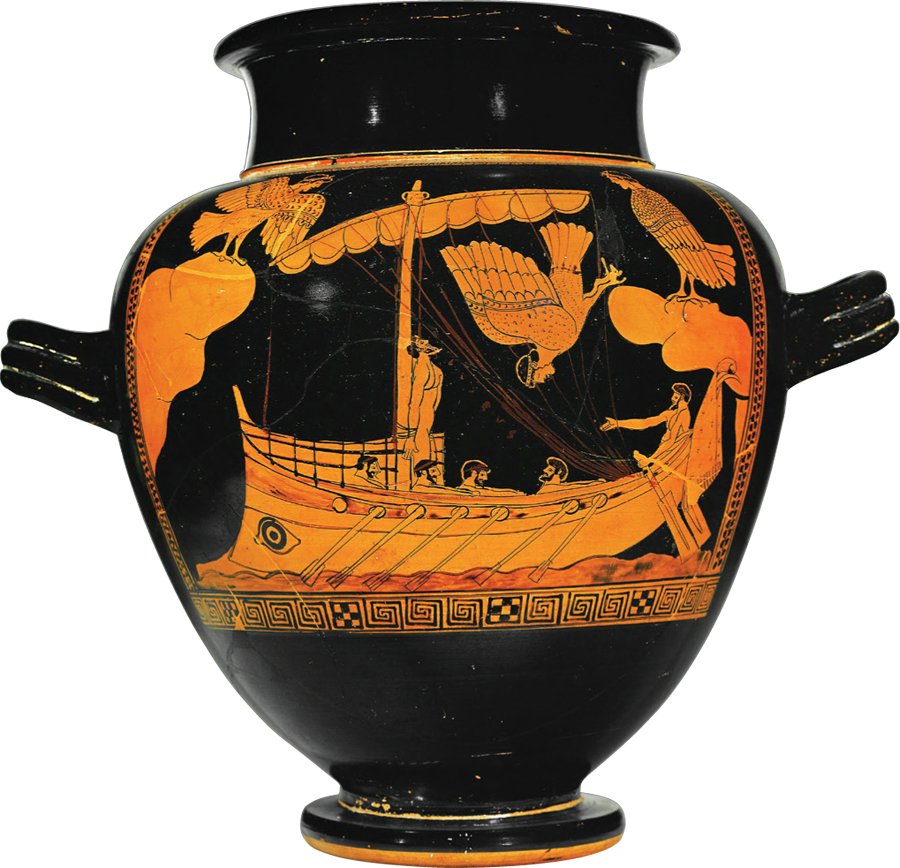
The society that Homer describes in his epic poems is centered on older values of hospitality and courage in warfare, the values that had sustained Greek communities at a time of poverty in resources and technologies. But his characters have varied qualities, reflecting a more complex morality. In the Iliad the warrior Achilles shows a passionate determination to pursue honor and a burning capacity for anger. His enemy, Hector, displays resolute courage in the defense of his home. And in the Odyssey, Odysseus reveals a dazzling wiliness—as well as formidable strength—in his pursuit of the conquest of Troy and then during his journey home. The complicated, often ironic ways in which their fates play out make the two poems surprisingly accessible today.
Homer’s work as a whole—and even more, that of his near contemporary Hesiod—also show what contact with older civilizations meant to the Greeks. The Greek writers composed and performed as individuals, supposedly inspired by goddesses (the nine Muses), but still speaking on their own authority and in their own voices. Hesiod even introduced his own name to his poems, making clear his personal responsibility for them. Some Near Eastern writers had done the same. But others had written as scribes and priests, explaining how the gods were related to one another, laying out the history and structure of the universe, and striving to convey the ways in which divinity and humanity interacted. The Hebrew Bible gives a sense of what this literature was like.
Greeks, so far as we know, had never attempted to put the stories of their many gods in any sort of formal order before this time. Now Homer, in a poem aimed at aristocrats who loved to hear about family histories so complex that modern readers find them almost impenetrable, traced the connections among the Olympian gods in passing comments. Hesiod devoted one of his major works to explaining the generations of the gods and their relationships to one another, in a scripture, of a sort, for a people who lacked one. More striking still, in a bitter poem on the life of the farmer, he insisted as sharply as any Egyptian that the duty of the authorities was to maintain a moral order, to preserve justice in the universe. In their hunger for the bribes that only the rich could provide, Hesiod observed, they often failed to carry out this duty. In his poetry we can hear the voices of those who lacked status and power, and earned their living by the hard work of the plow or by risking dangerous voyages on ships.
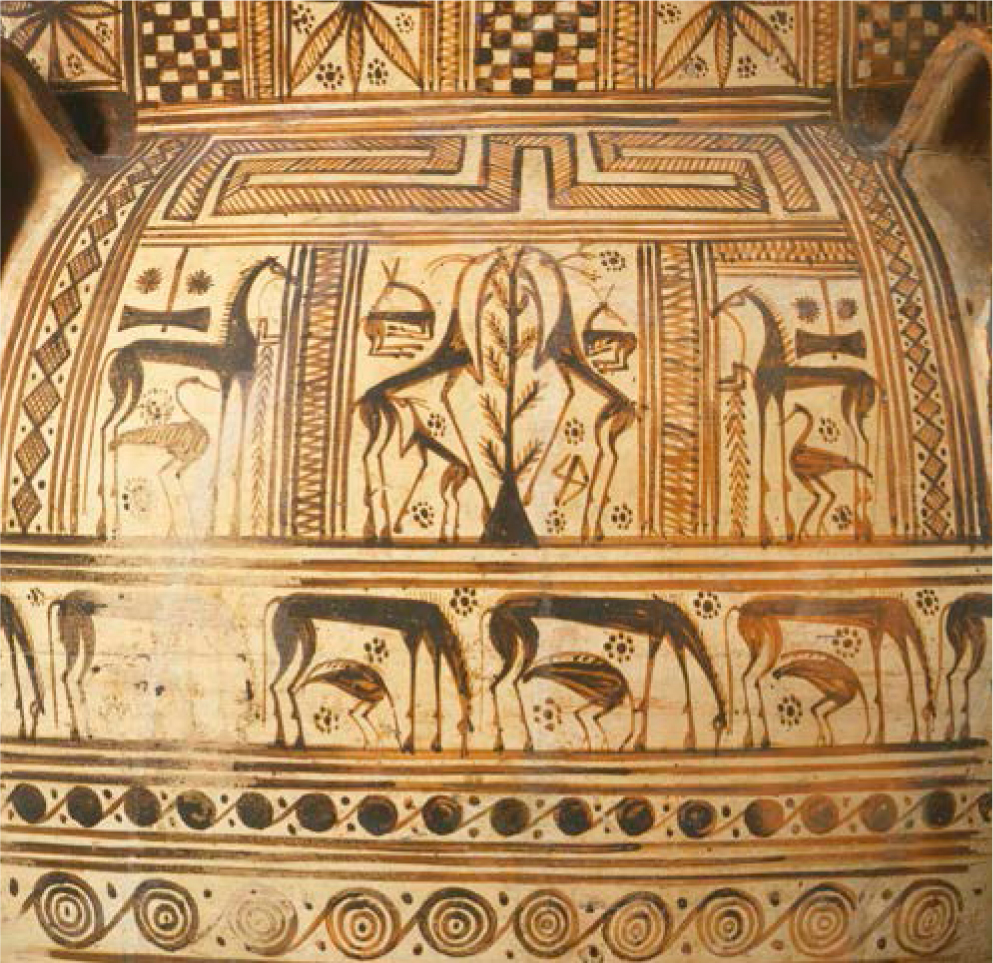
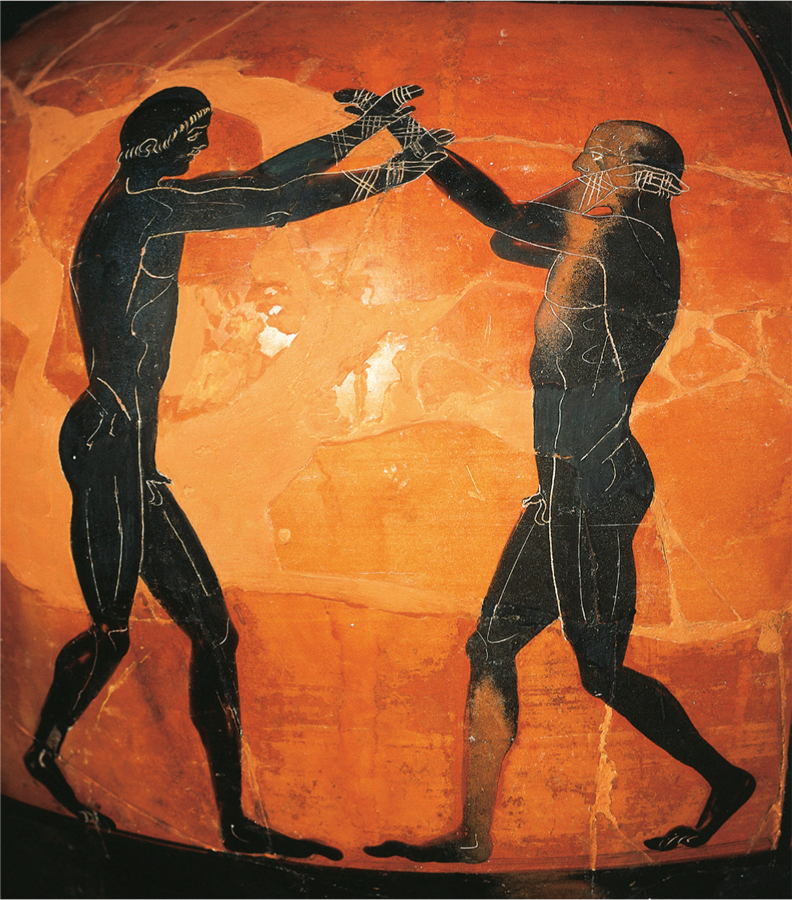
GREEK ARTS AND CRAFTS: BUILDING ON NEAR EASTERN AND EGYPTIAN MODELS Greek artists and artisans also explored the new possibilities that commerce with other cultures offered. In the age of Homer, as for centuries before, potters in Greece had decorated their wares with the abstract patterns that gave their style its name: Geometric. In the seventh and sixth centuries, by contrast, they followed models from the Near East and Egypt, and experimented boldly with new forms—animals, both real and imaginary, and humans engaged in rituals and social life. On the black vases of this period—so called because their figures were portrayed in black against the bright orange background of the clay—vivid figures of the gods appear. So do human athletes throwing the discus and the javelin to the sound of music made by a flute player, women gathering at a public fountain, and animals locking horns.
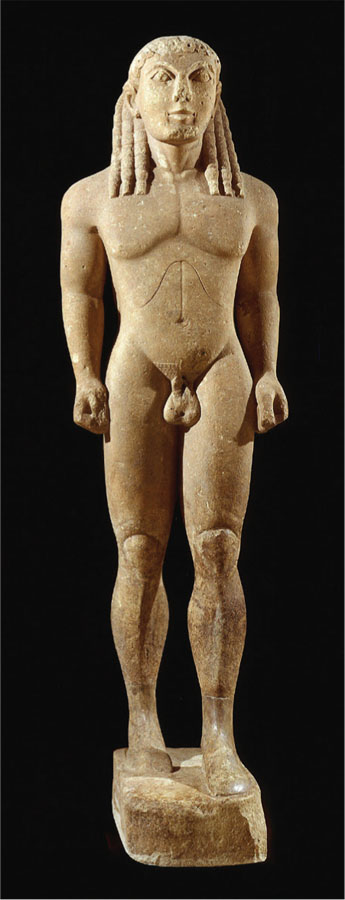
Greek sculptors, similarly, learned from their skilled Egyptian colleagues to create life-size statues, in bronze and stone alike, of human figures. Again, they rang changes on foreign innovations. Statues of young men—kouroi—were represented in the nude, and the sculptors dwelled with pleasure on every detail of the human form. Statues of women were clothed, the sculpted fabric falling in stiffly stylized drapes and folds. Using Egyptian conventions, Greek sculptors soon became astonishingly skillful at producing realistic figures that seemed balanced on the balls of their feet and ready to move.
In the eighth century BCE, Greeks began to build substantial temples to their gods. The same sculptural conventions they had developed to represent beautiful men and women served to represent the gods as well. For all their glorious wealth and all their ability to orchestrate the work of thousands of subjects, the rulers of the Near Eastern lands and Egypt had never imagined the gods so directly in their own image. When the poor seafarers and marginal farmers who clung to the bony slopes of Greece took this radical step, they revealed a cosmic self-confidence that would take them a very long way, as we will see.
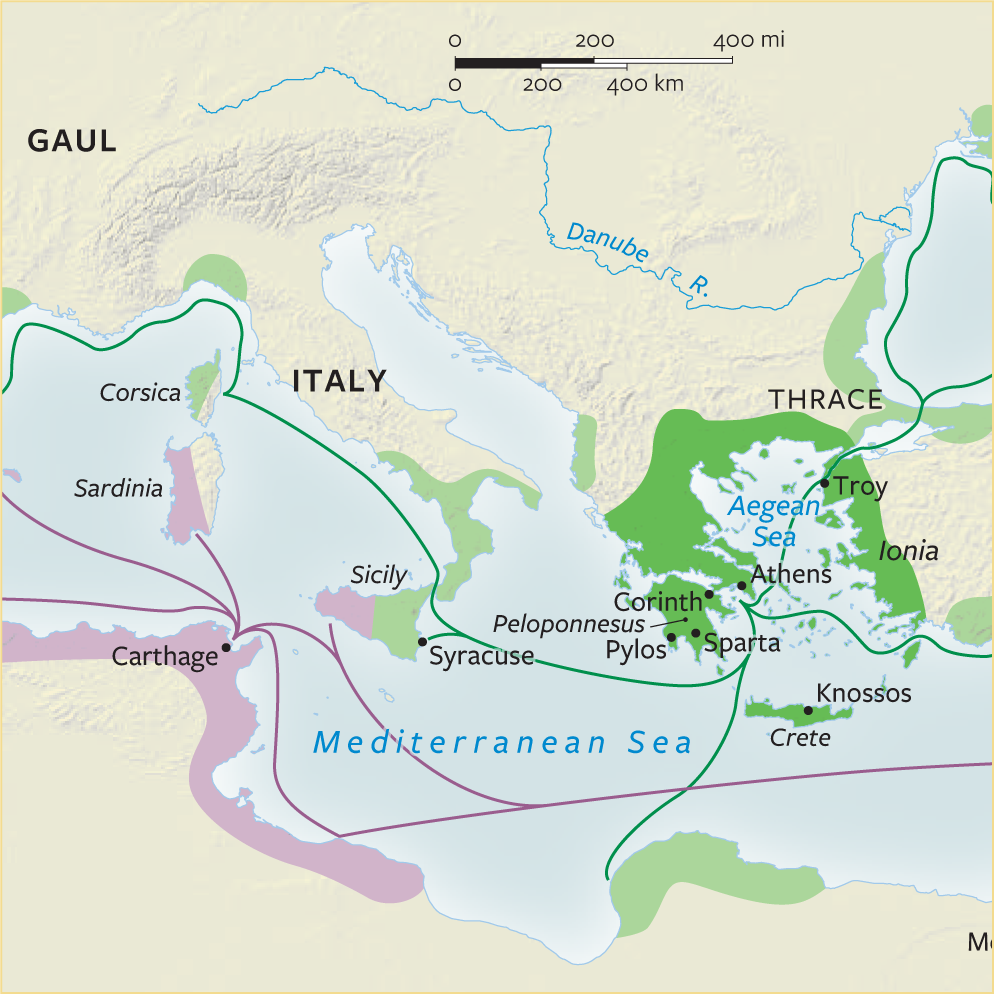
GREEK EXPANSION: THE COLONIES (9TH–6TH CENTURIES BCE) As the Greeks’ social and intellectual universe expanded, they set themselves in motion. From the early ninth century BCE on, the old city-states began to establish colonies around the Mediterranean. The Phoenicians, whose trading cities survived and prospered during the Bronze Age Crisis, also founded trading posts in the western Mediterranean in the same centuries when the Greeks did. Apart from Carthage in northern Africa, which became a powerful city-state in its own right, they stayed largely aloof from local politics. They came to trade. The Greeks built some of their colonies as trading posts, but they also set out from their home cities looking for sites to settle as independent cities. They searched for harbors well protected from bad weather and flanked by high headlands that could easily be fortified. Though they maintained contact with their home communities, the new settlements were politically independent.
In two bursts, one in the eighth and one in the sixth centuries BCE, the Greeks established colonies on the coast of Asia Minor, on Sicily, and in mainland Italy and Gaul (modern France). Some of these, like the Sicilian city of Syracuse, would become bigger, richer, and more powerful than many of the home cities their inhabitants had left behind. Greek civilization thus expanded to the east and to the west alike—a process that would last, in different ways, for hundreds of years and play a central role in the making of Western history.
HELLENIC CULTURE: CONVERSATION AND COMPETITION Even as Greeks scattered from the western coast of Asia Minor to the far western Mediterranean, new institutions were developing that helped them to form a collective identity. The Greeks called their lands Hellas and themselves Hellenes, and these new forms of sociability and competition came to define Hellenism. Some of these practices were rooted in the customs of the Dark Age communities, and perhaps in Mycenaean life before that. None was more durable or proved more fertile than the symposium (literally, “drinking together”), which became the central form of Greek social life.
The Iliad and the Odyssey already depicted groups of men and women reclining together on couches, drinking wine, and listening to a bard or talking. Over time, the symposium came to be a male event, one in which women appeared only as servants or entertainers. But it also became a model of free and open discussion in which philosophers and generals, men of inherited rank, and self-made men could take part. For centuries to come, Greeks were set apart by their passion for these meetings, which often launched new kinds of literature and new ideas.
Even more than the Greeks loved gathering to drink and argue, they loved to compete: “Strife,” Hesiod explained, “is wholesome for men. And potter is angry with potter, and craftsman with craftsman, and beggar is jealous of beggar, and minstrel of minstrel.” Homer has his heroes compete with all their strength, not only in warfare but also in the games that follow the deaths of their comrades, in which they race, wrestle, and box. In the ninth and eighth centuries BCE, these pursuits became the core activities at formal athletic competitions to which all Greeks were welcome. These were first held at Olympia, in the Peloponnesus, under the auspices of a great temple of Zeus, and then also at other sites.
Greek athletics took many forms, from boxing with hands wrapped in leather straps to racing chariots, and could be almost as dangerous as warfare itself. In 720 BCE, according to legend, one competitor lost his loincloth while running in a footrace. From then on, Greek athletes competed naked. As their contests began to occur regularly every two or four years, they developed into a pan-Hellenic institution. Special truces among warring groups enabled all contestants to attend the Olympics and other games. Poets celebrated the winners with elaborate verses of praise, and cities supported victors in comfort for the rest of their lives.
Conversation and competition both remained among the chief characteristics of Greek life for hundreds of years. Greeks were coming to have an identity as clear-cut as that of Babylonians or Egyptians—one centered on continual competition. The civilization that was beginning to take shape in the West already looked radically different from the older, wealthier, and more powerful societies with which it was in contact—and from which it learned so much.
Greek City-States (12th–6th Centuries BCE)
In ancient times, most Greeks identified less as members of a great Hellenic world that stretched across oceans and continents than as citizens of individual communities. Independent city-states—settlements that recognized no superior and governed themselves—became the norm in Greece during the Dark Age and Archaic period, and would remain the standard form of Greek settlement until centuries later, when Greece finally became part of one larger empire after another. Called the polis, the Greek city—as we will see—followed a very different path of development than the cities of the Near East had.
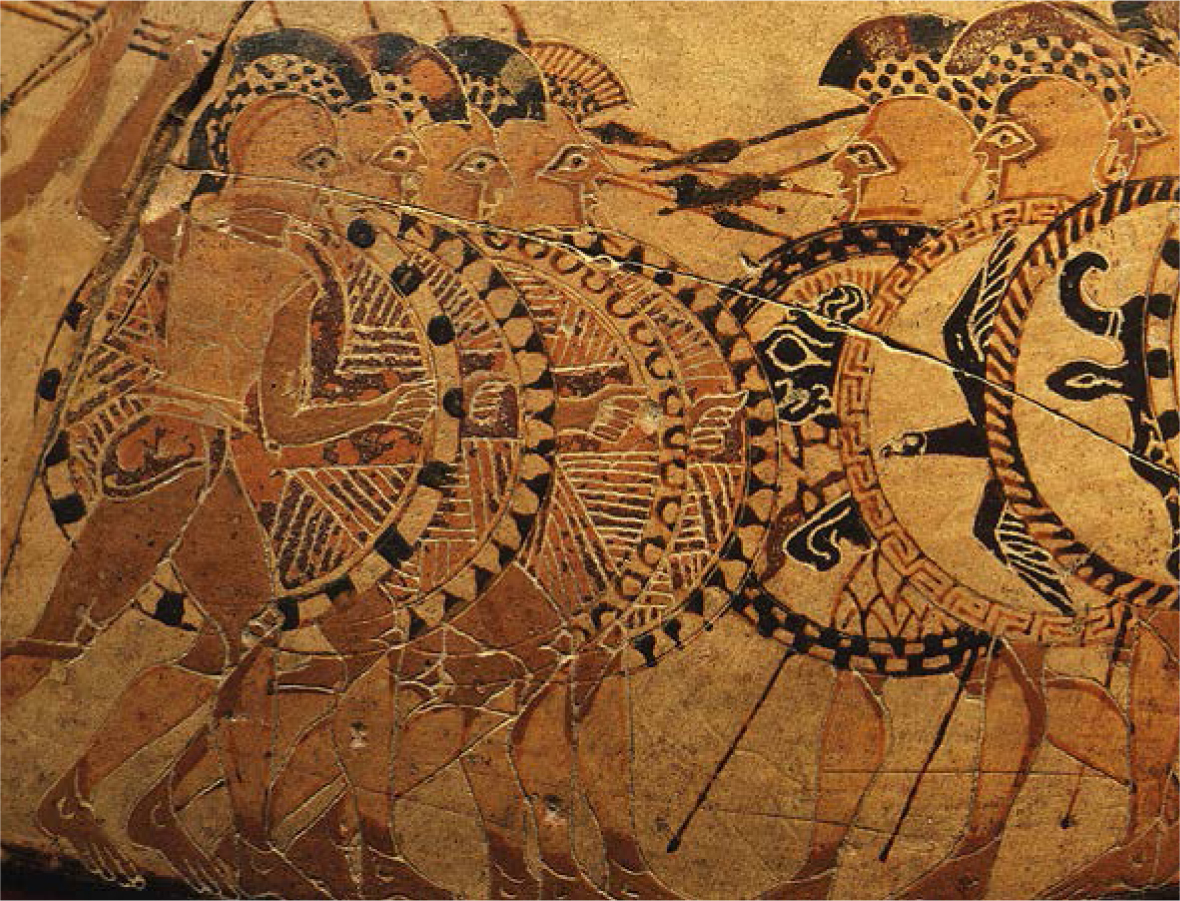
HOPLITE WARFARE AND SOCIAL TENSIONS Transformations in the city-state were the most consequential development of this consequential time. Bitter, prolonged warfare—consisting partly of pitched battles in which one side might rout and slaughter the other, and partly of long series of raids and crop-burnings in the countryside outside the enemy’s walls—became the city’s central activity during the Iron Age. The little communities controlled by noblemen now became larger settlements dominated by a class of fighting men called hoplites.
These soldiers mobilized in the warm weather to wage their campaigns and, in the fierce rivalry of Greek life, were called into action again and again. Each of them wore a helmet and carried a spear in his right hand and a large, round wooden shield in his left. Moving forward in a dense, coordinated formation called a phalanx, each hoplite was supposed to protect the man on his left with his shield, and trust the man on his right to do the same for him. These formations loosened as armies ran toward one another, but they still crashed together like waves until one side or the other broke, with many casualties. This form of warfare was not wholly new: the poems of Homer describe soldiers fighting behind walls of shields. But in the political world of the city, it had powerful social and political potential. In some cases, strife developed between the men of inherited rank who had traditionally claimed the right to command and the larger groups who now made war.
Between the eighth and sixth centuries BCE, polis after polis dealt with these tensions by developing a formal constitution—a set of rules, written or unwritten, that defined governmental institutions and regulated participation in them. Many cities, from Corinth in the eighth century to Athens in the sixth, either appointed a prominent person to serve as a monarchical ruler, or at least declared the wisdom of that policy. Laws were composed, though they were often ascribed to ancient lawgivers rather than to living men. Compromises provided for a partial sharing of power between the ancient families that had long dominated society and the wider group of soldiers who were now needed to defend the state.
Often these arrangements proved fragile. The sixth century BCE saw “tyrants” take power in Athens and many other cities. Not despots in the modern sense, tyrants were individual rulers who could not necessarily claim that their rule was legitimate, but who could offer efficiency in government. History now took place, at different tempos, on individual urban stages. Across the Greek world, as much in the colonies as on the mainland, Greeks thought of themselves first as Spartans or Athenians, Corinthians or Megarians, and only then as members of a coherent larger culture.
SPARTA: A DISTINCTIVE ORDER The Greek poleis (cities) varied widely in physical form and political constitution. But a small city on the Peloponnesus in southeastern Greece—Sparta—stood out as a model that others could only aspire to. It developed a distinctive constitution—traditionally attributed to the lawgiver Lycurgus—in the eighth and seventh centuries BCE, after a time of civil strife. The city had two hereditary kings—members of ancient families who led its armies in wartime and performed religious rites. Another set of officials, called ephors, had the right to challenge royal decisions, and they often did so. A council of elders, the gerousia, also took an active part in making policies and negotiating treaties. In addition, an assembly of men of military age had the right to vote on enactments proposed to it, but not to stage formal debates. In Greek terms, Sparta exemplified oligarchy: the state was ruled by the few, rather than a single monarch or a mass of citizens.
What made the Spartan state distinctive, much more than these institutions, was its social order—and the sheer power that it enabled the city to unleash when the multiple governing bodies agreed to make war. The core of the city’s strength lay in its fighting men, who called themselves homoioi (“men of the same kind”). Much of the social order was organized to train these men to be fighters of extraordinary skill and courage.
Spartan boys, who were taken from their families and raised for a time as members of age groups, were required to steal the food they needed to eat but punished severely if they were caught. For centuries after the city had ceased to exist, Greek writers told the story of a Spartan boy who, in his hunger, stole a live fox but had to come to the muster with it under his clothing. He proved his mettle by remaining silent, muffling his own cries, as the fox gnawed at his vital organs.
While growing up, each Spartan boy normally had his closest relationship with an older male lover, who would teach him the skills of warfare and the traditions of the city. Eventually the men would marry their female counterparts: Spartan women, who unlike those in the rest of Greece practiced gymnastics to make themselves fit wives and mothers for Spartan men. But even once they had reached adulthood, Spartan men lived more with one another in military messes—groups of men who ate together, feasting on the notorious Spartan blood sausage—than with their families. Male lovers marched into battle together, and their deep affection helps to explain the cohesion of Spartan armies, which astonished their enemies.
Sparta had its manufactures, but it never became an actively commercial society. The city never even minted its own coins, but used those of other states. The labor of slaves called helots provided the material support that sustained the system and the state. Tradition connected the helots to the wars that the Spartans waged in the eighth century against their Messenian neighbors in the southwestern Peloponnesus, though these accounts disagreed as to whether the helots were descended from the Messenians themselves or from Spartans who had not fought. The helots, who far outnumbered the free Spartans, worked at many jobs, from household service and sharecropping the farms of their masters to trade and crafts. Some reports stress how the helots were humiliated by their masters—for instance, being harassed by free citizens’ youth groups, forced to wear demeaning clothing, or made to drink wine with no water. Others point out that some helots owned considerable property and saved enough money to buy their own freedom.
Despite these uncertainties, it is clear that like later slave societies, Sparta was regularly threatened by rebellions of the helots. The city responded with ferocity. Young Spartans learned part of their craft as soldiers as they prowled Spartan territory, doing their best to terrify the slaves and catch and kill any who resisted. Rebellious helots were killed even when it meant removing them from shrines where they had sought sanctuary—itself a religious crime. Yet the Spartans also allowed helots to serve as soldiers, when numbers required it, and to deliver food and supplies to hard-pressed Spartan units—hardly the sort of duty one would normally assign to bitter enemies. Success at jobs like this often brought freedom.
In retrospect it seems an austere and frightening society. Yet for centuries most Greeks acknowledged that Sparta was the most virtuous society they knew or could imagine. Small though it was, without massive buildings or stunning works of art, Sparta took pride in the prowess of its relatively small class of citizen soldiers—who dominated most of the battlefields on which they appeared until the fourth century BCE—and in the stability of its social and political order.
Other Greeks respected Sparta, especially what they considered its excellent constitution. But the stability of the Spartan ruling class was an ideal to be admired rather than a model to follow. By the time the Spartan constitution took on its definitive shape in the sixth century BCE, Greece was embarking on a series of extraordinary experiments in every realm, from the state to speculative thought. The era of the mature Greek city-state had arrived. Forms of society and government unlike anything the Near East and Egypt had brought into being would take shape on Greek soil.
- epic
A form of literature that was a foundational part of the unified Greek culture that developed during the archaic age. Homer’s great epic poems, the Iliad and the Odyssey, recorded around 800 BCE, are set in the Mycenaean period and deal with events surrounding the Trojan War.
- symposium
An important Hellenic social institution that provided a forum for upper-class men to discuss important issues of the day, including philosophy and politics.
- polis:
Singular form of poleis: independent cities in ancient Greece that developed formal constitutions between the eighth and sixth centuries BCE.
- hoplite
A citizen-soldier of a Greek city-state of the seventh to fourth centuries BCE. Hoplites were armed with helmet, spear, and large wooden shield, and they fought in a tightly packed infantry formation called a “phalanx.”
- oligarchy
As first established in ancient Greece, particularly in Sparta, rule of the state by the few rather than by a monarch or all citizens.
- helot
A member of a Greek-speaking Messenian culture of the southwestern Peloponnesus enslaved by the Spartans in the eighth century BCE. Helots were tied to the land and forced to produce food so their Spartan masters could focus their efforts on military training and conquest.