
Athens and the Persian Wars (490–479 BCE)
M VIDEO: Aftermath of the Persian Wars
Athens was becoming not only a democracy but also the most powerful city-state in Greece. For generations, Sparta had seen itself as the dominant power in Greece and had combined diplomacy with force to settle affairs in other cities—even Athens. But when the Greeks found themselves facing the much greater power of Persia, they experimented with new forms of cooperation, which served them well in combat. During the Persian wars, Athens came to regard itself as Sparta’s equal and as the leader of the Greek states.
Conflict in Ionia
Long before, in the tenth century BCE and after, Greeks had established numerous independent city-states in Ionia, at the far western edge of Asia Minor. These lively and sophisticated cities were on the border of the empire of the Medes and then, after it was conquered and absorbed by Persia, that of the Persians. The massive Persian Empire, centered on the magnificent royal ceremonial capital of Persepolis in southwestern Iran, was far wealthier than Greece and saw itself—as most Greeks saw it—as the greatest power in the known world. Later, in the 540s, the Ionian Greeks had watched as Cyrus, the king of Persia, defeated their overlord, Croesus, the powerful king of Lydia in western Asia Minor. With this defeat, the western edge of the Persian Empire encompassed all of Ionia, including the Greek colonies.
Late in the sixth century BCE, Persians and Greeks began to come into direct conflict. In 500, Darius, the Persian monarch, sent a naval expedition into the Aegean to invade the wealthy island of Naxos, which would have given him a base near mainland Greece. This expedition was actually proposed by a Greek: Aristagoras, tyrant of the Greek city of Miletus in Asia Minor. When it failed, Aristagoras feared that the Persians would attack his city. He urged the citizens of Miletus and other Ionian Greek cities to join him in rebellion.
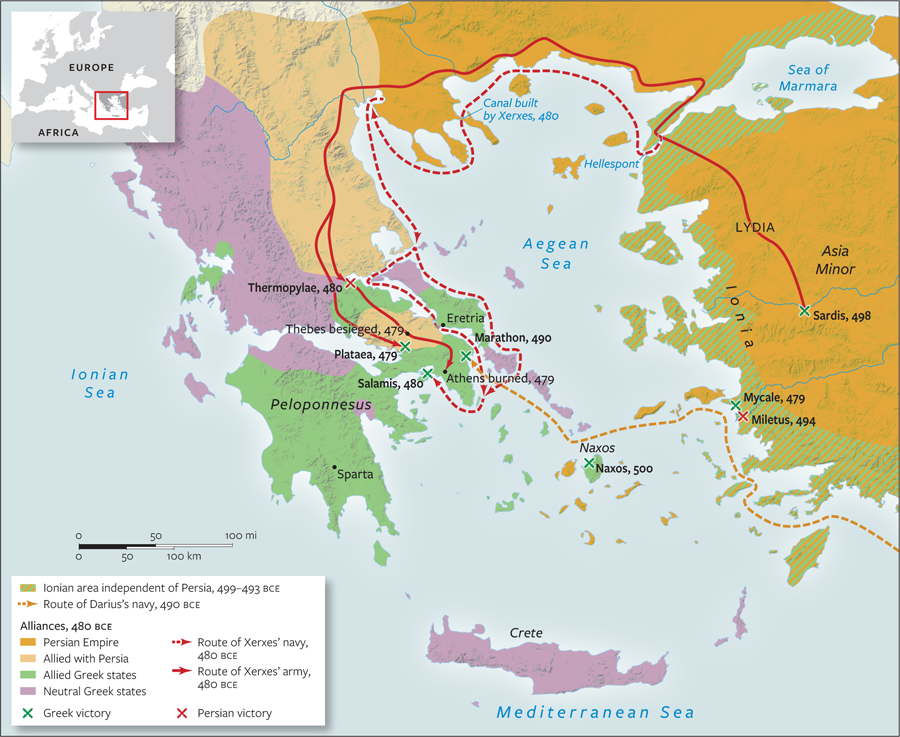
Despite the good advice of Hecataeus, a geographer who explained to the Ionian Greeks how powerful the Persians were, they went to war in 499 BCE. After destroying the Persian city of Sardis in 498, the Greek fleets and armies were decisively defeated. The Persians built vast siege mounds to take the Greek cities and also conquered several of the Greek islands off the Ionian coast. After their final victory in 493, the Persians burned the Ionian cities to the ground, made the Greek boys into eunuchs, and sent the girls to the royal harem.
The mainland Greeks took only a small part in this struggle. The Spartans had warned the Persians to leave their fellow Greeks alone, and the Athenians sent twenty ships to support their allies, the Eretrians, whose city, in mainland Greece, lay just across a narrow gulf from Athens. But after Darius crushed the Ionians’ rebellion, he decided to invade mainland Greece to punish its inhabitants for their meddling, and in 490 BCE he crossed to Eretria.
War in the Mainland
Darius arrived with a massive fleet of some 600 ships and a substantial army. The Greeks were horrified by the scale of the invasion. Many years later, the poet and philosopher Xenophanes described how Greek men would often ask one another when they first met, “How old were you when the Mede came?” Like the assassination of John F. Kennedy in 1963 or the attacks on New York and Washington, DC, in September 2001, the invasion became an unforgettable marker, a point at which time itself seemed to change.
The Spartans, whom the Eretrians asked for help, delayed until a religious festival was over. (Although they did not say so, they may still have resented the way that Cleisthenes had made Athens independent of them.) But Athens sent its hoplites, and one other city also sent troops. Apparently the Greeks were far fewer than the Persians—perhaps 10,000 Greeks arrayed against 20,000 or more Persians. After feeling out the enemy, the Greeks attacked, led by the Athenian general Miltiades, near the settlement of Marathon.
MARATHON New tactics gave the Greeks an advantage. The Persians, lightly armed, carried missile weapons—bows and slings. To avoid heavy losses early in the battle, the Athenian hoplites ran toward the enemy as soon as they came within missile range at about 200 yards from the Persian line. Giving the Persians little time to fire, the Greeks pressed their vulnerable enemies hard. The wings of the Greek army, deeper than the center, overran the Persian units that faced them. When the Persians pushed forward in the center, the Greek wings, instead of pursuing those they had beaten, enveloped the center and put the Persians to flight—as always, in Greece, the decisive moment of a battle.
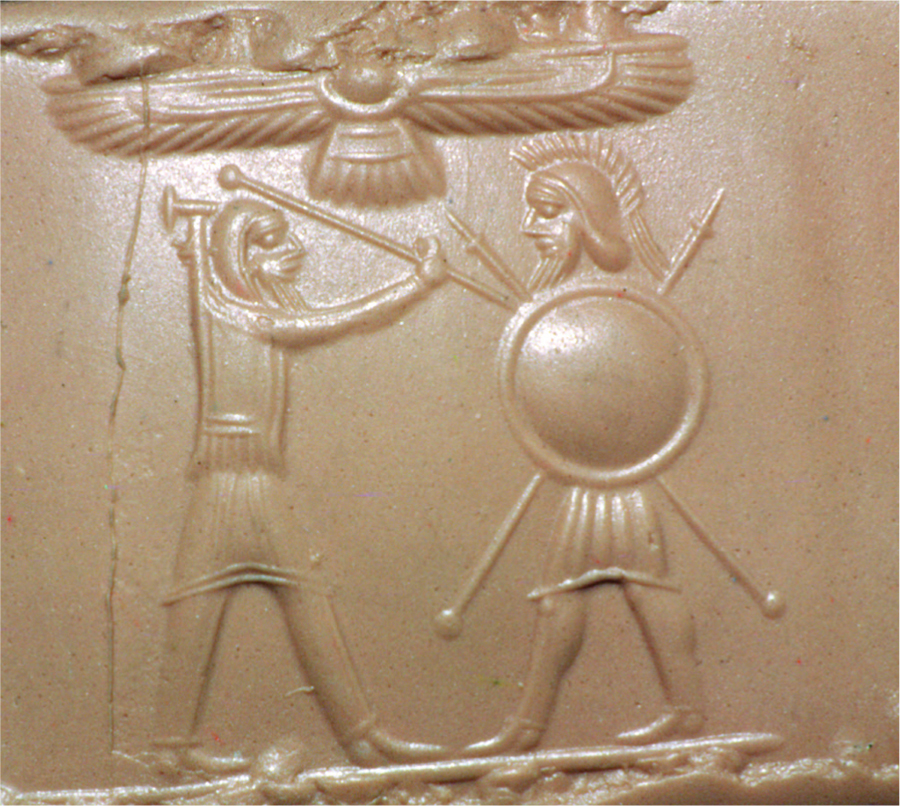
Several thousand Persians died at Marathon, as opposed to only 192 Athenians and 11 allies, most of whom were hindered by their heavy armor as they chased the Persians. The Athenians then marched quickly back to Athens, ready to defend the city. Much later, a legend grew up that a single Athenian, Pheidippides, had run the whole distance from Marathon to Athens, announced the Athenian victory, and died—thus creating the legendary basis for the modern marathon run. The Athenians considered the victory a tremendous achievement and a testimony to the power of their people. They buried their dead under a great mound of earth at the battlefield. The war with Persia would continue, but soon after the victory at Marathon the Athenians showed their sense of political autonomy by carrying out the first ostracism of a powerful politician.
THERMOPYLAE AND SALAMIS Darius’s successor, Xerxes—a harsher ruler than his predecessors, who campaigned brutally against the Babylonians when they rebelled against him—returned to the attack in 480–479 BCE. He brought a vast force against Greece: supposedly more than 1,200 ships and perhaps as many as 100,000 men. He had bridges built across the Hellespont (the strait between the Balkans and Asia Minor now known as the Dardanelles). The Spartans and a few of their Greek allies tried to cut off his advance at Thermopylae, where mountains on one side and the sea on the other left only a narrow, defensible pass. After a few days of savage fighting in which the Greek hoplites once again defeated the lighter Persian troops, a Greek traitor showed the Persians a path that led to the rear of the Greeks’ position. This flanking tactic made the Greeks’ situation hopeless, and most of them abandoned the fight. Three hundred Spartans, commanded by Leonidas, one of their two kings, remained with a few allies and died fighting heroically. Their epic last stand could not stop the Persian advance, though it may have bought the Athenians some time to prepare their ships for a decisive confrontation. But it became the first great model of what has remained the West’s standard for absolute heroism: the last stand of a rear guard.
At this point the Athenians, led by Themistocles, an aristocrat who had served as archon, made one of those decisions that show how people of the past—even those who invented our system of government—often thought in ways that seem alien to us today. Leaders and common people routinely consulted oracles—sites where a god or a dead hero answered questions of all kinds, sometimes through the mouth of a priest or priestess. In this case an oracle predicted that wooden walls would someday protect the Athenians. So they followed Themistocles and left their city, which Xerxes burned, and entrusted their safety to their wood-hulled ships. In a momentous naval battle, a Greek fleet defeated the Persians at Salamis in 480 BCE. Xerxes then left the war in the hands of his commander, Mardonius, and returned to his capital, while the Greeks won a second victory at Mycale in 479. Greek hoplite armies did the same at Plataea and killed Mardonius. After his death, the Persians—although they continued their struggle with the Greeks in the Aegean for decades to come—would never again threaten the mainland.
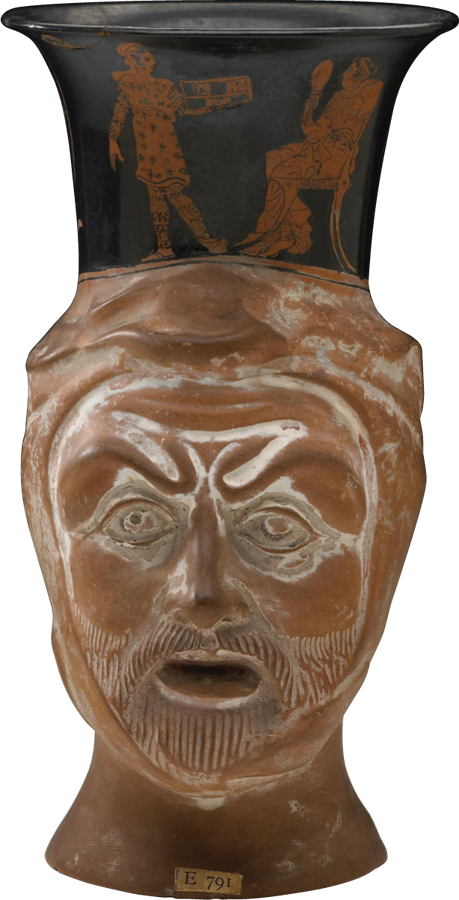
MEANINGS OF WAR The meaning of these confrontations depends on the point of view of those who interpret them. Persia not only survived its defeat but prospered. The Spartans remembered the heroic example set by the 300 fallen at Thermopylae and commemorated their brothers-in-arms by an inscription: “O stranger, tell the Spartans that we lie here, obedient to their word.” The Athenians saw themselves—especially their navy—as the saviors of Greece and set out to play the leading role in Greek affairs that they thought they had earned. By modern standards, they treated their triumph with modesty. The oldest surviving Greek tragedy, The Persians, is the work of Aeschylus, who fought at Marathon. Performed less than ten years after the battle, the play re-creates the response of Xerxes’ mother, and then of Xerxes himself, to the news of the Persian defeat at Salamis. The play shows both disdain for the Persians and a remarkable ability to imagine their suffering. But the Athenians also rebuilt their devastated city on a grand scale and looked for ways to expand their power.
The Athenian Empire (479–433 BCE)
M VIDEO: 5th Century Athens
Over the first half of the fifth century BCE, the Athenians made themselves the heads of what began largely as an alliance among equals but soon became an Athenian naval empire. After the Persian wars, the Athenians collected tribute from the other Greek states—supposedly to support expeditions to harry the land of the Persians. However, the Athenians seemed to do little with the gold that piled up on the island of Delos under the supervision of an Athenian treasurer. The “Delian League” came to seem increasingly like an instrument of Athenian power—especially after the Athenians, around 454 BCE, transferred the league’s treasury from Delos to the temple of Athena at Athens, a powerful symbolic change.
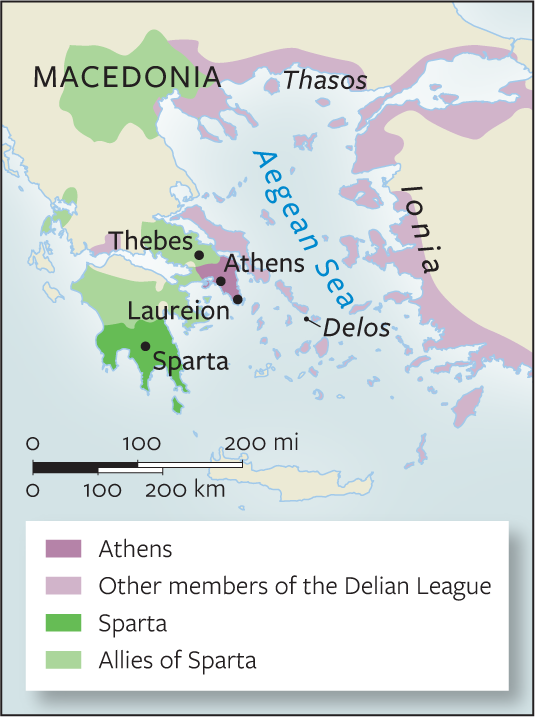
TRADE AND POWER More than symbols were at issue. Athens was developing its military power in a new and dramatic way. In 482 BCE, rich silver deposits were discovered in Laureion, near the eastern coast of Attica. The Athenian government leased these to entrepreneurs, who used a workforce of some 20,000 slaves to dig and purify the silver. Most important, Themistocles persuaded his fellow citizens not to divide the new treasure among themselves but to invest the revenue from the mines in the navy, and they continued to do so throughout the century. The Athenians also continued to collect tribute from allied city-states in return for protection against the Persians. Athens now dominated the ocean as no previous power had.
Trade flourished. Athens built the “Long Walls,” several miles in length, to ensure safe transport to and from its ports, Piraeus and Phalerum. Both ports were crammed with ships and swarmed with middlemen. Many of these were resident foreigners called metics (“co-dwellers”) who specialized in the activities vital to maintaining international trade, such as the manufacture of jars, the shipment of grain and wine to Athens, and the payment of Athenian silver to its suppliers.
Observers noted the vast range of goods available at Athens. Some of these—such as timber, which the bare hills of Attica did not produce—had to be imported if Athens was to sustain its naval power. The city depended on the rulers of Macedonia to the north for this vital raw material. Trade therefore was a matter of state, and the Athenians did their best to ensure that no other power interfered with their ability to obtain the raw materials on which their power rested. These included not only timber but pitch, rope, and all the other materials needed to outfit their warships.
Other Greek cities within the Delian League, such as Thebes and the island city of Thasos, found themselves compelled not only to pay Athens tribute but also to obtain its permission to engage in trade. One resentful aristocrat observed, “If a city is rich in shipbuilding timber, where will it dispose of it unless it wins the consent of the Athenians? What if some city is rich in iron or bronze or cloth? Where will it dispose of it unless it wins the consent of the rulers of the seas?” Athens was a democracy and favored democratic governments in other cities, yet its conduct seemed increasingly imperial. The Spartans saw themselves as the leading power in Greece, but the Athenians now made clear that they claimed to be, at the very least, the Spartans’ equals.
THE NAVY AND SOCIETY: TRIERARCHS AND OARSMEN What really mattered—and what made the expansion of trade possible—was the powerful navy that the Athenians built with their new wealth. They created a fleet of armed triremes—large galleys powered by muscular oarsmen sitting in groups of three, one above the other, all working to the limits of their strength. The Athenians developed sophisticated naval tactics. They practiced rapid rowing, probably reaching speeds higher than ten miles per hour, and sudden changes of course. They used the rams at the front of their ships to break enemy fleets, attacking them from the vulnerable flank. The marines and archers whom they carried made each trireme an even more fearsome weapon.
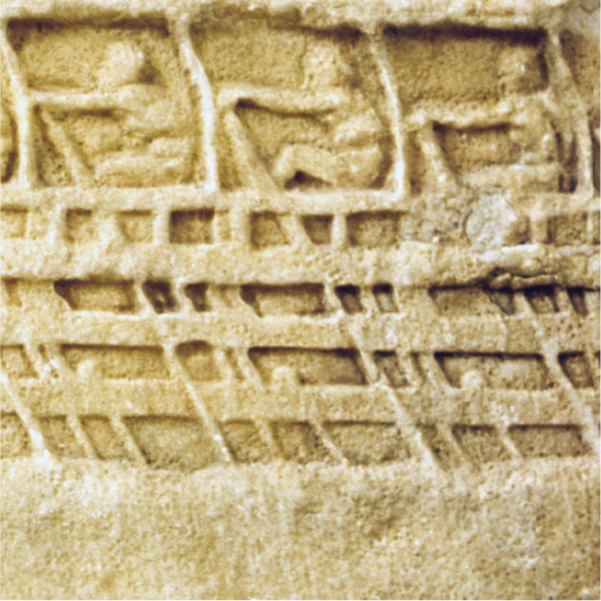
Later in the fifth century BCE, the Athenian democracy devised a new social and economic system to sustain the navy. This system required both the rich and the poor to contribute, and ultimately gave the poor what critics of democracy described as a preponderance of power. The wealthiest Athenians were required to use their fortunes, for a year at a time, to provide public services. Some served as trierarchs, responsible for outfitting and commanding triremes. The trierarchs worked with expert contractors who took care of the technical and military details; but the trierarchs still had to see to it, at their own expense, that one or more ships provided by the state had all the necessary equipment, and that the most skillful officers were employed to command the crew.
Like Sparta, Athens defined itself largely by the military that it maintained. Equipped by the wealthy, Athens’ military drew its forces from the populace. Poor Athenians rowed the galleys, and were paid for doing so out of the public revenues. Men who could afford arms served as marines, fighting from the ships, and they too were paid. In a society in which aristocrats still commanded armies and navies, men of low birth provided vital manpower and demanded respect for doing so. As a fifth-century critic of the regime explained, ironically expressing admiration for a system that he could neither accept nor change, “at Athens the poor and the commons seem justly to have the advantage over the well-born and the wealthy; for it is the poor who man the fleet and have brought the state her power.”
- oracle
A place or a person the ancient Greeks considered a vessel through which the words of the gods and goddesses could reach the public. Oracles were often asked for counsel and predictions of the future.
- Delian League
An alliance created by the Athenians in 478 BCE to evict the Persian fleet from the Aegean Sea. Named after the island of Delos, where the member city-states conferred, the league eventually became the basis for the growing Athenian naval empire.
- metics
Resident aliens of a Greek city-state who lived there legally but were not considered citizens. Many were invited to settle in Athens if they were skilled in trade, arts, crafts, or teaching.
- trireme
A military vessel used by the Athenians and later by the Romans. Its name derived from the three rows of oars on either side of the ship.