
The Peloponnesian War (431–404 BCE)
In the decades after the Persian wars, relations between Athens and Sparta—never easy—deteriorated. Sparta tried to prevent the Athenians from rebuilding their city’s walls after the Persians left, a decision that would have dramatically weakened Athens. The continuing buildup of Athenian naval power greatly worried the Spartans and their allies. In 465 BCE, a slave revolt broke out in Messenia, a region ruled by Sparta, and the helots seized a mountainside city that they could defend. The Spartans appealed to the Athenians, who were experienced in siege warfare, for help. The Athenians sent soldiers, but the Spartans ordered them away, fearing that they might join forces with the helots. This marked the end of the alliance between the two cities and the beginning of the final long slide into open conflict.
In 459 BCE Athens joined with a neighboring state, Megara, traditionally a Spartan ally, to fight Corinth, another Spartan ally. Sparta joined the war on Corinth’s side. The war lasted until 446/5 BCE, and the peace that followed was continually disturbed by conflicts over the great powers’ dependent cities. In 431, a full-scale war broke out, as Corinth pushed the Spartans to resist the growth of Athenian power.
Athens’ Defeat
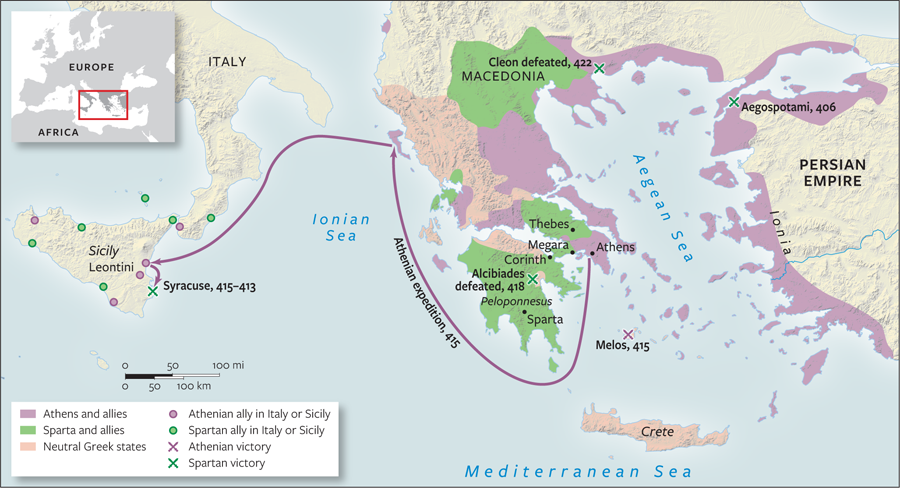
Cleon’s aggressive policies scored some successes, but in 422 BCE he was defeated and killed by the Spartans in northern Greece. Nicias made peace with the Spartans, but the two cities and their allies continued to struggle. A young Athenian politician, the brilliant and aggressive Alcibiades, pressed for renewed conflict. The Athenians lost this encounter in 418, but Alcibiades continued to enjoy wide support. Politics in Athens was now pitched in a new key, in which demagogic forms of expression—violent words and gestures—seemed more effective than the more moderate language and gestures of a Pericles. War, as Thucydides would remark, proved to be a harsh teacher.
Athenian policy became more radical. In 415 BCE an Athenian army destroyed the city of Melos, which refused to become an ally, and massacred its male inhabitants. In the same year, Alcibiades persuaded the Athenians to undertake a bold but ill-planned expedition to help allies in Sicily against the powerful Greek city of Syracuse. Nicias, who thought the expedition foolish, was forced to take command, and the Athenian forces were defeated on both sea and land. Though weakened, the city fought on. During the last years of the war, Persian satraps forged an alliance with Sparta. A naval loss at Aegospotami in 406 was the final blow, and two years later the Athenians and their allies surrendered to the Spartans. The long conflict had cost the Athenians thousands of their fellow citizens, dozens of ships, and much of their wealth. The Spartans removed the Long Walls, which were torn down to music played by flute girls. Athens could no longer wait out sieges, confident that it could import the grain its population needed.
The Thirty Tyrants
The period after the war’s end was hard for the Athenians. The Spartans had damaged Athenian farms and destroyed olive groves, which took a generation to replace; and they had allowed many of the slaves who worked in the state silver mines to escape. Less prosperous than they had been for generations, the Athenians had to import more of their food than ever.
Moreover, after the Athenians begged for peace in 404 BCE, a short-lived aristocratic junta, the Thirty Tyrants, took over with Spartan backing. This oligarchical government did more than rule the city; it declared its opponents public enemies, executed them, and confiscated their goods. This was a radical form of attack on fellow citizens that would be repeated during hard times in the Roman Republic and elsewhere. Opposition to the Thirty grew, and a small force of Athenian exiles seized a border fort. In bitter street fighting, the exiles defeated the leader of the Thirty, who died in the battle.
After further struggles, in 403 BCE the Thirty were expelled from Athens and the old laws and government restored. The democrats eventually declared an amnesty for the followers of the oligarchic regime, proclaiming that “we will remember past offenses no more.” With its citizens reunited, Athens regained much of its strength. In the 390s the Athenians rebuilt the Long Walls under the protection of a fleet sent by the Persians, who wanted to counter the growth of Spartan power. The Athenian state began minting silver coins again, instead of the bronze ones issued during the war. Prosperity gradually returned, but Athens struggled against Thebes and other states for power over Greece. None managed to establish its power in a lasting way.
The Meaning of Defeat
The world’s first great democracy was defeated in warfare by oligarchic Sparta. Those who have reflected on the story, from the historian Thucydides onward, have often suspected that the city’s ruthless pursuit of power over others brought about its defeat and the temporary overturning of its institutions—an outcome to worry supporters of democracy. The city and its institutions survived the turmoil, and a more or less democratic constitution lasted for some decades, but Athens would never again dominate the Greek world as it had.
Social and Political Catastrophes
Agitation and argument were constant during the Peloponnesian War, which stretched from 431 to 404 BCE. Pericles, who first led Athens into war but also cautiously recommended that the Athenians not battle the Spartans on land, died in a plague outbreak soon after the war began. The plague killed thousands of other Athenians as well, perhaps enough to undermine the city’s power and explain its eventual loss of the war. It also caused a breakdown in social customs. The great Athenian historian Thucydides tells us that the sick were abandoned, and the dead—in a radical violation of Greek tradition—were left unburied.
Yet even this disaster paled next to the other catastrophes that the Athenians endured. Through the second half of the fifth century, the pressures of the Peloponnesian War kept Athens in a state of agitation punctuated by emergencies. These occurred, for example, when the Spartans destroyed Athenian crops or when some internal enemy mutilated the statues of the god Hermes placed at crossroads in the city, causing a public panic. Although the wealthy, aristocratic general Nicias tried to carry on where Pericles had left off, he never won the favor of the people. They preferred Cleon, a politician who shouted and gesticulated in public, raised the pay of the jurors, and used the courts to attack his enemies.