
The Hellenistic Monarchies (305–30 BCE)
Soon after Alexander’s death, it became clear that only his energy and personal dominance had welded the vast range of peoples that made up his empire into a single political unit. Though a regent took control of the empire, the satraps of individual areas soon went to war, both with the emperor and with one another.
The Successor States
In the end, three large new states took shape among the ruins of the Macedonian Empire: (1) that of the Ptolemies, which extended from Egypt into Palestine, Libya, and Cyprus; (2) that of the Seleucids, in Palestine, Turkey, Mesopotamia, and parts of Afghanistan and India; and (3) that of the Antigonids, in Macedonia and northern Greece. But the crystallization of these larger states did not bring peace. Between 274 and 168 BCE, for example, the Seleucids and the Ptolemies fought no fewer than six wars in Syria.
Smaller states also sprang up, like that of the Attalids in western Asia Minor. One of Alexander’s generals, Lysimachus, had built a small empire between the Black Sea and the Mediterranean, which he ruled from the city of Pergamum. He maintained independence by adroitly switching allegiances. On his death, his realm fell apart. But the Attalids took over Pergamum and gradually built it up as a splendid city—a rival version of Alexandria, with great temples and libraries, and a fan-shaped upper city centered on the vast royal palace. Their kingdom survived until 133 BCE, when it was bequeathed to Rome.
Autocracy and Autonomy
The Hellenistic states basically followed the model that Alexander had sketched out—itself partly derived from the Persians. Unlike most of the Greek states of the last several centuries, all of the Hellenistic states were monarchical in form and sharply hierarchical in character. Greek elites, separated by language and customs from the natives, occupied the top levels, with native elites below them.
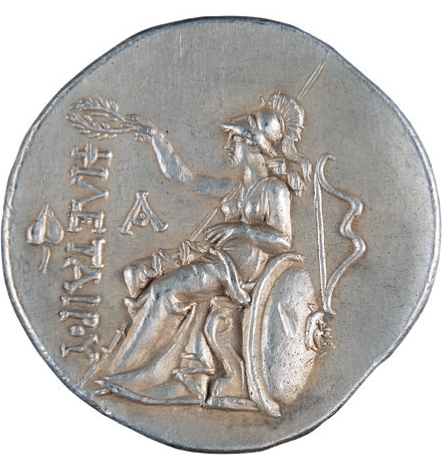
The workings of Hellenistic government are best known from the Egyptian kingdom of the Ptolemies (305–30 BCE). Emulating the ancient Egyptian pharaohs, whose kingdom the Macedonians had shattered, the Ptolemaic kings claimed godly status and used everything from public ceremony to coinage to teach subjects to see them in that light. The Ptolemies dealt with their Greek subjects as Greek rulers, communicating with them in Greek and allowing them to build and administer the normal Greek institutions, such as public gymnasia, in their cities. They dealt with their Egyptian subjects as the pharaohs had, using the Egyptian language for decrees that affected them. Two systems of justice applied—one Greek, and one Egyptian. The Egyptian state of the Ptolemies was thus bilingual and in large part bimodal.
The other successor states developed variants on this model. The Seleucids inherited the largest single share of Alexander’s empire—Turkey, Syria, and Iran. With a population of 50 or 60 million, these lands were immensely rich. Unlike the Ptolemies, the Seleucids employed natives in the administration and the armed forces, and encouraged their soldiers and other Macedonians to marry Asians. The children of these unions served in the Macedonian phalanx that was the core of the Seleucids’ army, along with native light infantry, archers, and javelin-throwers. In 305 BCE, after initial efforts to establish satraps in the Indus Valley failed, Seleucus I (r. 321–281 BCE) made a deal with Chandragupta Maurya (r. 322–298 BCE), an Indian who was founding his own dynasty. Seleucus abandoned all claims to Indian territory in return for war elephants. Yet with all their military resources and native helpers, the Seleucids could not establish an effective administration for their immense domains. They established a ruler cult, in which cities worshipped the ruler “as if he were a god,” and hoped that this could provide some of the unity that was imposed in Egypt by the nature of the Nile Valley.
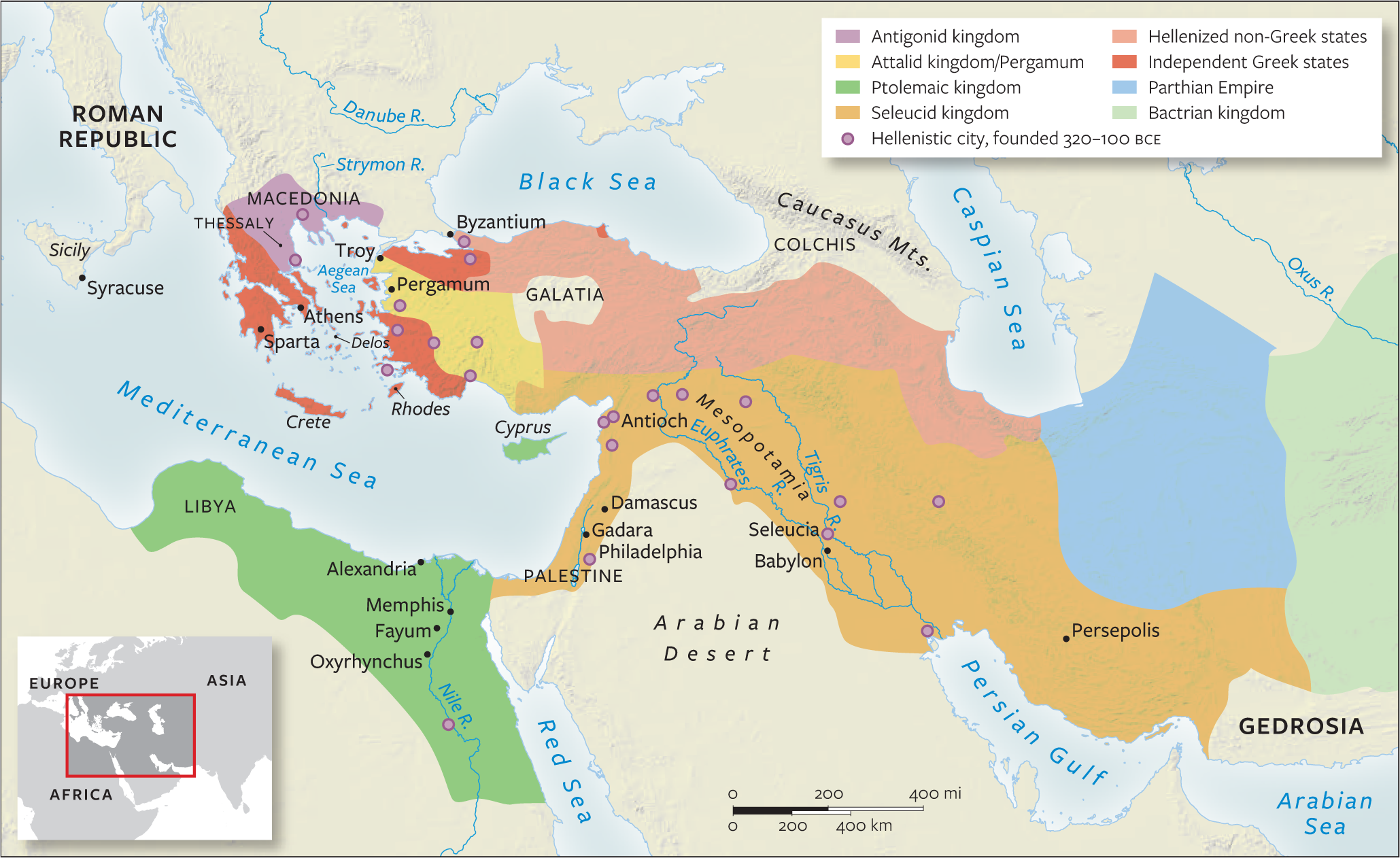
The Antigonids, for their part, ruled as something like constitutional monarchs. Their authority was unchallenged because they respected the traditions of their Macedonian subjects. They had the strongest army of the successors and used massive fortresses not so much to dominate Greece as to ensure that it would serve as a buffer, preventing the Seleucids and Ptolemies from invading their territory.
The Economic Foundations of Power
AGRICULTURE The Hellenistic kingdoms, whether Ptolemaic Egypt or Seleucid Babylon, relied on the work of rural villagers to produce vast amounts of grain—the foundation of the state’s prosperity. The Ptolemies considered themselves the true owners of all the land in Egypt. Lands outside their own estates, and those designated for use in the maintenance of temples, they assigned to officials who had served them well and to soldiers. Government officials introduced more effective agricultural methods, including irrigation, into the cultivation of especially fertile areas, such as the Fayum in north-central Egypt. They managed to push the desert back, improve yields, and create new settlements. Tax-farmers—entrepreneurs who bid for the right to gather taxes—maintained close oversight over the production, storage, and sale of wheat and other crops. Standing between landlords and villagers on the one hand and the kings on the other, tax-farmers made as much profit as possible by squeezing the taxpayers. The concerns of peasants reached the throne only in especially hard times, when mass flight from the land threatened the monarchy’s economic foundations.
A MONEY ECONOMY The grain economy and its structures were in part ancient, determined as much by the climate and geography of the Mediterranean world as by human decisions. But they now functioned within a new framework. Alexander’s successors followed his example by continuing to mint the Persian monarchs’ fabulous hoards of bullion into coin which they used, as Alexander had, to pay their troops, who came mostly from the Greek cities in the mainland and elsewhere. As precious metals filtered into the economy, each state began to depend on large amounts of coinage to maintain its military power. To ensure this supply, states and their tax-farmers insisted on collecting taxes in money rather than in kind. State revenues swelled. Alexander’s kingdom produced an income of 30,000 silver talents annually (a talent, during the Peloponnesian War, would pay the wages of a trireme’s crew for a month); Egypt, almost three centuries later, had an annual income of 12,500 talents. Sophisticated systems of exchange developed, and it was possible to write a wheat check in one part of Egypt that could be drawn from a wheat account 300 miles away.
TRADE A lively trade developed across the Mediterranean. Roads were bad during the Hellenistic period, but ships were the major carriers of cargo, and their numbers exploded. In the three centuries after Alexander’s death, the number of dateable wrecks on the floor of the Mediterranean went up 600 percent. Ship-borne commerce made possible the carriage of expensive goods from distant lands: African elephants for the Ptolemaic armies, spices from Yemen for the kitchens of the rich, olive oil and wine from Greece for homesick mercenaries and officials in Egypt, and other luxury goods from the Persian Gulf and southern Africa.
The monarchs taxed this trade, and by one scholar’s calculation the Ptolemaic government controlled as much as 40 percent of the gross national product of Egypt—as much as a typical twentieth-century government. This enormous income stream enabled the Ptolemies to build the lighthouses, fortifications, docks, and warehouses needed to create safe and efficient ports. They also developed huge warships with many banks of oars and solid decks designed to hold catapults. As ships grew larger, armies did the same. Not all of the Hellenistic states could match Egypt’s resources. But all of them could muster more sheer military force than any previous Greek state had possessed—even Athens at the height of its power.
New Greek Cities
Within these powerful new states, Greek ways thrived as never before. The spread of the Greek language and the development of a money economy helped people, goods, and ideas to circulate rapidly. The Seleucids, in particular, encouraged immigration, and thousands of Macedonians and Greeks settled in Turkey and Mesopotamia, where they founded cities by the dozen. New cities, in fact, sprang up everywhere from northern Africa to northern Afghanistan, and some turned into metropolises, such as Alexandria in Egypt and Antioch in Syria.
These cities became models of Greek architecture and town planning as well as centers of administration and culture. Massive temples, their roofs supported by great columns and their precincts adorned with sculpture, honored each city’s patron god or goddess. An agora was dedicated to public assemblies. Beside it stood a government building and a public auditorium. A second agora served merchants as a center for the exchange of goods and money. Often, the grandest complex in the city was a gymnasium or a theater, each a central Greek institution.
Alexandria, the Egyptian city founded by Alexander (who was buried there), had a Mediterranean port protected by an island, which made it a natural trading center. As the Ptolemies poured money into the city, massive public buildings took shape. These included the 400-foot-high lighthouse that took its place, in the first or second century CE, on the unofficial but widely circulated lists of the seven wonders of the ancient world. The city’s rectangular grid design was in place by the first century BCE, and probably much earlier. Two main streets more than 100 feet wide crossed the city. Immigrants whose languages and ways differed sharply from those of the Egyptian residents poured in as well, especially from Greece but also from Macedonia and Persia. A substantial Jewish population worshipped in a massive, spectacular temple. With 300,000 free inhabitants, according to one ancient account, Alexandria dwarfed even the Athens of Pericles. So did Antioch in Syria and other Hellenistic cities.
URBAN NETWORKS Whereas the Greek cities of the fifth-century BCE Classical period regarded one another with suspicion or hostility, those of the Hellenistic world did their best to support one another. They recognized one another’s gods, extended common privileges to one another’s citizens, and copied one another’s legislation. City walls fell into disrepair or were even torn down, and instead of joining military leagues, cities formed federations to maintain trading relations and protect one another against bandits and raiders. A group of Greek cities in Syria and Palestine, including Damascus, Philadelphia, and Gadara, formed the Decapolis (League of Ten Cities). Others formally recognized one another as friends, and when disputes and wars broke out, they sent their judges to serve as arbitrators. Cities also extended their power into the countryside around them, creating networks of substantial villages. The cosmopolitan urbanism of the Hellenistic period would have seemed strange to the Athenians and Spartans of the fifth century BCE.
URBAN BENEFACTORS Hellenistic cities drew creatively on Greek tradition. Athens had long depended on the trierarchs who fitted out its warships and the benefactors who staged and directed its plays. Now, in the Hellenistic period, cities also depended on “doers of good deeds.” Greeks had always loved to compete; now rich men competed to do good for their cities. They might pay for gymnasia or theaters; give the city financial capital, the interest on which could cover public needs; or help to float a loan. Individual benefactors built fountains for people and animals, and endowed the massage oil needed by athletes. Public inscriptions recorded communal gratitude for these essential services.
Soft Power in the Hellenistic World
The tradition of “doing good deeds” also governed relations among the Hellenistic rulers and their cities. Each king had a duty to support the cities in his realm, and as he did so, he set his stamp on each city. The Ptolemies, for example, made Alexandria a center for Greek thought and letters—a new Athens. Inspired in large part by Aristotle, they accomplished this by creating institutions for the pursuit of knowledge based on the model of his Lyceum, equipping them with the resources needed for research. Late in the fourth or early in the third century BCE, one of the Ptolemies founded a Museum—literally a temple of the Muses, the Greek goddesses who supposedly inspired poets, historians, and artists. There they established a learned society of literary men and philosophers who were paid not to teach but to carry out research on a broad range of questions, from the size of the earth to the meaning of obscure passages in Homer’s epic poems.
THE LIBRARY OF ALEXANDRIA The vast library that the Ptolemies created, and where some of these scholars worked, has become, like Alexander the Great, a legend—one far greater, in many of its versions, than the historical original. Yet the reality was extraordinary enough. The Ptolemies and their agents tried to assemble the entire corpus of Greek literature, and they succeeded in amassing some 700,000 papyrus scrolls. (Parchment—paper made from the skins of animals—was made from the second century BCE onward, but papyrus remained the normal writing material.) A law required ships calling in Alexandria to surrender all their books to the library. Those that were not already in the collection were kept, and the library provided copies for their original owners. To obtain the most accurate texts possible of the three great Athenian tragedians—Aeschylus, Sophocles, and Euripides—the library made a huge deposit, borrowed the official copies from the city of Athens, and then cheerfully forfeited the money in order to retain the precious Athenian books. Forged books, some created specially to meet the new demand for works of literature by the most famous Greek writers, accompanied the genuine ones into the library’s warehouses, and then into the cupboards where scrolls were kept.
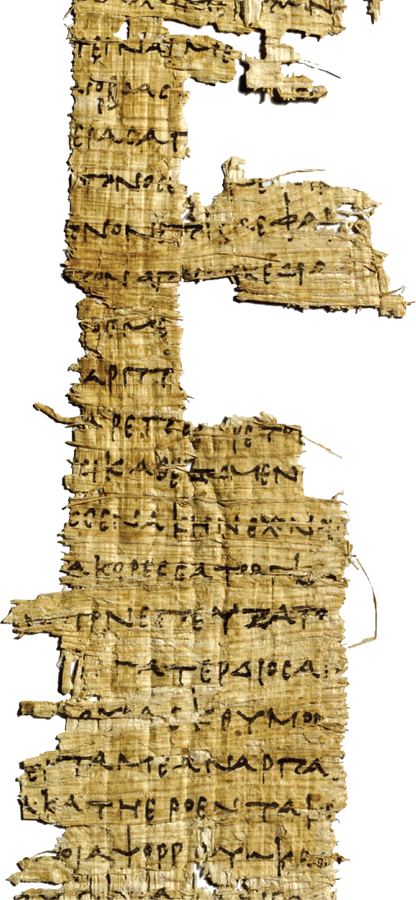
The Ptolemies found ways of dealing with efforts at deception. They appointed expert scholars to catalogue the collection—afirst—and to sort the genuine from the forged works attributed to each author. One of these men, the poet Callimachus (ca. 305–ca. 240 BCE), is remembered as the patron saint of librarians for his remark, “A big book is a big pain.” Several of them worked especially hard on the Iliad and the Odyssey, trying to correct the errors and remove the inauthentic verses that had entered both texts over the centuries.
FESTIVALS The Ptolemies undertook all this religious and literary activity partly because they, too, believed in the value of “doing good deeds.” Yet they also saw such patronage as a way to establish the prestige and power of their royal line, which was a new dynasty, after all, in a land that prided itself on being ancient and never changing. From early in the third century BCE, the Ptolemies staged a spectacular procession in Alexandria every four years to honor the Olympian gods. The procession in honor of Dionysos, the god of wine, was particularly spectacular. Men dressed as creatures from Greek myth were sent out in scores to restrain the crowd. They were followed by the priest of Dionysos, musicians, and a train of decorated carts, each grander than the last. One bore an eighteen-foot statue of the god reclining on an elephant; another carried a mechanical contraption in the form of a woman who stood up, poured a libation of milk from a gold vessel, and sat down again. Hordes of animals—including birds, Indian and Ethiopian cows, a pride of lions, and an Ethiopian rhinoceros—and staggering crown jewels filled in the display.
Though costly, such festivals were effective ways for the Ptolemies to assert their wealth and power—both to the Egyptians who watched their new Greek masters and gods parade through the streets of Alexandria, and to foreign nations whose diplomats witnessed the magnificent show. The Ptolemies used such displays to support the cult of their dynasty, each member of which claimed the status of a god. This was the foundation of the loyalty they commanded from aristocrats, soldiers, and priests.
A New Greek World
Royal support and trade made Alexandria into something like an ancient counterpart to twentieth-century Paris or New York—a world city, rich, impressive, and cosmopolitan. No other city matched it. Throughout the Greek world, rulers saw, as the Ptolemies did, that the soft power of culture could solidify their hold on their thrones. The Attalids, for example, although they asserted their independence from the Seleucid dynasty, also emulated the direct descendants of Alexander. They built a vast temple complex and an enormous library at Pergamum. They, too, employed scholars to study the Greek poets. As Greek styles of building spread across Central Asia to India, across Egypt to northern Africa, and up into Afghanistan, Hellenistic institutions accompanied them.
Though Greek in language, systems of exchange, and literature, the Hellenistic world was genuinely new. Hellenistic states differed fundamentally from earlier Greek states. They were massive, exerted control over many spheres of activity, and squeezed vast resources from their subjects. The royal will was decisive in a way previously unfamiliar to the Greeks. The distance between subjects and rulers was greater than before. In some ways the Hellenistic states resembled those of the ancient Near East more than the earlier Greek states. In other respects, though, Hellenistic life offered new possibilities for segments of society—especially, as we will see, for well-born women.
- Ptolemies
The dynasty established by Ptolemy that ruled a Hellenistic kingdom in Egypt for nearly three centuries (305–30 BCE) as a successor to Alexander’s empire. The Ptolemies epitomized the features of Hellenistic rule, as their society fused Greek and Egyptian customs, language, and institutions.