SEDENTARY SOCIETIES: THE FIRST PERMANENT SETTLEMENTS
While their cousins were still roaming the world, a few people began to settle down. In several places around the globe, they began to do so at roughly the same time. The first few formed settlements toward the end of the Ice Age, and then more followed after the end of the Younger Dryas. The best places to settle were along the migratory routes of nutritious beasts: let the food come to you, rather than chase after it.
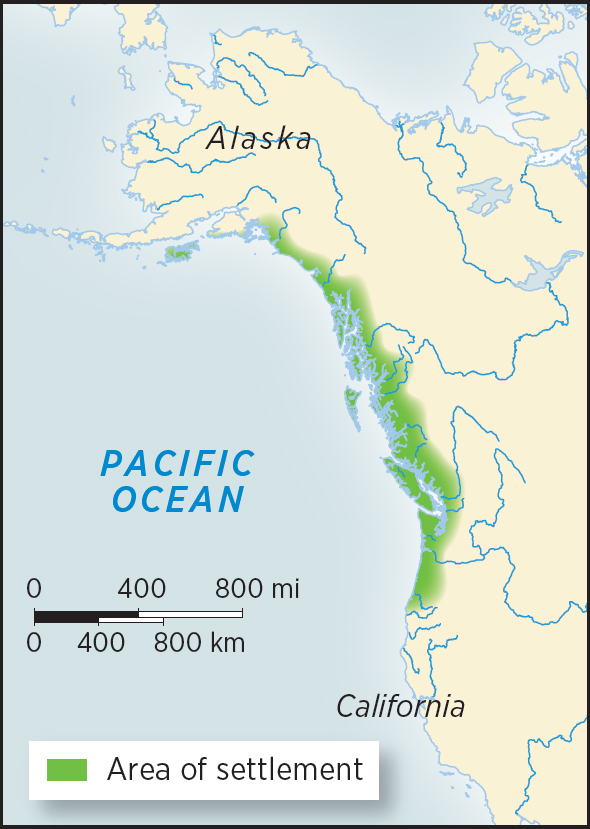
FOOD SOURCES AND THE EARLIEST SETTLEMENTS
People could do this only in a few places—for example, alongside the salmon rivers of the North Atlantic and North Pacific. Salmon swim up rivers to spawn in seasonal mass migrations that allow anyone with a net, the appropriate knowledge, and hand-eye coordination as good as a grizzly bear’s to stand beside a stream and harvest a year’s food supply in just a few weeks. The salmon runs are reliable and abundant in certain rivers, especially those from Alaska to northern California. This Pacific coastal region provided an ideal environment for sedentary life, and by about 6000 BCE—to judge from archeological remains—people had begun to settle down along several salmon rivers in western North America. Salmon harvesting also played a large role in the food supply of early post-glacial settlers of Scandinavia and the British Isles, but Atlantic salmon rarely run in the same profusion as their Pacific cousins, and therefore provided a poorer basis for sedentary life.
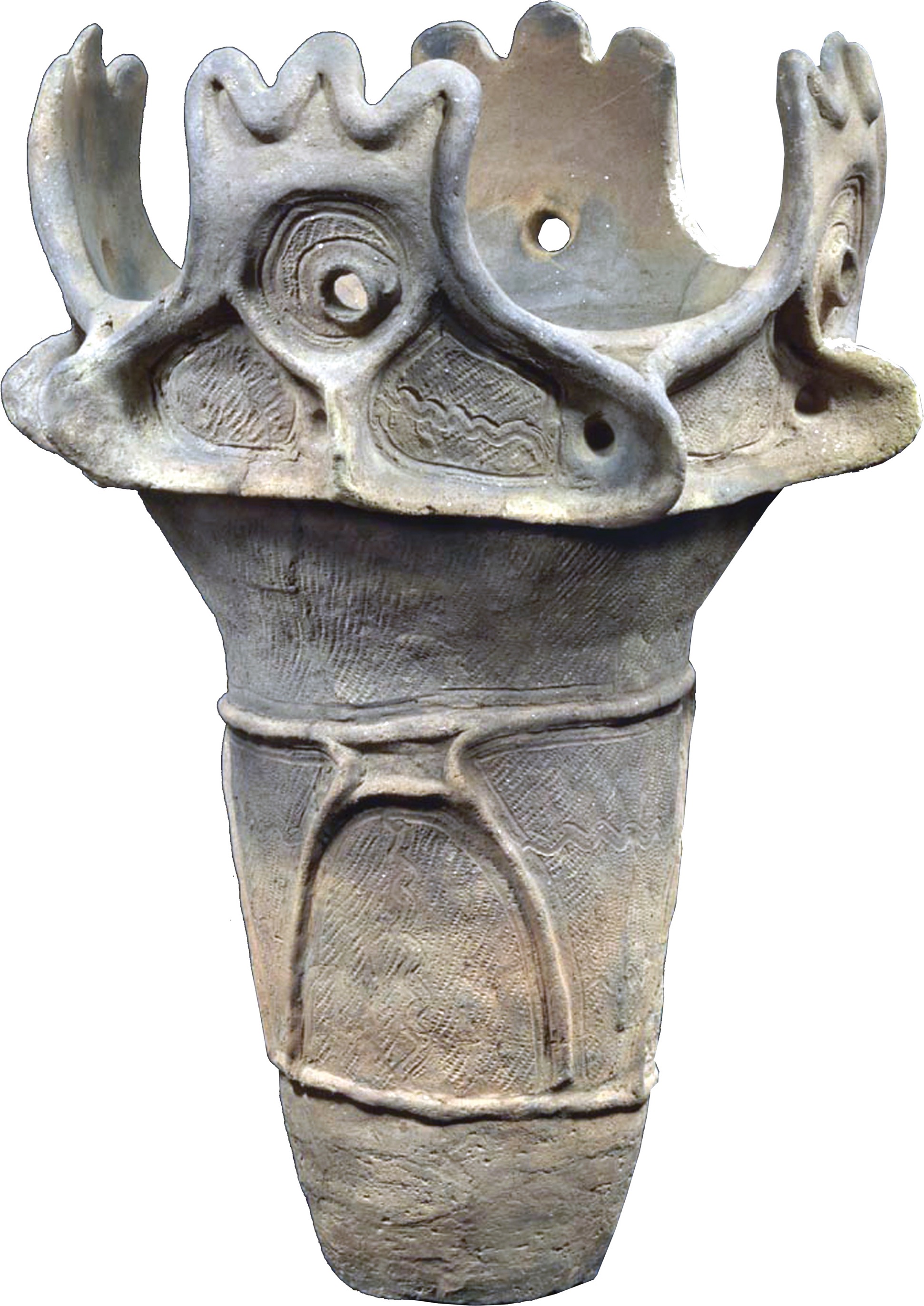
JOMON CULTURE On the western shores of the Pacific, in Japan, sedentary life also emerged in what archeologists call the Jomon culture. (In Japanese, the name refers to the rope-pattern decoration on pottery characteristic of this culture.) By about 7000 BCE, these people had found it possible to settle down, especially on the Pacific coast of east-central Japan, blessed with plenty of shellfish, fish, acorns, and chestnuts. They collected these foods but also hunted deer and other animals. The Jomon were among the first inventors of pottery in world history, even though they had no kilns or potter’s wheels—they made their pots by hand and fired them in bonfires. Their earliest pottery seems to be about 13,000 years old, but they didn’t make it in quantity until they became sedentary in their way of life. They lived in oval houses built over pits dug into the ground, and they used chestnut wood (among other types) to make dwellings, canoes, and shoes. They may even have planted chestnut trees. The Jomon attained an unusually high population density for a foraging people.
GÖBEKLI TEPE Recent archeology has turned up a curious case of sedentary or semi-sedentary life in southeastern Turkey at Göbekli Tepe. About 9000 BCE, semi-settled people (meaning they spent most but not all of each year in one spot) started doing something that no other pre-farming people anywhere on Earth did: building a large stone temple. Using only stone tools, they quarried blocks of stone weighing as much as 10 to 20 tons; dragged them several hundred yards; carved boars, ducks, snakes, and other wild animal shapes into them; and assembled them into a temple. These people had no draft animals. They needed at least 500 individuals working together to lug such big blocks of stone, and they fed themselves without agriculture. Göbekli Tepe is, as far as we know, a unique case of monumental architecture created by a hunting and foraging people.
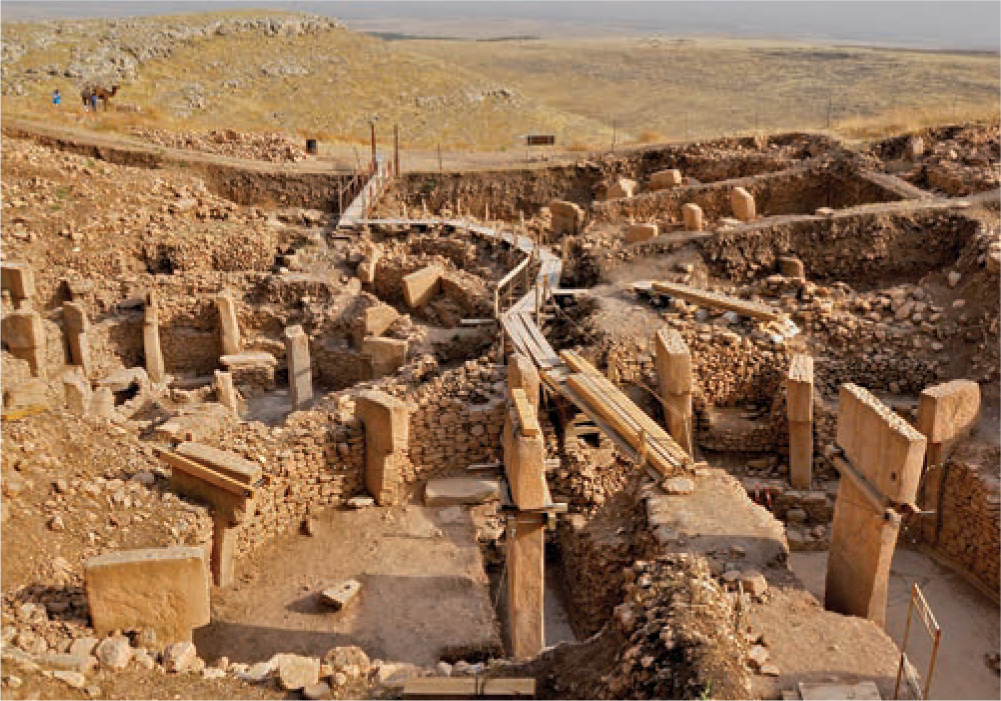
The best guess is that Göbekli Tepe is a religious site and gathering place built by semi-settled villagers who inhabited a landscape abundant with wild wheat, the result in part of warm and lush conditions that prevailed following the Younger Dryas. The choice of the site may have had something to do with its location between the plains of Mesopotamia and the mountain passes that gave entry into Anatolia. It stood beside trade routes. But by 7000 BCE, the site was abandoned—indeed, purposely buried in rock and debris—until archeologists started scratching around in the twentieth century. Nobody knows why people abandoned it. The temple at Göbekli Tepe shows that semi-settled people could organize their efforts on a substantial scale. Since 95 percent of the site remains to be excavated, we should expect to learn much more in the years ahead.
MAMMOTH HUNTERS OF UKRAINE The best places to settle down were beside salmon rivers, along coastlines rich with shellfish, or on rare patches of land flush with edible wild plants. A more dangerous and less reliable environment for settlement was along the migration routes of big mammals, such as the now-extinct wooly mammoths. Huge, shaggy beasts related to elephants, mammoths could provide hunters with plenty of food as well as leather and wooly clothing—the height of Eurasian fashion during the depths of the Ice Age.
The earliest evidence of sedentary lifestyles anywhere comes from the mammoth hunters of Ukraine, the region to the north of the Black Sea. They may have been only semi-sedentary, spending a few months at a time in the same place—no one knows for sure.
Scholars use the term mammoth steppe to refer to the region south of the glaciers, from France to eastern Siberia, where during the Ice Age summer grasses sustained sprawling herds of mammoths. As the Ice Age waned, the mammoths drifted northward, allowing skilled mammoth hunters to follow and flourish in otherwise forbidding landscapes. Mammoths probably migrated with the seasons along well-worn paths, especially river valleys. This made them easy to find and enabled teams of spear-wielding hunters and their families to stay put, especially after they learned to dig pits in the autumn and freeze meat for later roasting during the bone-chilling winters.
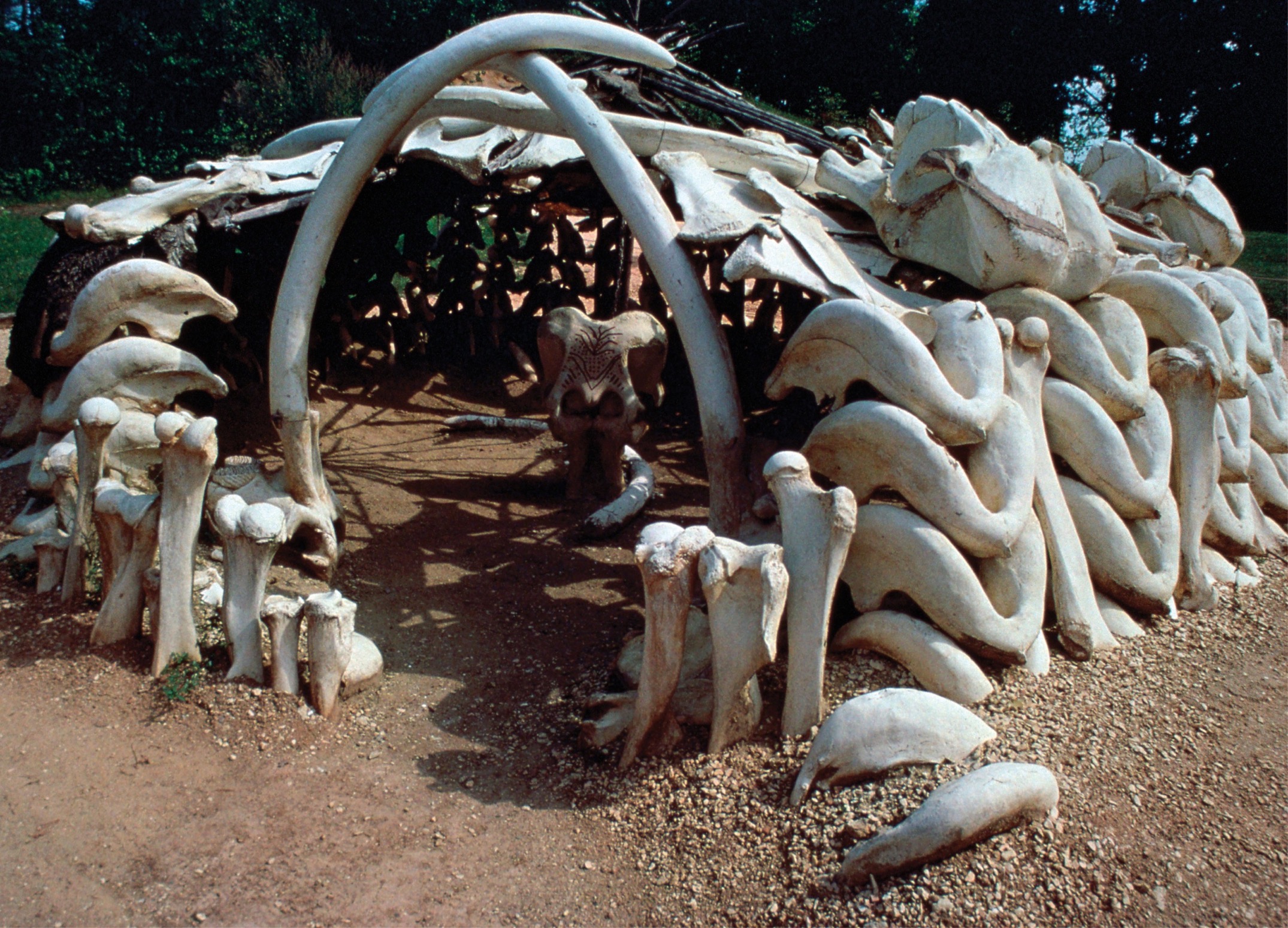
The mammoth hunters ate mammoth meat to stay alive, and to stay warm they lived inside shelters made of mammoth bones and skins. Around 27,000 years ago—during a cold phase of the last ice age—they began to build houses using mammoth tusks, ribs, and leg bones as the equivalent of construction timber. Carefully arranged and covered with hides, these materials made cozy dwellings against the cold. Archeologists have found about 70 of these mammoth-bone huts. The largest is over 190 ft. (60 m) long and 16 ft. (5 m) wide and must have housed scores of people. Whether people lived in this mammoth-mansion year-round is unclear. By 15,000 years ago along the Dnieper River in today’s Ukraine, clusters of mammoth huts developed—perhaps history’s first villages.
The mammoths died out 12,000 years ago. One likely explanation is that mammoth hunters were too skillful and killed off their favorite prey. It’s also plausible that warmer climate opened habitats to other herbivores, such as deer, that competed successfully against mammoths for edible vegetation. The huts of these inventive hunters were abandoned, to be discovered by archeologists only in the twentieth century.
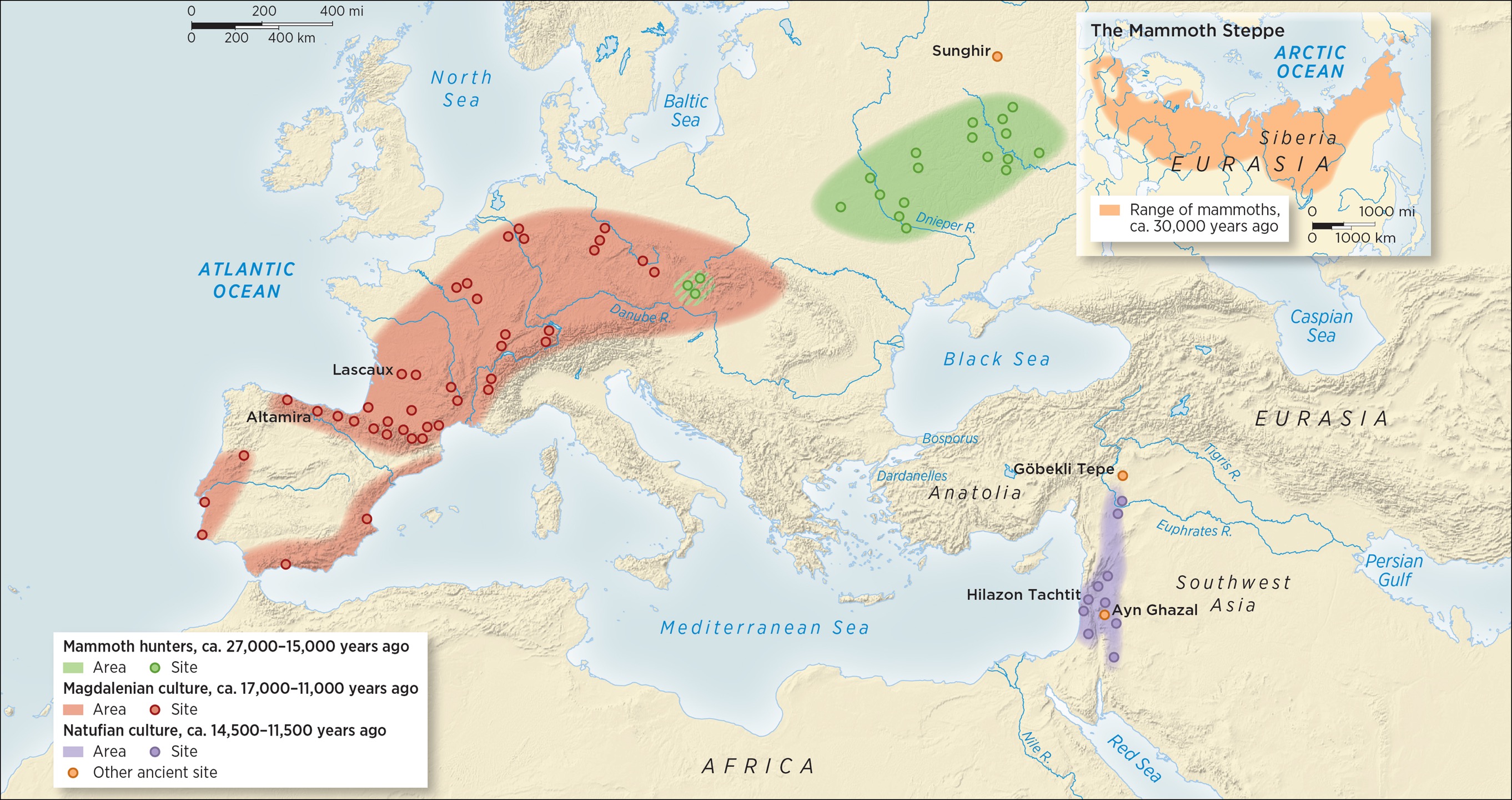
MAGDALENIAN CULTURE The mammoth hunters weren’t alone in settling down to make a living off of herds roaming the steppe. To their west between 18,000 and 12,000 years ago lived groups of reindeer hunters known to archeologists as the Magdalenian culture, named after a particular rock shelter in France—although the Magdalenians left archeological remains scattered between Portugal and Poland. These people hunted reindeer with the same general approach used by mammoth hunters: intercepting seasonal migrations. In staking out migration routes, they became at least semi-sedentary. Like the mammoth hunters, they varied their diet by hunting deer and wild horses too. They supplemented their meals with whatever nuts, fruits, and berries they could find in their chilly surroundings. Edible plants were rare, but the Magdalenians were clever and bold. They ate partially digested reindeer lichen (a small, bushy-looking fungus) scooped out of the stomachs of freshly killed reindeer.
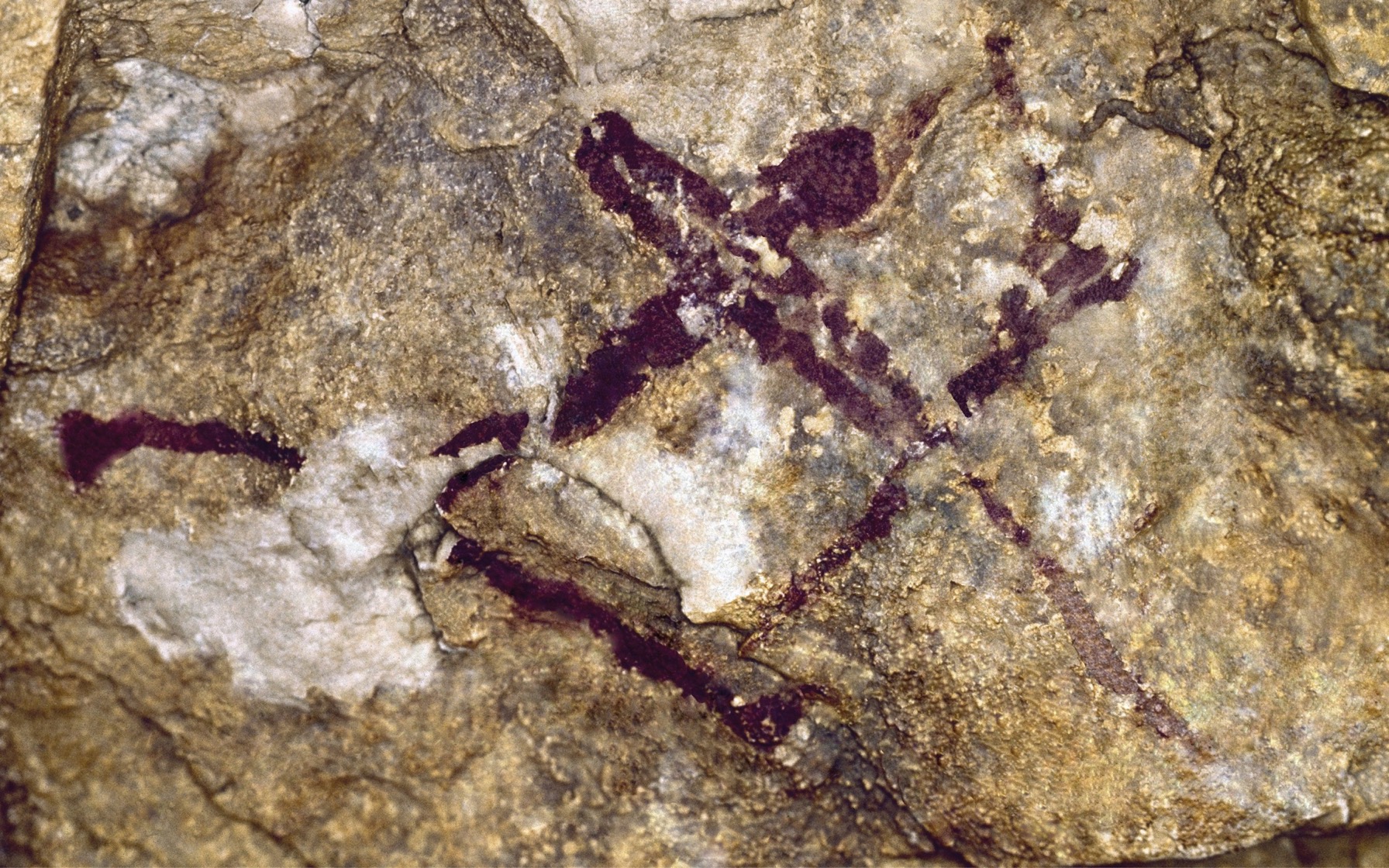
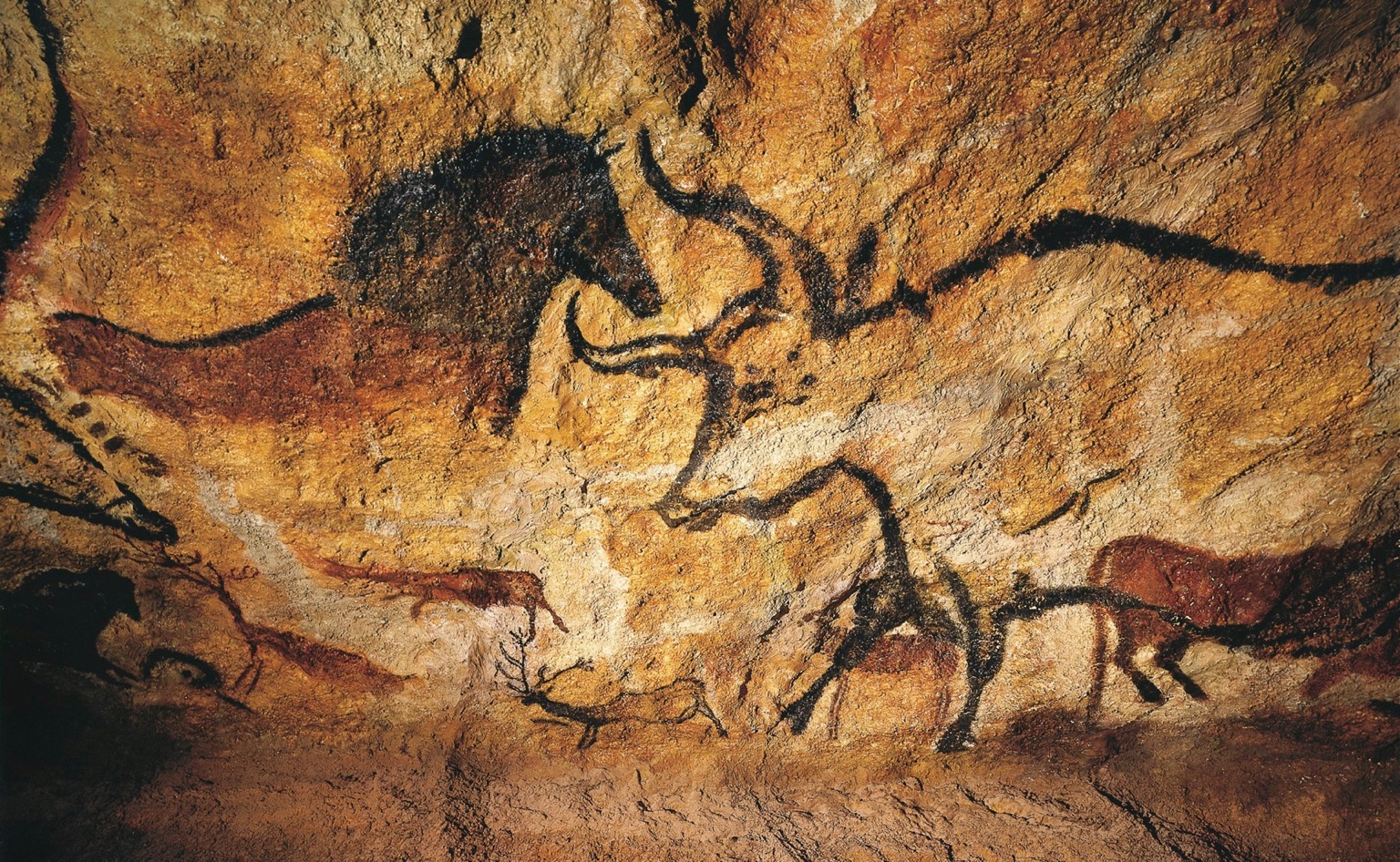
Settled or semi-settled life allowed new possibilities unavailable to peoples constantly on the move. Some Magdalenians in what is now France and Spain spent at least part of their time in caves, including the famous ones at Lascaux, where they painted some of the most stirring images known to history. The salmon eaters of North America staged rituals known as potlatch, which included competitive feasting and gift giving in quests for social status. The mammoth hunters accumulated jewelry, statuettes, baskets, and needles, and they seem to have pioneered a society stratified by social class: burials as well as house sizes indicate that some people had far more accumulated wealth than others. In the several spots where settled life became feasible at the end of the Ice Age, cultural revolutions took place: people had more leisure time to create new art, tools, and rituals, and they no longer had to limit their possessions to an amount they could conveniently carry.
SEDENTARY COMMUNITIES AND CULTURAL CHANGE
The scattered sedentary or semi-sedentary communities were hubs of social and cultural activity, loosely connected by the movements of mobile hunting and foraging peoples. In effect, the mobile peoples served as the threads on the very faint web of interaction that kept almost the entire human race in sporadic contact. The settled and semi-settled communities served as hubs of innovation. Their cultures grew more elaborate not only because they stayed put for all or most of the time, but also because they received influences from distant communities through contacts with mobile hunters and foragers. The mobile peoples—still the demographic majority even as recently as 8000 BCE—could serve as messengers, transmitting, for example, technologies such as the bow and arrow.
Sedentary life, paradoxically, spurred the mobility and exchange of objects. Before any groups had settled down, everyone had pretty much the same small set of tools and clothing, and more or less the same skills with which to make them. People didn’t have much else. Nobody carried trade goods around because they didn’t know when they might meet up with others, and they rarely met others who didn’t already have the same few items. But with the advent of sedentary life, people created more, and more varied, objects—tools, ornaments, maybe different kinds of clothes. Mobile people of the late Paleolithic could count on finding food, water, shelter, and probably a warm welcome at fixed places, so they had good reason to carry around rare things that other people really wanted. Among those items were flints for making fire, shells for decoration or cutting tools, and obsidian, a hard rock that can be fashioned into an excellent cutting edge.
These items often show up in archeological sites far from their points of origin, giving evidence of long-distance trade. For example, at an archeological site in Jordan (Kharaneh IV), where sedentary or near-sedentary people lived 19,000 years ago, scholars have found shells used as ornaments that came from the shores of the Indian Ocean, more than 1,200 miles (2,000 km) away. No doubt traders also carried more perishable goods that haven’t lasted. In short, sedentary life created a class of mobile traders who built webs of communication and exchange among communities of settled folk.
Glossary
- sedentary
- A term that describes people who stay in one place and form settlements instead of moving around.
- Jomon culture
- A group that became sedentary around 7000 BCE, mostly along the east-central Pacific coast of Japan. They lived off of shellfish, fish, acorns, and chestnuts and were among the first inventors of pottery.
- Göbekli Tepe [goh-behk-LEE teh-peh]
- A site in southeastern Turkey; likely a religious temple that a sedentary or semi-sedentary group built around 9000 BCE and abandoned by 7000 BCE.
- Magdalenian culture
- A semi-settled group that lived between Portugal and Poland and intercepted seasonal migrations of reindeer for sustenance. Magdalenians painted the famous cave art at Lascaux and Altamira.