As we’ve seen, the first settled societies appeared in scattered locations around the world, and the first domestication—of dogs—occurred somewhere in Eurasia. The first farming community—both sedentary and based on domestication—probably appeared in the Levant, along the eastern shore of the Mediterranean and its hinterland, about 13,000 years ago (11,000 BCE). The Levant forms the western edge of the Fertile Crescent, which encompasses a boomerang-shaped zone in Southwest Asia from the Red Sea northward along the Rift Valley and the Jordan River valley, curving around to the middle and southern reaches of the Tigris and Euphrates. The latest evidence suggests the possibility that several farming communities popped up here and there throughout the Fertile Crescent at roughly the same time. After farming got under way in the Fertile Crescent, agriculture soon emerged independently in several other parts of the world.
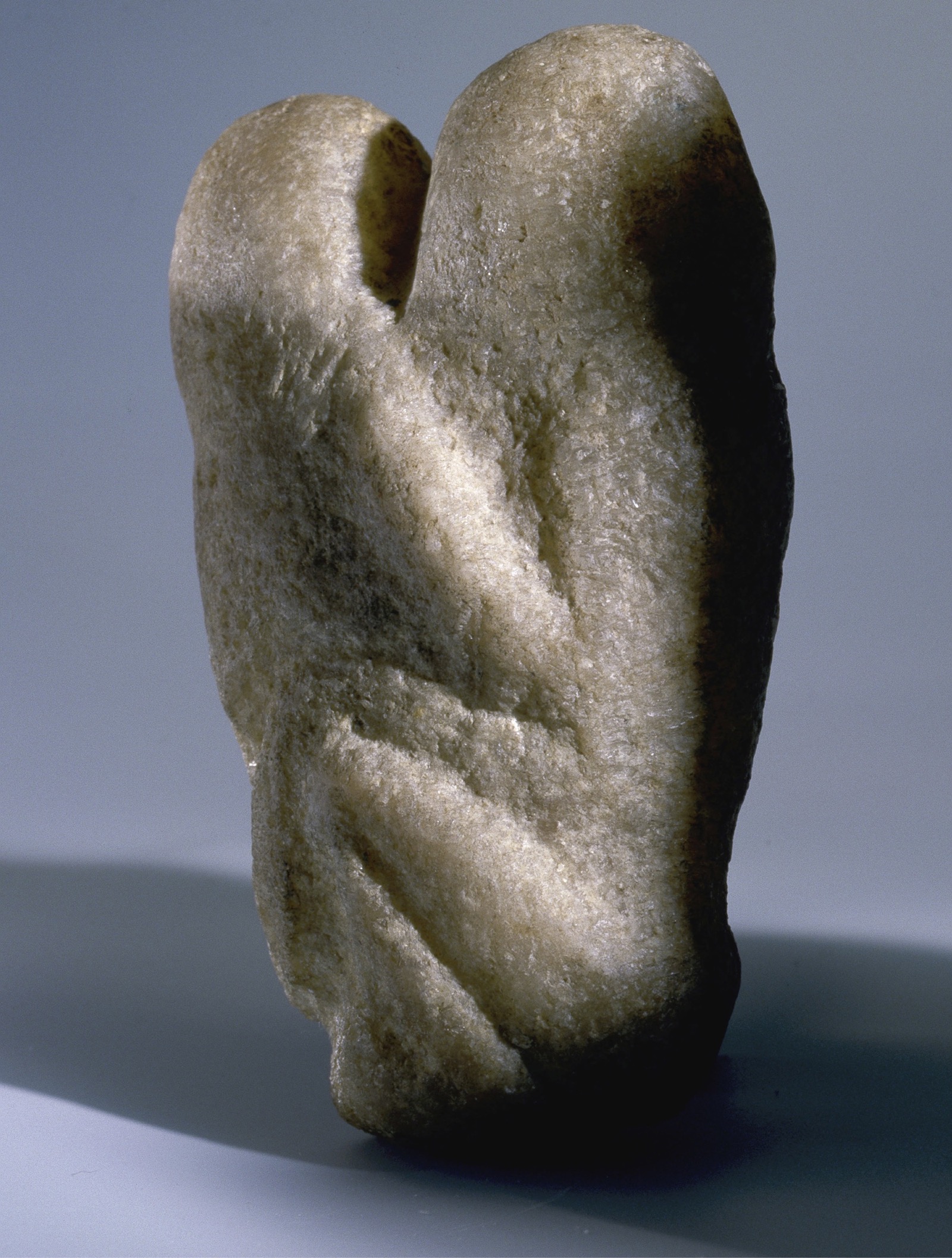
Processing Food This 11,000-year-old mortar and pestle from the Natufian culture would have been used to grind seeds or grains into powdery, edible forms. Sedentary peoples had the time and could create the tools necessary to process foods that couldn’t be eaten otherwise.
FAVORABLE CONDITIONS
As the Ice Age gave way to warmer and damper climate, both before and after the Younger Dryas, plant life flourished. Forests overgrew steppe and scrubland, deserts retreated, and rivers rose. In many locations, these were favorable trends for people, enabling some groups to settle down and live off newly abundant local plants and animals. In many spots in Southwest Asia, for example, there were now plenty of acorns, almonds,and grasses with edible and storable seeds. Grasses ancestral to wheat and barley spread like weeds with the changing climate, and their seeds provided 50 times more calories than a person burned in gathering them. Gazelles and other tasty herbivores provided meat. The scant evidence suggests that population across Eurasia rose, perhaps quintupling from 16,000 to 12,000 years ago, as climate warmed and foraging became easier. In a few favored locations, including the Levant, the locally abundant food made it possible for foragers to settle down.
Settled Peoples New artistic techniques, and more substantial forms of art and architecture, flourished among populations who became sedentary after the development of agriculture. The people who lived at ‘Ain Ghazal in the Levant around 9,000 years ago made this statue, one of the first large-scale representations of a human.
SETTLED POPULATIONS Settled populations tended to grow far faster than mobile ones. Parents didn’t have to lug children long distances and so were less inclined to try to prevent their birth or abandon babies. Where people collected the seeds of wild grasses, they could mash the seeds into gruel and feed it to babies, weaning infants from their mothers’ milk at a younger age. Since lactating women are much less likely to conceive, early weaning meant that mothers became fertile again sooner. The intervals between births tended to be shorter among settled people than among mobile ones.
But population growth among the settled folk gradually caused difficulties. More hunting thinned the numbers of big animals. In the Levant, for example, archeologists have found that people were hunting smaller and smaller animals as time went on—fewer gazelles and more rabbits. In many parts of the world, the standard solution for food shortage remained practical: walk somewhere else. But for settled folk with accumulated possessions, lots of small children, and perhaps spiritual and emotional commitments to preferred places, this approach was less practical. Instead, people intensified their quest for food, especially in circumscribed places such as the Levant (located between a rising sea and a desert), the Nile valley in Egypt (surrounded by desert), and China’s Yangzi valley (surrounded by steep hills). Rather than walk elsewhere, they foraged for a wider variety of plants, hunted more kinds of animals, and began to work spreading the seeds of preferred plants such as wild wheat and rice. Such efforts probably took place elsewhere as well, but the archeological record is so spotty that no one knows for sure.
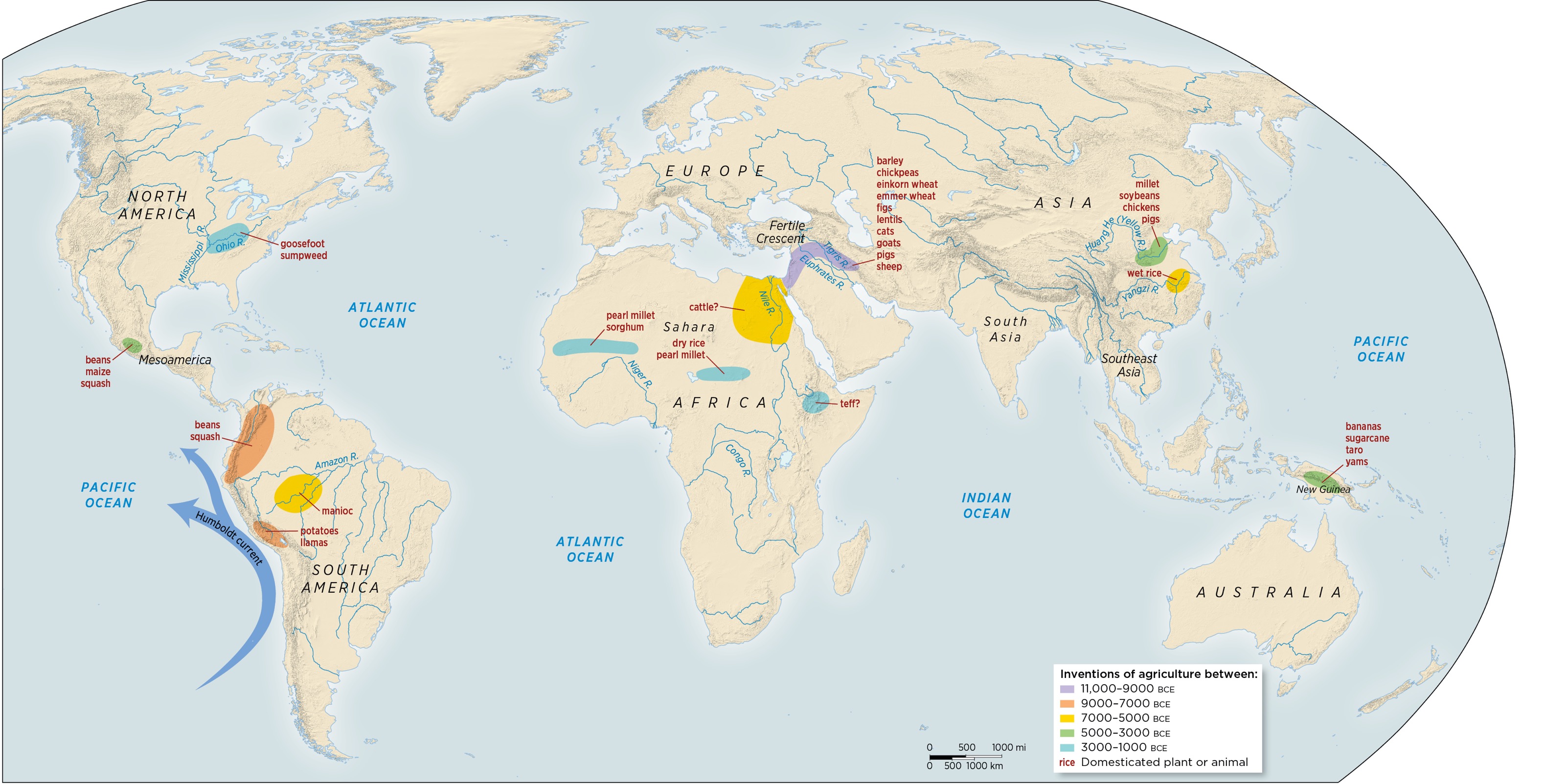
Inventions of Agriculture, 11,000–1000BCE After living from foraging, fishing, and hunting for more than 250,000 years, humans invented agriculture at least seven times, and probably more, after the end of the last ice age. The earliest of these occurrences, as far as we know, took place in the Fertile Crescent of Southwest Asia.
INTELLIGENCE AND CLIMATE Not long ago, scholars used to wonder why everyone didn’t take up farming. Now scholars wonder why anyone did. Farming turns out to involve more work than foraging and hunting, and it usually results in worse nutrition and worse health. Yet after more than 200,000 years without bothering to farm, shortly after the end of the Ice Age humans undertook at least seven transitions to farming on four continents. This seems most unlikely to be a random turn of events. Two important factors may help bring us closer to an understanding of what triggered the change: intelligence and climate.
Turning to a way of life that brings poorer nutrition and health yet requires more work may not seem a hallmark of intelligence, yet it surely did take intelligence to notice which plants grow best in which sorts of places, which ones yield easily edible seeds, which seeds store well, and so forth. Developing this sort of knowledge required communication—language—as well as powers of observation, memory, and reason. So it couldn’t have happened before modern, intelligent, language-wielding humans were on the scene.
Depending on when language emerged, there were either no or very few such humans around before the onset of the last ice age 130,000 years ago. During that ice age, conditions were too dry or too cold for agriculture outside of tropical locations, sharply reducing the chances that people would make a transition to farming successfully. And within tropical latitudes, the yield from foraging, hunting, and fishing was usually sufficient, so people didn’t bother with domesticating plants. The existence of intelligent, language-bearing humans living outside of lush environments yet enjoying interglacial climate, then, seems a likely prerequisite for transitions to agriculture. That might explain why no transitions to agriculture took place before the retreat of the ice.
THE PIVOTAL ROLE OF WOMEN One thing most scholars agree on is that agriculture in its earliest stages was women’s work. As far as we know, in most hunting and foraging societies women and children specialized in gathering useful plants for food, medicines, or fibers. Adult women presumably were the most knowledgeable about the habits of helpful plants. Although there’s no direct evidence for this, women presumably pioneered the transition from merely collecting plants to deliberately sowing the seed of desirable types of plants, and the further transition to sowing the seed of specific, individual plants with desirable characteristics. It seems highly likely, then, that one of the hallmark transformations of the human condition began with a change in women’s approach to the task of getting food for their families.
Women’s Work A ca. 4000 BCE statue from the Negev Desert in present-day Israel shows a woman carrying a pot, reflecting the role women played in procuring food and water in sedentary communities.
OTHER CONDITIONS Two further conditions for the emergence of agriculture also seem sure. First, only sedentary people would try to farm. Roving bands had no good reason to plant seeds, or save seeds for next year, since they couldn’t be sure they would come back to their plantings or that others might not reap their harvest first. The only other species that cultivate—those termites and ants that raise fungi—are also sedentary. Second, in every case, agriculture developed gradually over several centuries, and the people involved didn’t know they were undertaking a momentous shift. They were tinkering, experimenting, trying to improve their food supplies or reliability, or perhaps just trying to hold on to what they had in worsening circumstances.
THE FIRST TRANSITION TO AGRICULTURE: THE FERTILE CRESCENT AND THE LEVANT
The transition to agriculture that scholars know the most about is probably the earliest. It occurred in Southwest Asia, somewhere in the Fertile Crescent, probably on its western edge in the Levant, just inland of the eastern shore of the Mediterranean. Archeological evidence suggests that the earliest plant domestications took place here beginning around 11,000 BCE. Thereafter, more and more humans increasingly relied for their food on specific sorts of grass seed.
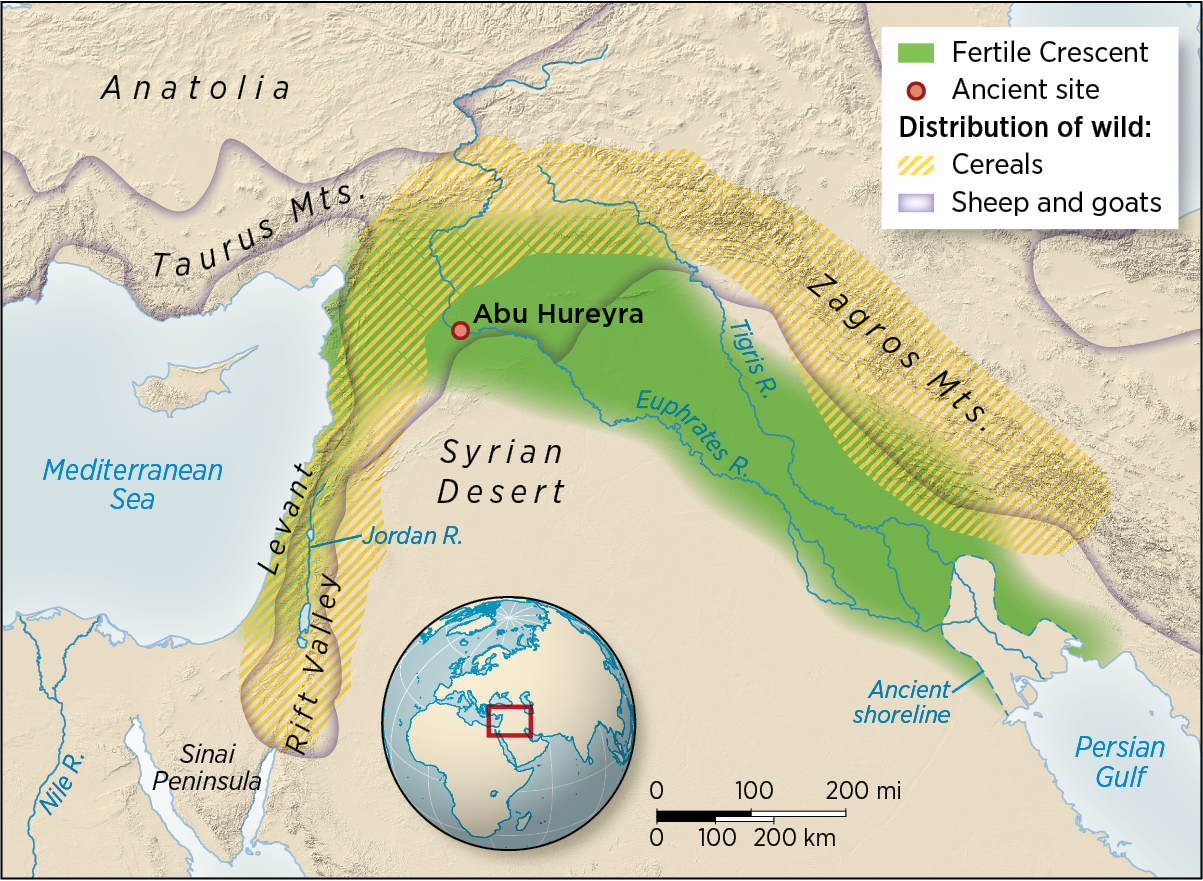
The Fertile Crescent isn’t really crescent-shaped, and much of it wasn’t especially fertile in soil nutrients. But it supported potentially domesticable food plants such as wheat and barley, and several domesticable herd animals such as sheep and goats. And the region offered fine gradients of climate owing to the interplay of air masses and elevations. People didn’t have to walk far to move from one microclimate to the next. This could have contributed to plant domestication by enabling people to go only a little ways to take a plant out of its natural range and place it where it needed human help to reproduce.
THE NATUFIANS: ENVIRONMENTAL REFUGEES After a few millennia in which climate grew warmer and wetter, the sudden shock of climate change in the form of the Younger Dryas cold snap hit around 10,700 BCE. For mobile people, this was a challenge, but one that they could meet by walking to warmer latitudes. For settled peoples, it was a crisis. One such people was the Natufians.
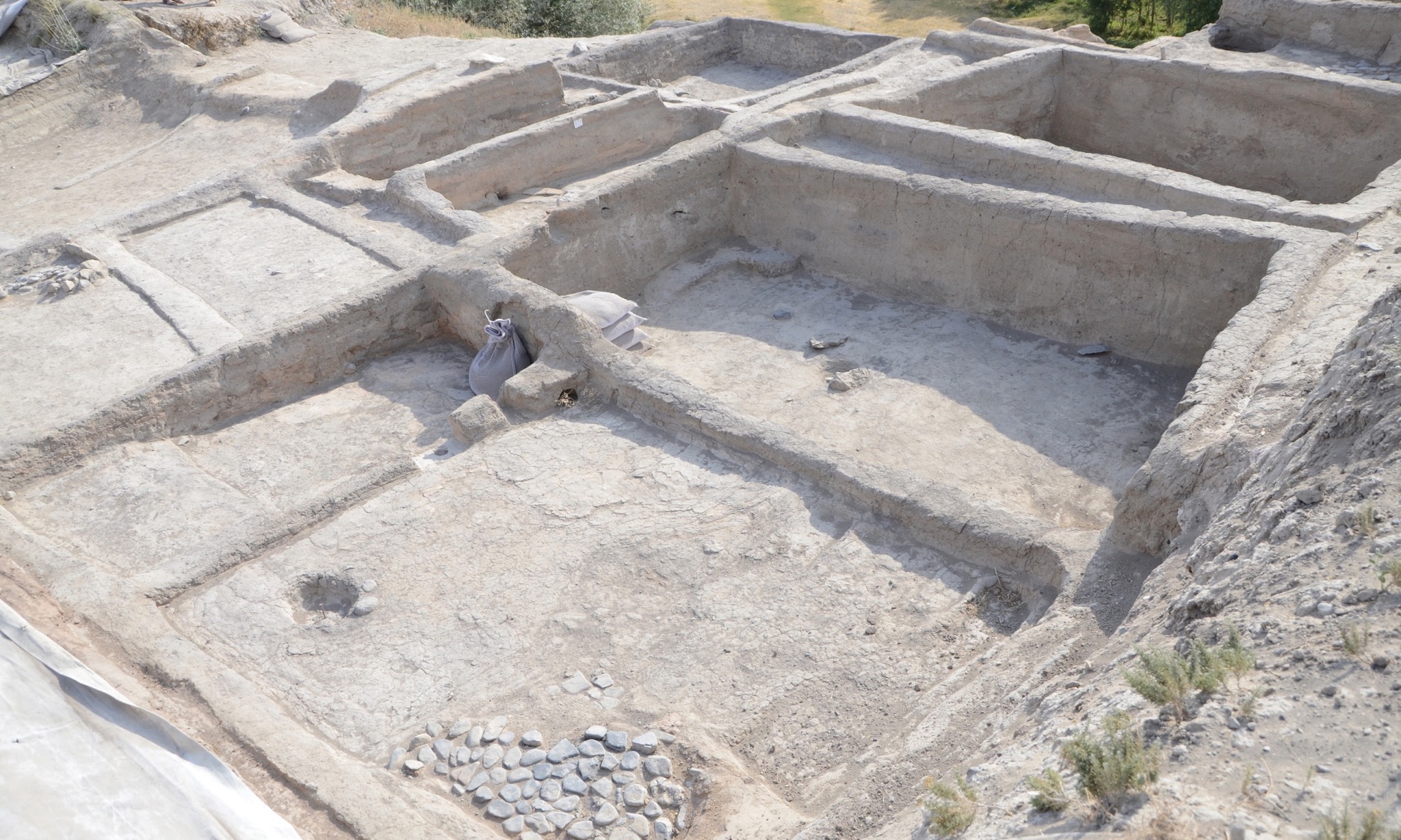
With the onset of the Younger Dryas, the 100 or so plants that the Natufians relied on became less reliable. The gazelles, sheep, horses, deer, and boar that they liked to eat grew rare because the grass and shrubs the animals fed on became scarcer. Populations of settled folk declined, and many of them became, in effect,environmental refugees, crowding into oases and riverbeds where there was still enough moisture and warmth for plant growth. (Some Natufians became migratory, although they continued to return to old villages, which they used as cemeteries.) The refugees may have brought seeds with them and sowed them in new settings. In one such location, Abu Hureyra on the Euphrates River in what is now northern Syria, there is spotty archeological evidence of cereal cultivation—not yet domestication—undertaken by Natufians from as early as 11,000 BCE.
As climate cooled down and dried out with the Younger Dryas, food plants withered. Gazelles and other hunting targets grew scarce. The Natufians increasingly sowed einkorn, emmer, and barley—wild grasses that would still yield a harvest in dry conditions. Over generations, they chose to sow and harvest the plants that yielded best. They probably also selected for softer husks, which made getting at the seed easier. With their choices they were slowly creating new plant species, including what we now call wheat and rye.
FIGS, CATS, GOATS, AND SHEEP Soon after domesticating cereals, peoples of the Fertile Crescent began to cultivate and then domesticate figs, chickpeas, peas, and lentils. They also domesticated wild animals, with cats perhaps coming first. Genetic evidence suggests that Arabian wild cats are the ancestors of today’s pet cats. Around 11,000 to 8000 BCE, when the Natufians were keeping piles of grain, they indirectly created paradises for mice. The lucky mice gorging themselves on stores of Natufian grain attracted wild cats, which ate the well-stuffed mice. Natufians connected the dots: more cats, fewer mice, more grain. Their protection of cats over centuries produced increasingly domesticated cats, comfortable with humans and good at protecting grain by catching mice.
Livestock The people who lived at Aşıklı Höyük in Anatolia (today’s Turkey) about 10,000 years ago kept sheep and other animals in pens in between their mud-brick houses, one of the earliest known examples of the domestication of herd animals.The Fertile Crescent The first transition to agriculture (as far as we know) took place somewhere in the boomerang-shaped region encompassing the valley of the Tigris and Euphrates Rivers and the coast of the eastern Mediterranean Sea. The earliest evidence of farming we have at present comes from Abu Hureyra.
The domestication of goats and sheep began between 11,000 and 9000 BCE, soon after the first plant domestications. People captured juveniles, raised them, and protected them from predators. Like dogs, wild goats and sheep had (and have) a social structure, and most animals follow a leader. Human herders in effect replaced the dominant rams as leaders of the flock. Once people controlled which animals reproduced and which ones did not, they could breed for desired characteristics such as docility, thick wool, and abundant milk. By killing the most defiant males and allowing only the more docile ones to breed, people gradually produced more submissive sheep and goats. They did the same with pigs starting around 8500 BCE, and cattle a few centuries later. The most important farm animals in most of the world—pigs, cattle, sheep, and goats—were created from wild ancestors through domestications undertaken between 11,000 and 7000 BCE in Southwest Asia or, in the case of cattle, possibly northeastern Africa.
Natufian Embrace A Natufian statue from about 9000 BCE is representative of other art from the period in depicting themes of fertility and sexuality.
CULTURAL CHANGE Some fundamental cultural changes came along with the transition to agriculture in the Fertile Crescent. Settlement size grew. Houses changed from an oval shape to a rectangular one as mud bricks came into use. People developed pottery for storing grain and liquids by about 7000 BCE. New burial practices emerged in which people lived in houses with their ancestors buried underneath. Skulls were used for home decoration, perhaps implying some sort of ancestor worship. And people fashioned clay figurines that are interpreted as mother goddesses and presumed to represent a fascination with fertility and sexuality.
By 6000 BCE, farming had taken firm root in many places in the Fertile Crescent. People had transformed several wild species into domesticated ones. They had acquired and shared knowledge of how to manage these new species. They learned when to plant and reap, which types of soil to use, how to manage flocks and herds, use animals’ manure to boost the growth of food plants, and discipline themselves to the daily and seasonal routines of farming. They may also have learned to share less widely and keep more within family units—that is, to consider crops, animals, tools, and so forth as private property. A new economic and cultural configuration had emerged, a blueprint of sorts for billions of people as yet unborn.
CHINA
So far as we know, the next transition to agriculture took place in China beginning about 7000 BCE. It happened entirely independent of developments in the Levant. There were actually two transitions to agriculture in China: one each in the basins of its two biggest rivers, the Yangzi and the Huang He (Yellow River). As elsewhere, the transition from wild plants to genuinely domesticated ones in China took thousands of years. It is still poorly reflected in the archeological record, so the chances are good that new finds will revise our understanding in the future.
THE YANGZI VALLEY In the valley of the Yangzi River, people began to domesticate rice by 7000 BCE if not before. Wild rice exists in many varieties, including some that grow in swampy terrain. These were the ancestors of many of the wet rice varieties cultivated in China today. They yield far more grain per plant, or per patch of ground, than the wheat or barley of Southwest Asia. But they also take much more work to cultivate. Rice shoots must be transplanted when only a few weeks old, and to achieve maximum yields they must be raised partly underwater. Natural seasonal flooding could do this in a few favored places, but elsewhere it required arduous labor. People had to level their land by building “terraces,” divide it into small patches marked off by little ridges of earth, divert stream or lake water onto these terraced paddies (or padis) at certain times of year, and drain them at others.
Wet rice agriculture often required cooperation among large numbers of people. They had to share water somehow. The vast labor needed to terrace sloping land and prepare it for planting required many hands. These considerations offset the crop’s enormous yields somewhat and slowed its spread. The first communities substantially dependent on rice farming appeared near the mouth of the Yangzi about 4500 BCE.
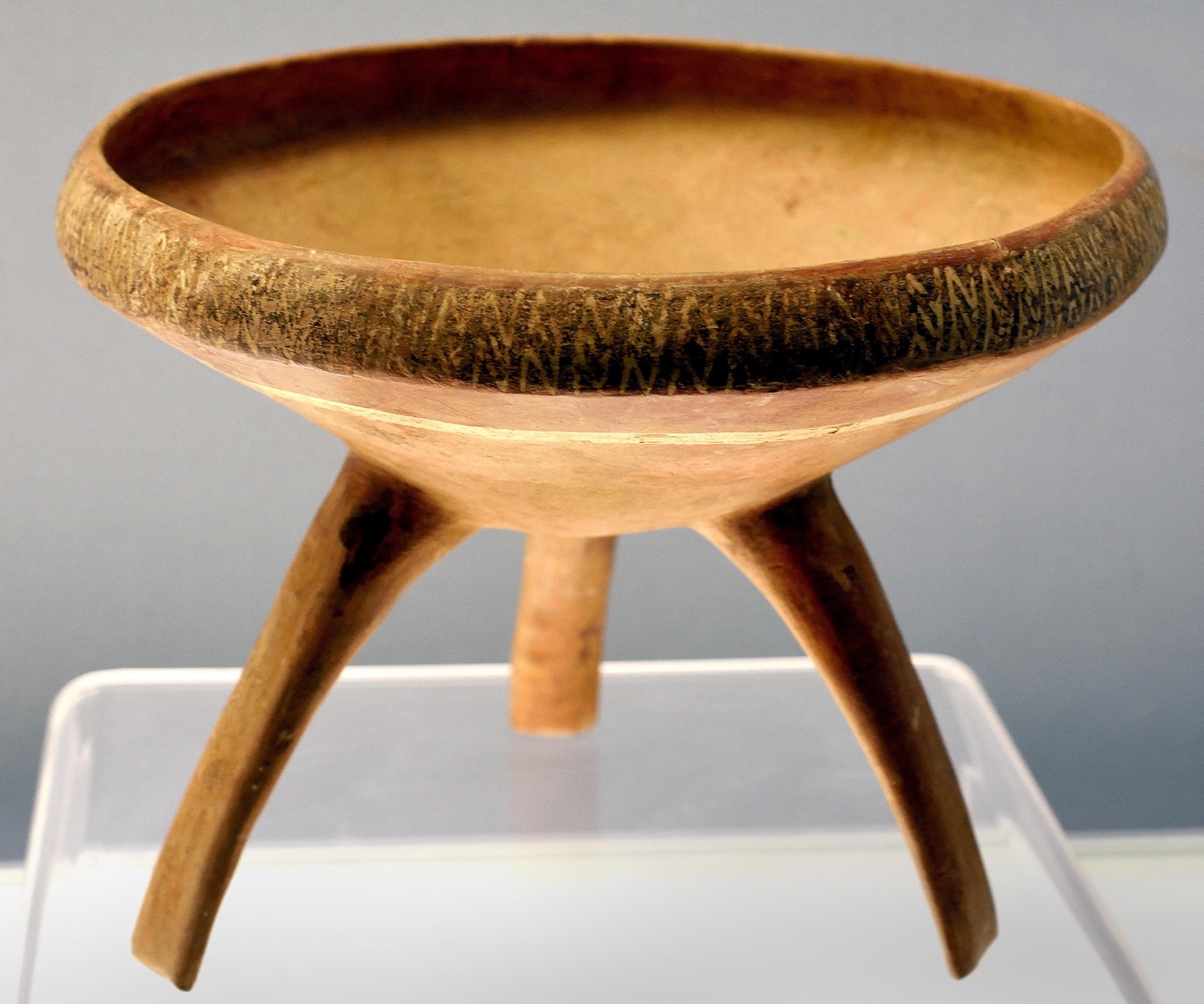
Chinese Pottery A red-clay pottery vessel (ca. 6000–5200 BCE) from a site in northern China rests on three legs, which might have allowed it to be placed over a cooking fire.
THE HUANG HE VALLEY In northern China, where rainfall was spotty and rice impractical, agriculture began with millet by 7000 BCE, then soybeans and a handful of other crops by about 6000 BCE. Millet, the most important crop, remained only a small part of people’s diets until well after 5000 BCE. Wild food sources predominated until perhaps 3000 BCE. Many parts of northern China have highly fertile loess (windblown) soils that yield excellent crops if enough rain falls. When and where rain didn’t fall, starvation threatened. This provided strong incentive to manage water carefully, as with rice cultivation along the Yangzi. Chickens and pigs were domesticated in northern China by 4500 BCE if not before. This was the second domestication of pigs, after the first in Southwest Asia.
One of the distinctive features of the development of agriculture in both river basins of China is that pottery marked the first step in the long process. Some recent archeological finds suggest that pottery preceded the domestication of rice and millet by nearly 10,000 years. Pre-farming peoples in East Asia developed a tradition of boiling and steaming their food in pots. With good pots, the storage of rice and millet was easy and the logic of relying on them improved. The more people relied on these crops, the more likely they were to start down the path toward domestication.
SOUTHEAST AND SOUTH ASIA
Somewhere in Southeast Asia, another independent transition to agriculture took place. Good evidence suggests that people on the island of New Guinea domesticated sugarcane, bananas, and root crops such as yams and taro by at least 5000 BCE and probably earlier. They used wetlands and patches of surrounding forest in the eastern highlands in a form of agriculture often called swidden, which involves farming for a few seasons at one spot and then moving one’s operation to another nearby. They didn’t domesticate any animals but eventually acquired chickens and dogs from mainland Southeast Asia. New Guinea’s may have been the only independent transition to agriculture in Southeast Asia, but we can’t be sure.
On the Southeast Asian mainland, sedentary villages and pottery preceded farming, as in China. The first evidence of farming dates from about 2500 BCE, and it probably represents an introduction from South China rather than an independent transition. Pigs and chickens were the important animals domesticated, and rice was the central crop.
It’s quite possible, however, that Southeast Asians made a transition to agriculture, or several, before the documented case in New Guinea, maybe even before it happened in China or the Levant. Some domesticable plants don’t normally leave traces that last over millennia, unlike rice, wheat, and barley grains. So all we can say with assurance is that there was one transition to agriculture in Southeast Asia, on New Guinea, by 5000 BCE if not before—and that the odds are good that we know only a fraction of the truth of the matter.
In South Asia, people took up wheat farming as early as 7000 BCE and rice farming by 6000 BCE. The strongest evidence at the moment suggests that these were imported introductions of agriculture to South Asia rather than independent transitions.
AFRICA
The story of early agriculture in Africa is sketchy because archeologists have done much less work there than elsewhere. Africans probably domesticated cattle, perhaps in Egypt, as early as 6000 BCE. For a few millennia after that, they refined their cattle-keeping ways and spread the practice into suitable parts of the continent, but as far as we know they didn’t yet domesticate plants. In this respect, Africa followed a different path from most parts of the world, where either the plants came first or both came more or less at the same time.
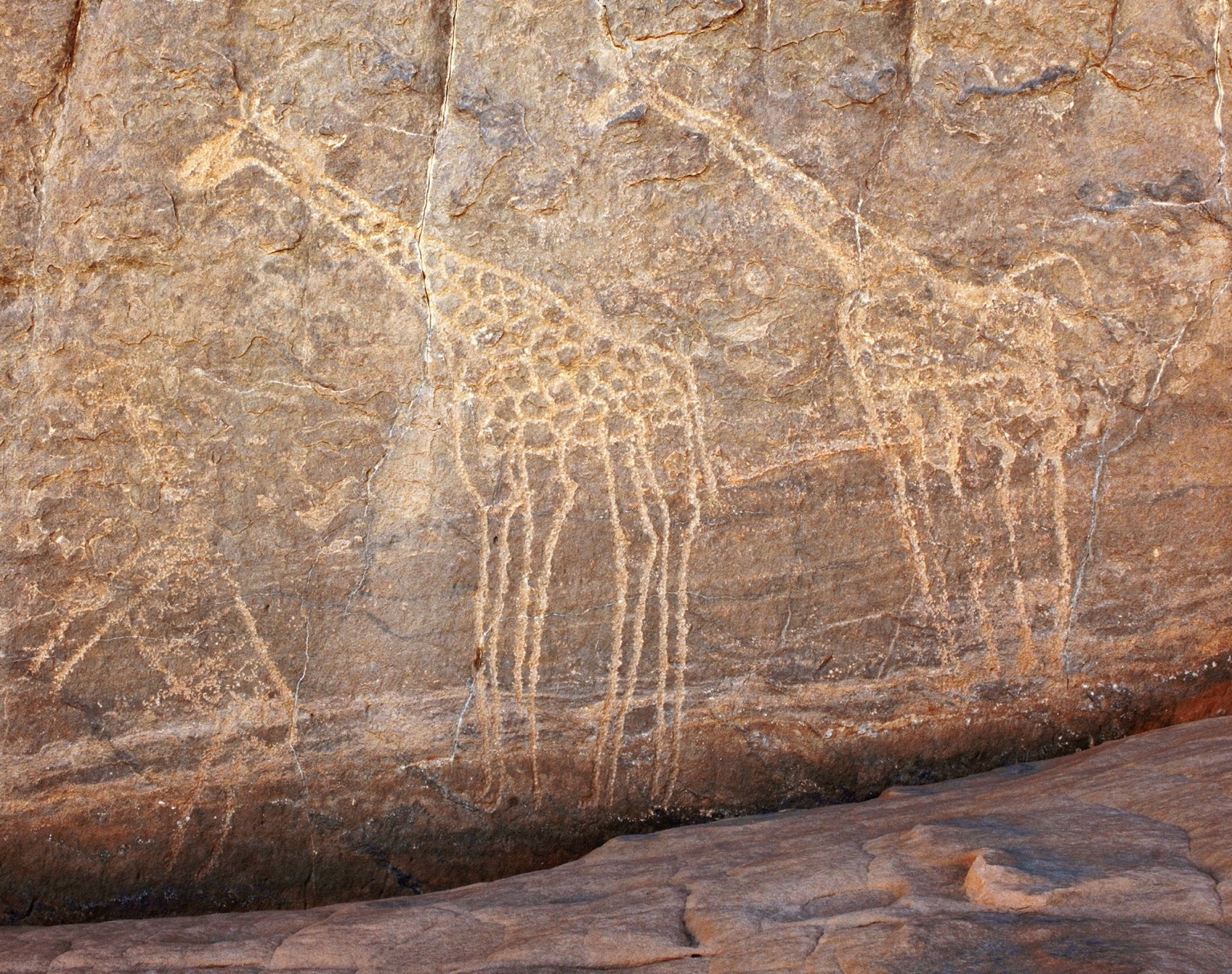
African Sedentary Peoples Rock art found in present-day Algeria attests to humans settling at water sources near the Sahara. The art depicts the animals that would have congregated around the same water sources: giraffes and another animal, perhaps a zebra.
Then, beginning about 3000 BCE, another independent transition to agriculture took place in Africa. It apparently happened at about the same time in several spots on the southern edge of the Sahara. Millet, sorghum, and dry rice (different varieties from the rice grown in East Asia) were the chief crops. As in the Fertile Crescent, climate change was probably a key factor motivating the transition to agriculture in Africa. After 8000 BCE, the Sahara grew wetter with regular summer rains. It hosted grass and wildlife—even lakes and hippopotami. People lived among the lakes, fishing, foraging, and hunting. As in East Asia, they developed pottery before domesticating plants, perhaps by 9000 BCE. They tended to boil their food into stews and porridges, in contrast to the tradition that prevailed in Southwest Asia in which grains were ground up and baked into bread and meat was roasted.
The Sahara region began to dry out about 4500 BCE. Lakes and wetlands began to shrink, depriving Saharan peoples of some of their best environments for foraging and fishing. With less food to go around, they faced pressures similar to those in the Levant when the Younger Dryas hit. They crowded into the remaining lakeshores, just as the Natufians had sought refuge in oases and next to riverbeds. Since the Saharan lakes were all shallow, they expanded and shrank considerably with the rains, which made soils around their edges often moist and suitable for growing plants. It was on these lake edges that Africans first began to domesticate and raise millet, rice, and sorghum.
CONSIDERING THE EVIDENCE
Crocodiles in the Sahara
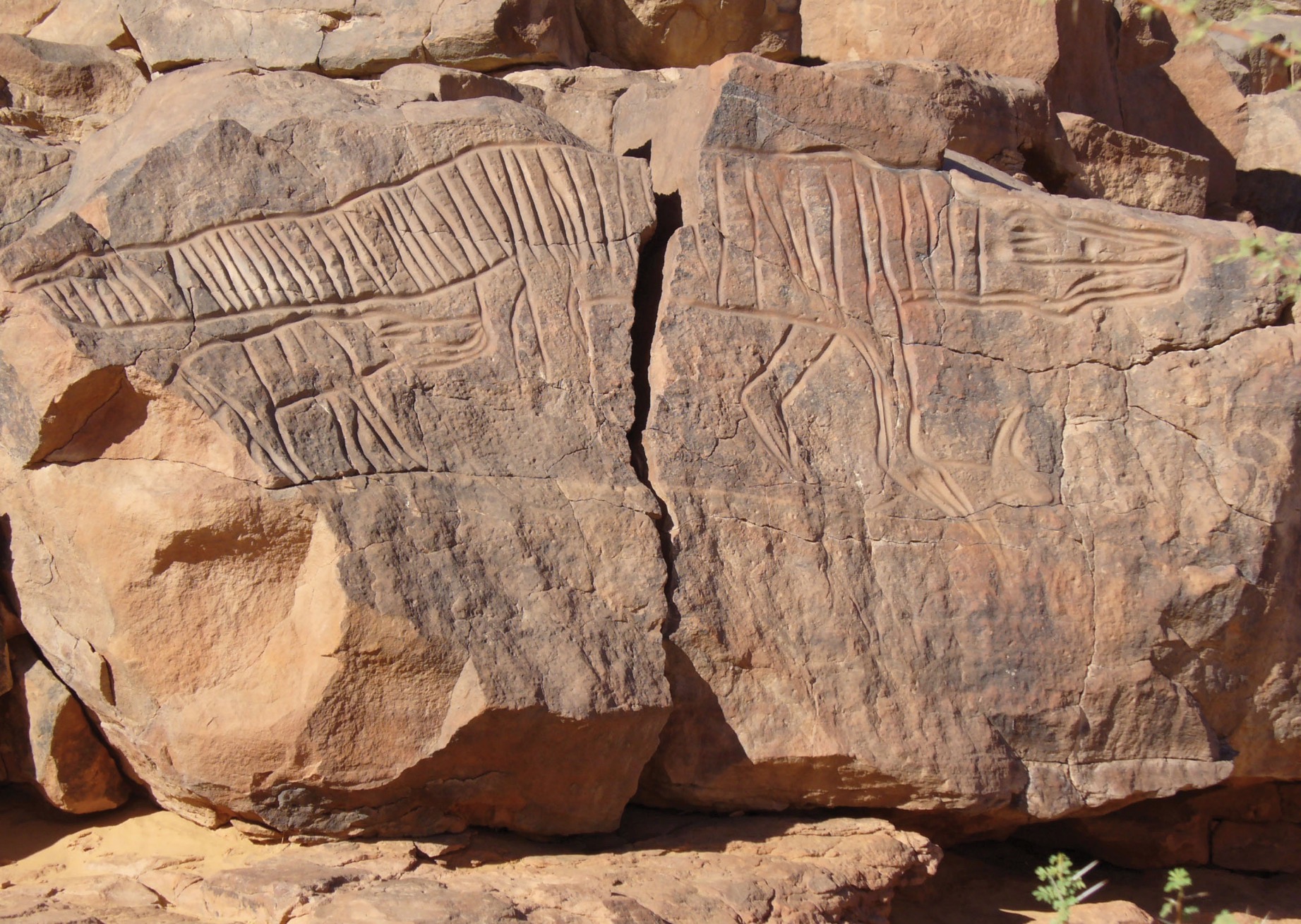
The Sahara desert might be the last place you’d expect to find a crocodile. Water has been scarce in the Sahara for thousands of years, but between 8000 and 4500 BCE it was a green place full of lakes and rivers. It attracted people who hunted hippos, elephants, and antelope, speared catfish with stone harpoons, and did their best to avoid the crocodiles. In addition to life-size paintings and carvings of animals and themselves, these people left behind ivory jewelry and pottery. The first humans to enter the Sahara eventually became sedentary hunters and fishers, living alongside lakes until the climate shifted again and forced them out. The crocodile engraving below is locatd in the Messale plateau in southwestern Libya and dates back at least 10,000 years.
QUESTIONS FOR ANALYSIS
Carving such large images into rock faces would have taken much time and work. What do these efforts suggest about the role of large game animals in the culture of the people who created these images?
How did life in the “green” Sahara compare to that of the Magdalenians in Europe, who painted scenes of wildlife in caves like Lascaux during the last ice age?
Some scholars suggest that rock art served a religious purpose. Does this example give any evidence for that? Explain your response.
In what might have been yet another independent transition to agriculture, people in the highlands of Ethiopia began to raise different crops before 1000 BCE—maybe long before. The main one was a cereal called teff, still today grown mainly in Ethiopia. Teff does well at mile-high altitudes, in dry conditions, and provides a nutritious payload of minerals and protein. It is still uncertain whether the domestication of teff occurred independently or in imitation of one of the nearby earlier transitions to agriculture.
SOUTH AMERICA
The archeological record is also thin in South America, so we don’t know much about the transition to agriculture there. Some scholars think it began with horticulture (the raising of vegetables or fruits in garden patches) in the lowland rain forests of what is now Colombia as early as 9000 BCE. Scattered evidence exists for domesticated plants in what is now Colombia, Ecuador, and Peru between 8000 and 4000 BCE. There is firmer evidence for squash and bean domestication, as well as the existence of small villages, along the coasts of Ecuador and Peru after about 3000 BCE. Squash and beans alone cannot support human populations, but on these coasts people lived next door to the Pacific’s Humboldt Current, one of the world’s richest marine provinces. Teeming with fish and offering a hunting ground for millions of seabirds, the Humboldt Current provided the coastal peoples of Peru with plenty of fish and birds’ eggs to eat.
But the Humboldt Current sometimes flowed weakly, thinning the fish and bird populations. During El Niño years, the fishing was poor and the incentive to seek other food sources was strong. It could be that the revival of El Niño after about 3000 BCE, a response to a general warming trend in the Pacific, provided a climate-change trigger to the emergence of agriculture here, as other climate changes seem to have done in the Levant and in Africa.
Potatoes, first domesticated in highland Peru between 3000 and 2000 BCE, could serve as a staple crop, a staff of life like rice or wheat and unlike squash and beans. Potatoes yield well in terms of calories per acre and also provide a healthy variety of vitamins and minerals by themselves. When people in the Andes learned to freeze-dry potatoes to make an easily storable and portable foodstuff, called chuño, they acquired the basis for exchange and accumulation of foodstuffs that rice, wheat, or maize provided elsewhere in the world.
Manioc, also known as cassava, is a root crop native to South America that was first domesticated in the western part of Amazonia’s rain forest no later than 4000 BCE. It provides plentiful calories but little else in the way of nutrition. But if raised by people who also fish, hunt, and forage, it could provide a reliable food supply. It fares well in poor soils and withstands drought better than most crops. So in South America at least one, and perhaps more, independent transition to farming took place.
MESOAMERICA AND NORTH AMERICA
In Mesoamerica—roughly the region between Costa Rica and northern Mexico—crop domestication began perhaps as early as 6000 BCE. Squash, beans, and especially maize formed the basis of Mesoamerican agriculture. Thanks to human selection, maize evolved from a small wild plant called teosinte to become the staple of life in much of the Americas. Over thousands of years, maize farmers chose to plant those varieties of teosinte that grew bigger, matured faster, and had other desirable traits. Scholars debate just where the domestication of maize began, but most argue for western Mexico.
We may never know just when and where maize was domesticated, but we know that it mattered for the societies that relied on it. Dried maize stores very well, making it—like rice, wheat, barley, and freeze-dried potatoes—a basis for accumulation and exchange. Maize also yields richly in calories, although it lacks niacin (a form of vitamin B and an essential human nutrient), so people who rely on it heavily often suffer from deficiency diseases. Farmers grew it widely in the Americas. It became a significant food in Peru by 2000 BCE at the latest, and in what is now the southwestern United States at about the same time. Farming spread across the North American continent, arriving as far as eastern Canada about 1,000 years ago.
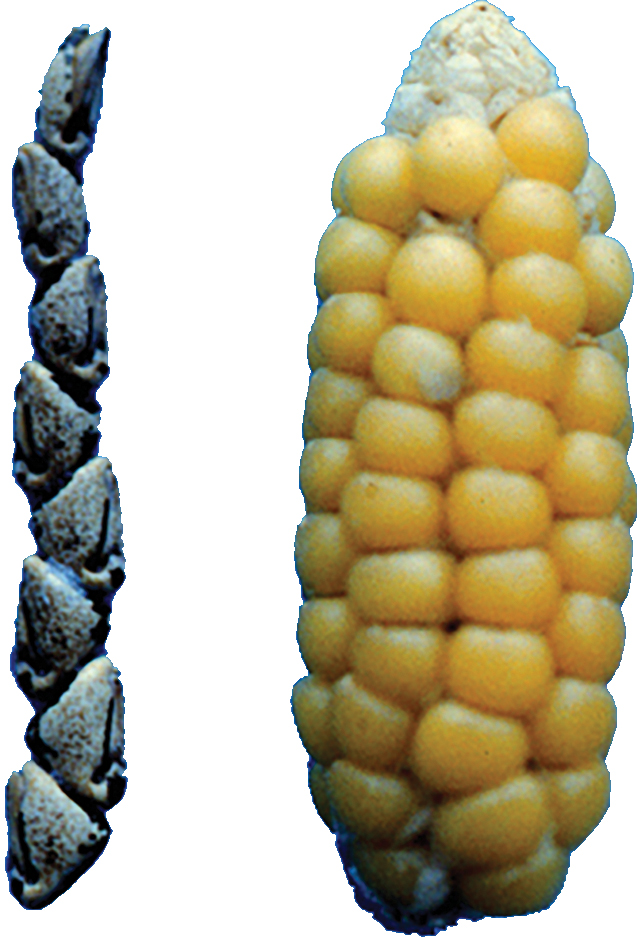
Domesticating Maize Millennia of careful cultivation went into developing strains of corn (right) that were bigger and more nutritious than wild teosinte (left).
Archeologists have also found evidence for an independent transition to agriculture in the heartland of North America. By about 2500 BCE, people living in river floodplains of what is now Ohio, Kentucky, Tennessee, and Illinois were raising plants such as sumpweed and goosefoot. These people are sometimes called mound builders because they piled up earth into mounds, presumably in connection with ceremonies of some sort. They lived in small villages until they acquired maize from Mexico (about 800 CE), which enabled their populations and the scale of their settlements to grow quickly. We’ll return to them in a later chapter.
One important feature of the transitions to farming in the Americas is that animals hardly figured in the story. In the Andes, people domesticated llamas about 4000 BCE. But nowhere did they have animals they could use for traction, like the oxen and horses of Eurasia. People had to do all the work of farming themselves. And nowhere did domestic animals, or their milk, form a significant part of people’s diets.
The archeological and genetic record concerning the transitions to agriculture elsewhere around the world is slender. We don’t even know how many independent transitions there were, although the best guess is eight in all. But we do know that the turn to agriculture spread widely and began a sea change in the human condition.
The eastern Mediterranean coast and its hinterland. It forms the western edge of the Fertile Crescent and is the location of the first strong evidence of farming.
The switch between human populations finding or cultivating food and settled human populations producing food through domestication. This process occurred in various places independently of one another.