THE SPREAD OF AGRICULTURE
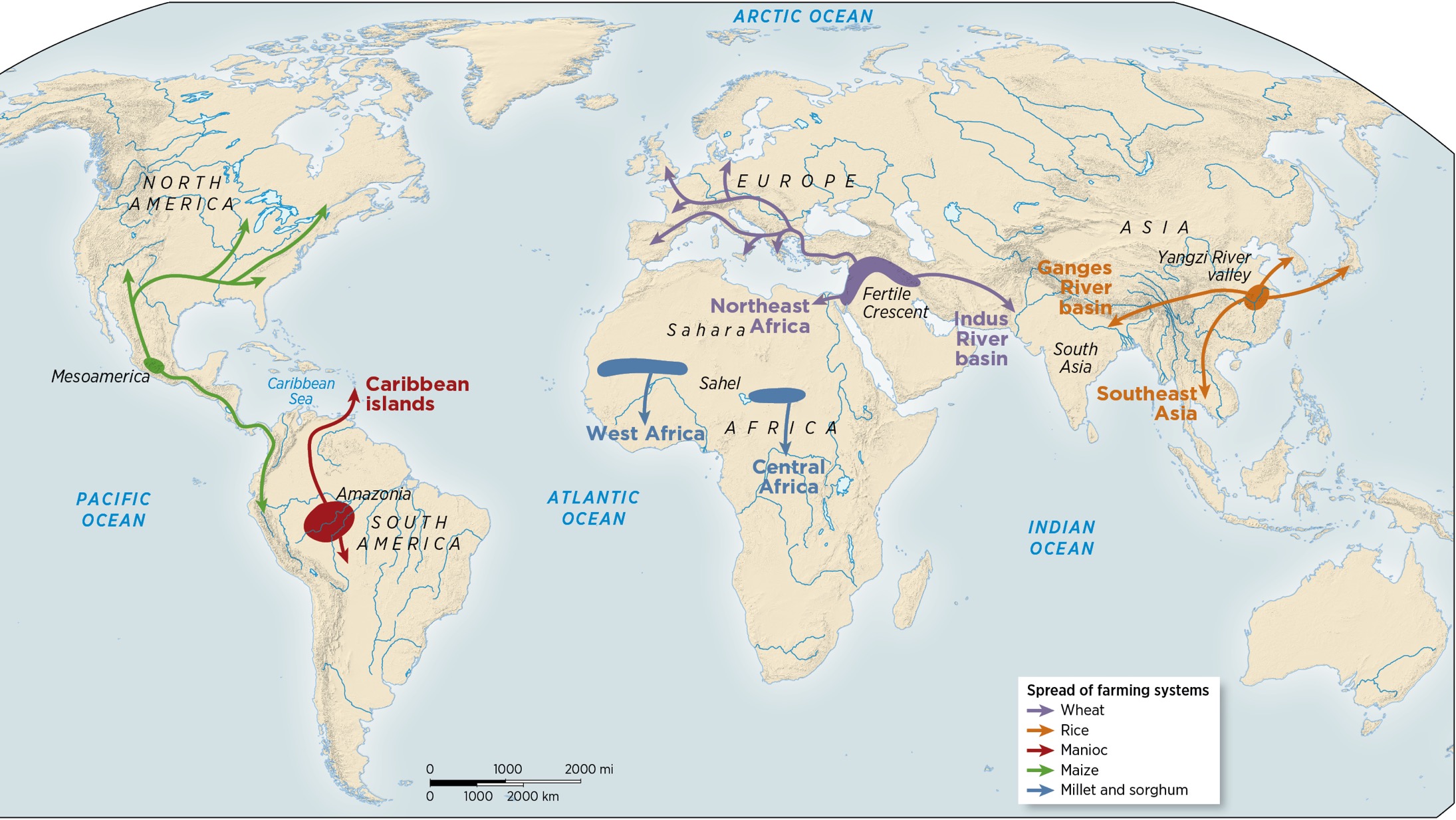
From its several points of origin, agriculture spread far and wide. The cereal culture of the Fertile Crescent, the rice culture of China, and the maize and beans culture of Mesoamerica diffused farthest and gave rise to the world’s most influential and widespread farming systems. The Fertile Crescent farming system spread along the northern shores of the Mediterranean into Anatolia and Greece. Between about 7000 and 4000 BCE, people carried it from Anatolia to the British Isles. It moved eastward too, into northwestern India by perhaps 7000 BCE. Meanwhile, on a small scale, the rice-based system of the Yangzi apparently spread westward into the Ganges valley of northeastern India by about 6000 BCE, although some scholars maintain that rice was independently domesticated there. The rice system also spread to mainland Southeast Asia after about 2500 BCE. Maize culture spread from its Mesoamerican home both northward and southward, and became the staple food of most farmers in the Americas by 1000 BCE.
While those three farming systems cast the longest shadow in world history, they weren’t the only ones to spread. In Africa, the cultivation of millet and sorghum spread southward from its origins in the Sahel (the belt of semi-arid land on the southern edges of the Sahara) into parts of West and Central Africa. Highland Ethiopia’s teff-based farming system, however, scarcely expanded beyond its homeland. The same was true of the high Andes tradition of potato farming, which (until after 1500 CE) barely spread at all. Manioc, however, first cultivated in the forests of Amazonia, proved a good traveler throughout the damp lowlands of South America and, by 500 BCE, was raised in the small islands of the eastern Caribbean.
Farming spread in two main ways. First, farmers sometimes displaced foragers, pushed them off fertile lands, and extended their own domain. Second, the idea of agriculture sometimes spread: people who hadn’t formerly practiced it learned about it and imitated the practice of others.
EXPANSION BY DISPLACEMENT
Farmers could often displace foragers through violence. Food production allowed greater densities of population. Bigger groups normally prevailed over smaller ones in violent contests. Moreover, the bigger social groups became, the more likely they could support specialists in weapon making and the arts of violence. People who had the skills to make good farming tools could also make good weapons. Foraging bands, even those that included skilled hunters, couldn’t consistently withstand the collective pressure that farming peoples could bring to bear.
INFECTIOUS DISEASE Farmers could also displace foragers and hunters without even trying—through infectious disease. Because farming folk lived side by side with herd animals, their bodies gradually came to host microbes whose ancestor-microbes had routinely lived in sheep, goats, cattle, or dogs. Some of these species-jumping microbes caused deadly diseases among humans. Influenza comes from pigs and ducks. Smallpox may derive from some rodent-borne virus. Camels donated a common cold virus. In all, about 60 percent of the infections that human bodies host came originally from other animals. Over many generations, in what must have been a painful process with many mini-epidemics along the way, the immune systems of farming folk became increasingly resistant to these microbes. Indeed, when infectious diseases were constantly present, only those individuals with robust immune systems survived childhood. Their own children, in turn, would be likelier to have robust immune systems, or at least immune systems attuned to the risks posed by sedentary life among animals and animal-derived diseases. In effect, a new selection process was at work among farming peoples—selection for disease resistance.
Hunters and foragers didn’t normally face this grim pressure. As long as they kept their distance from farmers, they stayed healthier than sons and daughters of the soil.But if they came into prolonged contact with farmers, disaster routinely followed. Their immune systems hadn’t built up resistance to the infections now common among farmers, and they sickened and died at appalling rates. This process has happened again and again in more recent times, and it’s extremely likely that it happened early in the history of the expansion of farming too, although the archeological evidence for it is slender. It’s highly probable that greater vulnerability to new human infections cost foragers and hunters terribly, clearing the way for further expansion of farming.
ENVIRONMENTAL CHANGE In some environments, farming probably spread because it indirectly ruined landscapes for hunters and foragers. The daily activities of farmers often depleted the nearby wild herds on which hunters depended. Farmers’ own herds and flocks munched and trampled their way over the countryside, reducing the availability of forage plants for wildlife. Farmers often set fire to vegetation to prepare the ground for their own plantings. By pursuing their own subsistence methods, farmers often made it harder for anyone to make a living without farming.
EXPANSION BY IMITATION
Farming also spread through less destructive processes, as when the ideas of domestication and cultivation spread from one person to the next, without anyone killing or infecting anyone else. The early crops of Iberian (today’s Spain and Portugal) farming, and all the animals that farmers raised, came from the Levant and its neighborhood. But genetic evidence shows clearly that Iberians did not, in the main, come from the Levant. The idea of farming spread to Iberians: they became farmers without being substantially replaced by immigrant farmers. Studies of the advent of farming to neighboring North Africa, and to the Baltic countries in northeastern Europe, show much the same thing. In short, examples abound of both ways in which farming spread—as a process of demographic displacement and as a process of inspiration and imitation.
THE FARMING REGIME
Not everyone took up farming. Some people either lived in or retreated to environments too dry, cold, or infertile for farming. Others, like the Jomon in Japan, found farming unappealing compared to the rewards of foraging and hunting, and they persisted in their way of life for several thousand years despite contact with farmers. In Africa, and in South and Southeast Asia, people probably often toggled between farming and other ways of life. Elsewhere, shifts to agriculture were more likely to be permanent.
Over the last 10,000 years, the spread of farming has almost matched the earlier spread of the use of fire and language. At one point in time, no one used these technologies. Then some people used them while others did not; and those who did, enjoyed great advantages against those who did not. Eventually, fire and language came into use by all people. This point may yet come with respect to agriculture too, although to this day in the Arctic, and in several moist tropical forests, people survive who neither practice agriculture themselves nor eat its products. These hunters and foragers now account for less than 1 percent of humankind.