The transitions to farming and its subsequent spread brought fundamental and durable consequences for human communities. Human populations increased even as people grew unhealthier. New expressions of culture in arenas such as religion, architecture, and pottery also emerged.
EFFECTS ON POPULATION
The most basic advantage of farming, and the reason for its widespread practice, is that it enabled far more people—10 to 100 times as many—to live on the same amount of land as did hunting and foraging. Farming women had more babies, at more frequent intervals, than the women of hunting and foraging peoples. Although those babies died in droves from infections, the number of children still grew. This conferred the advantages of superior numbers on farmer folk in any competitions with hunters and foragers.
No censuses were taken during the Paleolithic, and the available evidence for early human populations is scanty. The table below shows one plausible reconstruction. If these numbers are anywhere close to accurate, they show the revolutionary demographic implications of the spread of farming in the millennia after 8000 BCE.
HEALTH EFFECTS
Along with the advantages that account for its spread, farming carried costs. These costs emerged gradually so that the first farmers in any locale didn’t suffer from them—at least, not all at once. Remember that adoptions of farming probably took place over hundreds or even thousands of years during which people practiced foraging, hunting, and farming, with the role of farming expanding over time. The more fully dependent people became on farming, the more prominent its costs became.
GLOBAL POPULATION ESTIMATES
YEAR
POPULATION
RATE OF ANNUAL INCREASE
40,000 BCE
600,000
n/a
8000 BCE
6,000,000
0.003%
3000 BCE
20,000,000
0.014%
1500 BCE
100,000,000
0.053%
Source: M. Perrault, “85 milliards d’humains plus tard” (2003).
DIET AND STATURE Farming folk ate a narrower diet than foragers and hunters. Depending heavily on a few staple foods left them at greater risk for poor nutrition from a lack of key vitamins or minerals. They ate less meat and got less protein, which probably accounts for the smaller stature of farming people compared to their pre-farming ancestors. Skeletal remains from sites between Ukraine and North Africa indicate that late Paleolithic men on average stood 5ʹ8ʺ (177 cm) tall, and women 5ʹ4ʺ (166 cm). In the last thousand years before agriculture—the period when game was growing scarce and climate colder and dryer—their average stature shrank by 2 inches (5 cm). During the first millennium after the origins of farming, they shrank faster, by another 2 to 4 inches (5–10 cm).
DISEASE Farmers were sicker as well as smaller than their hunting and foraging ancestors. The shift to agriculture was a gigantic stride backward for human health. Among the reasons for this is that farming folk, like all sedentary people, lived amid their own garbage and wastes. Moreover, they often deliberately handled human and animal feces to use it as fertilizer. They suffered heavily from gastrointestinal diseases carried by worms and other parasites, which one might collectively call diseases of sedentism.
Farming communities also suffered from what one could call diseases of domestication. As we’ve seen, many human diseases derive from domesticated-animal diseases. Half of these come from dogs, cattle, sheep, and goats. Even chickens and cats have donated some of their infections to their human masters. As these infections evolved into human diseases, babies in farming communities in Eurasia and Africa (not in the Americas, which hardly had any domesticated animals) increasingly were born into hazardous microbial environments teeming with influenza, smallpox, mumps, tuberculosis, tetanus, and a host of other killing diseases.
Farming invited diseases from other sources as well. As we’ve seen, stored grain attracted rats and mice, putting farming communities at enhanced risk for hemorrhagic fevers and other nasty infections carried by rodents. There are about 35 human diseases derived from rats or from the fleas and ticks that live on rats. And where farmers cleared forest, and especially where they allowed water to accumulate, they created new habitat for malarial mosquitoes, another dangerous disease vector. Malaria, one of humankind’s worst scourges, seems powerfully correlated with farming environments—at least, where climates are warm enough for the relevant mosquitoes. In Africa and Asia, it seems to have taken firm hold among humans soon after they took up farming, although it probably wasn’t unknown before.
CHILDREN AND WOMEN All these diseases made life for farming folk, especially children, far more hazardous than for hunting and foraging peoples—at least, for those who could stay away from disease-bearing farmers. Farmers had far more babies than did hunters and foragers, but their disease environments also killed them faster. If anyone had known these facts of disease history, they would have avoided agriculture like the plague. But they didn’t know.
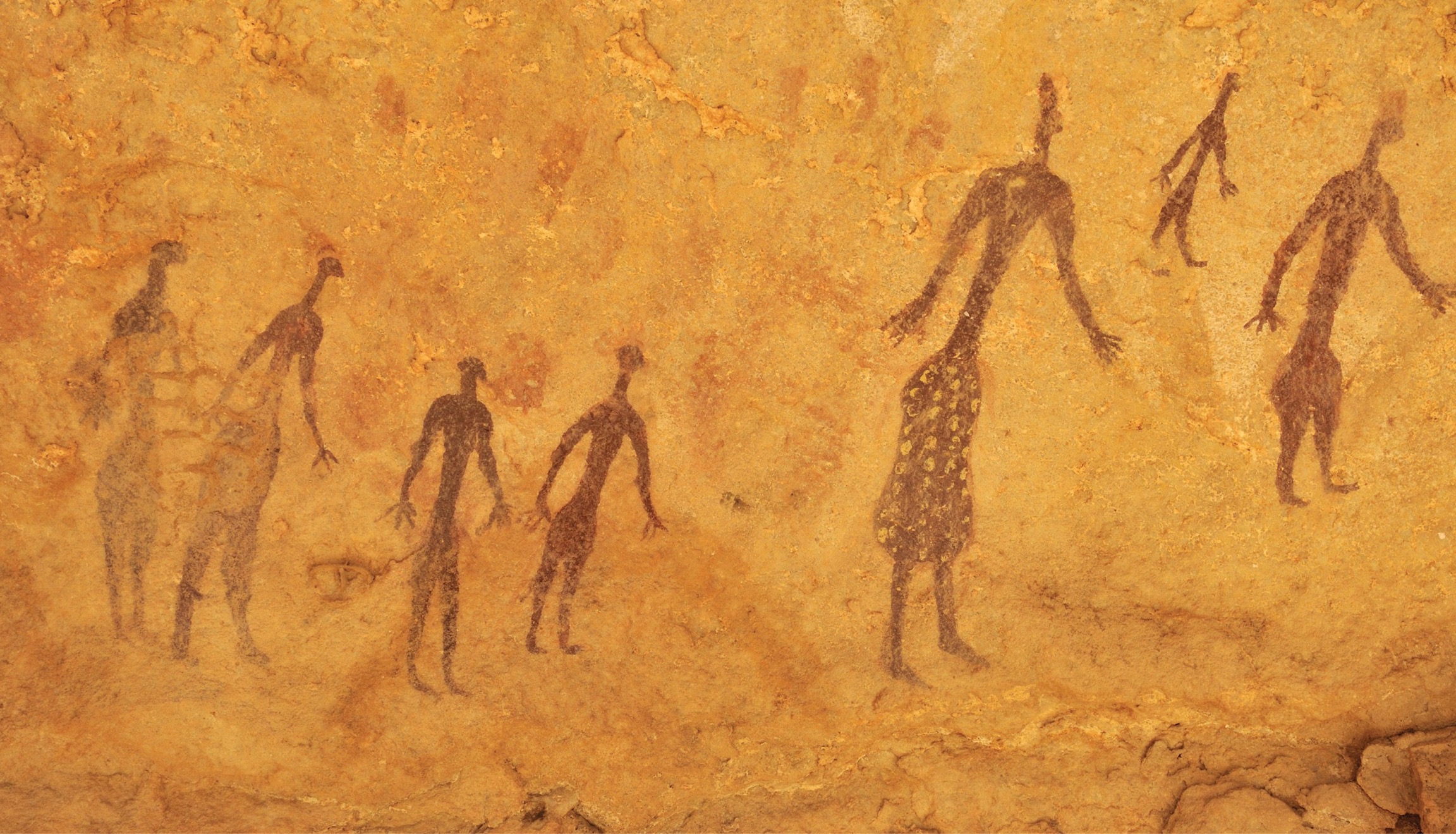
Social Units Neolithic rock art found in present-day Algeria depicts a small group of people of different sizes, possibly adults and children within a larger farming community.
Our old friends the Natufians show that some of the health costs of taking up farming fell mostly on women. The Natufians left more skeletons than most people, giving archeologists an opportunity to calculate life expectancies. After the Natufians shifted to agriculture, men lived longer than before but women less long. Two likely reasons for this gender difference are that death by violence and hunting accidents (more likely to befall men) decreased as people took up farming, but that death in the act of giving birth became more common as fertility rates rose. The routines of work among farmers also left telling marks on Natufian female skeletons. They show signs of stresses in their knees, wrists, and backs from the endless kneeling and bending required for grinding grain. In general, the transition to agriculture made people shorter, sicker, and more likely to suffer from acute malnutrition—and in most cases, the effects were worse for women than for men.
THE SELF-DOMESTICATION OF HUMANS
Here is a final reflection on what settling down and taking up farming meant for human bodies. At the same time that our ancestors were domesticating dogs, grasses, sheep, and goats, they were—equally unknowingly—domesticating themselves. Their bodies became smaller and weaker. Survival came to depend less on strength and physical courage, and more on the ability to get along with others and accept one’s place in a hierarchy, the same sort of docility that humans appreciated in goats and sheep.
GRACIALIZATION In some respects, this process of self-domestication may go further back: gracialization—the evolutionary process by which skeletons became thinner, smaller, and lighter—began in Eurasia as early as 40,000 years ago. Earlier skeletons show much stronger legs among mobile hunters and foragers than among later farmers, and more powerful right arms on most males, perhaps a result of throwing rocks and spears. Gracialization suggests a gradual process of selection for traits other than brute strength.
Gracialization in recent millennia (since 40,000 years ago) has gone furthest among Africans and Asians. It has gone least far among the isolated populations of Tierra del Fuego at the southern tip of South America (they only arrived there 12,000 years ago at the earliest) and Australian Aborigines. This suggests gracialization is ongoing and recent, and connected to the emergence of bigger social groups. Survival and reproduction within the bigger groups made possible by sedentism and farming favors the sociable, the politically skilled, the good cooperators and clever deceivers—as well as those with strong immune systems. In short, sedentism and farming encouraged the evolution of a wily political animal no longer as reliant on strength and stamina.
SELECTION FOR DOCILITY So as our ancestors were domesticating other species, they were also domesticating themselves through genetic selection. Farming in particular selected for people who would accept both the repetitive routines of farming life and their place in a social order in which only a few could be near the top. Farming began a process that selected against defiance and for docility in humans as well as in farm animals. This process is still ongoing after 10,000 years.
At the same time that our bodies and minds evolved so as to fit the demands of the farming life, we created cultures that help us endure numbing routines and social subordination. Cultural adjustment to the demands of farming eased the pressures for genetic adjustment. And our cultures evolved quickly in response to the risks and rewards of farming, as much of the rest of this book will show. Even in the first few thousand years after the transitions to farming, major cultural shifts occurred. Let’s look briefly at some of these.
CHANGES IN HUMAN CULTURE
The transition to agriculture is one of the great transformations in the history of the human species. Raising one’s food as opposed to collecting or hunting it brought broad cultural changes. It required people to submit to laborious routines, but it allowed enormous expansions in cultural richness and diversity. Mobile hunters and foragers around the world had only a few, very similar tools, the same social structures just about everywhere, and—as far as we know—roughly the same sorts of ideas about nature and spirits. By later standards, there wasn’t much cultural diversity during the Paleolithic, because mobile people had to carry their culture with them. With sedentary farming, all that changed.
ENERGY The most fundamental change brought by farming was an energy revolution. Like cooking long before it, or the harnessing of fossil fuels long afterward, farming vastly increased the amount of energy available to human communities. The added calories that farming made available brought a dramatic change in demography, as we have seen. Now people died at faster rates than before; but babies were born even faster, and populations grew more quickly than at any previous time, thanks to the fertility of farming families.
THE SOCIAL UNIT Transitions to agriculture also changed the basic social unit: from the mobile band of perhaps 30 to 80 people, to farming families. These weren’t necessarily nuclear families of just two parents and their children. Many agricultural societies recognized family units of three generations or groups of cousins. Bigger family units were useful for some kinds of farm work. Moreover, many farming societies clustered into villages where hundreds of people gathered together, forming another, larger, looser social unit. In global terms, until the rapid urbanization of the last 30 years, the farming village remained the characteristic human settlement and social environment.
Spiritual Practices A circle of stones at the Nabta Playa site in the Egyptian desert from around 5000 BCE may have been arranged to indicate the positions of the sun and stars at certain times of the year, perhaps related to religious observances.
DAILY ROUTINES Farming brought big and long-lasting changes in daily routines. Farming people normally had to work more days and longer hours every day than did hunters and foragers. Preparing the ground for sowing or planting was laborious, even with the help of fire and domestic animals. Planting, weeding, watering, and harvesting all required long hours of tedious work. So did threshing, preparing, and cooking grains. Grinding grain, where that was practiced, took even more time and effort. Farmers had far less free time than foragers and hunters did.
RELIGION Farming brought changes in religion too. Most farming communities placed an emphasis on fertility and found ways to revere it. They also came to locate their gods in the skies as much as in animals, trees, and rocks. This gave greater scope for religious specialists—priests—who could study the heavens and give advice about when to plant and harvest. Unlike migratory birds or flowering plants, humans have no innate sense of when in the year to perform certain tasks, but agriculture in most settings required that farmers act with a precise understanding of changing seasons. Religions acquired ever more features that connected them to the annual rhythms of farm life.
CULTURAL DIVERSIFICATION With farming came cultural elaboration in other areas as well. New styles of architecture emerged, owing in part to new materials such as bricks. Pottery became larger, more widespread, and more intricate in design. Art, tools, and weapons grew more diverse and elaborate. People could make these advances not because they had more time to spare but because they were staying put in one spot, and the efficiency of food production allowed a tiny minority to engage in creative activities.
A basic similarity in social structure underlay this cultural diversification. Agricultural society allowed social stratification of a sort unseen in mobile bands or even among sedentary foragers. Farming opened more opportunities for the accumulation of wealth, both through clever exchanges and through violent intimidation and seizure. This broad pattern of heightened stratification was fundamental to farming societies. It emerged in both Eurasia and the Americas, between which there was no contact during this period, as well as in Africa. Later chapters will explain the forms it took.
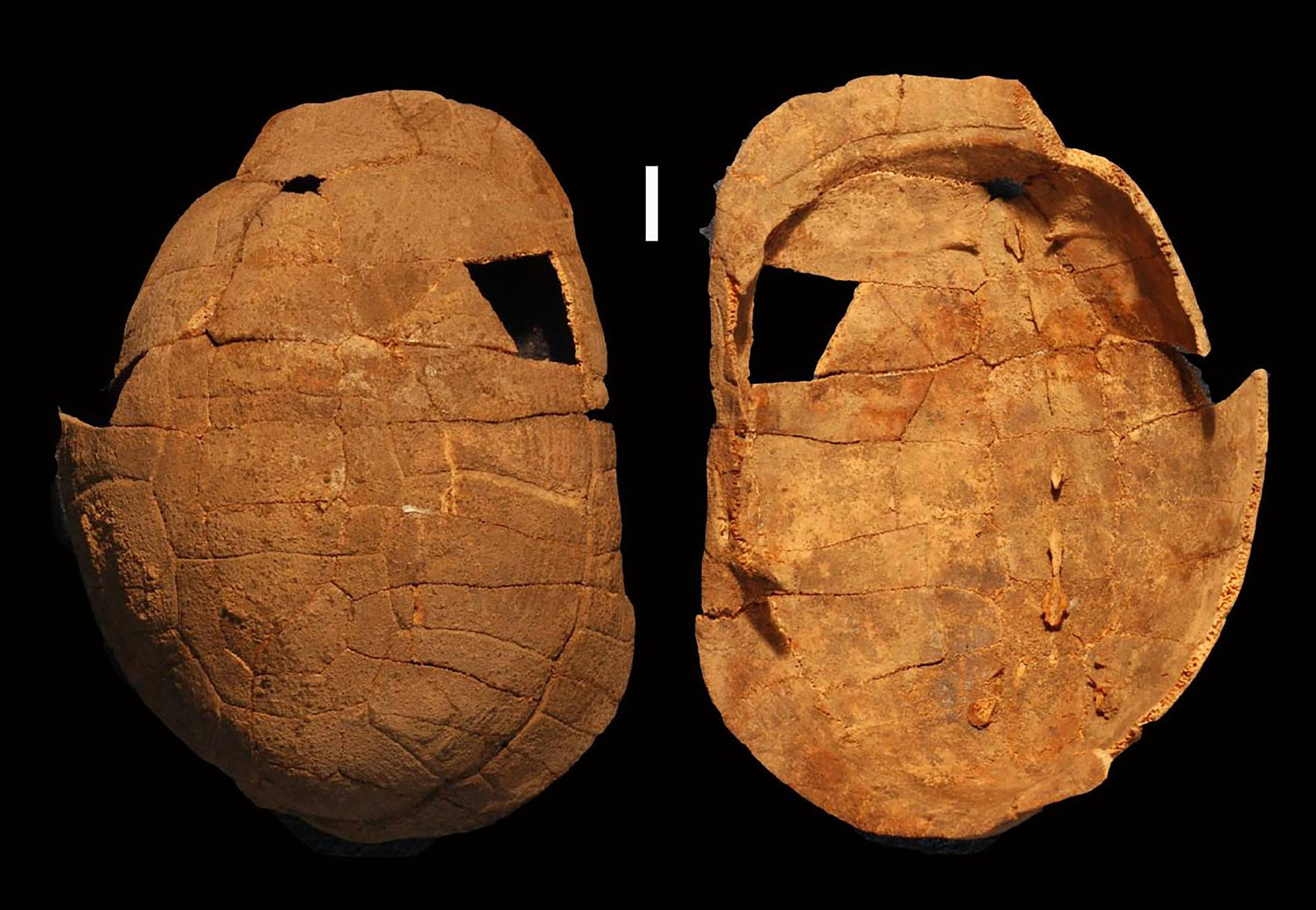
Honoring the Dead These tortoise shells were found in the grave of the Natufian shaman who was buried 12,000 years ago at Hilazon Tachtit. They are remains of the lavish feast held during her funerary rites. Religious practices were transformed by the transition to agriculture.
The thinning and shrinking of skeletons through evolution. Humans underwent this process as social groups grew and relied less on their physical strength for survival.