HERDERS
Some environments, such as arid scrubland and semi-arid grasslands, couldn’t support much in the way of food crops. To survive in these parts of the world, people had to live off animal products. Sheep, goats, cattle, donkeys, horses, camels, yaks, reindeer, llamas, and other domesticated grazing animals can turn grass or shrubby vegetation into meat, milk, wool, hides, horn, bone, and dung. With enough skill, people could make these animal products into food, clothing, tents, tools, weapons, and fuel. Domestic grazing animals expanded human reach into new environments and enriched human life.

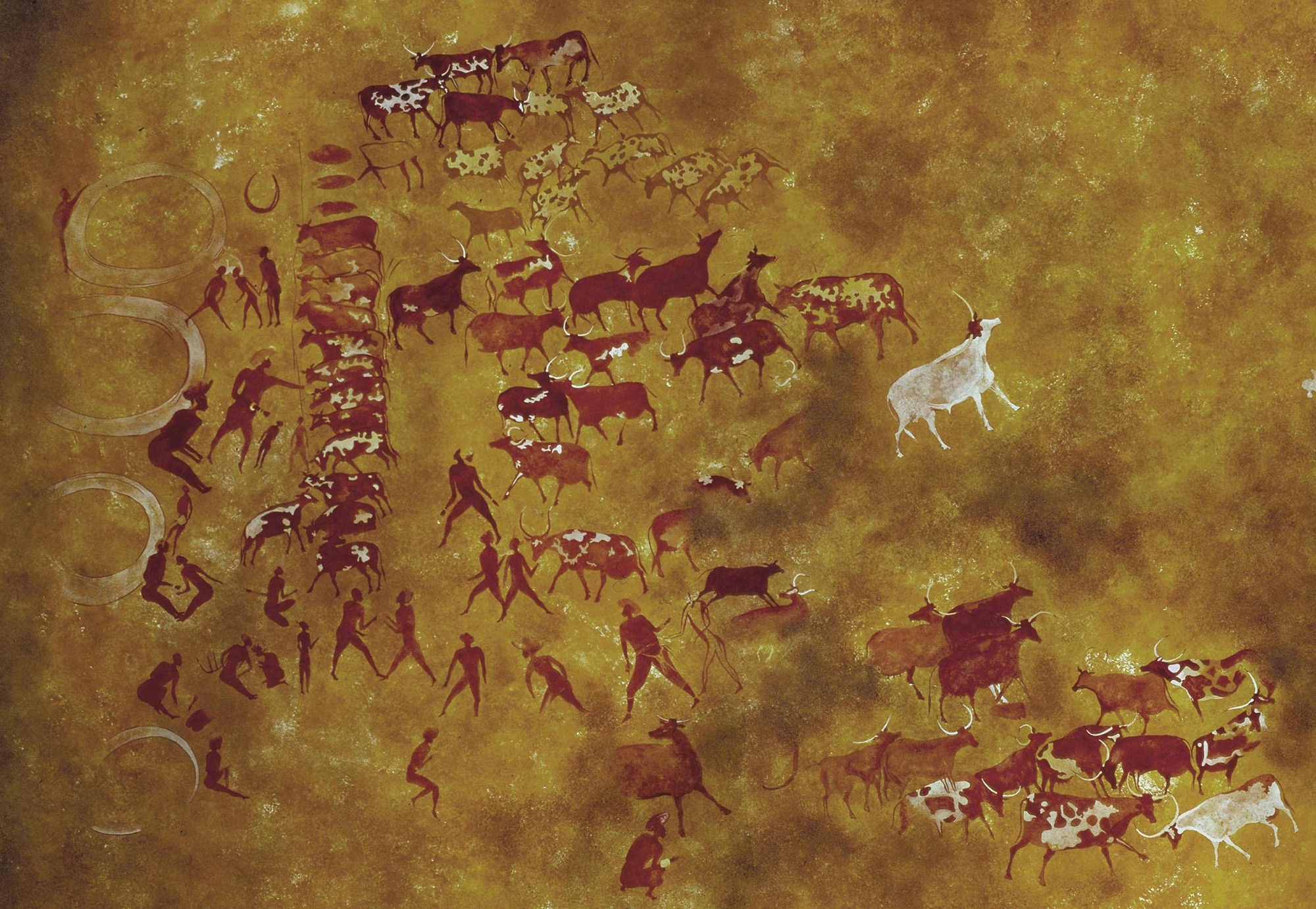
People who live mainly off their animals are called herders or pastoralists, and their way of life is called pastoralism. How pastoralism originated is unclear, but it was probably an offshoot of early farming. Tending animals requires specialized skills, and herders at first were people who acquired these skills and used them on lands that were either temporarily or always unused for agriculture. Herding likely became a full-time specialization only after 5000 BCE or so. Most scholars think herding arose first on the fringes of farming communities in Mesopotamia. It might also have evolved as a full-time specialization on the southern edges of the Sahara, in the belt of semi-arid land called the African Sahel, perhaps around 4500 BCE. Millions of people in Africa and Asia live as herders today.
It’s convenient to divide people into fixed categories and to think of farmers and herders as separate groups, as we do here. But in practice, the line between the two was sometimes fuzzy. Farmers often kept animals and might take them out to graze on nearby grasslands for a few weeks. Herders might settle for a few months and grow some crops. People might shift back and forth between farming and herding, depending on weather or other factors. But more often than not, farmers and herders regarded themselves as fundamentally different and preferred their own company.
HERDER LANDS AND LIVESTOCK
The domain of herders was primarily the grasslands and scrublands of Eurasia and Africa. In Australia and Oceania, there were no grazing animals capable of domestication, so there were no herders. In the Americas, herding as a way of life didn’t exist because only llamas and alpacas could be domesticated among large animals, and since they were useful in farm work, farmers raised them. In sub-Saharan Africa, herders concentrated in the Sahel and grassy parts of eastern and southern Africa. In moister African lands, their range was restricted by a livestock disease carried by the tsetse fly. In the zone from northwestern Africa to northeastern China, pastoralism became a common way of life, especially on the broad grasslands known as the Eurasian steppe.
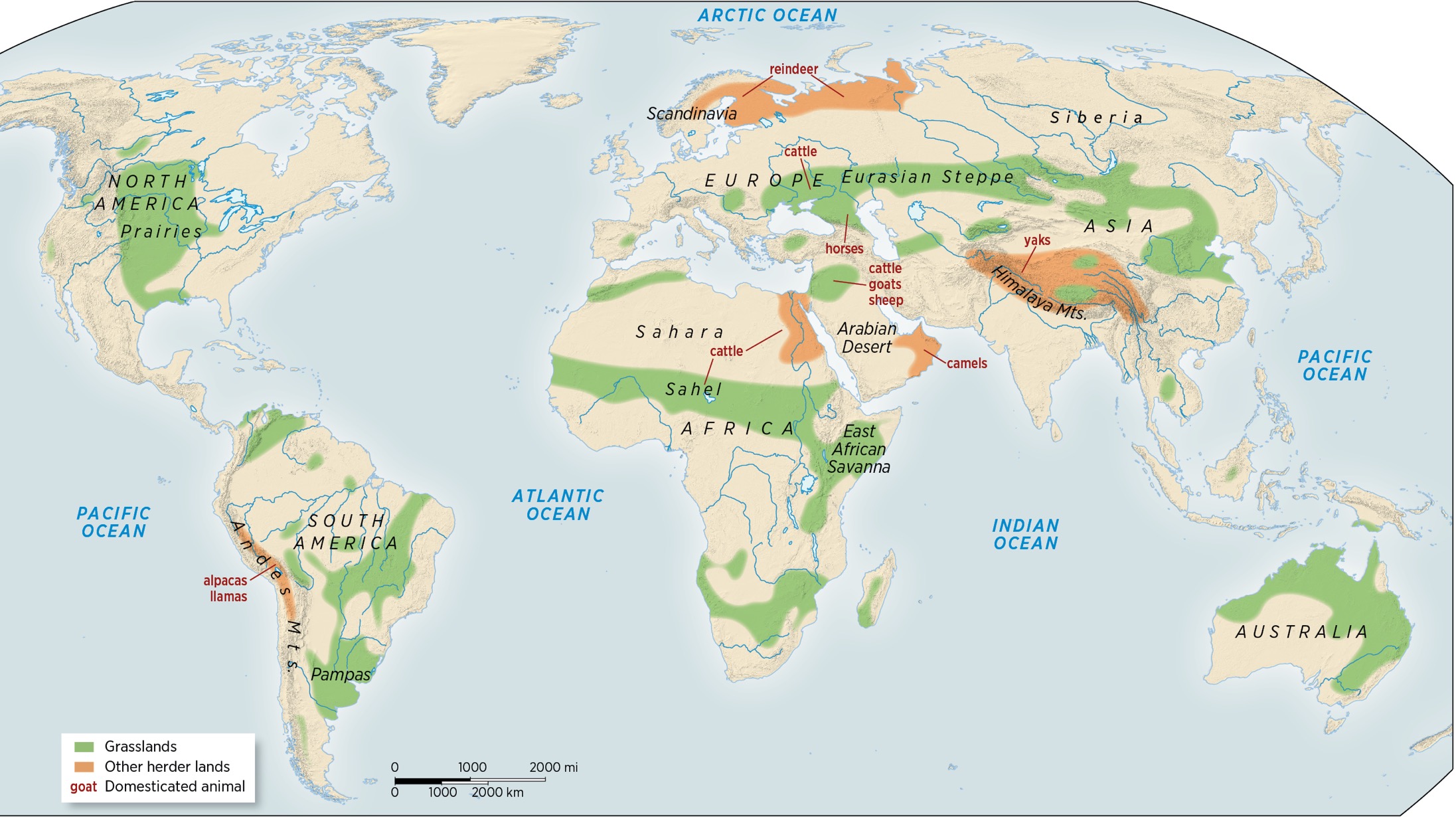
Eight different animals supported herder societies. Some were found almost everywhere, but others had narrow ranges. Yaks, for example, were herded at high elevations in the Himalaya and the Tibetan Plateau but nowhere else. Reindeer herding has been confined mainly to Scandinavia and Siberia. Camels, first domesticated around 2000 BCE, were wondrously adapted to the arid conditions of North Africa as well as Southwest and Central Asia. In sub-Saharan Africa, most herders focused their attention on cattle, although they might keep sheep and goats as well. In Southwest and Central Asia, sheep and goats were the preferred livestock, but herders also raised cattle, donkeys, and eventually horses and camels. On the Eurasian steppe, herders kept sheep and goats too, and sometimes cattle and Bactrian (Central Asian, two-humped) camels as well. On the broad steppe lands, herding came into its own only with horse domestication.
HERDER SOCIETIES
Herders routinely traded with farming folk. Farmers often wanted the hides, wool, and sometimes the meat or cheese that herders produced. By 2000 BCE, farmers, or at least their rulers, also wanted horses as weapons of war. Herders wanted grain and other foodstuffs, weapons, pots, baskets, and woven cloth. Many herder societies could make all these things for themselves, but often they found it advantageous to focus their efforts on raising animals and trading animal products for other items: economic specialization and exchange could work to everyone’s advantage.
Herders spent all or part of their time on the move, seeking better grass and forage for their animals. Some were true nomads with no fixed homes. Most, however, followed defined routes and settled for a few weeks or months in familiar places when the grazing was good. Their movements were seasonal, aimed at getting the best food for their livestock. Like all human communities, they also liked to congregate with relatives for periodic festivals and ceremonies.
PROPERTY, STATUS, AND GENDER Like hunters and foragers, pastoralists had to limit their possessions to what they and their animals could carry. As a result of their mobility and limited material culture, herders typically didn’t recognize private property in land; pastures generally belonged to groups such as lineages or tribes. This marked them off from farmers, who usually did eventually develop concepts of private property—individual or family property—in land. Even with less fixed property, herder society exhibited status hierarchies. Status among herders rested in part on individual and family achievements—feats of fertility, war, and endurance, for example. In part, it rested on the size of one’s herds, the main form of wealth. It could also depend on ancestry: different families and clans enjoyed differing levels of prestige.
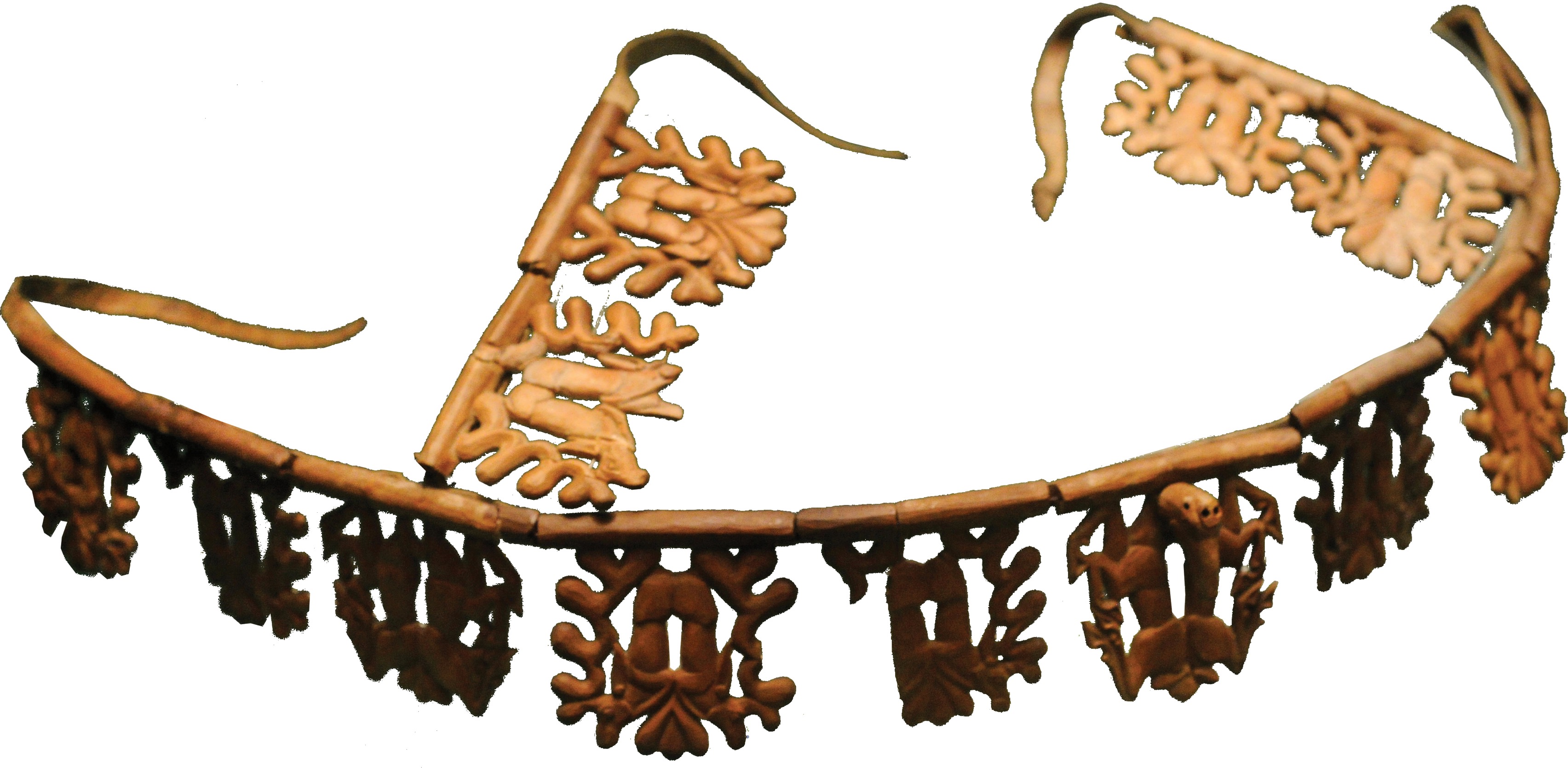
Herder societies normally observed sharp distinctions between male and female roles. Boys were raised to herd, fight, and if they had horses, ride. Courage, endurance, and defense of personal and family honor were highly prized male virtues. Girls were raised to do chores around tent or hut; to cook, sew, and mind babies and toddlers. Some women in Central Asia around 500 BCE were buried with weapons, perhaps an indication of warrior roles or of high social status. Women often handled commerce, especially when menfolk were away.
SMALL NUMBERS, LARGE IMPACT Herding supported much smaller, and more scattered, populations than farming. The reasons for this difference were, first, that farmers ate plants while herders ate animals that ate plants, giving them access to only about one-tenth of the energy per unit of area available to farmers. Second, herders’ lands were normally less fertile to begin with, limiting the nutritional support for larger animals. Herder populations were limited by conditions, not preference. They revered fertility in soil, animals, men, and women no less than farmers did.
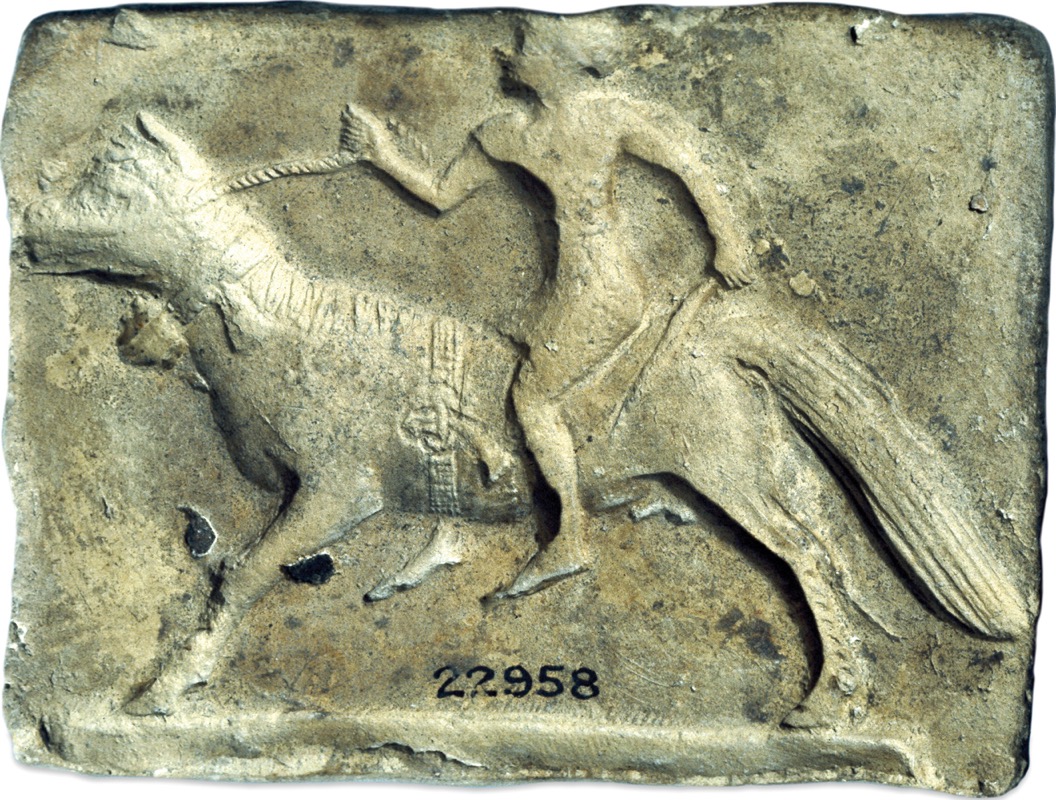
Despite their smaller numbers, herders often terrified farming folk. Where and when they mastered horses, their enhanced mobility gave them a great military advantage. They could attack when and where they pleased, and then fade away into the steppe or desert. They often operated what today we would call protection rackets—in effect, trading promises to forgo violence in exchange for grain or other goods. Conflict with farming communities usually took place on small scales, as raids rather than warfare.
Through their mobility, raiding, and trading, herders played an outsized role in world history, strengthening the strands of connection among settled folk in Eurasia and Africa, spinning additional threads of the world’s webs. In the Americas and Australia, where pastoralism didn’t develop until recent centuries, the process of web building was slower.
Glossary
- Eurasian steppe
- A broad grassland that stretches from eastern Europe to East Asia.
- herders
- People who mainly lived off of domesticated grazing animals that they raised in arid and semi-arid grassland and scrubland regions.