FARMING SOCIETIES ON THE MOVE
While herders played an outsized role in linking populations over long distances in Eurasia and Africa, migrating farmers occasionally had the same effect. Sometimes they moved into uninhabited spaces, but at other times they pushed other people off the lands they wanted. Either way, they spread the village way of life and, where villages became clustered together, built new and tighter, if local, webs of exchange.
Most of the farmer migrations of the period before 1000 BCE were small in scale and lost in the mists of time. To minimize the problem of scanty evidence, we will look at some farmer migrations that lasted for millennia and left comparatively good traces through archeology, genetics, or historical linguistics. This will take us momentarily into later periods of history.
EURASIA’S INDO-EUROPEAN MIGRATIONS
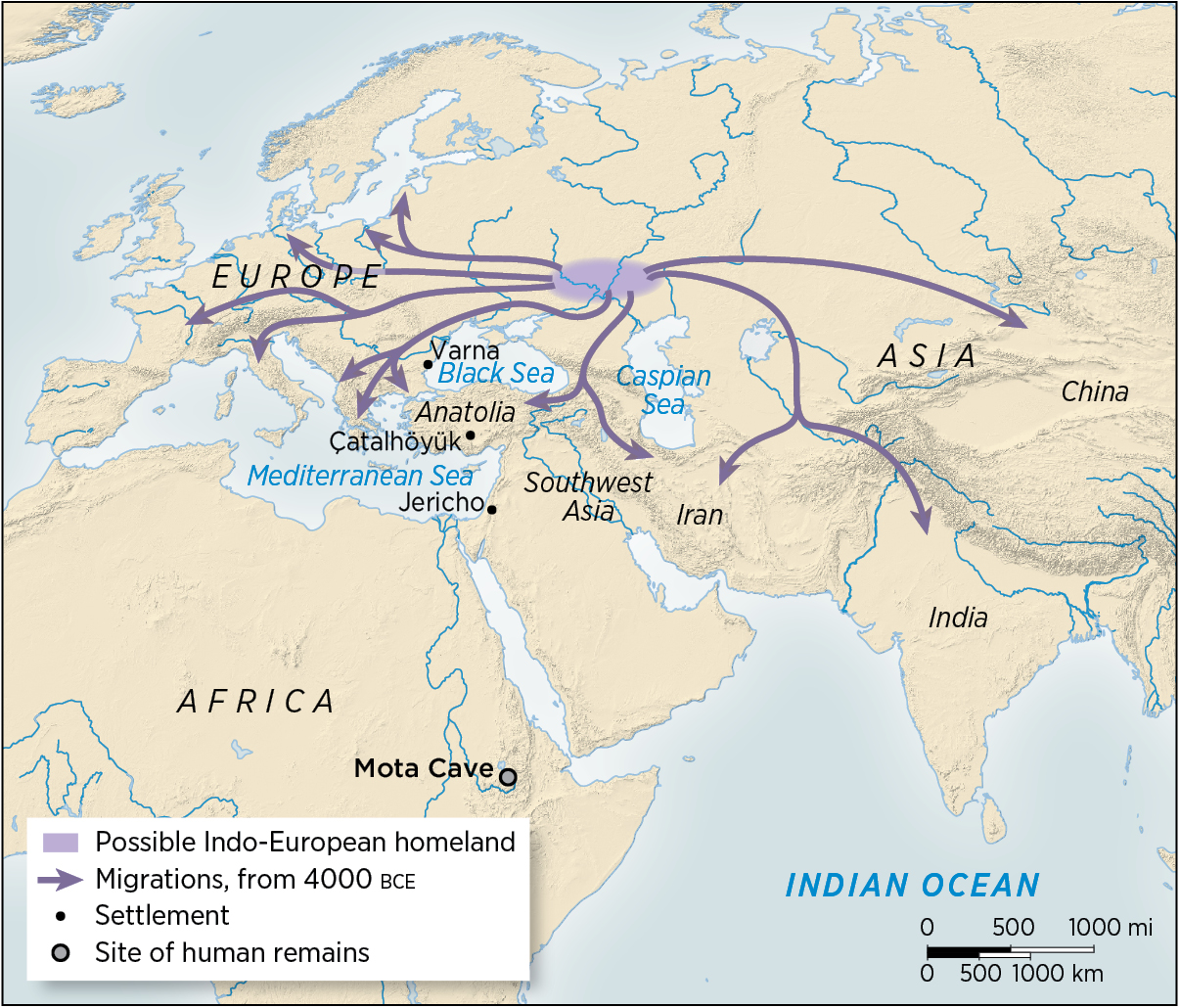
On occasion, farmers and their ways spread like slow-motion starbursts in multiple directions. There is linguistic evidence of such an event in the common roots of what became Germanic, Slavic, Romance, Celtic, Iranian, and several Indian languages. Migrations likely brought a single ancestral language into Iran, India, and Europe. Although there’s no consensus, most specialists think such migrations began north of the Black Sea about 4000 BCE, when the onset of colder and drier climate may have triggered migrations.
The Indo-European migrations, which extended into westernmost China as well, seem in most cases connected to the spread of farming. Many words, notably for items related to agriculture, are sufficiently similar in Indian and European languages to indicate common origin. The word for “yoke,” a wooden crosspiece fastening two oxen together so that they can pull a plow, is one example. In Sanskrit, a language of ancient India, it is yuj; in ancient Persian, yog; and in Latin, iugum. Similar variants exist in most other Indo-European languages. Archeological and genetic evidence supports the idea of a starburst migration of farmers into Europe and India.
As is often the case in migrations, young men seeking to establish themselves may have led the way. The Indo-European migrations were probably not ones in which men, women, and children all picked up and moved. Genetic evidence suggests that women were much less likely to have migrated. It also suggests that the immigrants to Europe and India had more success than local men in passing their genes on to future generations. This implies that the newcomers enjoyed higher status, supporting the notion they were farmers and more prosperous than other men.
Farming people from Southwest Asia also migrated into Africa. (This is how Africans acquired their tiny proportion of Neanderthal genes.) A 4,500-year-old male skeleton, called Mota after the Ethiopian cave in which it was found, tells us so. When compared to modern African populations, Mota’s remains indicate considerable admixture of Eurasian DNA. The imported DNA reached all but the most isolated populations of East Africa, implying that immigrants from Southwest Asia were both numerous and highly successful in transmitting their genes to later generations. But the evidence from Mota’s mortal remains cannot tell us how that happened.
Overall, the linguistic, archeological, and genetic evidence combine to suggest a starburst migration of farming people originating roughly 4000 BCE north of the Black Sea. Different groups moved in different directions—into India, Europe, and on a much smaller scale, northeastern Africa and westernmost China.
AFRICA’S BANTU MIGRATIONS
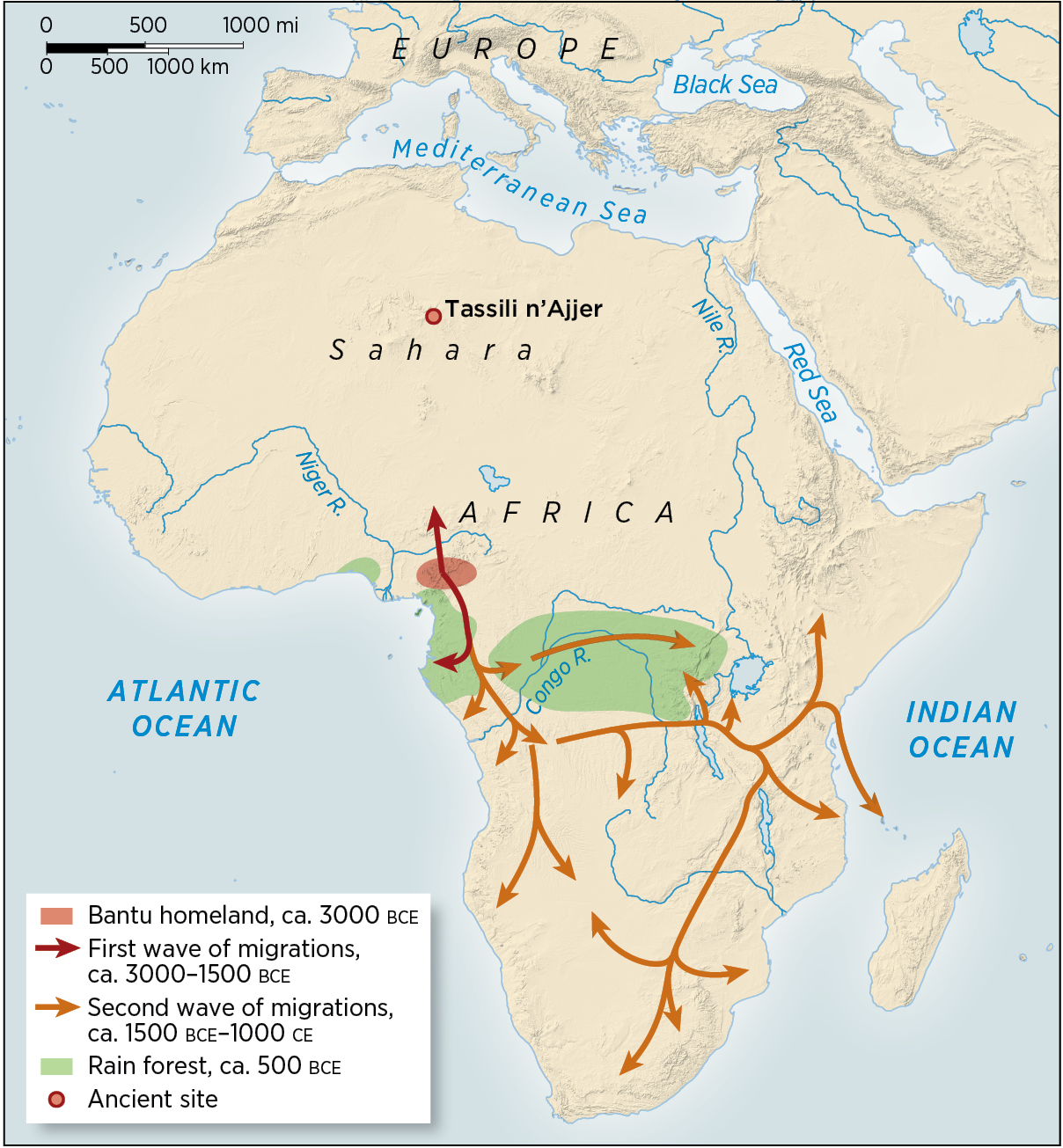
Later farmer migrations shaped African history much more deeply. Bantu is a language group of about 600 related tongues, now spoken widely in East, central, and southern Africa by hundreds of millions of people. Yet Bantu-speaking populations show the lowest genetic diversity within Africa, implying a small and comparatively recent founding population—another starburst that occurred around 3000 BCE.
Bantu-speakers originated in the Cameroon-Nigeria border region. In two main pulses they spread out, first within their region (ca. 3000–2500 BCE) and then into much of East and southern Africa (ca. 1500 BCE–500 CE). We know nothing about why they moved. They went slowly, reaching what is now South Africa about 1000 CE. Later Bantu migrants had better tools and weapons than the prior populations in central and southern Africa. They were skilled at cultivating yams and bananas, which do well in rainforest settings, and some of them became herders of cattle at some point along the way, probably in East Africa. With these skills they became increasingly successful colonizers, especially once they got south of central Africa’s rain forests, which are challenging environments for farmers.
The migrants also had a secret weapon. They were more malaria-resistant than the pre-existing central and southern African populations. Genetic evidence shows that these local populations had minimal experience with malaria before Bantu-speakers trickled in. Bantu-speakers and their ancestors, in contrast, had lived in intense malaria environments for many generations in West Africa, an experience that had ruthlessly selected for malaria resistance. On top of that, their staple food, yams, included chemical compounds that fight malaria. When Bantu-speakers moved into central, East, and southern Africa, they brought malaria with them. The mosquitoes that transmit malaria, not suited to dense forest, thrived in the agricultural clearings. The Bantu-speakers—quite accidentally—created dangerous environments for others in which they themselves could survive more successfully than anyone else.
Genetic evidence suggests that Bantu-speakers both replaced and absorbed the existing populations of central, East, and southern Africa. More specifically, it implies that migrant men had great success in passing their genes on to future generations, whereas the indigenous male populations did not—and that women of all backgrounds increasingly had their children with Bantu-speaking men. This is similar to the pattern revealed in the Indo-European migrations into Europe and India.
POLYNESIAN MIGRATIONS IN THE PACIFIC
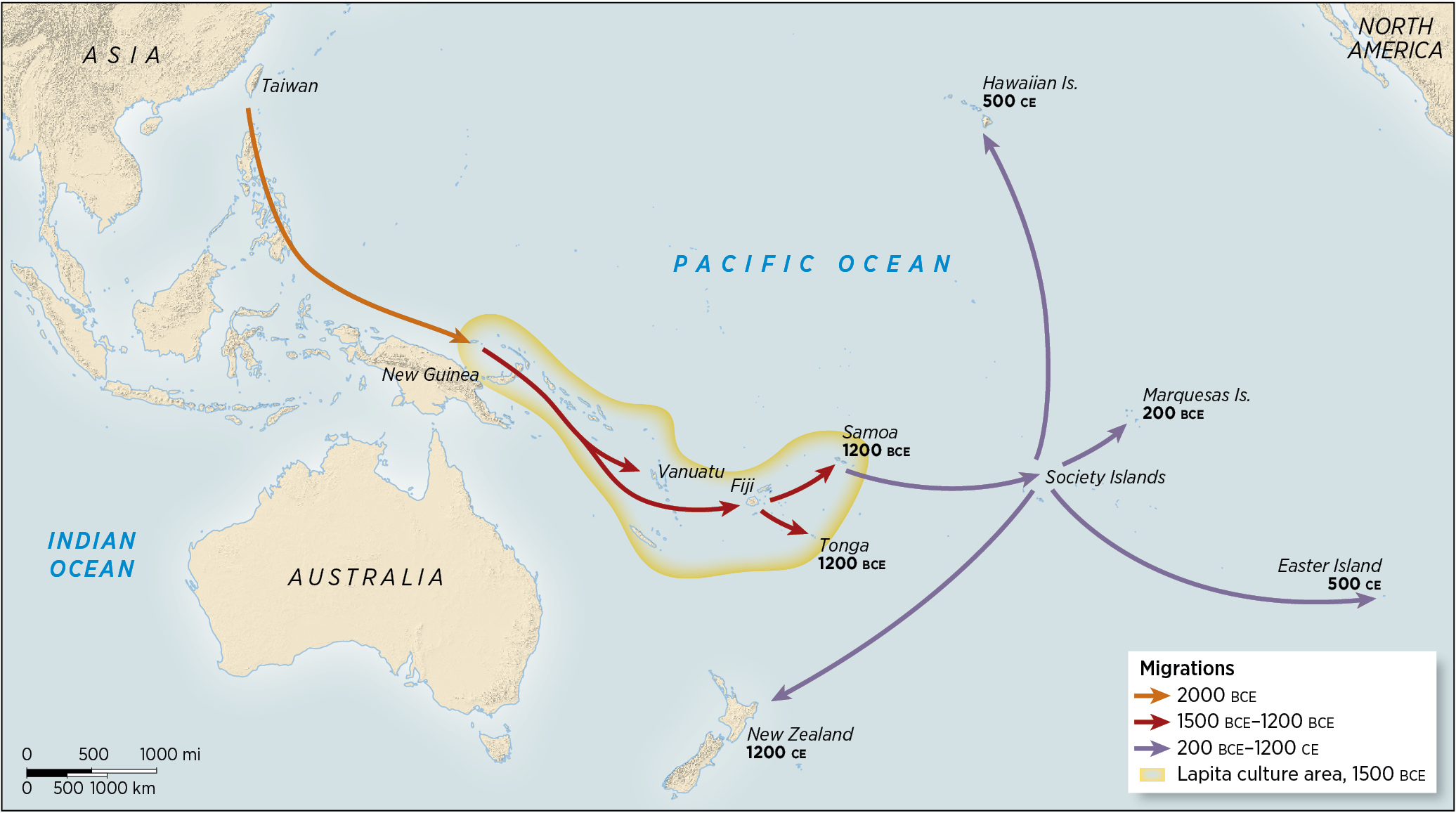
While Bantu-speaking farmers slowly made their way across a continent, Polynesians made their way across an ocean. Their distant ancestors came from islands of the westernmost Pacific such as Taiwan. Farmers, probably speaking a language ancestral to those of modern Southeast Asia, spread out from the Asian mainland into the islands of the western Pacific by 2000 BCE. Here they stayed put for a while, not venturing further out to sea—and with good reason. The Pacific covers about one-third of the globe and has only a few thousand habitable islands in it, most of them tiny. Those who sailed the open Pacific had to know what they were doing.
About 1500 BCE, the ancestors of today’s Polynesians—often called Lapita after their style of pottery—began to sail over immense distances and settle formerly uninhabited islands. By 1200 BCE, some had reached Samoa and Tonga. A thousand years later, Polynesians settled the Marquesas Islands in the central Pacific, and by 500 CE they had arrived in Hawaii and on Easter Island. It took until about 1200 CE before they settled New Zealand, the final frontier of Polynesian settlement.
Navigating the Pacific required skill and courage. Polynesians used big wooden dugout canoes with outriggers for stability. The largest could fit a hundred or more paddlers, but all canoes used sails on the open sea. They often sailed in fleets. The Polynesian voyagers learned to get their bearings from the stars, read the patterns of ocean waves and swells, and find land by watching the flight patterns of birds. They recorded geographic information on maps made of reeds and shells. Unlike the Indo-Europeans and the Bantu, the Polynesians couldn’t simply walk to their new lands.
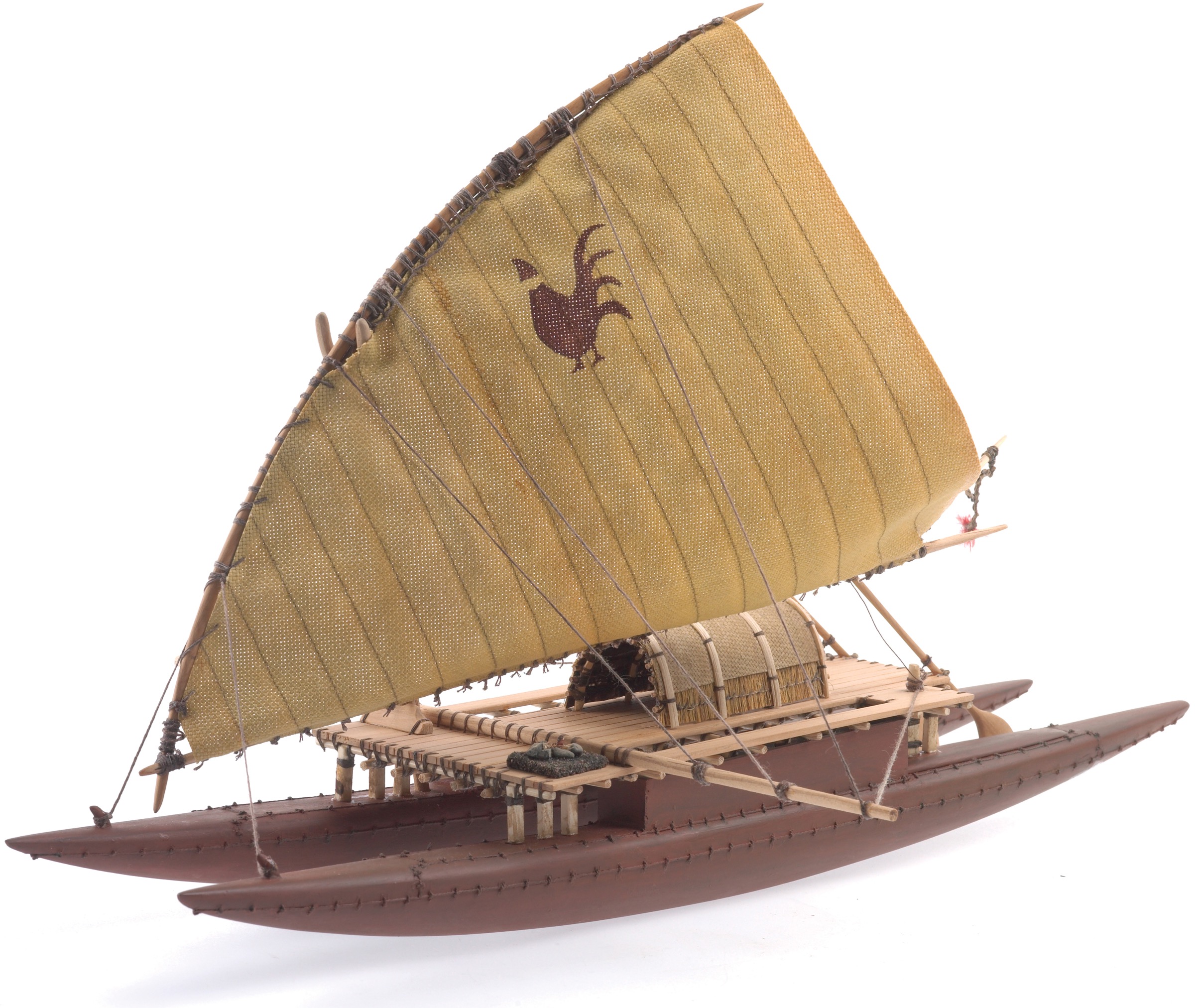
This extraordinary epic of exploration and colonization, like the Bantu and Indo-European migrations, was a movement of farmers. The Polynesians took their favorite crops—taro (a starchy root crop), and coconut and breadfruit (both tree crops)—wherever they went. They also brought their domesticated animals, mainly chickens, pigs, and dogs. These fellow passengers helped them colonize a few hundred Pacific islands, most of which didn’t offer abundant food. On islands with coastal lagoons, Polynesians enjoyed an initial bonanza of fish and shellfish. After they depleted the lagoons, and where no lagoons were present, they farmed to survive.
THE DYNAMISM OF FARMING SOCIETY
The Indo-European, Bantu, and Polynesian migrations show the dynamism of farming populations. Their ways of life gave them certain characteristics that encouraged them to spread into lands that had no farmers or, in the case of the Polynesian islands, no people at all. First, their populations tended to grow and provide streams of young people seeking their futures. Second, at least in some cases such as the Bantu and malaria, they had disease resistance that others lacked, easing their migrations. Third, as farmers, they all had some combination of tools and skills that were previously absent in the lands to which they went. They had reasons to migrate and skills that enabled them to do so successfully.
It is also instructive to note that hunter-foragers did not migrate into terrain occupied by settled farming communities and somehow displace them. They didn’t have the numbers and power to do so. Moreover, the Bantu speakers did not migrate into Egypt, which already had a dense network of farming villages; they moved into sparsely inhabited territory instead. The Polynesians didn’t colonize the coasts of China, which already hosted farming communities; they risked voyages into the unknown instead. These farmer migrations thus extended the domain of farming into new lands and stretched the thin web of human interaction in new directions.
Glossary
- Bantu [BAN-too]
- A language group that originated in the area of the modern-day Cameroon-Nigerian border. It is made up of 600 related languages now spoken in East, central, and southern Africa.