THE FIRST BIG, FAINT WEBS
By 5000 BCE, if not before, village farmers made up most of humanity. There were still hunter-foragers, of course, and in areas inhospitable to farming—deserts, steppes, and dense forest zones—they might well have outnumbered farmers at that time. But globally, farmers accounted for ever larger numbers and spread their ways with each passing century. As the world became dotted with farming villages and inhabited by ever more people, it knitted itself together into interactive webs faster than before.
TRADE AND TECHNOLOGY
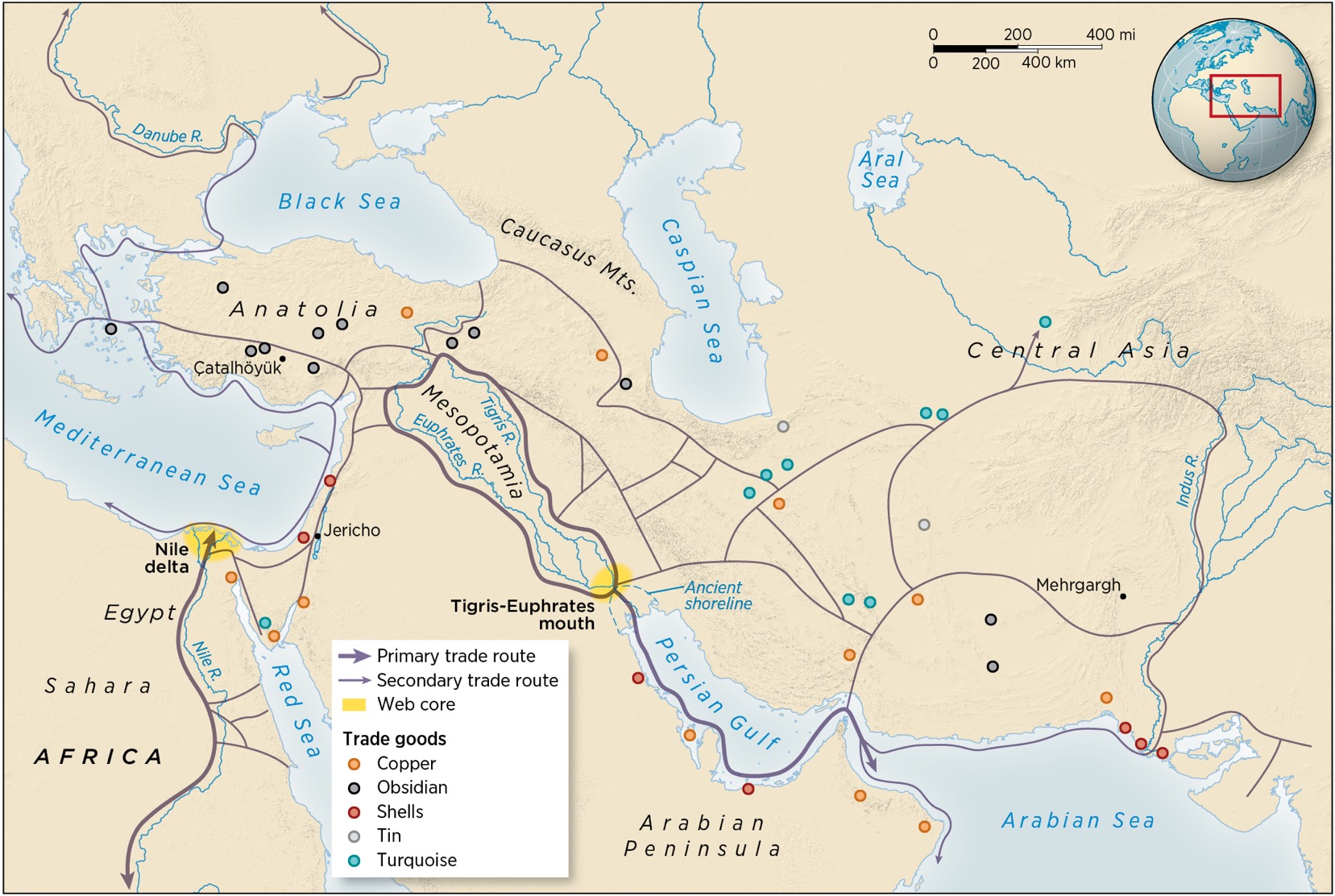
Although villages could be self-sufficient for a time, producing their own food, fuel, and other basic commodities, most could not always do so. To acquire commodities beyond the basics, many villages linked to one another, and sometimes to distant sources of high-value goods, like the obsidian of Çatalhöyük or the salt of Jericho. Precious goods might be traded, one village to the next, over distances of hundreds of miles. For example, a farming center in the lower Indus valley region, Mehrgargh, acquired shells from the Persian Gulf and turquoise from Central Asia as early as 6000 BCE.

WHEELED CARTS Trade in bulk goods was limited to easily navigable rivers and coastlines until someone invented the wheel. The earliest evidence of wheels and axles dates to around 3500 BCE and turns up in several places more or less at once—Poland, the Balkans, the Caucasus, and Mesopotamia. It’s possible that people re-invented the wheel shortly after it was invented, or the technology may have spread quickly because it was so useful. Oxen pulling wheeled carts could move ten times the load that a beast of burden might carry. By 3000 BCE, people on the steppes of western Eurasia probably lived in animal-drawn wheeled carts—the first mobile homes. On flat land, oxcarts became a crucial technology, smoothing movement and exchange. In rugged lands, the wheel had little use. Its invention and spread, therefore, contributed to the unevenness of the Eurasian economy: a boon to level lands, especially the clusters of villages in the already well-populated floodplains of Mesopotamia, Egypt, and the Indus, but of no value in hilly country.
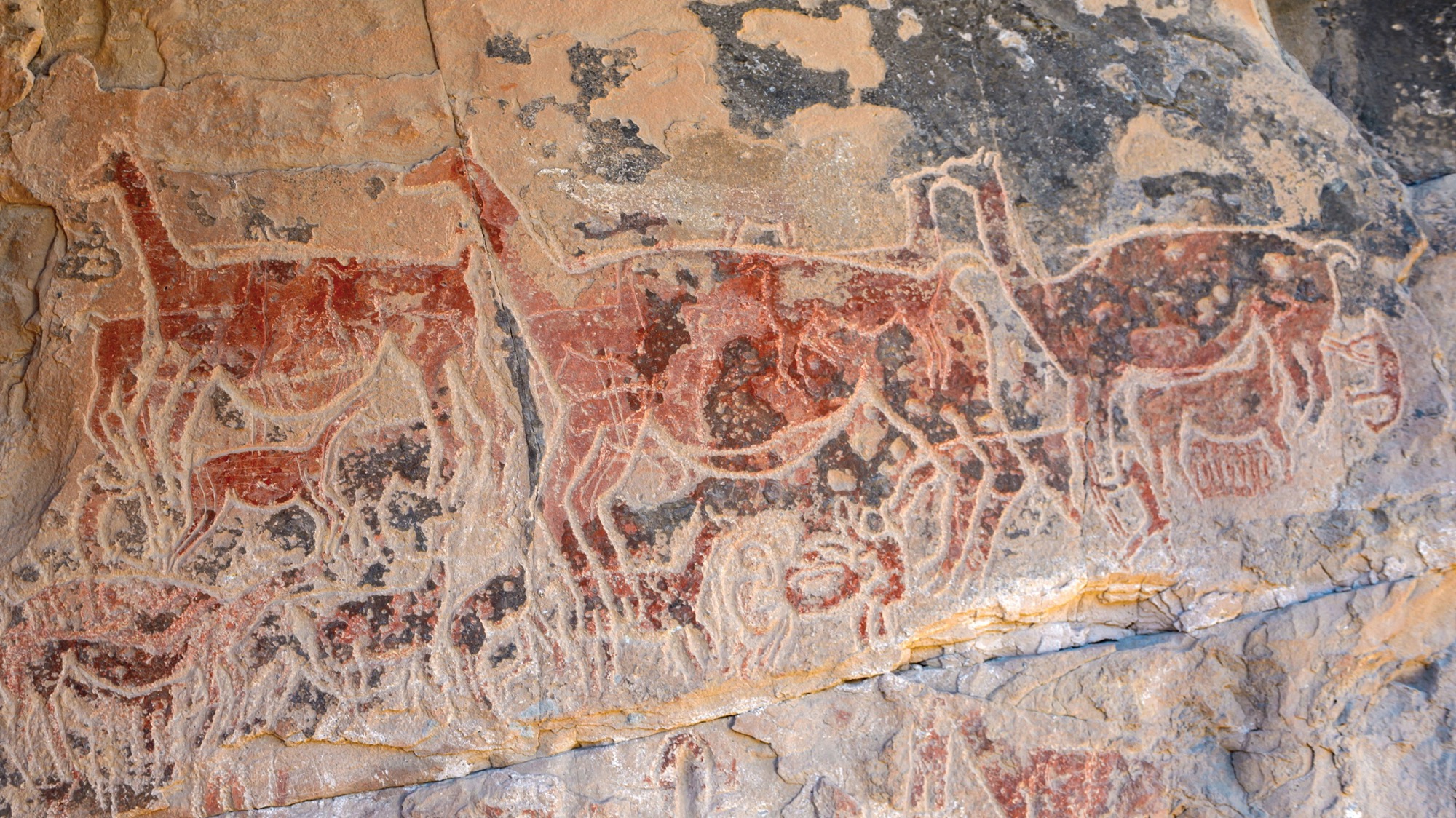
DONKEY CARAVANS At about the same time that the wheel made its debut, people in Southwest Asia and Egypt started transporting goods in donkey caravans. Although much less efficient on flat land than wheeled transport, strings of donkeys could navigate uneven terrain. They helped to link uplands, where timber and useful ores were more common, to the more densely populated lowlands. By and large, pack animal transport developed earlier and more fully in Southwest Asia than anywhere else. In East and Southeast Asia, river transport loomed larger. In Africa south of the Sahara, river transport and human porterage proved more practical than beasts of burden, which suffered heavily there from a livestock disease. In the Americas, there were no suitable beasts of burden outside the Andes, where llama caravans played much the same role that donkey caravans did in Southwest Asia.
Beyond these economic links, villagers interacted with their neighbors in nearby settlements through regular festivals and ceremonies, and at times in efforts to defend themselves against invaders from afar. Families sought marriage partners for sons and daughters in neighboring communities—it was always prudent to have kinfolk a day or two away in case something went wrong in one’s own village. So for social as well as economic reasons, villages formed ever tighter, if tiny, webs of interaction with neighboring villages.
THE FIRST REGIONAL WEBS
The first regional webs in Eurasia and North Africa began to appear by around 5000 BCE, even before cities and states. Rivers were central to this web-building process. Water transport, even on mere rafts or canoes, was far cheaper than on land. The frequency of interactions with distant villages was far greater for people living along navigable rivers. Where these rivers linked up to seaborne transport networks and to local overland routes, villages became especially interactive and interconnected. Examples of such locations include the mouth of the Nile in Egypt and the Tigris-Euphrates in southern Mesopotamia.
Two technological developments soon spurred on the development of regional webs in Eurasia and Egypt. The first was the combination of horse domestication and the wheel, which gradually made it easier to transit broad grasslands after 3500 BCE. The second occurred by roughly 3000 BCE, when people from the Persian Gulf to the Pacific began to learn how to use sails efficiently, making seaborne and upstream river-borne transport more practical. It took many more centuries for people to learn the best routes and the ideal ways to rig sailing vessels. These two technological changes eased human trade and travel in Eurasia and North Africa, and helped prepare the way for bigger, thicker, regional webs to form—as we will see in later chapters.
After 3000 BCE, writing as well as transport technologies eased the development of regional webs. Record keeping enabled merchants to operate more reliably over long distances by keeping track of who owed how many bolts of cloth or baskets of rice. And it enabled states to recruit, feed, and equip larger armies and extend their authority over larger territories.
WEB EXPANSION FROM THE TOP DOWN The expansion of these regional webs also derived from the wishes of people involved, especially powerful people. Village and rural elites benefited from involvement in larger networks. If they could get farmers or herders under their influence to produce goods that cities wanted such as grain or leather, then in exchange they could enjoy the fruits of urban craft production—fine clothing, dazzling jewelry, effective weaponry. Rulers normally sought to collect rents or taxes from more people to maximize their income. When they could, they spread the worship of their preferred gods widely. Such goals were attractive enough that rulers everywhere routinely used their armies, priests, and wealth to break down centers of resistance to their authority. They extended their states, founded new cities, and in so doing spread webs of interaction.
WEB EXPANSION FROM THE BOTTOM UP Web building, to a lesser extent, also resulted from the daily activities of petty traders, sailors plying unfamiliar seas, refugees escaping from wars, slaves taken from their homes, soldiers posted to faraway lands, and countless others who introduced their accustomed ways in new places. The metals that were traded over long distances were passed from trader to trader in little towns; after all, big trade networks consisted of lots of smaller networks. Sailors, soldiers, refugees, and slaves—anyone traveling or living far from home—occasionally introduced to their new communities novel ways of worshipping, cooking, dyeing cloth, decorating pots, or fletching arrows.Without intending anything of the sort, they too brought communities into closer economic and cultural contact, simply by traveling or living away from home.
As a result of the routine activities of common people and the ambitions of the powerful, fewer villages retained the autonomy of earlier times. Instead, people found themselves entangled in larger webs, entranced by the culture of cities, enmeshed in complex society—and subject to the authority of states.
WEBS AND THE DURABILITY OF KNOWLEDGE
Although webs grew bigger and tighter, the whole process was fragile and occasionally reversed. Webs could break down under the impact of epidemics and famines that reduced population sharply. Pirates and brigands could stop traffic on seas or steppes. But usually these proved to be temporary interruptions, and patient effort guided by the self-interest of elites and the daily routines of people traveling far from home normally rebuilt torn webs.
With the advent of dense populations, complex societies, cities, and states, the likelihood of a lasting breakdown in webs dwindled. During the Paleolithic, when people were few and spread out, disasters could eliminate skills and knowledge. An example is the case of the native Tasmanians. Tasmania, now an island the size of Indiana or Maine, was part of the Australian mainland until rising seas filled the Bass Strait about 10,000 years ago. At that time, fewer than 4,000 people lived on the new island. No one had boats capable of crossing the strait, so the Tasmanians were isolated. They gradually lost the capacity to make items such as fishhooks and sewing awls (big needles). They could no longer fish or make clothing. They even lost the ability to make fire.
This small story shows the penalty of small numbers. When those Tasmanians who knew how to make fishhooks died, they hadn’t passed on their knowledge to enough other people to ensure its perpetuation. Useful knowledge was lost because it wasn’t stored in enough different brains.
In large regions such as Mesopotamia, Egypt, China, or Mesoamerica, however, once dense populations, complex societies, and regional webs were in place, such cultural losses couldn’t happen. Population density meant that skills diffused readily to large numbers of people. Interactive webs enabled people far away to learn of every new skill or technology, and some of them would adopt it or alter it to fit their circumstances. With writing, information could survive outside of people’s brains altogether, and live on beyond any individual’s death. Innovation and learning became more cumulative inside the webs. The losses that Tasmanians experienced only happen among small, isolated populations—of which there were ever fewer as complex society, cities, states, and webs spread.