THE WORLD’S WEBS IN THE FIFTEENTH CENTURY
As of 1400, the 350 to 450 million people on Earth spoke several thousand languages, followed several hundred religions, and recognized several hundred political rulers. (A few tens of millions of them recognized no rulers at all, although with each passing year fewer and fewer lived in so-called stateless societies.) Despite nearly 5,000 years of states, cities, and empires, and some 2,000 years of expanding, proselytizing religions, the human race remained politically and culturally fragmented. It was in no deep sense a community. Even within the Old World web, spectacular diversity prevailed—from the refined world of Confucian scholars in urban China, with its leisured philosophy and gorgeous calligraphy, to the austere and dangerous world of illiterate fisherfolk on the coasts of Scotland.
THE OLD WORLD WEB
That diversity resulted partly from the sheer size of the Old World web. Its frontiers, in 1400, stretched from Greenland to Japan and from Indonesia to West Africa. Three-fourths of humanity lived within it. Thousands of caravan tracks, navigable rivers, and sea routes held the web together. It included hubs or nodes, such as Malacca, Calicut, Hormuz, Cairo, Constantinople, or Venice, where people heard many languages and where the silks of China crossed paths with the ivory of East Africa or the amber of Scandinavia. But it also included spaces where people kept to themselves, deep in the forests of Siberia or high in the Himalaya mountains, minimally connected to empires, trade routes, or major religions. These people, comparatively few in number, lived within the Old World web’s frontiers, but they were not part of its fabric—at least, not yet in 1400.
INTERACTIONS WITHIN THE OLD WORLD WEB The Old World web had two main trunk routes. The overland caravan routes, collectively known as the Silk Road, linked eastern and western Eurasia. The caravan routes flourished in times of peace, when strong empires kept brigands in check and prevented dozens of local rulers from demanding payment from traders in exchange for safe passage. The best example is the Pax Mongolica (ca. 1260–1350), when the short-lived Mongol Empire stamped out brigandage almost everywhere along routes between Korea and Iraq, making travel safer for merchants.
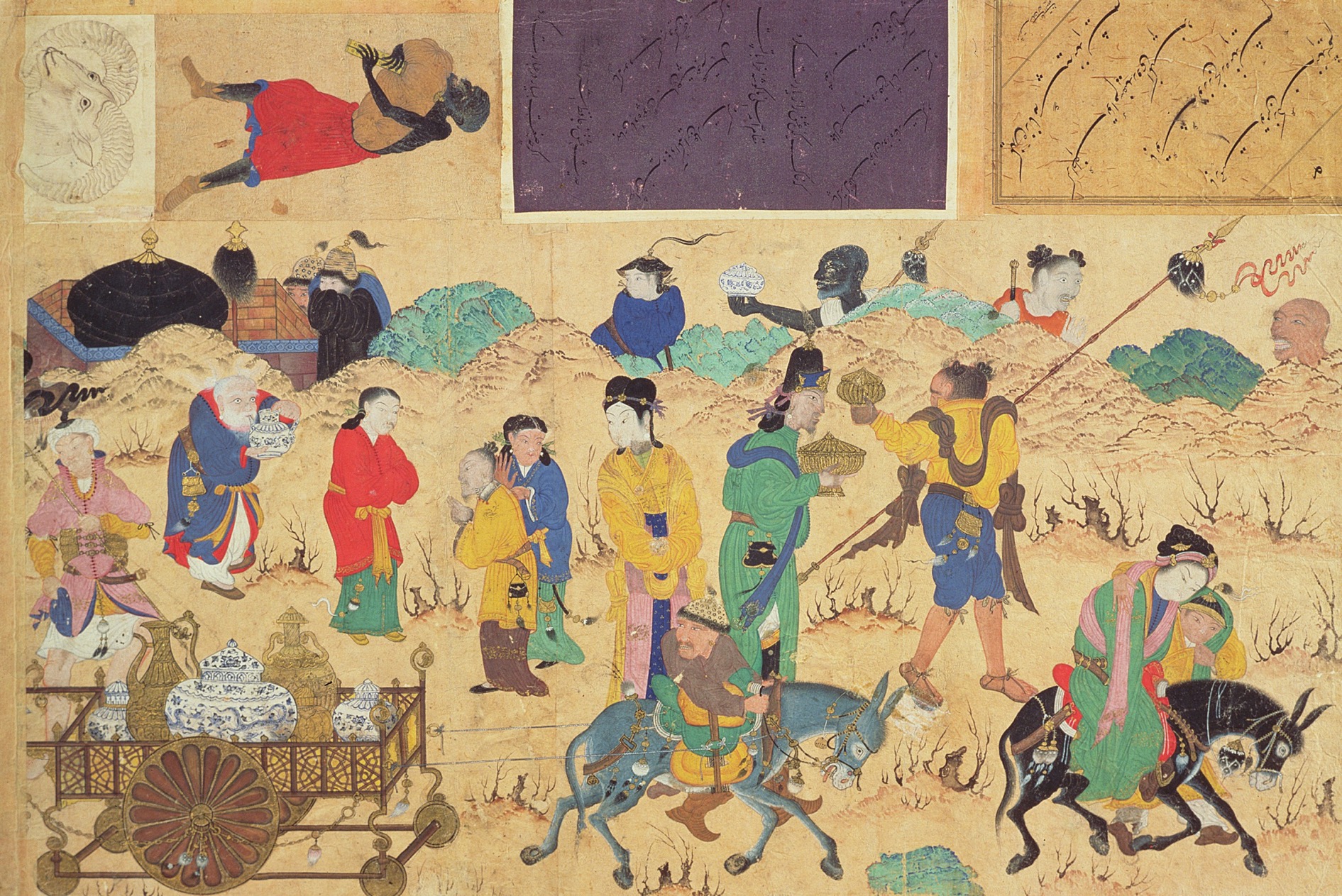
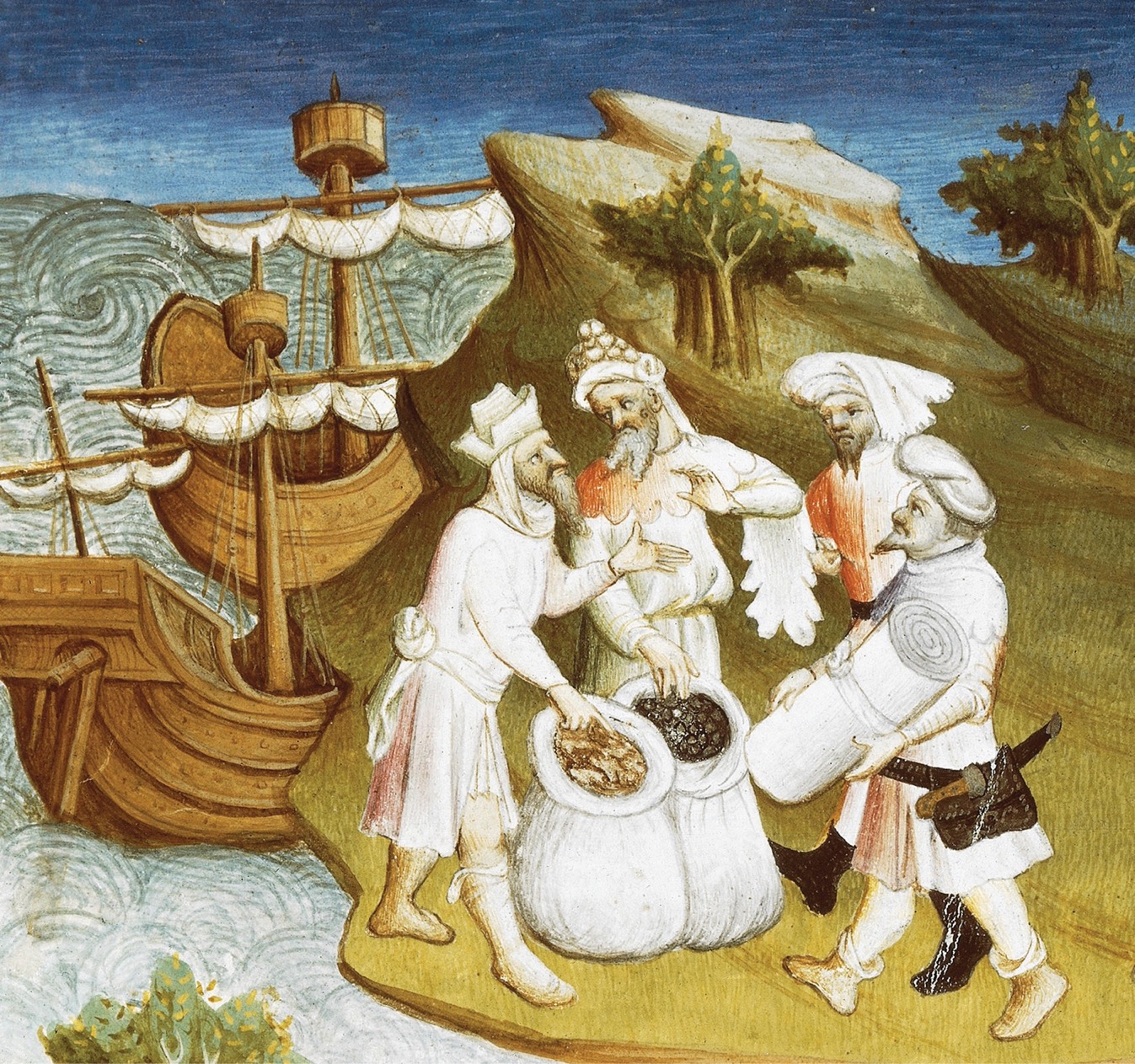
The second main trunk route, also in reality a series of connected routes, was by sea. It extended from the East Asian ports through the waters of Southeast Asia and into the Indian Ocean, as far west as the coasts of Africa. Via a short overland passage in Egypt, these routes connected to the Mediterranean. Mastery of the monsoon winds had opened this trunk route in ancient times.
The traffic within the Old World web, along these trunk routes and countless lesser ones, served as a homogenizing force. Cultural interaction and political conquests reduced the number of different languages spoken. Meanwhile, more and more people chose (sometimes under duress) to follow fewer and fewer religions, and so Buddhism, Hinduism, Christianity, and Islam (some people would include Confucianism as a religion too) each acquired tens of millions of believers, while many other religions disappeared. Of course, at the same time, the big religions fractured, developing internal splits such as the Sunni–Shi’a divide in Islam or the Orthodox–Catholic schism in Christianity. And the big languages fractured too, although slowly. They developed dialects, so the Arabic spoken in Morocco gradually came to seem strange to Arabs in Iraq because it sounded so different from their own. So the process of homogenization in the Old World web had its limits and counter-currents.
A THICKENING WEB During the fifteenth century, the eastern and western edges of the Old World web were rapidly consolidating and thickening as a result of maritime trade. In earlier centuries, mastery of the arts of camel management had boosted the connectivity of the central regions of the Old World web, making desert crossings in Central Asia, Arabia, and Africa much more practical. Mastery of the monsoon winds had given sea traders in the Indian Ocean world a precocious start in developing long-distance networks. But now, from at least 1200 onward, improving ship design and navigational skill in both western Europe and eastern Asia were fast accumulating, reducing the risks of sea travel and making trade and economic specialization yet more rewarding. Sailing the western Pacific waters from Japan to Java, or the eastern Atlantic from Scandinavia to Spain, was dangerous indeed. Both seas featured frequent, furious storms, not to mention (especially in the western Pacific) bold, enterprising pirates. But bigger and better ships helped sailors overcome their understandable fears of these hazards.
The rewards to risking one’s life and cargo at sea were genuine and growing. Both western Europe and eastern Asia produced a wide diversity of resources and goods. Markets had sprung up offering tempting prices at which to sell scarce goods from afar, whether Spanish wine in the Netherlands or Moluccan spices in China. At times, even bulk goods such as rice, salt, and timber could justify voyages in these two sea rooms.

Both these emerging maritime worlds drew additional traffic from networks of navigable rivers. In Europe, the big rivers flow fairly evenly throughout the year and permit ship or barge traffic well inland. In East and Southeast Asia, the big rivers are more seasonal because of the pattern of summer monsoon rain. But with painstaking construction of canals, dikes, and dams, these rivers too served as reliable avenues of commerce, linking interior regions with the sea.
So, in 1400, the eastern and western edges of the Old World web were humming with riverine and seaborne trade. Knowledge of geography, winds, and currents, of ship design, cartography, and navigation, of goods, markets, and prices was growing at ever faster rates. Both regions were developing a more maritime and commercial culture. Populations were recovering from the disease and climate disasters of the fourteenth century, and cities were expanding rapidly.
LOCAL WEBS
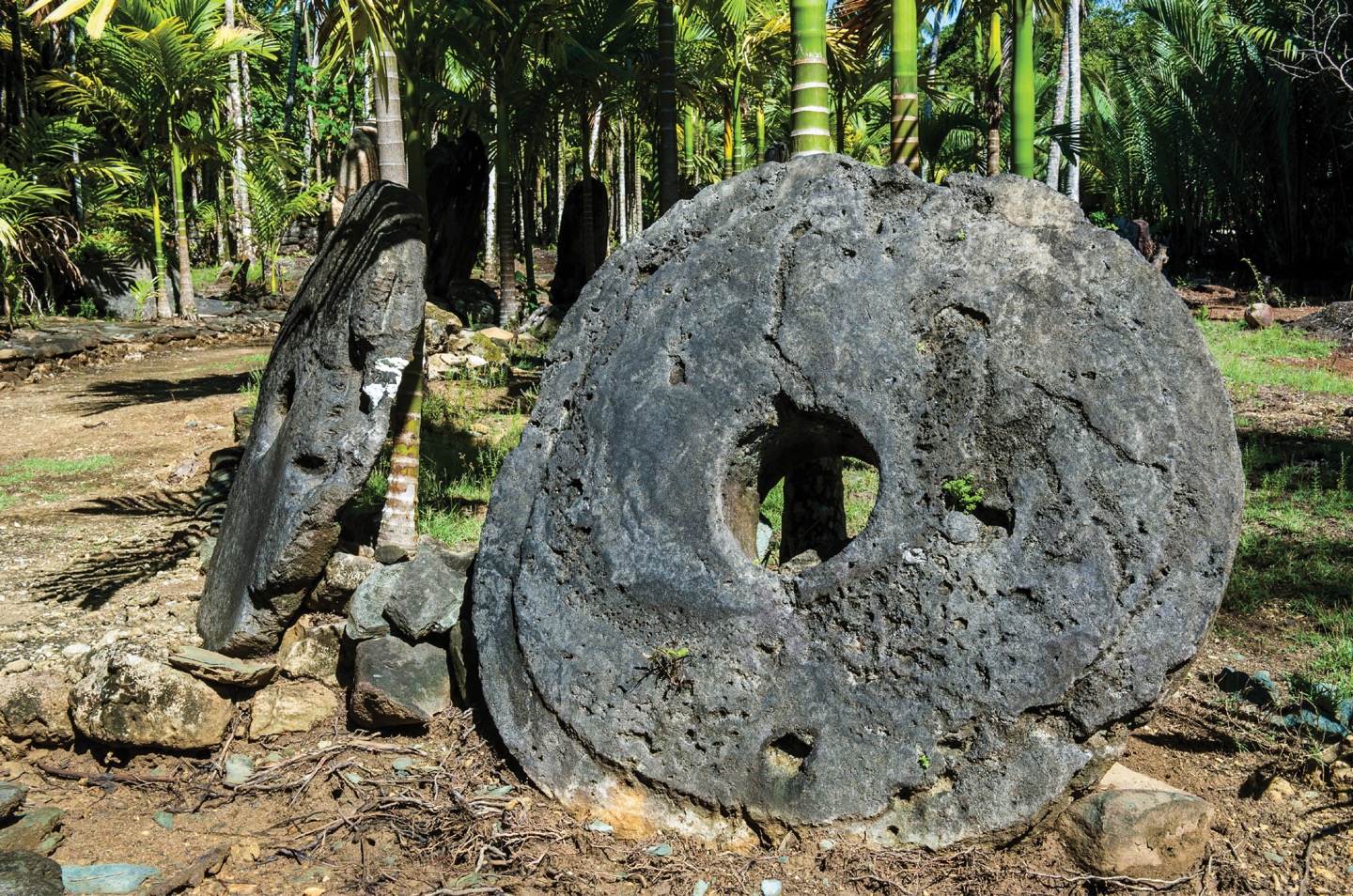
In 1400, some 60 to 120 million people in Oceania, the Americas, and the southern third of Africa lived outside the Old World web altogether. They too, of course, took part in trade networks, military conquests, and the same sorts of activities as people in the Old World web. But their scales of operations were smaller. In Oceania, people in Polynesia and Micronesia had built their own small webs of interaction. Archipelagoes like that of Hawaii, or Tonga and Fiji, hosted constant interactions among hundreds of thousands of people. In the Caroline Islands of Micronesia by 1400 or 1450, a well-integrated exchange network had grown up, using big stone discs as money—some of them heavier than a car. But this little web probably involved at most tens of thousands of people. In demographic terms, these Oceanic networks were tiny compared to the Old World web.
WEBS IN THE AMERICAS
In the Americas, as we saw in Chapter 15, much larger webs had developed around the dense populations in the Andes and in Mesoamerica. In 1400, perhaps 40 to 70 million people lived in the Americas, and about half were in either the Andes or Mesoamerica. Most Amerindians, and all those in the Andes or Mesoamerica, took part in interactive webs. In the absence of pack animals (outside of llamas and alpacas in the high Andes), goods could travel only by watercraft or human porters in the American webs. Canoes and rafts linked peoples on riverbanks and shorelines. Elsewhere, people had to carry everything themselves.
So the character of the American webs was slightly different from that of the Old World web, with less bulk commerce in transit. Crops such as maize diffused widely within this web, and so did some cultural practices such as ball games and mound building. But the volume and intensity of the exchanges of goods over long distances were modest compared to what occurred in the Old World web with its caravans and shipping. Buzzing markets did exist, but mainly on the local level—as in the Basin of Mexico, the region around today’s Mexico City. As in the Old World web, those societies enmeshed in the American web featured more specialization and exchange, greater wealth, greater inequality, greater military power, than those societies outside the web.
Like its counterparts, the American webs left some people out entirely. In the far south of South America and in the northern reaches of North America, scattered populations lived essentially subsistence lives. In pockets of Central American or Amazonian rain forest too, there were some people living substantially in isolation.
WEBS IN AFRICA
Most of the northern half of Africa, by 1400, lay within the Old World web. Egypt had long been one of its linchpins. Trade and cultural exchange, most notably the spread of Islam, tied the East African coast as far south as Kilwa and Sofala, the Mediterranean lands, and the West African Sahel firmly to the rest of the Old World web. Where rivers made travel easy, as along the Nile and Niger, tendrils of the Old World web reached further still.
But the southern third of Africa, like sizeable parts of the Americas, or Siberia, stood apart from any big web. People there were not importing shiploads of luxury goods from Egypt or India; they were not sending young men to study Islam in Cairo or Baghdad. They were not experimenting with Indian Ocean world technology such as sugar mills or lateen-rigged sails. Instead, they were producing food and clothing for themselves or for local use, they were following their own religions, and they were using the same technologies—perhaps with minor alterations—that their ancestors had employed for many generations. They lived outside the Old World web, but within much smaller webs of their own making.
As in the Americas, these little webs in southern Africa were better for circulating ideas than goods. Without pack animals, wheeled vehicles, or ships, people here had to move everything on their backs, on their heads, or in canoes.
So in 1400 the world included one giant interactive web in Eurasia and the northern half of Africa, a large one in the Americas, and small, local ones elsewhere. The Old World web was home to most of the world’s people, and to its most formidable states and societies. It alone had sailing ships capable of carrying hundreds of tons of cargo. It alone had many kinds of pack animals suited to almost any terrain. It alone had wheeled vehicles. By 1400, it had fewer obstacles to interaction, especially to trade, than did the other, smaller webs around the world.
The Old World web was not necessarily a pleasant place to live—certainly not if life expectancy or social equality are the measures—but it is where people had built the most powerful militaries, the most efficient communications networks, and the most sophisticated technologies. Therefore, it comes as no surprise that the people who brought the world’s webs together, who forged the first truly global web, came from the edges of the Old World web.