EUROPE: EXTREME TURBULENCE
As we’ve seen in previous chapters, it was primarily Atlantic Europeans who made the voyages that forged the Global web. So it was primarily in European societies that the global harvest of new information arrived first, sped forward by the printing press. These circumstances colored three great disruptions in the intellectual sphere in early-modern Europe, major developments that we now call the Renaissance, the Protestant Reformation, and the Scientific Revolution. The first deeply affected European thought but did not travel well beyond Europe’s shores. The second involved far more people than the others, brought fierce conflict, and motivated spasms of violence. The third involved only a tiny few but brought far larger, and more global, consequences in the long run.
THE RENAISSANCE
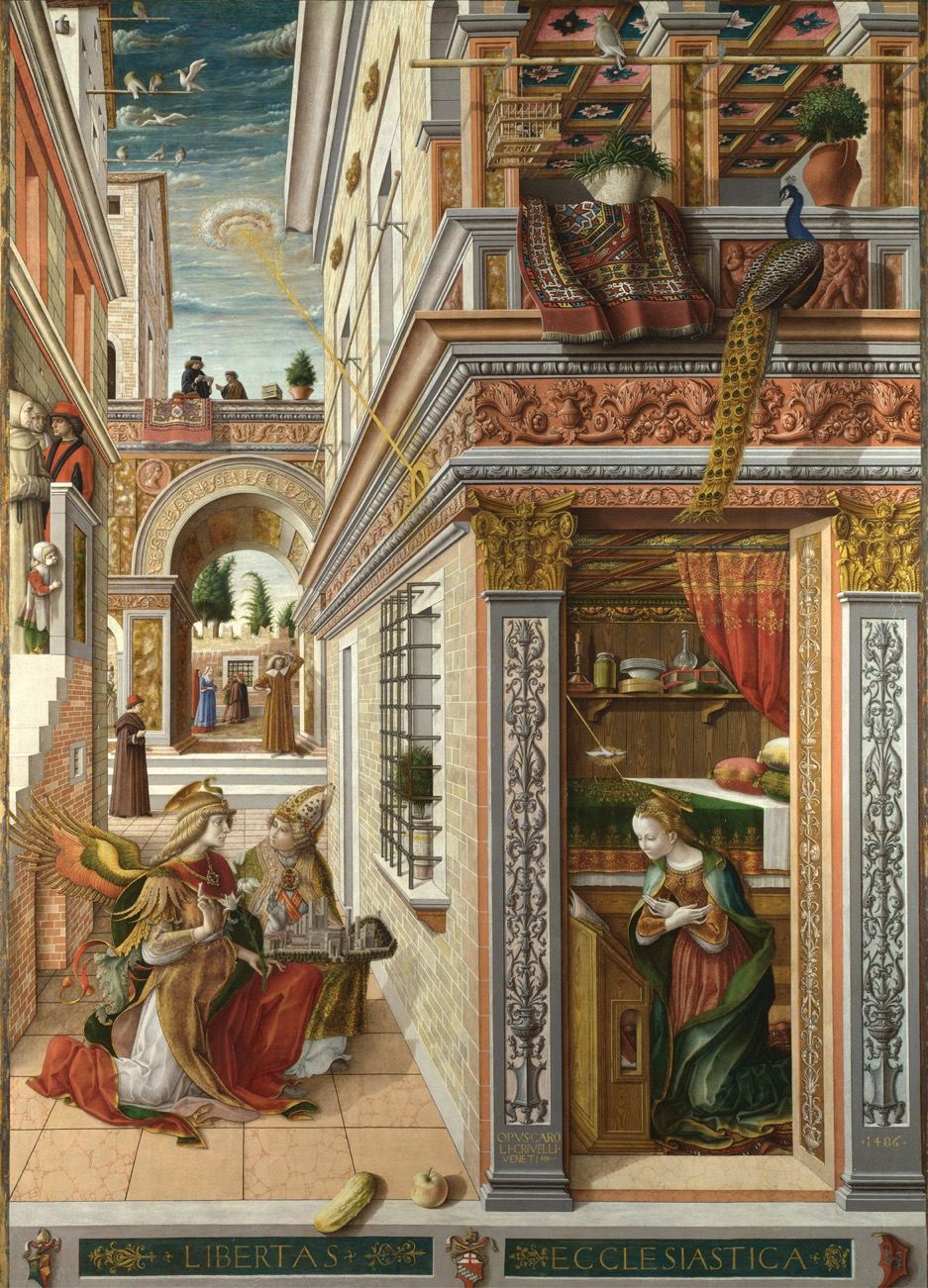
In an earlier chapter we saw how exposure to Arab and Byzantine Greek learning helped to stimulate new thinking in twelfth- and thirteenth-century Europe, especially challenges to longstanding Christian dogmas within the newly invented institution of the university. Knowledge of Arabic and Greek gave access to bodies of thought from the ancient world that were otherwise out of reach. Political and military pressure on the waning Byzantine Empire motivated many learned Greeks to seek safe spaces in Italian universities in the early fifteenth century, bringing perspectives, and manuscripts, previously unknown there. The growing fascination with ancient Greek and Roman wisdom brought what historians since the nineteenth century have called the Renaissance, meaning a re-birth of ancient learning. Of course, ancient learning was never dead. It was alive and well in Greek and Arab lands. But in western Europe much had vanished, and it is from that perspective that the term Renaissance makes sense.
The heart of the Renaissance was a re-engagement with the literatures, histories, philosophies, and art of the ancient Greeks and Romans. Their emphasis on human affairs and human achievement—as opposed to more spiritual matters—found a ready audience among the literate classes and their wealthy patrons. Plato and Cicero came back into style. Translations of the histories of Herodotus and Thucydides appeared, as did the work of ancient Greek playwrights. Sculptors imitated the ancients’ marble statuary, with its emphasis on accurate human form.
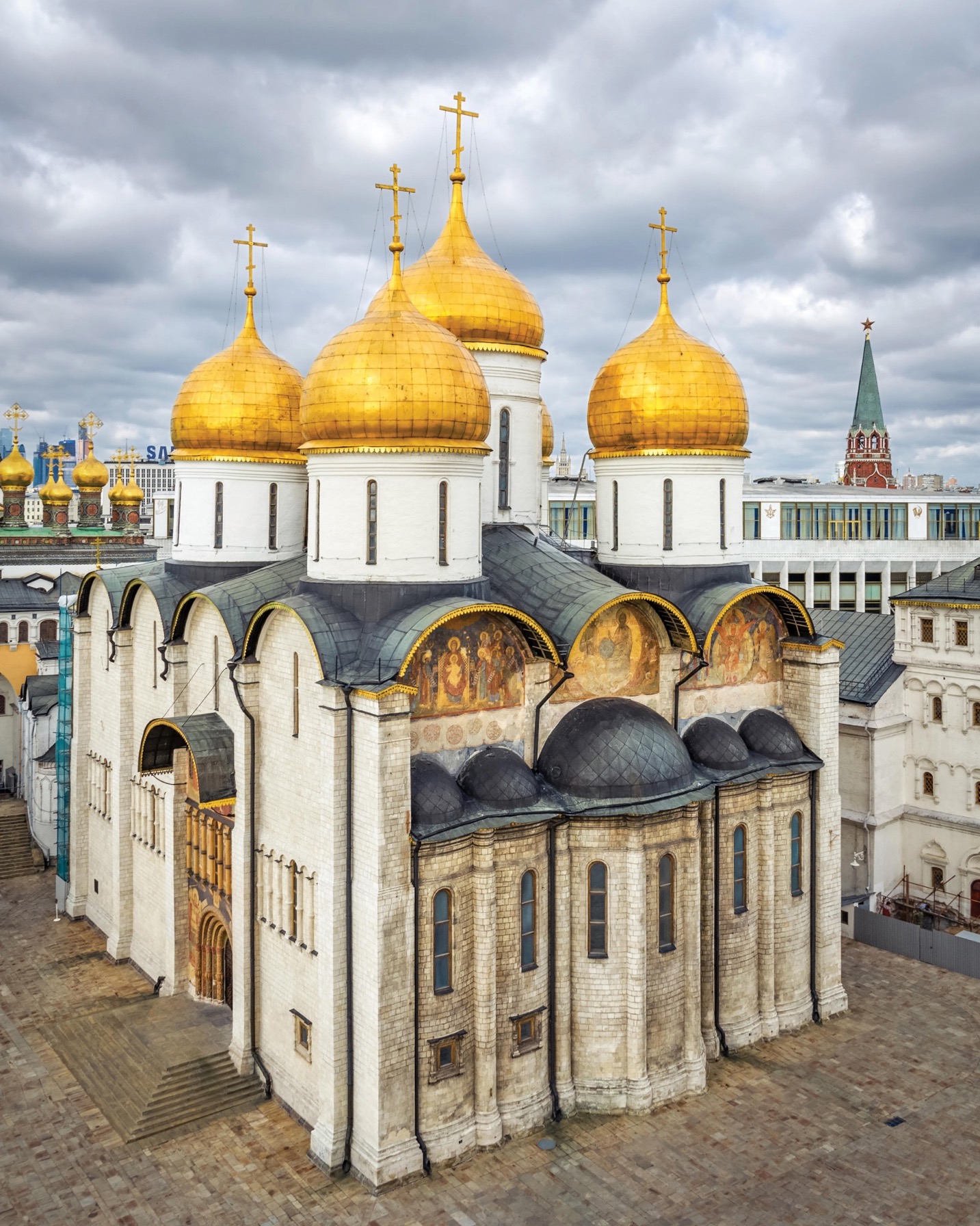
The Renaissance began in Italy, especially in the city-state of Florence. The political fragmentation of northern Italy probably helped the movement along because local dukes and princes supported artists, architects, and scholars in their competition for political prestige. By the mid-fifteenth century, Italian architects and scholars were in demand elsewhere in Europe too. In Hungary, Poland, and even Russia, rulers hired Italians to build magnificent buildings, such as the Cathedral of the Dormition in Moscow’s Kremlin. Aided in part by the printing press, Renaissance texts—literature, history, philosophy—circulated swiftly in sixteenth- and seventeenth-century Europe. Renaissance art, using geometry to achieve perspective and depicting everyday life as well as traditional subjects such as Bible scenes and stories of saints, spread almost as quickly.
Renaissance ideals, especially humanism—the view that human affairs were worthy of careful study and suitable themes for art and literature—also took root in the Netherlands, the German lands, France, England, and beyond. Erasmus of Rotterdam, educated and employed at universities in Paris, Cambridge, Turin, Oxford, and Leuven (now in Belgium), used his extraordinary talents in ancient languages and well-honed powers of reason to produce more coherent translations of the New Testament and to call the Catholic Church to account on some of its inconsistencies. Even the study of politics took on a humanistic tone as writers such as Niccolò Machiavelli, a diplomat in Florence in the early sixteenth century, sought to depict political life as it really was rather than in relation to ideal worlds. The Renaissance affected European elites strongly, especially those who read Latin, and to some extent those in lands elsewhere controlled by Europeans. It did not resonate deeply anywhere else—unlike the upheavals in Christianity, which had more widespread repercussions.
RELIGION: PROTESTANT AND CATHOLIC REFORMATIONS
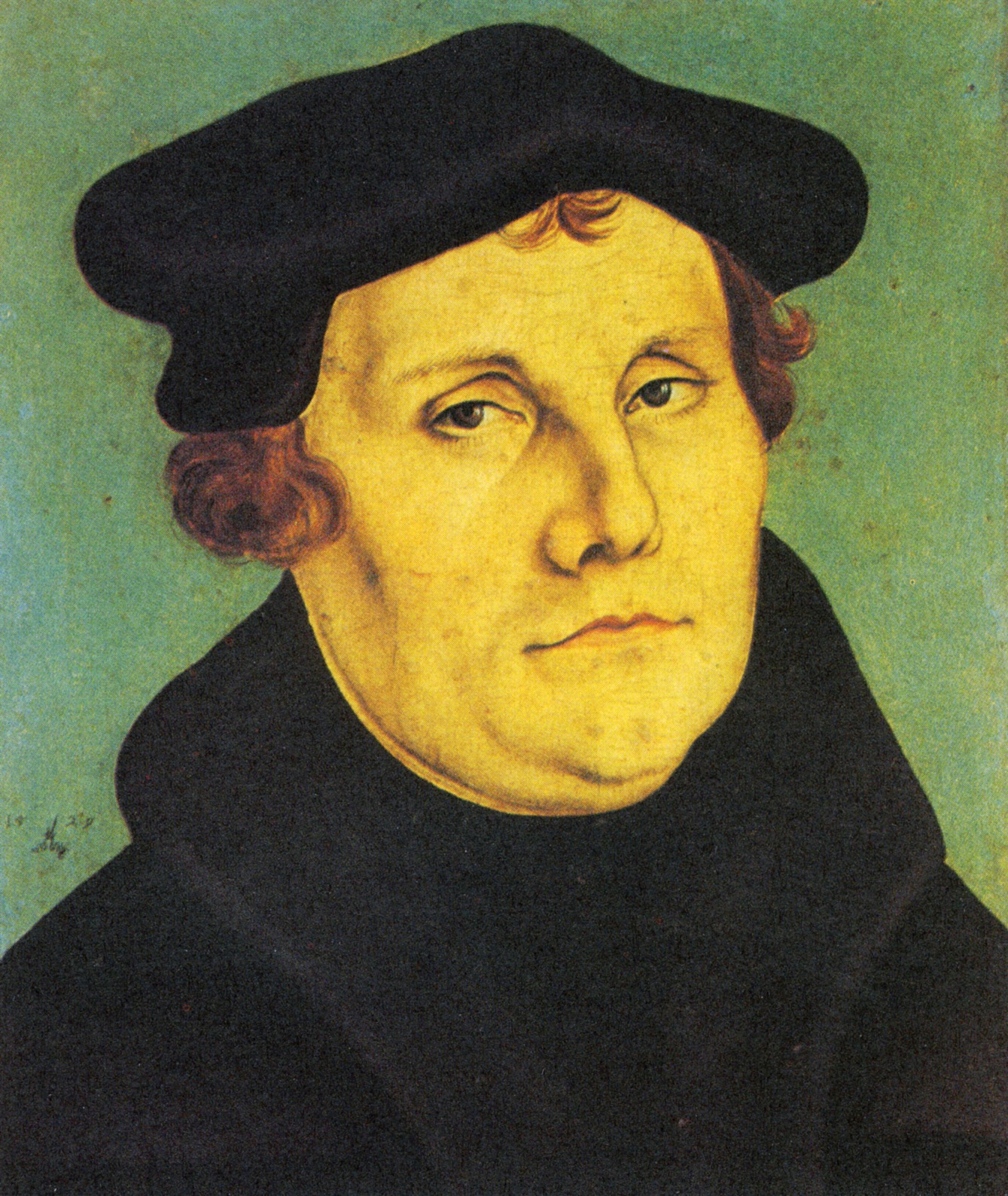
By 1500, the Catholic Church in Europe had met and mastered many challenges. Since the so-called Great Schism in 1054, when the Church of Rome and the Orthodox Church parted ways, Catholicism had spawned many innovations. The church authorities regarded most of these innovations as heresies. It almost invariably succeeded in stamping them out or confining them to remote mountain districts, often using armed force provided by secular rulers. However, in 1517 Martin Luther (1483–1546) launched a new heresy that proved too popular to uproot. It evolved into a new branch of Christianity, called Protestantism.
LUTHER AND PROTESTANTISM Luther was born to middle-class parents. His father leased and operated mines in a part of Germany known as Saxony. His parents’ ambitions for young Martin extended to sending him to the University of Erfurt. He completed his degree by age 21 and entered law school at his father’s insistence. He hated it, dropped out, and seeking deeper truths, decided to become an Augustinian friar. His father was outraged, considering that path a waste of a good university education. Martin, however, recalled the University of Erfurt as “a beer hall and whorehouse” and preferred to devote himself to confession, prayer, and pilgrimage.
But Luther was not done with education. His Augustinian mentors encouraged him to study theology, and after acquiring a few university degrees, Luther joined the theology faculty at the newly founded University of Wittenberg just before his thirtieth birthday. He remained employed there all his life.
In his schooling, writings, preaching, and teaching, Luther developed two main ideas. One was the primacy of scripture over the traditions of the church. So, for example, Luther noted that celibacy for priests has no basis in the Bible (it became required practice in the late fourth century CE). Nor, he argued, did the ritual of confession, or the concept of purgatory—in Catholic theology, an anteroom to heaven in which all but the sinless souls must linger for as long as it takes to burn away their sins. He came to regard these (and much else) as obstacles to the proper practice of Christianity. Rather than follow traditions unsanctioned in the Bible, believers should, Luther said, read scripture themselves and decide for themselves just what it meant. To make that easier, he translated the Bible into German, finishing in 1534. In effect, said Luther, Christians should be their own priests.
The second idea is known as justification by faith alone. This meant that salvation of one’s soul could result only from a full embrace of the Christian faith and the gift of divine mercy. For Luther, true Christianity was an inward commitment. He took issue with the church’s position that one could ensure salvation through “good works,” such as donating money to the church, although he thought that people who had that inward commitment would likely want to perform good works. Luther held fast to these two ideas, arguing for his beliefs with both skill and ferocity.
Earlier reformers had foreshadowed some of Luther’s ideas. Jan Hus, a university rector in Prague (in today’s Czech Republic), challenged the privileges of the clergy and the church’s quests for money. Hus also preached a more intimate, personal commitment as the core of Christianity. In 1415, he was burned at the stake at the command of a bishop. Hus and his followers had drawn much of their outlook from John Wycliffe, who preached, taught, and wrote mainly at Oxford University. He oversaw the first translation of the Bible into English, completed in 1382. Wycliffe railed at the wealth and power of the clergy and Papacy, recommending a more personal Christianity and the primacy of scripture over church and tradition. The Pope denounced him, and the head of Oxford University had him imprisoned for his views. Wycliffe died of natural causes in England in 1384, but in 1431 a pope ordered that his corpse be dug up and burned, as befitted a heretic.
Luther found it particularly offensive that the church, in need of money to pay for the building of St. Peter’s Basilica in Rome, had sent churchmen around Europe offering promises of expedited salvation in exchange for donations. This practice, not so different from the deals forged between holy men and the Gupta kings in India (noted in Chapter 13), was called the sale of indulgences. The practice was invented in the 1090s to persuade people to join the Crusades. It was never official policy, but it had become routine procedure by Luther’s time. In effect, the gates of heaven were treated like a tollbooth. Sinners who paid could escape a painful term in purgatory. The most successful salesmen of indulgences promised that even the most unspeakable sins could be wiped away for a suitable fee.
Luther wrote up his objections, in Latin, in a document now called his Ninety-five Theses. This was not quite the undertaking it might seem: most of his theses were only a sentence long. He did not seek to challenge the church directly, but the implications of some of his theses aroused the ire of Rome. Number 86, for example, which he described as a shrewd question of lay people, read: “Why does the Pope, whose wealth today is greater than the wealth of the richest Crassus, build the basilica of St. Peter with the money of poor believers rather than with his own money?”
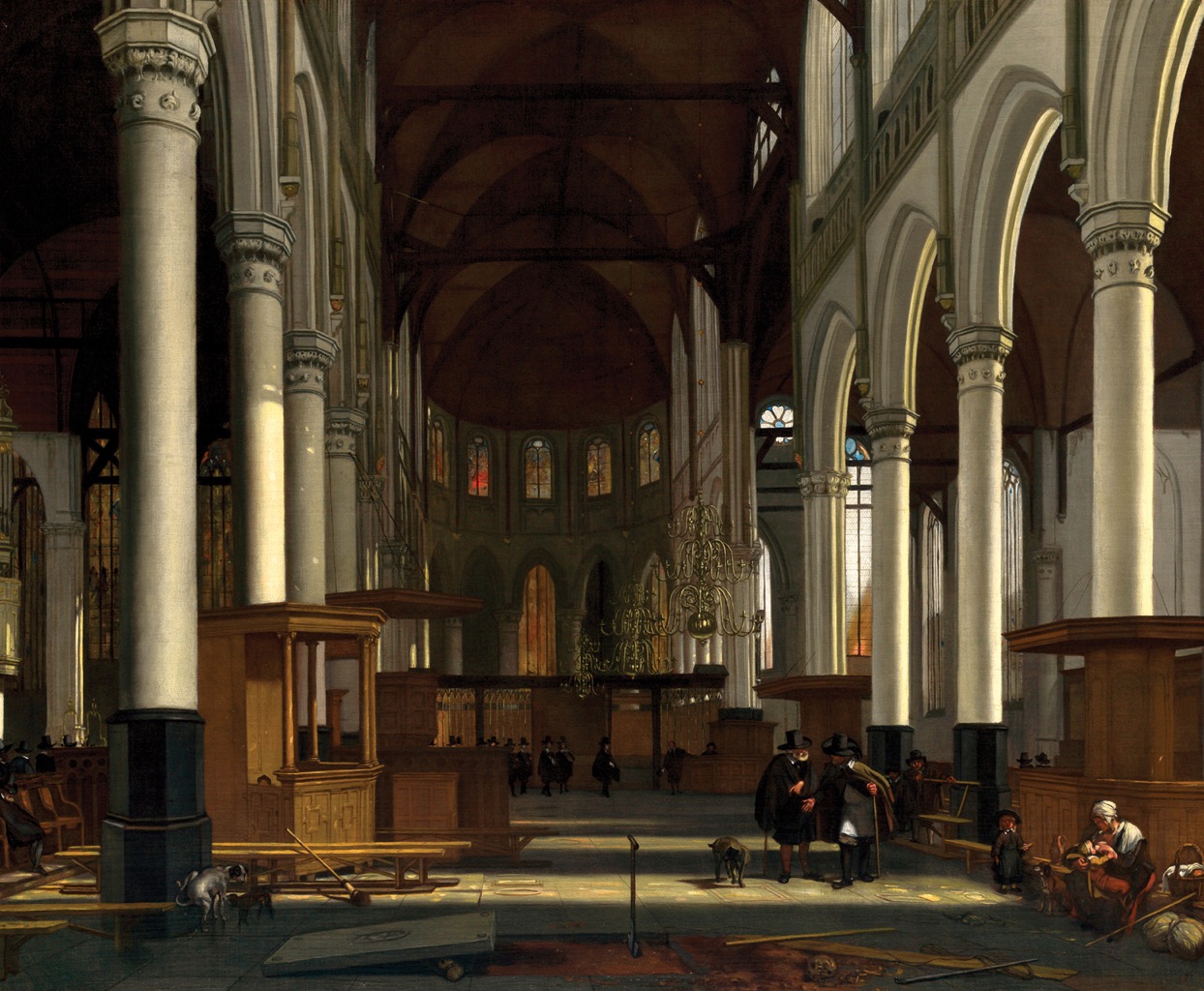
Legend has it that Luther nailed his theses to the door of the cathedral at Wittenberg in 1517. The door often served as a bulletin board. Whether the story is true or not (it probably is not), he did allow friends to translate his text into German and print it in early 1518 as a pamphlet. By 1519, it had circulated all over Europe.
Here it is important to note the political landscape surrounding Luther and his ideas. Germany was not a unified state but a mosaic of dozens of small states, most of them offering a cautious allegiance to the Holy Roman Empire. The Holy Roman Empire was nominally the successor to Charlemagne’s kingdom of the ninth century, but in fact it was a loose and weak collection of duchies and principalities whose rulers enjoyed great autonomy. It also comprised about 100 self-governing “free cities,” not subject to any duke or prince. The Holy Roman Empire’s territory had been shrinking for centuries (and would continue to do so until it was wiped off the map in 1806). It was, however, usually the political force most inclined to serve the interests of the Pope. The political fragmentation of Germany made it hard for authorities to do anything, such as executing Luther, unless every prince, duke, and free city agreed.
By Luther’s day, the Papacy had plenty of experience in handling upstarts and heretics. It gave Luther a few chances to recant his positions, which he refused, most dramatically in 1521 at the Diet of Worms (not a college meal plan, but an assembly of officials of the Holy Roman Empire held in the town of Worms). Luther stood his ground, and soon the Pope excommunicated him from the church, calling Luther a “wild boar in the vineyards of the Lord.” The Pope’s political allies called for Luther’s murder. Luther responded to efforts to muzzle him by taking more radical positions, including denying the legitimacy of the Papacy altogether and calling the Pope the antichrist and “servant of the devil.” He denounced several important church rituals as unchristian. This was a quarrel that could not be patched up.
Despite having enemies in high places, Luther lived on, in effect an outlaw protected by German princes who liked his ideas, and by his university. He produced his German-language edition of the Bible, wrote many hymns and pamphlets, read a translation of the Qur’an and supported its publication (on the grounds that its errors should be held to scrutiny), and in his last years wrote violent screeds against Jews, few of whom he had ever seen. Always bull-headed, by the end of his life he zealously courted controversy and confrontation.
The printing press and spreading literacy, discussed above, made it more difficult for the church to extinguish an appealing heresy. Luther’s many pamphlets found receptive readers all over Europe, and he became a celebrity professor. Even an organization as vast and staffed with talent as the church could not keep Luther’s ideas in check.
Variations on Luther’s themes soon appeared in Swiss cities. In Zurich, a Catholic priest, Ulrich Zwingli, preached a message similar to Luther’s and won over the town leaders. In Geneva, John Calvin took up Luther’s cause and gave it his own spin based on the gloomy idea that everyone’s fate—heaven or hell—was predestined and no amount of good behavior (or donations to the church) could improve one’s odds of salvation. Bad behavior such as blasphemy, witchcraft, adultery, or heresy, in contrast, brought a parade of executions by drowning, beheading, and burning in Calvin’s Geneva after 1536. Calvin’s uncompromising formula, much influenced by St. Augustine, claimed to be the sole authentic form of Christianity. It spread further than Lutheranism in the sixteenth century, taking root in parts of Switzerland, France, Britain, Germany, and the Low Countries. Emigrants from these lands carried it to South Africa and North America in the seventeenth century.
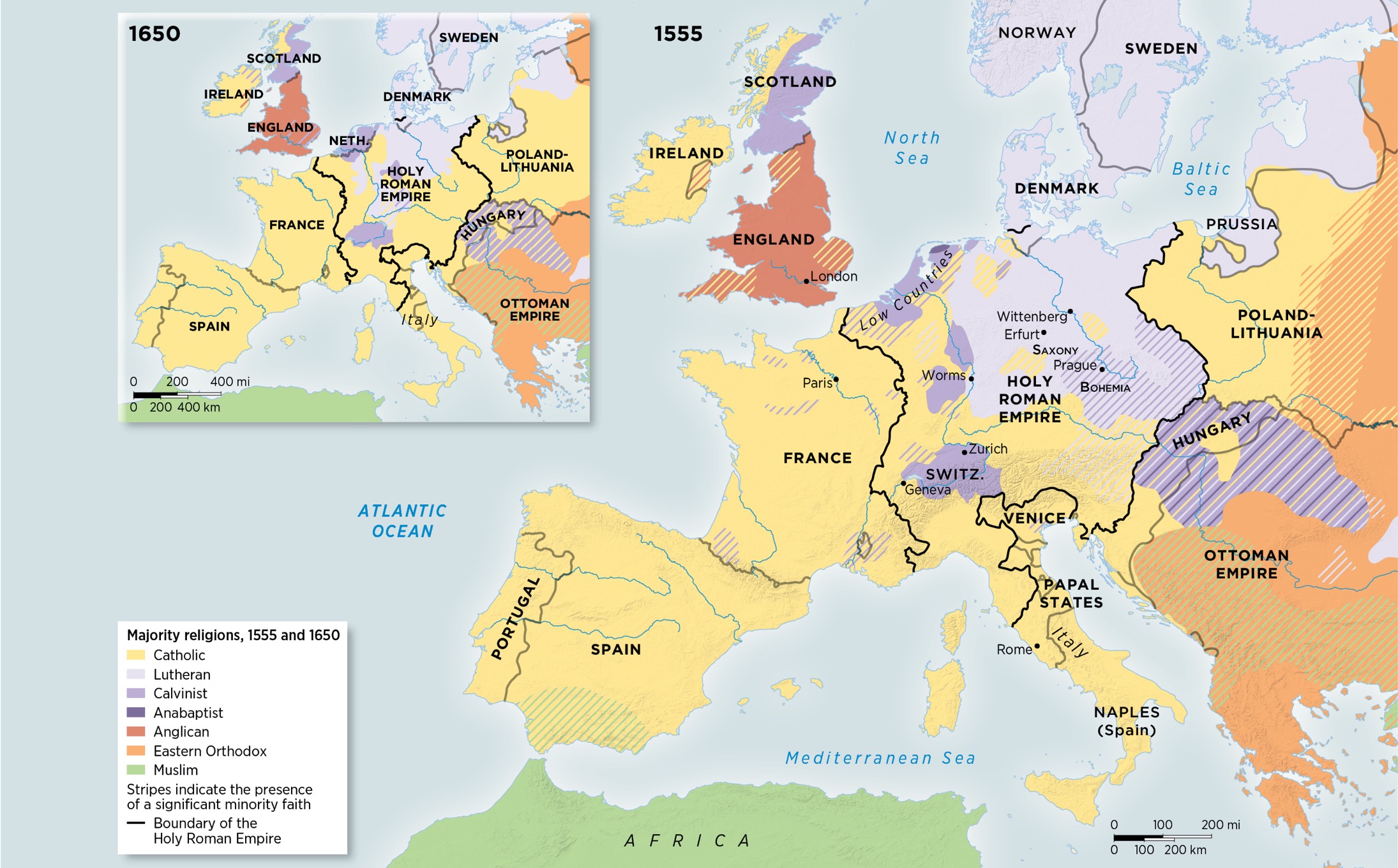
Various groups of Protestants (the term was in use by 1530) formed in pockets across Europe. Those who embraced it tended to be more urban and literate than average. Cities with printing presses were particularly likely to turn Protestant. But village peasants too, especially in Germany, often found Protestantism appealing. They felt its emphasis on “God’s law” justified their revolt in 1524–1525 against taxes and levies imposed by princes and the church. Luther disavowed the revolt, and it was crushed.
In general, Protestants shared the view that salvation rested on personal commitment to God and that the Catholic Church had grown stale, stolid, and corrupt, standing as a barrier between individuals and God. Several rulers embraced this new creed, finding it appealing in its own right and often advantageous in political terms—it provided grounds for confiscating church and monastic property, a tempting target. Many German princes had chosen Protestantism by 1530. By 1560, the rulers of Denmark, Sweden, England, and Scotland had become Protestant and encouraged or obliged their subjects to follow suit. In France maybe 10 to 20 percent of the population was Protestant, and in German lands closer to 80 percent. Most of the German speakers in Poland—a sizeable minority there—were as well. Protestantism in the mid-sixteenth century seemed an unstoppable force in Europe north of Italy, Spain, and Portugal.
THE CATHOLIC REFORMATION Yet between 1550 and 1620 the Catholic Church did manage to check the spread of Protestantism. Indeed, the church and its allies regained some lost ground, winning back people in the southern part of the Netherlands (now Belgium) and a good share of Germans. The Catholic Church nearly stamped out Protestantism in Poland and France, and it crushed the followers of Jan Hus in Bohemia (now part of the Czech Republic). Part of its success came through war. The Pope had armies in those days, and so did the house of Habsburg, a firmly Catholic family that held the Spanish and Austrian thrones, as well as a few other duchies and provinces.
The Protestants could not unify their resistance. Splinter sects popped up constantly, much to the annoyance of Luther and Calvin, none more hated than those Anabaptists who regarded polygamy, pacifism, and communal property (as opposed to private property) as acceptable. Protestant sects and princes quarreled fiercely among themselves over fine points of doctrine and over political advantage, which made it harder to fight effectively against Catholic powers. Struggles abated somewhat after an agreement of 1555, the Peace of Augsburg, in which Catholic and Lutheran rulers in central Europe agreed on the principle that rulers should be free to require either Catholicism or Lutheranism of their populations.
The church also undertook major reforms in response to the Protestant Reformation. Beginning in the 1540s, in a movement called the Catholic Reformation (or the Counter-Reformation), the church cleaned up its act considerably. No more libertine popes, living in luxury, fathering children and making a mockery of Christian morals. Bishops and abbots cut back on high living. The church grew more centralized and standardized, settling on a single required script for mass, for example. Popes became more powerful over bishops and priests, abbots and monks. The Papacy re-established its Inquisition (1542), an office tasked with rooting out heresy, and created the so-called Index of banned books (1559). The Index stopped work in 1966.
The church also went global. While Luther and Calvin were diverting souls in Europe from Catholicism, missionaries found fertile fields for the salvation of different souls overseas. In the first half of the sixteenth century, Catholic priests ventured to the Americas, Africa, India, China, Japan, and almost everywhere in between. Religious orders such as Augustinians, Dominicans, and Franciscans came to specialize in converting unbelievers around the world, usually focusing their efforts on the poor. The Jesuits also took to evangelical work, generally working from the top down, trying to convert rulers and courts. They led the rollback of Protestantism in Poland, helped lead it in Germany, brought Catholicism to Japan, and were especially active in China.
By 1620, the Catholic Church had revitalized itself and stopped the Protestant surge. Divisions in Europe—intellectual, cultural, political—became more entrenched. Vicious religious wars only deepened cleavages and resentments, culminating in the Thirty Years War (1618–1648) in western and central Europe, which reduced population there by as much as one-third. As the French mathematician and philosopher Blaise Pascal noted in the 1650s, people “never do so much harm so happily as when they do it through religious conviction.” The convulsions in religious life in sixteenth-century Europe created divisions and sectarian identities that live on to this day—less lethally—in Europe itself, wherever European migrants have settled and wherever Christian missionaries made converts.
All durable religions develop schisms and rival sects that get tangled up in struggles for wealth and power. Islam’s two largest factions broke apart soon after Muhammad’s death, and both Sunni and Shi’a communities subsequently fragmented into many sub-groups. Buddhism’s two leading forms, Theravada and Mahayana, also fragmented into smaller sects. Christianity splintered into several churches early in its history. While every schism and sect is different, the human capacity for religious innovation, and reform, makes the process commonplace.
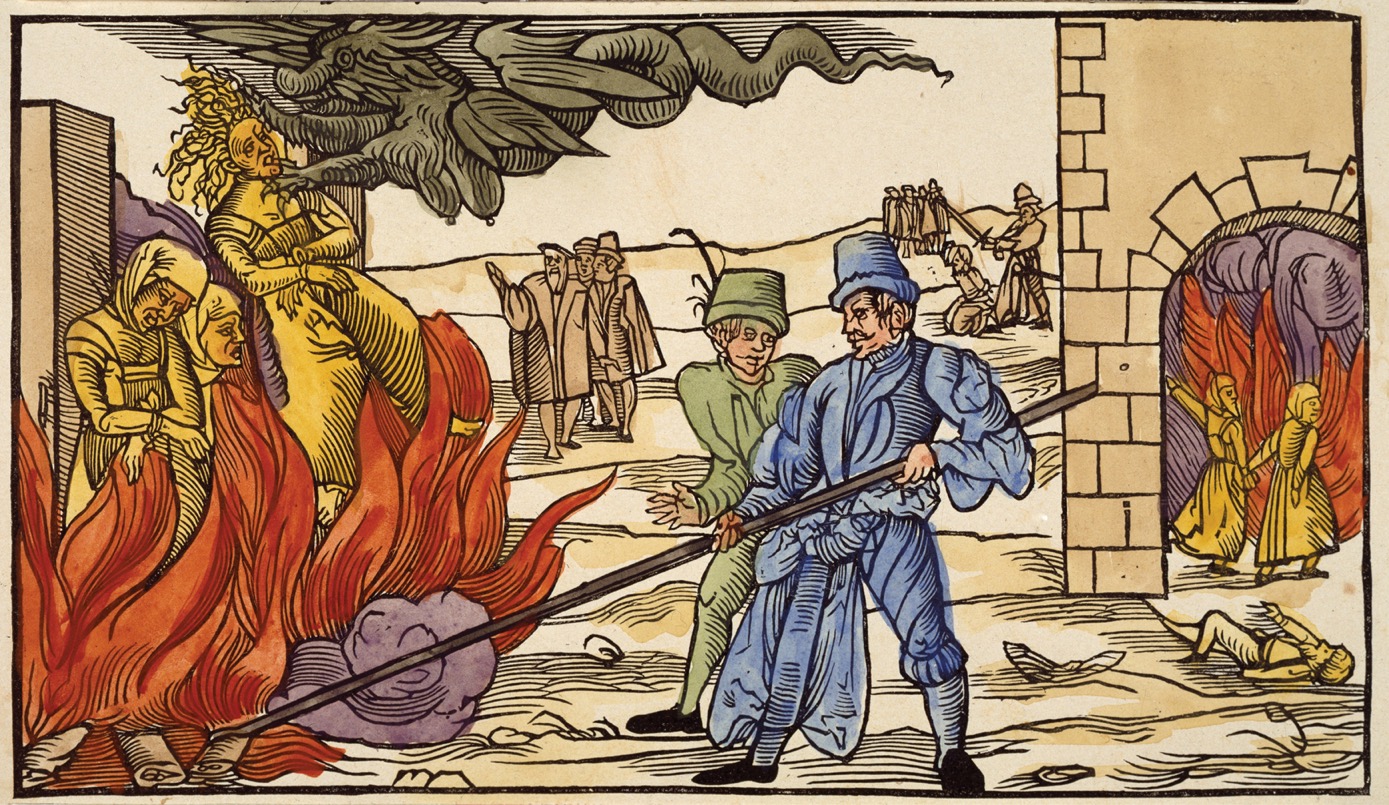
WITCH HUNTS The competition between Catholicism and Protestantism proved Pascal’s point in another respect. It fueled a craze for witch trials. Accusations of witchcraft—typically understood as working with the devil to obtain supernatural powers to use against neighbors or family—had been rare in Europe until 1550, by which time they reached a few hundred annually. The next century, however, brought a flurry of accusations, trials, and executions, reaching a peak about 1620 with more than 5,000 trials and 2,000 executions annually. In total, between 1500 and 1700, about 40,000 to 60,000 people were hanged, drowned, or burned as witches, often after confessions extracted with torture. Of these, 75 to 80 percent were women, usually over 40 years of age; although in parts of northernmost Europe—Iceland, Finland, Estonia, and Russia—the majority of those accused and killed were men.
Historians still struggle to explain why the witch hunts arose and why they stopped. Nearly nine-tenths of the executions took place in Germany (about 42 percent), Switzerland (35 percent), or France (10 percent), mainly in areas where Protestants and Catholics were vigorously competing for allegiance. One way a ruler could demonstrate the logic of accepting his (or, in rare cases, her) preferred religion was to encourage trials and convictions of witches, so as to appear committed to defending the people against the devil’s mischief. King James VI of Scotland personally oversaw some cases and published a book in 1597 about witchcraft, which explained the justice of persecuting witches in a Christian community. (Shakespeare borrowed liberally from this book in writing Macbeth). Countries with little Catholic-Protestant rivalry saw far fewer cases. Staunchly Catholic Portugal, Spain, and Italy together accounted for only 6 percent of witchcraft executions.
The fact that the majority of victims were women, in Protestant and Catholic lands alike, requires a different explanation, one anchored in demography. A rise in the proportion of unmarried women likely played a big role. Unmarried women, especially those not under the authority of an adult male, seemed a threat to the sanctioned social order. But the ongoing religious struggles contributed to the visibility of unmarried women: Protestant rulers often seized convents’ property and pushed nuns out into society at large.
THE SCIENTIFIC REVOLUTION
While both the Renaissance and the Reformation were gathering pace, shaking up the European intellectual landscape, the Scientific Revolution began. The term itself is controversial among experts, some of whom see the gradual pace of change in scientific thinking as reason to avoid the term revolution. But if significance rather than pace is the key criterion, then the term is warranted.
Two deep principles underlay the Scientific Revolution. The first was accepting that religious scripture and ancient texts did not contain everything worth knowing after all. The logic of accepting this principle strengthened as unfamiliar and baffling information arrived from overseas. Neither scripture nor the ancients had said anything about the existence of manatees and llamas, or hurricanes and typhoons. The second deep principle was the embrace of mathematics and a quantitative culture. In most fields of scientific endeavor, the book of nature was written in the language of mathematics, as the Italian astronomer Galileo put it.
The Scientific Revolution began roughly around 1500, although it is possible to find evidence of new directions in science before that. It too began mainly in northern Italy, like the Renaissance, but quickly leapfrogged to towns, especially university towns, all over Europe. Again, urbanization, universities, printing, and the challenge of new information from overseas helped to create and sustain the Scientific Revolution. So did political fragmentation, in the sense that it was hard for anyone to crush ideas they didn’t like when people could easily move to another city or duchy. In addition, the widespread use of Latin helped advance the Scientific Revolution because scholars all over Europe, whatever their native tongue, wrote and read the language.
Historians sometimes say the Scientific Revolution ended around 1700, because many of the fundamental principles of modern science had by then been articulated. But in one sense the Scientific Revolution has never stopped, because its core procedures and deep principles have remained behind scientific inquiry ever since.
One final factor behind the Scientific Revolution deserves emphasis. European scientists in 1500 had no great body of wisdom to protect against new ideas and information. In this they were like the Arab intellectuals after the early Islamic conquests of the seventh and eighth centuries who suddenly came into possession of philosophy and science from India, Persia, and the Greek and Jewish worlds. This situation had led to daring new syntheses, as Arab thinkers tried to reconcile discordant ideas and data and fit them to their own religion. Their emirs and sultans had not felt required to quash this new thinking, because it offered no threat to them or their supporters. Something similar happened in Europe after 1500. Novel ideas, some of them very ancient but new to Europeans, jostled together. New observations from distant continents, and even some from distant planets, challenged old wisdom. But European intellectuals and rulers rarely felt they needed to protect existing ideas (at least, scientific ones) from competitors. And thanks to political fragmentation, intellectual protectionism, when tried, did not fully succeed.
Systematic observation and experimentation lay at the heart of the Scientific Revolution. Scientifically minded men (and a few women) increasingly sought to find the true essence of things by careful study and designed experiments, rather than relying on the theories of Aristotle and his interpreters. They sought, like many before them, to understand the workings of the heavens, the nature of matter, the secret of human health—but with different methods.
The Scientific Revolution was not anti-religion. Every one of its prominent figures considered himself a Christian. Many of them were priests. Most of them sought to reveal God’s glory by revealing the perfection of creation in the precise, regular, harmonious workings of the universe. They aimed to read the book of nature alongside the book of scripture, as early Christian writers had put it. The seventeenth-century English scientist Robert Boyle regarded the study of God’s creation as a form of religious worship and enjoyed conducting experiments on Sundays. Boyle’s father was the second-richest man in England, so Robert could afford to study chemistry and physics every day of the week.
Since the early nineteenth century we have divided science into fields called disciplines, but no one did that in the sixteenth and seventeenth centuries. Many thinkers ranged across fields, considering all of science to be one. But to see its long-term impact, it is helpful to look at a few particular fields before returning to the whole.
ASTRONOMY AND HELIOCENTRISM Let’s begin with astronomy. In 1500, most people supposed that the sun moved around the Earth because that’s what their eyes told them every day. Ancient Greek philosophers, notably Ptolemy, had explained how and why that was so (although one or two ancient Greeks had suggested the Earth might move around the sun instead). Careful observation of the movements of planets and stars raised questions about Ptolemy’s system. One of those puzzled by discordant observations was a Polish-German student in northern Italy, known by his Latinized name as Nicholas Copernicus (1473–1543). He knew Latin and Greek, as well as Polish, German, and Italian, giving him access to a wide intellectual heritage. In 1514, he wrote up an alternative explanation based on a heliocentric system in which planets spin around the sun. He tinkered with it for decades, while working in Poland as a cathedral administrator. Just before his death he overcame his fears of persecution and his perfectionist tendencies and published his work in 1543. In it he cited both ancient and recent Islamic astronomers and was clearly influenced by both.
Copernicus’s heliocentric system did not catch on quickly. It violated common sense as well as the wisdom of the ancients. Nor did it arouse the ire of the church, as Copernicus had feared. It was useful for astrologers because it simplified calculations about future positions of the planets. Astrology was a prestigious branch of science in those days. When Elizabeth I of England chose a day for her coronation, she consulted a mathematician and an astrologer. So did the Pope when choosing an auspicious day for laying the cornerstone of the Basilica of St. Peter’s in Rome in 1506. It took some 200 years, and many further observations and refinements of Copernicus’s system, before all serious students of the heavens had abandoned Ptolemaic astronomy.
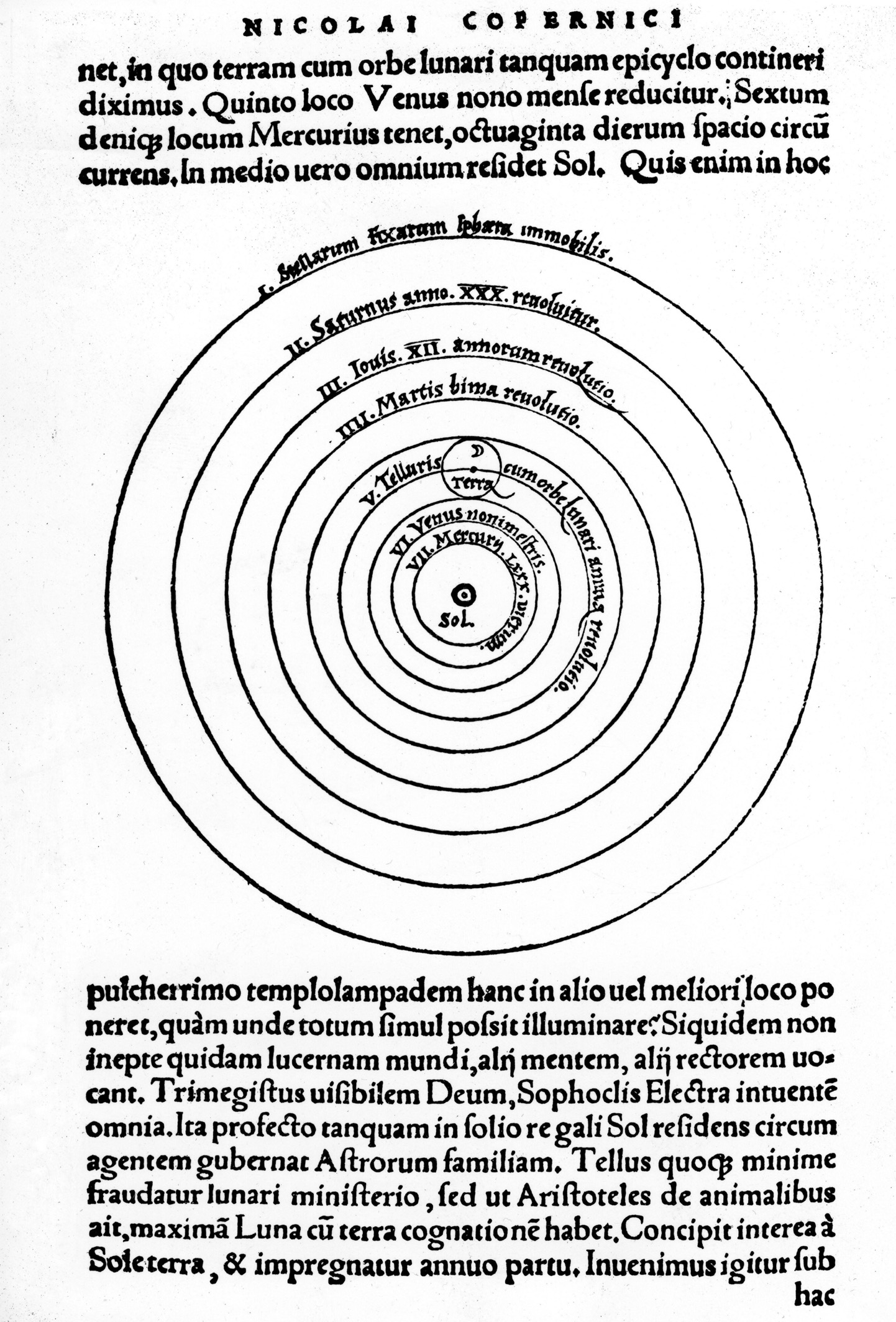
The three scientists whose work did the most to confirm Copernicus’s heliocentric view were Johannes Kepler (1571–1630), Galileo Galilei (1564–1642), and Isaac Newton (1643–1727). Kepler, whose major works were published between 1609 and 1627, used careful mathematics to show that planets revolved around the sun in elliptical, not circular, orbits. That helped resolve some discrepancies between observations and Copernicus’s theories, although it took decades to become accepted. Kepler lived in German cities and, although he considered himself a proper Christian, had to overcome occasional persecution at the hands of Lutheran churchmen, Catholic authorities, and political leaders alike. His mother, Katharina Guldemann, was tried for witchcraft.
Kepler’s contemporary, Galileo, lived in northern Italy and provided detailed observations of the planets using homemade telescopes. In 1615 Catholic officials warned him to stop writing in favor of the heliocentric view, and in 1632 they put him on trial. He officially recanted when faced with the prospect of torture. His works were banned by the church, but this did not stop their spread. The church abandoned its objections to heliocentrism in 1835.
Two generations later, Isaac Newton, a professor of mathematics at Cambridge University, clinched the case for heliocentrism. In the 1660s and 1670s he formulated his laws of motion and gravity, accounting in detailed mathematical proofs for the movement of planets, comets, the tides, and much else. He too considered himself a devout Christian and maintained that his work, published by 1687, laid out the elegance and beauty of God’s creation as revealed by mathematics. The official Anglican Church did not bother trying to dispute or suppress his work. The scientific battle launched by Copernicus in 1543 was over, and heliocentrists had won.
CHEMISTRY AND EXPERIMENTATION As astrology was to astronomy, so was alchemy to chemistry. The greatest motivation behind experiments and new thinking in chemistry during the Scientific Revolution was the hope that cheap metals could be transformed into valuable ones—for example, lead into gold. Boyle dabbled in alchemy and claimed to have seen base metals changed into gold. Alchemy, unlike astrology, did not carry much prestige and was often scorned at universities, although Newton, at Cambridge, was fascinated by it. It had no classical pedigree from ancient Greeks or Romans, it was messy, and its practitioners had reputations as con men.
But, working on their own, sometimes in their own kitchens, sixteenth- and seventeenth-century chemists developed a tradition of experimentation and precise recording of results. We now consider most of the ideas they advanced to be wrong, but their methods proved enduringly useful. One prominent chemist, physician, and astrologer was the Swiss-born Philippus Aureolus Theophrastus Bombastus von Hohenheim, who, understandably, preferred to go by the name Paracelsus (1493–1541). He entered and quickly exited six universities before earning a degree at Ferrara, in northern Italy, in 1516. Along the way he developed the view that all disease results from too much of either sulfur, mercury, or salt, three chemicals that he considered central to all matter. Disdaining tradition in favor of experimentation, he claimed that “my shoe buckles are more learned than Galen and Avicenna [Ibn Sina].” Although often wrong in his conclusions, his insistence on experimentation to show the medical uses of chemicals and minerals helped establish genuinely scientific methods. More than any other branch of science, it was in chemistry that the methodology of experimentation evolved.
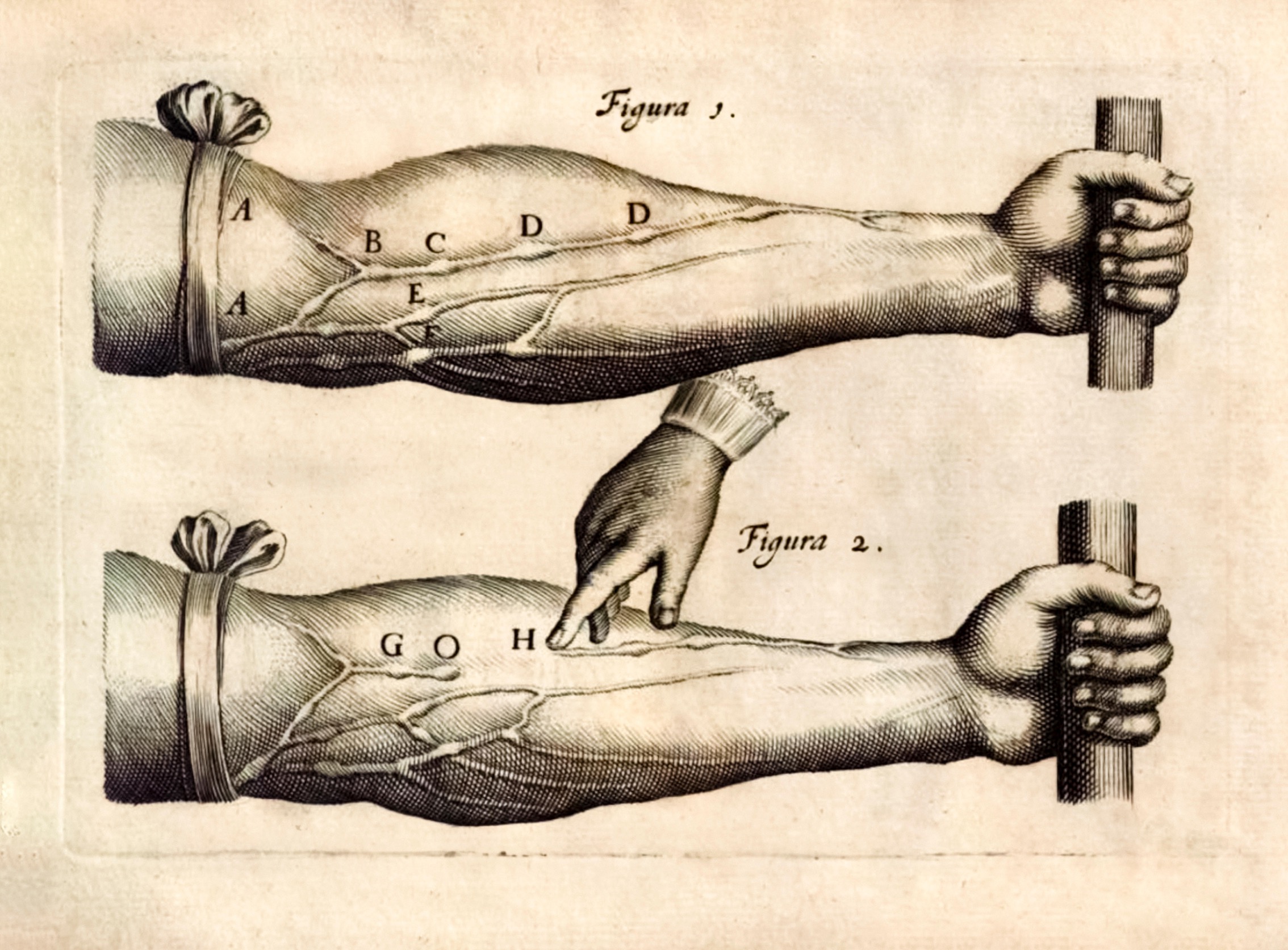
MEDICINE Unlike chemistry, medicine was among the prestigious subjects and professions. It too underwent major revision, in both methods and concepts. The most important new methods paralleled changes everywhere in science: greater reliance on observation and experiment, and less deference to ancient authors. The most significant new concept was the principle of the circulation of the blood, detailed by the Englishman William Harvey.
Harvey (1578–1657), the son of a small-town mayor, entered Cambridge University at age 15. After studying medicine for six years, he moved on to northern Italy (like Copernicus and Paracelsus before him), where he learned the fine points of dissection of human cadavers and live animals. In 1628, now a prosperous physician in London, Harvey published his book on the circulation of the blood, showing that the heart pumped blood through arteries into capillaries, and that veins returned the same blood to the heart. Like Copernicus, Harvey showed what others had earlier guessed—notably, Ibn al-Nafis in thirteenth-century Cairo. He built on assertions made by medical men in Italy and Egypt, using systematic observation, in this case based on dissections. In his work, as in Copernicus’s, we can see the circulation of knowledge between the Islamic and Christian worlds, made possible by the longstanding connections of the Old World web.
INSTITUTIONS AND CONNECTIONS Every field of science, from astronomy to zoology, experienced some upheaval during the Scientific Revolution. Those most influenced by the global harvest of information and ideas were probably botany and zoology, due to the large number of strange species attested to in distant lands. Ideas and principles from China, India, and the Islamic world, as well as observations made elsewhere, brought challenges to received wisdom in Europe.
The links between science and technology were weaker in those days than ours, but nonetheless the new scientific outlook filtered into fields such as mining, cartography, navigation, and clock making. In particular, more precise mathematics and a culture of quantification helped these fields develop. Technical advances in these fields helped, in turn, to promote commerce and connections within Europe and between Europe and other lands, contributing to the tightening of the Global web.
The Scientific Revolution was a permanent revolution: it continues to this day. Part of the reason for that is the institutionalization of scientific inquiry that began in the late seventeenth century. Academies of science sprouted first in Italy. An 18-year-old from a wealthy family in Rome founded the first one in 1603, but it folded in 1630 upon his death. More durable academies, enjoying royal support, were created in London (1662) and Paris (1666). Others followed in the eighteenth century in Uppsala (Sweden), Berlin, St. Petersburg, and Philadelphia. Networks of scientists solidified, based on correspondence and travel from one city or university town to another, and eased by the shared use of Latin. Carl Linnaeus, the eighteenth-century Swedish botanist who developed a system for naming, ranking, and classifying organisms, maintained a correspondence with nearly a thousand people. Such networks, combined with print technology, prepared the way for publication of scientific journals, the first of which appeared in England in 1665 and is still going strong. These academies, networks, and journals helped to entrench the Scientific Revolution in European thought and society by 1700. In later centuries similar institutions would underpin science around the world, helping to make modern science a global undertaking.
Glossary
- Renaissance
- A fascination among European elites with the intellectual and artistic traditions of the ancient Greeks and Romans. Humanism, the focus on human bodies and experiences, was a defining feature of the Renaissance.
- Protestantism
- A branch of Christianity, initiated by the monk Martin Luther (1483–1546), that took issue with the Catholic Church. Luther’s writing and preaching emphasized scripture over tradition and salvation by inner faith. Many variations of Protestantism arose, but all denominations generally emphasized the importance of individual relationships with God.
- Catholic Reformation
- Also called the Counter-Reformation, a period of major reforms in the Catholic Church undertaken in response to the Protestant Reformation. The Catholic Church became more centralized and standardized; popes, bishops, and abbots cut back on high living; efforts were made to root out heresy and ban certain books.
- witch hunts
- The spike in accusations of witchcraft between 1500 and 1700, which resulted in the widespread use of torture and execution of accused witches. Unmarried women over age 40 were the main targets.
- Scientific Revolution
- The adoption of mathematics, observation, and systematic experimentation to understand the world instead of relying solely on scripture and ancient texts, as had been done previously.
- heliocentric system
- The idea, which Nicholas Copernicus wrote down in 1514, that planets rotate around the sun as opposed to the idea that the sun moves around the Earth. Johannes Kepler, Galileo Galilei, and Isaac Newton built on this work, and the heliocentric system won acceptance in 1687.