THE WORLD OF ISLAM: A SHI’A REFORMATION
The intellectual world of Islam, like that of India and China, underwent less turbulence than Europe in the centuries between 1500 and 1700. Its cities were less affected by newly forged links to distant lands than Seville or Amsterdam were. Its religious and scientific establishments by now had a great deal of established belief, practice, and knowledge to protect from novelty. But nonetheless, human creativity, the rise of commerce, and the advance of urbanization helped bring about some intellectual realignments in Islamdom. The most important of these was the success of the Shi’a branch of Islam in Iran.
SHI’ISM
Shi’ism is almost as old as Islam itself. Its followers regard descendants of Muhammad through his daughter Fatima and his son-in-law Ali to be especially endowed with religious and political authority. Only members of Muhammad’s lineage could provide proper earthly guidance.
In the early years of Islam, Sunni caliphs crushed Shi’a factions in battle, and they survived only as a tiny minority. For 800 years Shi’ism suffered frequent persecution from Sunni rulers, who regarded it as heresy, and its followers often kept their convictions secret. Many Shi’a felt disdain for power, authority, and sometimes wealth, seeing virtue in humility and commitment to justice. The most important dynasties to embrace Shi’ism were the Fatimids in Egypt (909–1171) and the Buyids in southern Iran and Iraq (934–1048), but they did not impose it upon their populations. Iran in 1450 had very few Shi’a Muslims.
Shi’a Islam triumphed in Iran for political reasons. In the chaotic conditions of the late fourteenth century, following the decline of Il-Khanid Mongol overlords in northern Iran, charismatic religious leaders competed for influence. They won followers through demonstrations of religious power and military success. Most of them were Sufis.
Sufism (see Chapter 14) is an umbrella term for philosophical, theological, and literary traditions within Islam that emphasize a mystical, intense, and personal engagement with God. Sufi leaders, who usually called themselves sheiks, did not need much formal education in Islamic theology or law. They attracted followers by convincing people that they had a special connection to God. They flourished in regions where states, law, and the ulema (the learned interpreters of Islam) were weak. They built solidarity with their followers through rituals involving dance and music—attractions that had no place in more formal versions of Islam. They sometimes added distinctive practices in order to stand out from the competition. As from time to time with various sects in Christianity, Jainism, and Buddhism, these practices could include extreme self-denial and the acceptance of self-inflicted pain. The Riffaiyya, a Sufi sect whose followers lived mainly in Egypt and Syria, felt they could improve their relationship with God by biting the heads off living snakes, thrusting iron spikes into their own bodies, and climbing into hot ovens. Theirs was probably the most eccentric set of practices among hundreds of Sufi brotherhoods. Sufi sheikhs usually required unquestioning obedience among their followers, so Sufi organizations were very hierarchical.
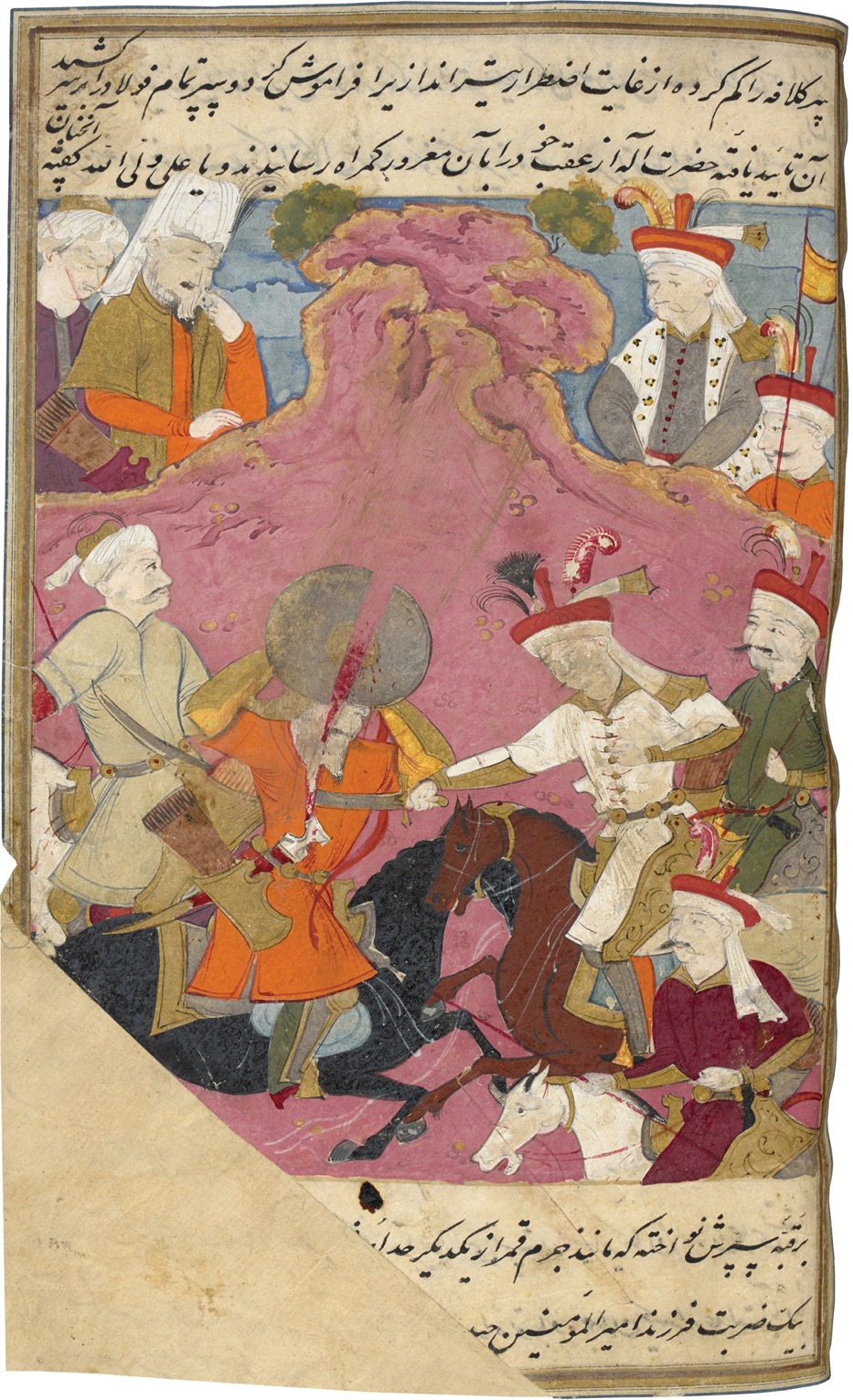
As Iran (and neighboring parts of Anatolia and the Caucasus) became more chaotic in the fourteenth and fifteenth centuries, Sufi movements increasingly coalesced into orders or brotherhoods, often for self-protection. To the extent they could provide protection, they attracted more followers. The most successful, by 1450, were the Safavis, a Sunni and Sufi brotherhood. They organized herders, former soldiers, and anyone else willing to pledge loyalty into a formidable warrior band, distinguished by their red headgear, which earned them the name kizilbash (“red head”).
SAFAVIDS AND SHI’ISM IN IRAN
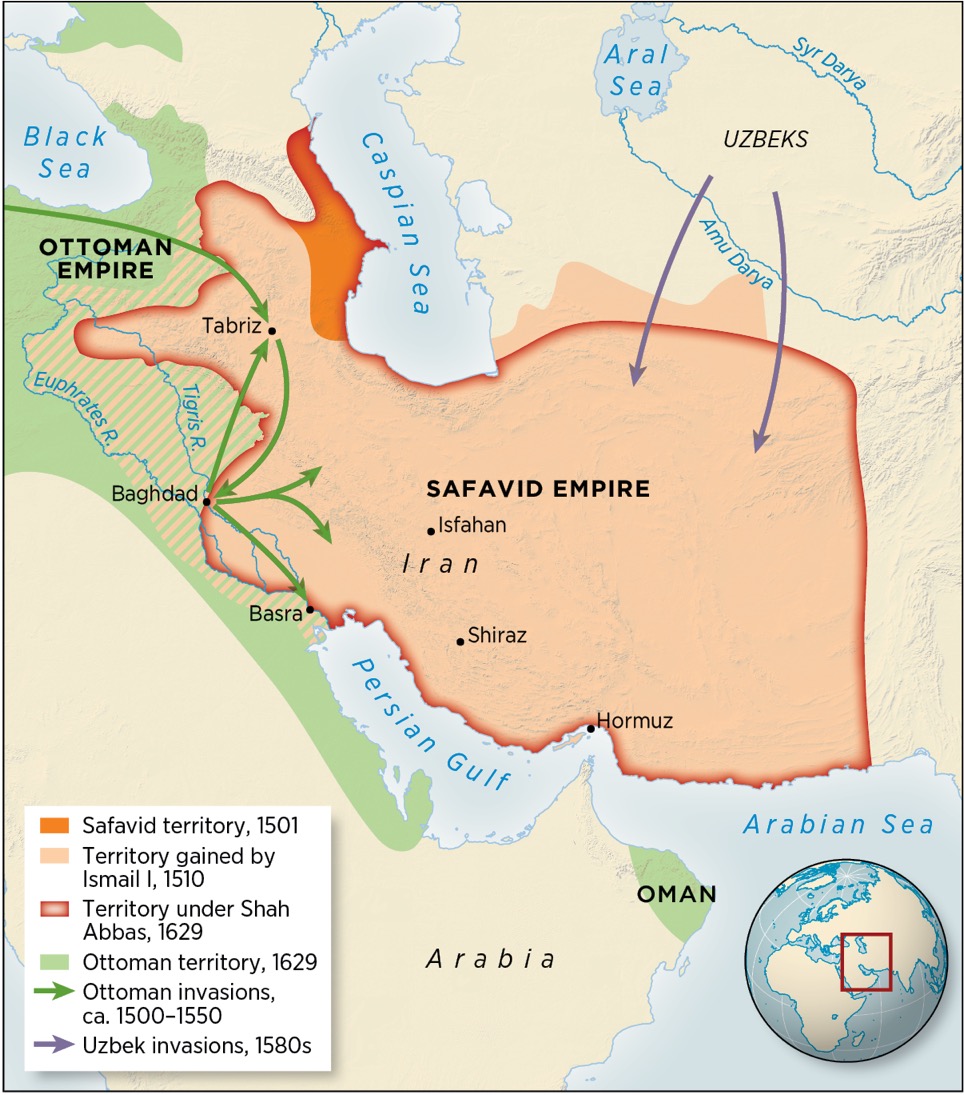
At some point after 1450, the leader of the Safavis decided to embrace Shi’a Islam, perhaps to mark his leadership off from all the competition. He began to claim descent from Ali. His grandson Ismail—at age 14—led kizilbash warriors to several victories and in 1501 established a dynastic state with the northwestern Iranian city of Tabriz as its capital. By 1510 Ismail had taken over all of Iran and much of Iraq as well. He declared himself the Hidden Imam—in Shi’a theology, the messiah who will return at the right moment to bring justice to humankind. Ismail sought to cloak himself in the mantle of prestigious religious and political figures to enhance his legitimacy as ruler:
My name is Shah Ismail.
I am on God’s side, the leader of warriors.
My mother is Fatima, my father Ali.
I too am one of the twelve Imams....
Know that I am the true coin of Haidar [i.e., Ali]
Ever-living Khezer, and Jesus son of Mary.
I am the Alexander of the people of this era.
Before he died in 1524, Ismail set about converting the entire population to Shi’a Islam, something prior Shi’a rulers had not attempted. He had to import scholars from afar because Iran had so few Shi’a. His son, Tahmasp, who ruled for 52 years (r. 1524–1576), took this program further. He closed brothels, taverns, and gambling dens and forbade shaving beards. He banned music from his court. The Safavids (Safavis as a Sufi brotherhood, Safavids as a ruling dynasty) executed or exiled Muslims who overtly resisted their religious program and instituted harsh penalties for rule-breakers—a bit like Calvin’s Geneva, but on a larger scale.
As with many an embattled theocracy, relations with hostile neighbors made the Safavids sterner at home. They faced a powerful foe in the Ottoman Empire to the west, a champion of Sunni orthodoxy with whom they fought for most of the first half of the sixteenth century. They also fought another Sunni polity to their northeast, the Uzbeks. Despite a difficult military situation, the Safavids obtained a peace treaty with the Ottomans that recognized them as Shi’a Muslims rather than heretics or unbelievers. The Treaty of Amasya, signed in 1555, also secured the right of shahs in Iran to enforce the religion of their choice within their domain—coincidentally, the same year as the Peace of Augsburg that cemented similar rights for central European rulers. Both agreements soothed half a century of deadly religious rivalry by granting opponents legitimacy and allowing monarchs to impose their religions upon their subjects. The Safavids eventually endorsed forced conversion of Jews, Zoroastrians, and most Christians in their quest for uniform religious purity—and political security. The Safavids even turned on Sufis and massacred thousands.
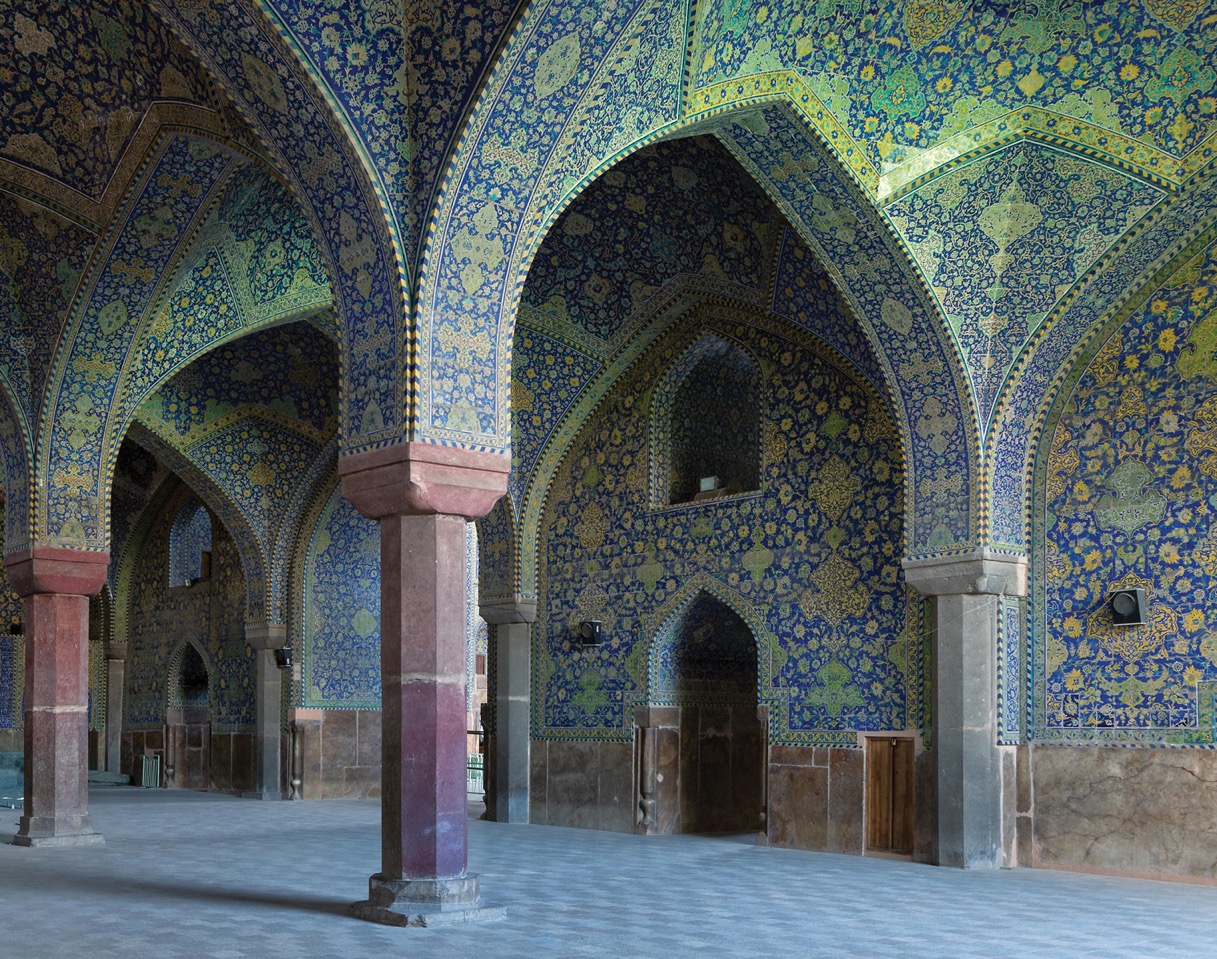
SHI’ISM UNDER THE SAFAVIDS Under Safavid rule, Iran experienced a philosophical and religious reorientation. State power was at the center of it. The most effective of Safavid rulers, Shah Abbas I (r. 1587–1629), enjoyed great economic and military success, and supported artists and thinkers, at least of the sort he preferred—not Sufi sheikhs, whom he preferred to execute. He built a new capital at Isfahan, in west-central Iran, with lavish mosques and palaces. He supported painters, especially the miniaturists who became all the rage in Iran and northern India (Shah Tahmasp had been trained to paint in this tradition). Shah Abbas I also encouraged Shi’a theologians, who worked out a new religious orthodoxy that provided some much-needed glue for Safavid society and equally needed legitimacy for the state.
The most prominent of these theologians was Ṣadrad-Dīn Muḥammad Shīrāzī (or Mulla Sadra, 1571–1640). He was born to a courtly family and moved to the capital of Isfahan for study as a young man. He developed unorthodox ideas that resulted in many years of exile to a village, where he began his writing career, trying to reconcile Sufi emotion and intuition with a more reasoned and intellectual Islam. A provincial governor who liked Mulla Sadra’s message installed him as the head of a school in Shiraz, in southwestern Iran, where he built an arts and sciences curriculum. An English traveler who passed through in 1629 wrote: “Shyraz has a colledge wherein is read Philosophy, Astrology, Physick, Chemistry and the Mathematicks; so as ‘tis the more famoused through Persia.”
Mulla Sadra wrote prolifically on deep metaphysical and theological issues, squaring mystical Sufi impulses with the thought of earlier Muslim philosophers such as Ibn Sina (Avicenna). He leaned toward a personal, reflective engagement with the world and with God, and taught that one must live by the principles one’s philosophy reveals. He died in Basra while en route to Mecca to perform his seventh hajj. He may fairly be considered the most influential Shi’a philosopher and, despite his early troubles with the authorities, the most important intellectual of Safavid Iran.
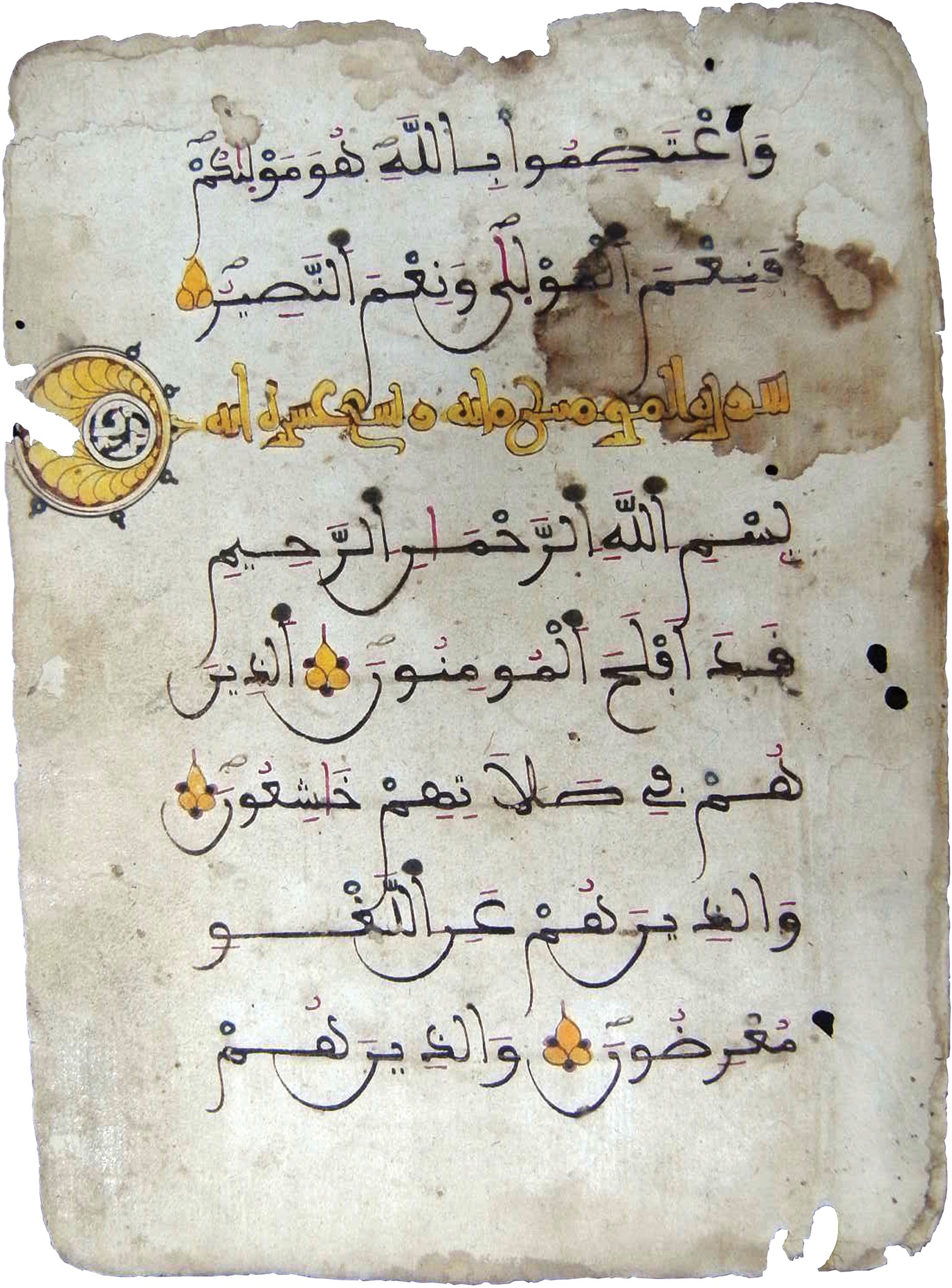
THE WIDER ISLAMIC WORLD The reformulation of Shi’a belief and its adoption as the state religion in Iran was the most important intellectual current within the Islamic world in these centuries, but it was far from the only one. Iranian refugees from Safavid persecution brought many new wrinkles in philosophy, art, and literature to northern India, including the tradition of miniatures in painting. Scholars in Timbuktu, which had some 150 Qur’anic schools in the sixteenth century, brought ideas and practices from Egypt to West Africa, often when returning from a hajj to Mecca. The annual practice of pilgrimage drew pious Muslims from West Africa to Southeast Asia together in Mecca, where they mingled for weeks or months, prayed together, and debated the fine points of religion. Muslim traders traveled far and wide, bringing their particular beliefs in their saddlebags. The quickening of commerce and the growth of cities, especially port and caravan cities, led to faster circulation of ideas and more friction among faiths and sects. Political turmoil in the Islamic world, as we will see in the next chapter, encouraged rulers to embrace legitimating ideologies, including religion above all, as the Safavids did when embracing Shi’a Islam.
Glossary
- Shi’a [SHEE-ah] Islam
- An orthodox branch of Islam that was adopted as the state religion in Iran under the Safavid dynasty in the sixteenth and seventeenth centuries. Followers of Shi’a Islam believe that only members of Muhammad’s lineage can hold religious and political authority.
- Safavids [SAH-fah-vihds]
- A dynasty that originated as a Sunni-Sufi brotherhood but adopted Shi’a Islam and then conquered Iran and most of Iraq. They made Shi’a Islam the state religion, reformulated its theology, and pursued mass conversions.
- Mulla Sadra [MOO-lah SA-drah] (1571–1640)
- An influential Shi’a theologian living in Safavid Iran. His writings attempted to reconcile Sufi mysticism with Islamic philosophical traditions and helped create an intellectual foundation for the Safavid theocracy.